Toolkit: General web-based resources

Return to Toolkit homepage

What can’t I find on this page?

We have tried to put web-based resources and projects into our main theme pages:

  1. Book stock
  2. Maps & plans
  3. Oral history
  4. Photographs & other visual material
  5. Newspapers
  6. Ephemera
  7. Directories
  8. Archives
  9. Subscription websites
  10. Archive transcriptions

However, there are some online resources and projects that defy classification, so here is is a selection of them.

General local studies resources:

British History Online : What it says on the tin – as of December 2020, it contained “nearly 1300 volumes of primary and secondary content relating to British and Irish history, and histories of empire and the British world. BHO also provides access to 40,000 images and 10,000 tiles of historic maps of the British Isles.” Plus material from the Victoria County Histories!

 Society of Antiquaries of London subject index contains lots of references to local history material dating from 1930s to 1988.

Scottish Resources:

Scottish Local History Forum’s special issue on online resources

Got something to add?

Do you have any comments, suggestions or updates for this page? Add a comment below or contact us. This toolkit is only as good as you make it.

Return to Toolkit homepage

Toolkit: What is the role of a Local Studies Librarian?

Return to Toolkit homepage

The Local Studies Librarian is the person who collects, arranges and makes available resources about the local area. In essence, they curate the ‘National Collection’ for their section of the country.

Those with responsibility for a local studies collection should hold an accredited postgraduate qualification in library and information science. Many employers also look for CILIP Chartership or a willingness to work towards Chartership of CILIP.

As can be seen by the structure of this toolkit, Local Studies Librarians are all-rounders. An experienced local studies librarian will have the vast majority of the skills required by librarians across the sector, including cataloguing, classification and indexing skills, customer care skills, creating and maintaining relationships with stakeholders, managing staff and volunteers, service planning, website design, teaching and presentation skills, project design, digitisation, conservation, marketing and, after a long day, the willingness to shelve heavy bound newspapers. Most will quickly fall in love with the history of the area they care for and it will become a life-long affair.

Local Studies Librarians used to feature in every major library.  In some places this responsibility is no longer a separate specialism, but one shared by several staff. But the essence of the role is the same and its importance must be upheld.

The big three

Collecting

The Local Studies Librarian has the responsibility to monitor and collect information output about their collection area

Typical library resources are collected:

  • Books, journals, newspapers, maps and these resources can be catalogued in the normal way
  • But information comes in many other formats, all of which should be collected if possible:
  • Pamphlets, leaflets, ephemera: tickets, notices, posters, notes, cuttings, reports, directories
  • Community produced materials
  • Visual documentation:
  • Photographs, Postcards, Prints,
  • Digital data sources; Born digital files; film clips, audio recordings

Once they have been collected they then need to be catalogued, with different resources being described in different ways.

Sorting and storage

Unlike most lending stock in the library, local studies materials tend to be kept even when they are not being borrowed and their content is deemed outmoded or even inaccurate; as with clothes, fashions will change. The remit is to build up a comprehensive collection of materials from all ages and standpoints. We are not particularly swayed by the literary merit of works; we are interested in capturing resources from all decades and keeping them for their interest to future generations.

So storage is a potential problem; our collections increase with the years. This is often difficult to convey to colleagues, both within the library service and elsewhere in our parent organisations.

Sorting the material we collect is also problematic. In the past many Local Studies Librarians devised their own classification schemes to try to circumvent the fact that much of the material is likely to end up with the same class number or code when a standard classification scheme is used. But using such in-house schemes is no longer so common. They cause problems for succeeding staff, and do not sit comfortably with networked library catalogues, especially when many library services are now part of consortia with joint catalogues.  

Promotion and sharing of resources

Local Studies Collections at their best are important heritage and cultural resources for the local community and for those interested in the catchment area.  They can help people of all ages to find out more about and to appreciate their surroundings. They are useful for creative people, learners and educators. The Local Studies Librarian has a responsibility to share the resources held; to educate, inform, entertain, enrich and add value to the life of the local community.

Methods of promotion/ community engagement include:

  • Answering enquiries and helping people use the collection.
  • Exhibitions
  • Publications and articles
  • Special events
  • Training courses
  • School and learning resources
  • Partnership working
  • Forging relationships with local organisations and community groups
  • Reminiscence and oral history
  • Group visits
  • Indexes
  • Social media
  • Media interviews

Our collections reflect the lives of the ordinary people who make up an important aspect of our nation’s history, one which has not always been recognised. But Local Studies Librarians know the value of local history and it is our job to share that knowledge with others.

The Local Studies Librarian has an endlessly interesting role, enthusing others about our collections, preserving old publications, engaging with collections about the past, collecting information as it is produced and saving it for the benefit of the current and future generations.

Typical local studies roles:

Local studies paraprofessionals

Additional local studies staff should be provided in sufficient numbers to oversee public access to the collection effectively, to answer routine enquiries and to assist local studies librarians with their other duties.

All members of the local studies team should possess a reasonable proportion of the attributes expected of a local studies librarian, with customer care skills and a willingness to develop personal knowledge of local studies of prime importance.

As with everyone who walks into a local studies library, supporting staff will bring with them their own strengths, weaknesses and experiences and these should be harnessed in order to build an effective local studies service. After all, if a Local Studies Assistant had a background in family history, the use of social media, teaching or IT, local studies units would be unwise not to make the most of their skills.

If the collection is housed within a joint local studies & archives unit, assistants may take on both local studies and archive duties.

Volunteers

Volunteers are increasingly becoming important members of the local studies team, providing help and support by performing talks that staff would never have time to do. More information on the role of volunteers will be found in the volunteers section of the toolkit.

Head of Heritage

A heritage professional normally responsible for the management of services such as the County Archive, Local Studies Services, Museums and Archaeological Services. Can be part of the Senior Leadership Team of a wider Library or cultural service. Some post holders will also be the “County Archivist”, which is a role reserved for a qualified archivist.

County Local Studies Librarian/Senior Librarian, Local Studies

The co-ordinator of local studies work across a county. Increasingly they sit within a County Record Office structure and are a member of the service management team, reporting to an officer with responsibility for archives and other heritage services.

Local Studies Librarian in a county record office

Assist the County Local Studies Librarians with their duties.

Local Studies Librarian within a unitary authority

As County Local studies Librarian, though on smaller scale. The post could be a within a small Borough archive service or within the library service.

Librarian with Local Studies as part of their role

In a county tends to be the librarian with responsibility for collections and initiatives within part of a county. In a smaller service local studies this can be one aspect of a larger role. Line management of this role tends to be within the library service structure.

Sample Job Descriptions and Person Specifications

Got something to add?

Do you have any comments, suggestions or updates for this page? Add a comment below or contact us. This toolkit is only as good as you make it.

Return to Toolkit homepage
Toolkit: Who uses a local studies collection?

Return to Toolkit homepage

General principles

Local studies play a vital role in fostering community awareness and identity. By maintaining and broadening a shared interest in our common heritage the local studies service can actively promote the principles of equality and diversity.

Users of local studies libraries come from all areas of society, irrespective of class, colour, religion, ethnicity, educational background, gender, age or disability. All users’ needs should be served with equal care and attention. Some people are less able to explain their needs and requirements so library staff must be prepared to spend time with them, helping them to derive full benefit from the library’s resources.

The first step is creating and maintaining a welcoming atmosphere that is available to all. This includes providing extensive opening hours, a comfortable reading room and an easy to use online presence. Libraries Connected provides some guides which are aimed at lending libraries but include some useful hints – https://www.librariesconnected.org.uk/resources (especially Talking to customers and The reader experience).

Equality, diversity and inclusion

Local studies libraries have a proud tradition of reaching out to communities and the various groups within them and this tradition should be maintained and further developed. Further details will be found in the Community Engagement planning section of the Toolkit.

Many people still believe that local studies libraries are “not for us” so special efforts have to be made to attract users from all backgrounds. An understanding of the principles of equality and diversity is essential.

The Archives and Records Association has a useful section of diversity and inclusion resources in the resources section of their website.

Consultation with users and non-users is another tool to make services more relevant to all. The National Archives has some guides.

Keeping statistics which record information on users’ backgrounds can show which communities are not being reached. With this information in hand, you can then find ways to reach the more elusive parts of the community.

The Local Studies Librarian as the facilitator

The task of the local studies librarian is to assist users by providing the resources for research, alerting researchers to relevant material and providing guidance in use of the material, both within and beyond the immediate collection.

Requests for moderate amounts of subject information should be accommodated. Though users should normally carry out their own research, the amount of help an individual researcher will require will vary from case to case. For example, users who cannot visit through distance or disability may require special consideration.

Staffing levels are not always sufficient to deal with the demand so guidelines allocating time and resources should be established. Enquirers should be given clear information about the level of service they can expect free of charge. Some local studies libraries limit this to half an hour and some charge for additional support.

Building and maintaining relationships with users is essential. Use of social media and e-mail lists is essential to promote library events, put people in touch with one another, provide speakers for talks, facilitate consultation and assist in stock selection by providing information about research priorities.

An informal atmosphere and interaction with users is invaluable in building up the collection, increasing use, providing volunteers and reacting to demand.

Types of researcher

It is essential for the local studies librarian to develop an understanding of the full range of users expecting service.

Use of collections has expanded enormously and readers come from a wide variety of backgrounds and professions while demand from traditional areas such as family and local historians and educational users has also increased.

Family historians

The massive expansion of interest in family history over the last twenty or thirty years has led to genealogists becoming a mainstay of all local studies libraries. Some family historians are people with no tradition of library use and perhaps limited formal education. The group will also contain some of your most enthusiastic users.

Library staff will need knowledge of the practice and principles of family history and referral skills to point users to other relevant collections.

Support through guides, information sheets and possibly courses and workshops will be necessary though the active and supportive family history community may provide volunteers who can help with this. Close liaison with family history societies benefits the society and the library, with many now manning information points, helping to run Ancestry drop-in sessions and family history courses in the library.

For many the fact that the library holds material relating to their family is a matter of pride and creates a sense of attachment. This often leads to family history users becoming volunteers and donating interesting material to the collection.

Local historians

There has been a similar expansion of interest in local history. The story of your area is no longer just a tale of the rich and powerful of the distant past, but is a rich tapestry of experiences of everyone who has lived within your collection area. It attracts a wide range of people, some without a tradition of library use, but including many retired and unemployed people who may feel they are denied the opportunity to contribute to society in other ways. Local history is a rare area of study where amateurs can produce work of equal value to professionals but newcomers may need guidance in using resources and possibly in research, analytical and evaluation skills. The development of these transferable and life skills often leads to a growth of self-confidence and can only benefit people, especially in an era of “fake news”.

House historians

People are fascinated by the history of their houses and the full range of local history resources can be used to discover more about the history of a property and the land beneath. It is a good way of getting non-users interested in the collection and the wider history of their area.

Teachers

Schoolchildren are now expected to use primary sources and the combined expertise of library staff and teachers is needed to make the most of complex materials. Liaison with local teachers is vital but can be difficult to achieve, though links with colleagues from schools library services and children’s teams can often help.

Though primary school children in Key Stage 1 & 2 are often given local history projects, our resources can be used for virtually any area of the curriculum; though links to citizenship and geography are more obvious, English teachers can examine changes to language contained in materials from different eras, maths teachers can use maps to teach scaling and art teachers can find inspiration in anything and everything.

Our resources can also be used by all ages, from Reception-aged children doing colouring to A-Level Geography pupils investigating how a local high street evolved over the decades. Less academically inclined pupils can also share an interest in their locality which can help to build community awareness.

Creation of online lesson plans linked to the curriculum can be useful. Examples can be accessed at https://www.tameside.gov.uk/archives/educationalresources. Examples of other services for schools linked to the curriculum appear at http://www.archivesplus.org/schools/. Walsall & Merton have also produced a guide to their services for schools.

A good introduction to a local studies library is thorough class visits and INSET sessions for teachers. The provision of materials for class-based activities can be the spark which leads to a lifelong interest in local history.

Children

Children can be reached through more leisure-orientated events such as craft sessions or local history treasure hunts, especially during the school holidays. Again, good contacts with your children’s team are essential.

Researchers, undergraduate students & postgraduate students

Academics probably need less help than other users but will draw heavily on your stock knowledge, making an awareness of other relevant regional, national and specialist collections especially helpful.

Many researchers, both professional and amateur, will be interested in a wider field such as economic or social history, transport history, the history of photography or science etc.

As with teachers, though historians are likely to use your collection in greatest numbers, researchers in virtually any field will come through your door. Geographers, geologists, archaeologists, folklorists are all likely to use local studies libraries at some point as they may need access to your maps, photographs, statistics, reports, grey literature, music, folk tales, dialect writings and speech. Some of this will be of a technical nature and unique to the local studies library – presenting cataloguing and indexing challenges.

The reports these researchers produce can be useful additions to the collection, especially any unpublished materials.

Black and Minority Ethnic community

The contribution of people from Black and Minority Ethnic groups to the history of the locality needs to be recognised and recorded. Without relevant materials in the collection people from these communities are not likely to use the library or consider depositing materials and this could result in an increasingly partial and irrelevant local studies collection and service.

Depending on the circumstances of its development, a local studies collection may need to be pro-active in engaging with the BME community and may even involve the creation of sources, for example, through oral history projects. People from minority ethnic communities have lived in the UK for generations and it is sometimes possible to harness the energies of the army of family historians to highlight any early references they may come across in their research in a “recovering history” project. The Black and Asian Studies Association has useful material on its website.

LGBTQ+ community

In a similar way to the BME community, materials should be sought out or created to make sure the contribution of LGBTQ+ people is recognised and collections are made relevant for them. Cataloguing and indexing of this material should be sensitive to the community and use terms which they find acceptable. A similar “recovering history” project can pick up references to the hidden history of these groups. Manchester Archives+ holds material relating to the local LGBTQ+ community – https://manchesterarchiveplus.wordpress.com/category/radical-manchester/.

Other under-represented groups

Local Studies collections need to reflect and attract the communities in their collecting area. Local Studies Librarians should be aware of the different groups in their community and how they are represented in their collections and be proactive in filling the gaps in their collections. As well as groups such as BME and LGBTQ+ groups discussed above, it should also look at groups such as women, class and migration from different areas of the UK. Most authorities will have members of library staff with ‘inclusion’ as part of their remit and making the most of their knowledge, experience and contacts should be advantageous. Visit the Collection Development section of the toolkit for more information.

People with disabilities

It is rare for public buildings not to be fully accessible, but there may be other ways of providing the local studies service to people with disabilities. Attempts can be made to take resources and exhibitions out to groups who cannot visit, materials can be made available through digitisation and loan boxes. Audio material and podcasts can reach people with visual impairments. Bringing people together for talks, workshops or as volunteers can have beneficial effects on combating isolation and mental health problems.

Elderly people

Local history has a particular appeal for older people. Nostalgic interest in the past can often lead on to more serious study, involvement as a volunteer or in a specific project. Links with Age UK and similar groups help promote the library to older people. The local studies collection includes a range of resources of great use for reminiscence work with older people and those suffering from dementia. Old photographs, adverts, oral history materials, music, dialect writings can all be useful. Many elderly people are unable to visit libraries. Local studies services should consider visiting residents of care homes and sheltered housing. There may be activities coordinators based in these locations who can assist in the organisation and delivery of sessions. Your authority’s home library service may have some useful contacts.

Projects can be as simple as printing-out carefully selected images from your collection in loan boxes or, as North Somerset has done, placing them on tablets. Examples of oral material recorded by the East Midlands Oral History Archive can be heard online. There is a good introduction to reminiscence work for those in care homes can be found on the Social Care Institute for Excellence website, whilst tips can be found on the oral history pages of the toolkit. Lincolnshire also ran an interesting lottery-funded project combining reminiscences and craft activities.

Commercial interests

Businesses need to use local studies libraries for building community profiles and for publicity materials. Pubs and restaurants often want old photographs for display. All forms of media – radio, television, print media, social media and websites can use library resources. Commercial interests are entitled to a basic free service and there may be additional opportunities for income generation. With media use a balance may have to be struck between promotion of the service and charges – see the Budgeting section of the Toolkit.

It is always useful to impress on commercial users that the library will benefit from material they publish such as reports, trade catalogues and brochures.

Community groups

Many community groups such as churches, trade unions, amateur dramatic societies, civic societies, women’s groups, leisure organisations and, of course family and local history societies use local studies libraries for a variety of purposes – such as enquiries, commemorations of events in their history, talks, exhibitions etc. This can be mutually beneficial as the societies can promote the library and may have material which can be added to the collection.

As with researchers, these groups create histories of their own organisations and it is important to collect the fruits of their work once they have been published.

Tourists

People may visit for information about the locality such as museums, places of interest, even existence of hotels and places to eat, especially in areas without a tourist information office, but the local studies library can also attract heritage tourists from all over the globe as people come to visit the homes of their ancestors. It can be useful to collect information about the proportion of visitors from outside the area and whether they are staying in hotels, shopping or using cafes as a way of indicating the service’s contribution to the local economy.

Tourist information services may benefit from input from the local studies service – for example in creating historical trails, information for blue plaques and other interpretive displays.

Local government officers and other officials

Planners, engineers, environmental health, legal officers, health workers may need to consult maps, reports, previous local authority publications, old newspapers and similar sources. General historical material may be needed by country park wardens, museums staff, events and publicity people. Local studies input may be required for the preparation of grant applications. This can be helpful to show the usefulness of local studies to the local authority as a whole – and may help in the collection of material produced by other departments.

Local Studies materials can also be used at Civic events to show guests that the Council has pride in its area and its history.

General library users

General readers may contact the library for one-off queries such as background for planning applications or disputes, other legal disputes, rights-of-way, local byelaws, checks of old voters lists, quiz questions, trivia etc. They may be searching for long lost acquaintances, looking for information about adoption, checking whether a relative’s old friendly society book is still valid, trying to establish whether a garden boundary has been moved. Surprising enquiries will always turn up and some have to be dealt with very sympathetically. It can be possible to build up a quick reference file which provides the tools to answer some of these queries. One of the joys of manning a public library enquiry desk is that you never know what the next question will be.

Remote users

Many people will only have contact with the local studies service through the website or social media. They may make direct contact with the library with an email enquiry or comment on social media or they may just browse an online photograph or oral history collection. It is important to record this use, which is just as valid as someone visiting the building to browse the collection. See other relevant sections of the Toolkit for ways to reach remote users.

Future users

Unlike many other areas of the library service, local studies libraries have to consider very long-term future users and their interests should be regarded as of equal importance to those of present patrons. Storage and conservation are important issues here and are dealt with elsewhere in the Toolkit.

Got something to add?

Do you have any comments, suggestions or updates for this page? Add a comment below or contact us. This toolkit is only as good as you make it.

Return to Toolkit homepage
Toolkit : Budgeting

Return to Toolkit homepage

Funding is essential to further the vast majority of local studies priorities.

Local Studies budget

Local Studies core budget: Local Studies Librarians are normally granted budgets to run core activities, such as stock purchasing, binding and preservation. These can be divided into a number of budget lines for specific areas of activity or they can be concentrated in one local studies fund. It may give you more flexibility if separate budget lines can be amalgamated into one so if less books are published than usual during the year, the left-over money can be spent on other priorities.

Local Studies can be paid out of other library (and council) budget lines….

Other potential funds within your service:

  • ICT- digitization equipment
  • E-resources: subscriptions to products such as Ancestry and Find my Past. Could you argue that a new heritage website is an e-resource?
  • Volunteer expenses: should that money come out of the same pot as other library volunteers?
  • Seed money may also be available for projects that match the priorities of your wider service and the local authority. As is shown in the LA priorities sections of the toolkit, local studies materials are tools that can be used by other departments to further their priorities and, if they do, surely should help pay for the costs incurred.

Looking further afield for funding

If you have a large project, perhaps a donation, a group of materials or a project that needs indexing, digitizing or researching, then often the only way to progress it is by applying for special funding. In the past this may have been possible to achieve via internal funding from a council body, but this is now rare, and most funding is received externally. Sources of external funding includes:

  • Crowdfunding
  • Harnessing the power of volunteers
  • Grants: There are many grant schemes available offering a wide range of amounts of money and up to date information is available on the government website: https://www.gov.uk/government/publications/libraries-applying-for-funding/potential-funding-sources-for-libraries. Digitisation company Townsweb have also provided an annual grant to help support digitisation projects.
  • Friends group: If you work in an archive or record office, then you may be able to raise money through a “Friends” group, as a small voluntary organization can often access grants which a local authority cannot. These groups are less common in library settings, although you may occasionally receive a bequest which may have conditions attached as to how the money should be spent.

Making money go further

Many public libraries, archives and record offices have had their budgets reduced over the past few years, so you may need adopt more creative approaches:

General income raised via digital prints, microfilm copies or the sale of publications may be another way of increasing income, along with hiring rooms or staff giving talks, but in a library setting this may go into the general pot rather than being passed on to the local studies team.

Users can also be authors and publishers and will often be happy to help support you in obtaining their books, such as presenting a copy of their work as an acknowledgement of the help you have given or giving you a discount for the purchase of multiple copies. You can also barter, so if an author or publisher wishes to include photographs from your collection, it may be possible to negotiate a discount or free copies of books in lieu of payment, (in addition to a credit). A book signing or an offer of hosting a talk to promote the book could also be offered in return for free copies.

It is also worth asking suppliers if they are able to offer you a discount as they may be able to do this if a large amount is being spent, if they have older or display stock that they need to sell quickly, or if it is a quiet time of year.

If money is very tight it may be necessary to think of how you can achieve something over a number of years, for example, specialist conservation of a collection could be undertaken in small sections over a number of years rather than in one batch.

It is also useful to have a wish list of items that can be quickly purchased if money is left over toward the end of the year, or if a pot of money is found elsewhere. Conservation items, for example, acid free photograph pockets are always needed and the time between ordering and receiving the goods can be within a couple of weeks, so this is always a good option. However, it is also important to identify larger items that may need replacing, for example, scanners, microfilm readers, or display cabinets, so details can be provided quickly if money is available unexpectedly.

Be realistic with any project costs, especially if part of a grant funded project. HLF and similar funders expect to pay professionals for their time, and to cover costs. This can include time taken to catalogue items, room hire, staff time and storage. These costs need to be built into the project pan from the start.

Are your charges at the right levels? Many people, though not all, realize that local services need to cover their costs and users are now more used to paying to access electronic versions of parish records and old newspapers. Compare your costs for providing copies, room hire, answering enquiries, giving talks etc. to others, including neighboring library authorities.

Lastly is it time to check that your priorities are the correct ones? For example:

Is your Local Studies Collections Policy right, for example, are you collecting for the right geographical area? Are your collections duplicating those of others? Are there gaps which need concentrating on?

Rather than have items conserved it may be advisable to ensure the originals do not deteriorate by directing users to online surrogates, such as those hosted by https://maps.nls.uk, https://www.hathitrust.org and https://archive.org/details/books

Most importantly, are you doing what users want and need? Does data and users’ comments support your priorities?

Further reading:

Got something to add?

Do you have any comments, suggestions or updates for this page? Add a comment below or contact us. This toolkit is only as good as you make it.

Return to Toolkit homepage

Toolkit : Photographs & Visual Materials

Return to Toolkit homepage

How to store, provide access to and make the most of your artistic, graphic and other visual collections.

What is a visual collection?

Collections can contain many and varied art forms using different mediums such as photographic prints, glass plate and film negatives, etchings and prints, paintings, cartoons and sketches, postcards, greetings cards, posters and more.

These materials may be housed together or separately as part of collections donated by individuals or organisations. Their size, medium and format mean that they may prove hard to store and maintain and will need special care and consideration if they form part of a local studies collection.

Storage

General advice:

All visual material is susceptible to damage. As with all single sheet materials, they can be placed in an appropriate sized inert polyester envelope which provides a certain amount of protection from handling. You can also use permanent markers to write catalogue numbers on the cover rather than the item itself.

Does the item need to be accessed easily? Perhaps not, if it has been digitised. In that case you can purchase inert polyester in ready-made envelopes, open either one or two sides, plus you can buy cheaper rolls which can be sealed using a specially designed machine, or just with the use of double-sided tape. These can then be stored in an appropriately sized box.

If you need public access, you can consider placing images in files, albums or hang covers from bars which can then be stored in filing cabinets.

Photographic material

Dating from the mid-19th century, photographs and negatives are an unstable medium and can degrade quickly if not stored in adequate conditions. Use acid-free envelopes to keep them as inert as possible; remove any card backings or mounts if you can. Keep them away from light, avoid damp conditions and store at as cool a temperature as possible. Keep an eye on the relative humidity too; a high RH level can be particularly damaging. The same will be true for film and glass plate negatives; the latter being very prone to damage (glass can crack easily). Do not fold or roll photographs and use acid free card and tissue for additional protection if necessary.

Photographic material is particularly susceptible to marking. Never use anything other than soft pencil (5B is best) to write on the back. Handle with gloves whenever possible and by the corners of the images when you cannot, as once a fingerprint is placed on the image, it cannot be removed from the original.

Printed material

Postcards can date from the late 19th century but prints can be a great deal older, although many prints date from the 18th century. Both mediums are more robust than photographic material, but the card and paper they are made of can still degrade over time. Store in acid-free boxes. Postcards can be stored in 4-pocket acid-free envelopes to save space. Prints can vary in size; always store flat wherever possible. It is advisable never to fold or roll prints. Modern items may include posters and greetings cards. Again, store in acid free conditions and, if possible, do not fold or roll posters as this will weaken them and make them more prone to damage.

Artworks

Watercolours require less specialist storage than oil works which may be better placed in your local museum or art gallery. Again, store in acid free boxes; use acid free tissue for additional protection if necessary. Flat storage works best. Do not fold or roll items; this will cause stress on the material and lead to further deterioration. Remove any backing which may react with the works or cause difficulty in storing the items correctly, including frames, mounts and metal clips etc.

Long-term preservation of materials

Consider the best place for visual items to be stored. The medium used to create many of them will be unstable in nature and they may be best placed in a specialist repository. If you have created a digital surrogate you can think about depositing the originals in your local archive or museum if they have dedicated storage facilities  such as a climate controlled strong room, or in a regional repository, such as Hampshire Archives & Local Studies which is home to the Wessex Film and Sound Archive https://www.hants.gov.uk/librariesandarchives/archives/wessex-film-sound and contains the specialist storage facilities required for film.

Conservation suppliers:

Access (aka cataloguing and metadata)

Often such items provide rare and possibly unique images of local people, places and events. This means that they should be catalogued individually; these details are often lost when cataloguing at collection level. Specialist software such as MODES (the Museum Object Data Entry System) or CALM can be used to create individual templates for visual material types such as photographs, whilst Lancashire’s Red Rose Collections used an image management system to digitize and catalogue images whilst providing online access.

If you do not have access to specialist cataloguing software, you can use as little as an Excel Spreadsheet. Google Form or Microsoft Form allow you to set up a cataloguing form and then inputs the data into a linked spreadsheet which can be used as a finding aid. This can then be used to upload to an online platform at a later date.

It is essential to catalogue items in your collection to make them:

  • Accessible for customers
  • Locate the items easily
  • Each piece of information should be in a separate field, so it can be easily manipulated at a later date.
  • Follows the eighteen internationally respected Dublin Core principles so that information can be easily used in different projects and systems at a later date.
  • An essential component of the cataloguing process is to be consistent with your data inputting to ensure that you create a robust, high quality finding aid. Certain data, such as place name, the way you enter a person’s name and locality type should be specified at the start of the process and strictly adhered to. After all, rubbish in, rubbish out – the quality of the finding aid will only be as good as the data that is put into it.
  • Photographs may have also been catalogued in previous years. These can be harnessed, though you have to be aware that they may have been catalogued in different ways.

Sample set of fields:

Key information includes:

Type of object – for example postcard, photograph or print

Unique ID number – each item should have its own catalogue entry number. This is usually prefixed by the date it entered the collection (accession date) but not always; do whatever works best for you

Brief description – to include a description of the contents of the image and anything within it that is unusual or draws your attention. This can include costume, architecture, internal fittings or fixtures etc. Details of people in the image and the context surrounding it, for instance it may be a wedding or a stone laying ceremony.

Title (optional) – if you decide that your brief description should be longer than a line of text.

Long description (optional) – if the image is fascinating, you may wish to write a paragraph or two on the item. This can then be reused for marketing purposes.

Date – of the medium itself and of the contents of the image, for example this could be a modern copy of an old photograph; both dates will be needed to give an accurate record of the item. If an exact date cannot be determined even an approximate one is preferable to leaving this field blank

Keywords : Location – record the place the item relates to.

Keyword: Subject term – This can include a ‘locality type’ such as church or school. You can start with a basic list of terms which can then be built up as you go along if you do not currently hold any.

Keyword: Names – Individuals and companies.

Depositor – details of the person/organisation for provenance purposes, though avoid including personal details on public catalogues

Date of entry into the collection and the date of the catalogue entry

Creator/Production data – for instance, the name of the photographer or artist who created the item

Dimensions and condition of the item – useful when considering the fragility or difficulty of moving the item

Current storage location – this data is essential so that you can find the item quickly and easily

Rights data – has this image been checked for copyright? Are there any restrictions regarding its use? For more information about copyright, see the Copyright section of the toolkit.

Digitisation – has the item been digitised? If so, provide details of the whereabouts of the surrogate

Digitising collections

Visual materials are an amazing resource that can help to promote your local studies collection. A digitisation project can help you access the value of the collection. It can also help create surrogates that will extend the life of the original item, particularly if it is fragile as it will be handled less frequently and will allow it to be kept under stable conditions for extended periods. Scanners are useful for digitisation work, but a good quality SLR camera on a fixed stand is an alternative. Digitisation projects are a good candidate for Crowdsourcing to gain funds to buy digital equipment (see the Crowdsourcing section of the toolkit), HLF Funding and for bid funding.

During the digitisation process, try to alter the settings as little as possible. In this way you can attempt to keep the essence of the original image alive in the digital version, only manipulating any further copies you may produce (see ‘storage of digital items’ for further details). The only permitted changes are the “white and black” levels .

There are many scanners on the market, though the Epson Perfection V800 Film and Photo Scanner often comes out as a recommended choice. Though only an A4 scanner, it works well with slides and negatives and large images can be scanned in section and then “stitched” together with software.

Quality of digital images

To make the most of images for varied uses, it is best to digitise to as high a resolution as possible. If you can do this, it is also possible (where appropriate adhering to copyright law) to make income from your visual collections through the provision of high-resolution copies. Scanning at 1200dpi is a good choice as is maintaining the resolution of images captured by an SLR camera. Many projects suggest using 600dpi as a standard for prints, but higher specifications for negatives. However, you do need to ensure that your scanner can make images up to your selected quality as some scanners only “guess” for higher quality scans.

Storage of these images can be an issue long-term, so think carefully about which images you store and where. Save digital images in an industry standard format. TIFFs are ideal as they retain the pixels throughout the life of the image however many times it is viewed, unlike JPEGs. You can create additional low-resolution jpgs specifically for online use as and when you need them. For online use via social media, low resolution images are fine; even images around 520 pixels wide work well.

Think about the use of your images online. Be aware that they may get re-used and copied for free. You may want to watermark your images; if they are re-used and copied this gives you provenance and a way to promote your collection further. You can do this by adding text via Paint or free online tools such as watermark.ws. Do not use the copyright symbol unless you are explicitly the copyright holder. Instead, use the name of your organisation or ‘Courtesy of…’ to avoid confusion.

Storage of digital images

There are many ways to store digital images, but you will need to keep up with technological changes over time to ensure that your images will remain accessible in the long-term. You might be able to use your organisation’s current storage facility, although this may not be possible if you are creating many high-resolution images that will take up a lot of space. Instead, you could use external hard drives. Three copies should be made, with a working copy and two backups. At least one of the backups should be stored in a different building.

More recently, cloud storage is possible via external organisations. Think carefully about the long-term security of this and take advice if you need it. Your organisation may be developing their own cloud-based systems which would be ideal.

Keep your main store of digital images as a stand-alone digital collection; a ‘digital image repository’. You can then copy and alter/enhance any of these images as you need them, storing these additional copies separately or deleting them after use as appropriate.

Sample guidelines

Promotion of collections

Once digitised, visual materials can be used to showcase your Local Studies collection; for example Swindon Local Studies have placed digital copies of many of their photographs on Flikr

1920s?: Swindon Carnival Queen

Images also make great content for social media platforms such as Facebook, Twitter and Instagram.

Beware of copyright issues regarding the publication of images online – see the Copyright section of the toolkit for more information.

Images are also hugely important for exhibitions and presentations (these are generally exempt from copyright if used for educational purposes).

Harnessing the power of volunteers

Volunteers will prove invaluable to help you build up your finding aid catalogue and to digitise your collections but be aware that cataloguing is a particular skill that some volunteers may have trouble mastering and may need additional support. Areas that volunteers find especially problematic is the use of subject terms. Use a limited number of terms whilst asking other staff to add those as part of the checking process.

Projects

Here are a selection of presentations from the LSG South 2014 Study Day on Digitisation, together with the report from Local Studies Librarian

Got something to add?

Do you have any comments, suggestions or updates for this page? Add a comment below or contact us. This toolkit is only as good as you make it.

Return to Toolkit homepage

Other interesting projects that include images:

Know your place West of England includes the KYPWilts Postcards Project:

Got something to add?

Do you have any comments, suggestions or updates for this page? Add a comment below or contact us. This toolkit is only as good as you make it.

Return to Toolkit homepage
Toolkit: Ephemera

Return to Toolkit homepage

the minor transient documents of everyday life

Maurice Rickards, founder of the Ephemera Society.

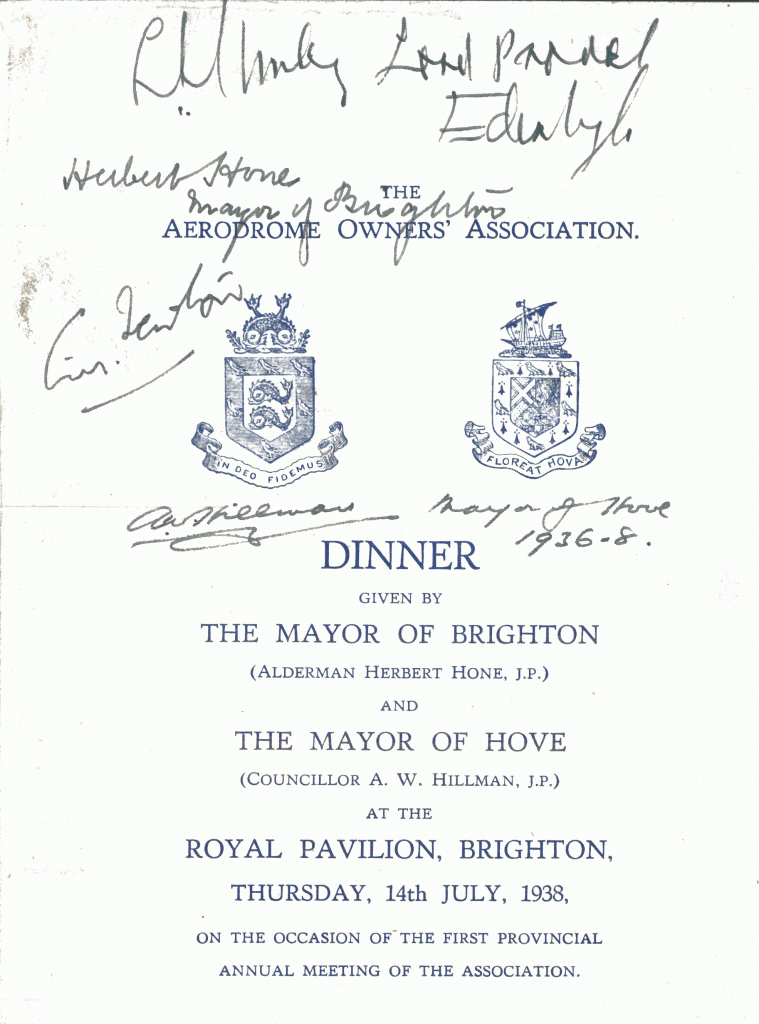
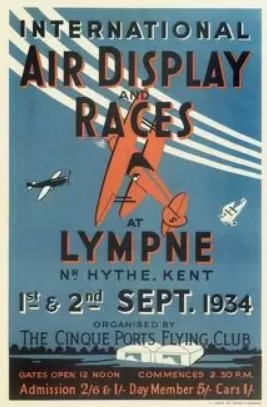
Ephemera can give a real insight into what everyday life was like within a given period often in a very visual way, so it is useful both to the serious researcher and those with no particular interest in a subject but are attracted to it by its design and then want to find out more about the subject or period of time. It can add to what is known about a subject or be the only record that an event has taken place, and therefore be invaluable.

What is ephemera?

Ephemera is a term usually used to describe single paper items, produced for example to promote a one-time only event or created for a limited time period, with the eventual intention of  being thrown away once the time period has passed. In most collections, ephemera dates from the nineteenth century onward, although earlier examples can be found particularly in special collections.

There are many different types of ephemera but they usually fall within three main categories:

  • Items produced for a practical purpose, for example; bus or rail timetables, tickets, theatre or musical programmes;
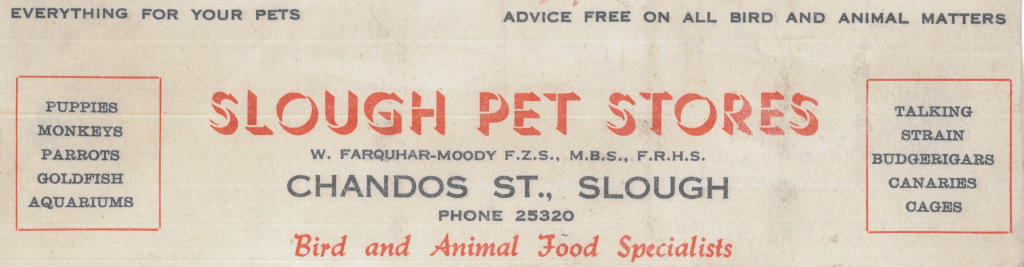
  • Promotional material, for example; business flyers, posters for specific events and postcards
  • Miscellaneous material, for example; greetings cards or special editions of newspapers etc.

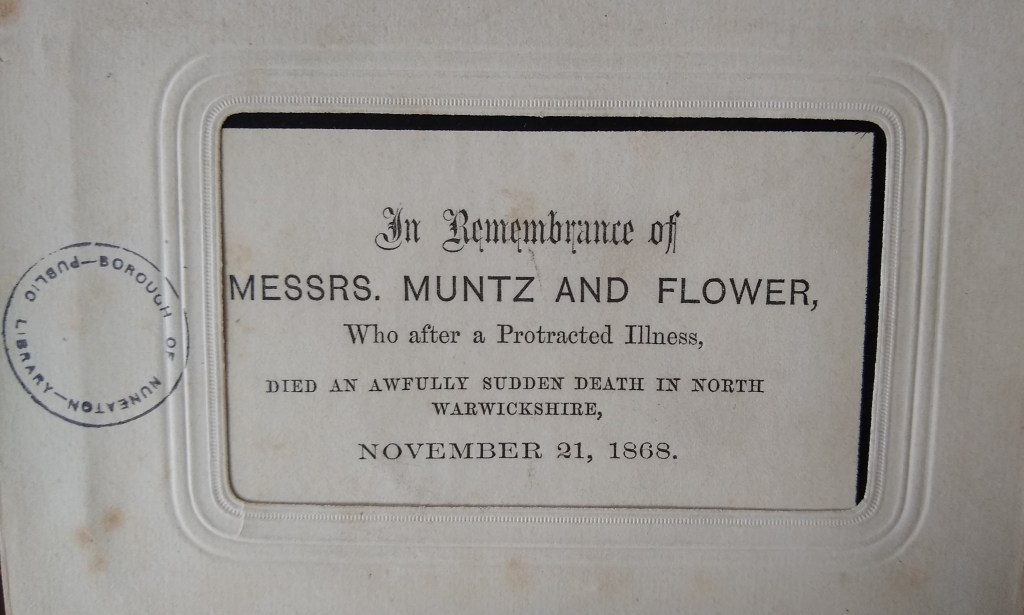
Political and religious ephemera can also be found in collections along with rarer items including mourning cards, advertisements for estate sales, posters of executions, beer mats and bookmarks.

As it was produced to be thrown away, the paper chosen for ephemera is often of poor quality and over time becomes quite fragile.  Designs can vary from only basic text to the highly decorative with beautiful illustrations.

Ephemera gives us a flavour of the cultural and social past, in an authentic way. It may be the only tangible evidence that an event took place or that a business existed. In addition to traditional users of local history collections and people with a special interest, ephemera may also be useful to those with interest in the arts, including students of graphic design and fashion.

Despite being an invaluable resource, we also need to be aware of its potential issues. For example, in a poster advertising a play, the year may be missing, the same printing blocks or design may have been used for multiple annual events or the content may be biased towards a specific point of view.

Collecting ephemera today

Because its purpose is short lived, ephemera is often discarded before a librarian or archivist knows about it. For example, current flyers pushed through the door may end up straight in the recycling bin in many households and older items found clearing a house after a bereavement may be discarded as being out of date or just “rubbish”.

In addition to the more usual pieces of ephemera, an awareness of local fringe organisations, even extreme political groups and campaigning groups that may produce literature, reflecting an aspect of the community often unrepresented elsewhere should not be forgotten. This is where new subjects such as the history of LGBTQ people often first appears in documents. The library can sometimes go on mailing lists for this kind of material. Cataloguing these items can be complicated, including finding a terminology that the groups themselves favour, but this barrier should be overcome.

Talking to colleagues, customers and the community about the value of ephemera items should be done at every opportunity so it can be saved for future generations to enjoy and use.

Organising and cataloguing ephemera

Ephemera is often one or two pages long and is usually filed with other material of interest on the same subject within subject files in filing cabinets. Alternative ways of organising material include using Dewey Classification numbers or an in-house designed classification system. In some libraries, booklets and pamphlets that don’t fall into the periodical category may also be referred to as ephemera and are filed in subject files whilst other libraries may have a separate section for pamphlets and booklets, or file them within the main sequence of books. (The disadvantage of this is that they can easily be damaged or lost) so be aware that the standard definition may be expanded. In some cases, for example, postcards, the precedent may be that they are filed with photographs and illustrations.

You may also find that some larger ephemera for example, posters or estate sale particulars are stored in vertical map tanks or on a horizontal shelf so it is always worth bearing this in mind when accessioning items to give clear references to enable their quick location for staff.

As always, it’s useful to follow the precedent of the collection but bear the conservation requirements of the item and the customer in mind when deciding where to place it and how to catalogue it.

In public library collections, particularly those over 100 years old you may find that a card index is still the traditional way of accessing most of the ephemera held. However, many libraries have stopped using card indexes and have started adding material to online databases or catalogues. If this is the case then ideally, accessioning older items retrospectively to replace the card index would be recommended but this may be a long-term aspiration and only possible with the help of volunteers. Adding ephemera to online databases or the library catalogue improves the visibility of the items especially if good key word indexing is adopted, to ensure the items are available to all who may be interested in the content, period of production or design. Though it is always best to catalogue each item of ephemera, time restraints may make this difficult for larger collections in which case it would be worth considering cataloguing groups of items, for example, as has been done with this collection of menus.

Preservation of ephemera

As a piece of ephemera is often a single piece of paper, it can also be easily lost, misfiled or stolen and so extra care needs to be given when working with it or giving it to a customer to view. In the latter situation, if in a closed building, such as an archive, where the weighing in and out of documents is usual practice and items belonging to a customer, for example, coats and bags, are locked away this may not be so much of an issue. However, for public libraries some system does need to be in place to ensure that items within a folder are recorded. A simple signing in and out sheet might be adequate; where items are counted out in front of a customer and then counted back in on return.

As previously mentioned, the quality of the paper used to produce ephemera is often poor and so many pieces are quite fragile and may need specialist conservation. Handling such items can damage it further and so in these cases the use of cotton gloves isn’t recommended as you aren’t able to feel the paper you may inadvertently tear or damage the item further.

Much can be done to preserve these items even if the budget is tight; including, making sure that they are in individual acid-free pockets (for example, Melinex archival polyester) and if necessary, supported with conservation grade mount board (for example, Microchamber). These can then be placed in a boxboard pamphlet or archive box.

If items are stored vertically within a drawer then they should have “breathing space” so they are not tightly constrained. If something is particularly fragile then the item may be placed in a separate box within the sequence or in a separate sequence. (Amend the existing index card or online entry to show the new location)

For fragile, useful, commercially valuable or popular items (if copyright allows) a digital copy can also be made and kept alongside the original. Usually the surrogate copy is adequate for most customers. If the digital image is safely named and stored it can be used if a copy is later required for a customer, for use on a wall mounted display or if you decide to digitise the collection in the future.

In certain circumstances you may have a group of similar items, for example, a series of play bills that you feel would be best preserved together. A special conservation grade album or box with pockets to insert the individual items might be the best way to do this. This enables them to be seen more easily as a collection, but also gives them a greater level of protection from general handling.

If you are working within an organisation with a separate archive facility, it may be possible for them to advise you on how best to store the item or make a box or album for you. Similarly, a conservation resources supplier can provide readymade resources, or a bespoke box.

Some specialist collections have pull out drawer units offering the ability to lay related pieces of ephemera together to offer an instant display of material on a given subject. This would be the ideal way to store ephemera and is an aspiration for many with such collections.

The Ephemera Society http://www.ephemera-society.org.uk/ promotes the conservation and preservation of ephemera and they maintain a useful website.

Collections of ephemera

Most library collections will have some ephemera, and this will usually be incorporated into the main local studies collection. However, special collections of ephemera exist in libraries all over the country. Examples include:

Many local historians and other individuals also collect ephemera so it is useful to find out who may have a collection in your community as they may be able to help you with your enquiries, lend material for exhibitions or talk about their collections as part of your library events programme.  

Further reading

Got something to add?

Do you have any comments, suggestions or updates for this page? Add a comment below or contact us. This toolkit is only as good as you make it.

Return to Toolkit homepage

Toolkit: Book stock

Return to Toolkit homepage

What should you collect?

Building up a collection which preserves the history of the area and gives people tools to understand our past is one of the most satisfying aspects of the local studies librarian’s job and is one by which many future generations will judge us. It is an art, rather than a science.

The Collections Development Policy should guide all of your choices on what you should and should not include in your collection, however a good policy should be clear, but not rigid and inflexible and should be subject to regular review.  

The main sections of a Policy are outlined in the Collection Development section of the toolkit, but in order to construct an excellent policy and, as a consequence, develop an excellent collection, you will need to consider a number of aspects and find the right balance for your collection:

  • Comprehensiveness – should the aim be to collect all books and pamphlets relating to the geographical area or should their quality, literacy, bias etc be considered? This will probably vary as large city collections will be dealing with a larger number of publications than smaller or more rural libraries.
  • Subject collections – as well as books relating directly to the geographical area readers may need more general historical studies to give students a chance to place the development of their area into a wider context.
  • Local history and family history manuals and journals – readers will benefit from a selection of books on how to study local and family history and use old documents while journals will help keep them up to date with new ideas.
  • Local authors – should works by local authors (fiction and non-fiction) be collected? If limits are to be set on local authors clear criteria should be established. Important collections of material relating to authors of national reputation should be well promoted.
  • Creative works set in the area – most local studies libraries would want to include these books.
  • Locally printed items – many libraries hold locally printed books, mainly early printed works, private press books and other special categories.  (The librarian may need to report relevant items for inclusion in national catalogues such as the English Short Title Catalogue)
  • Some libraries have inherited collections which are particularly strong in one subject area, for example dialect poetry, should these areas be built on?
  • Some libraries will include special collections which may not immediately seem of direct relevance, for example the books of a local naturalist. These collections may need to be promoted more widely.
  • Neighbouring authorities – coordinating collection policies with neighbouring authorities, perhaps especially in the metropolitan counties, might be useful. However, there are cases where there should be overlap and sometimes subtle ones. For example, school children in Slough are given projects on the history of Windsor so general local history books would be suitable, but local historians in Windsor would be very unlikely to use Slough’s collection to study their local area.
  • Books as an artefact – books are objects as well as information sources, so you should bear in mind the provenance of particular copies. An extreme example can be found in Islington:
The defaced Islington Public Library Service Book Covers, 1959-62

Branch collections

In large geographical areas there may be a need for extensive reference collections in branches and mobile libraries, perhaps including non-book items. Local studies staff need to monitor these collections and may need to create materials for them. Branch collections should only include duplicates – originals or only copies, should go to the centralised collection.

Book selection

Personal contact with local groups and users of the library is an important way of alerting staff to relevant new publications. In a large rural county staff in the general library service should be trained to look out for material.

Social media posts by local groups, especially local history and family history societies, academic institutions and their staff and local newspapers will promote new relevant publications.

Relevant journals and local newspapers are invaluable sources of information about new books. Local history and academic journals will include book reviews and can be very helpful in alerting librarians to new subject areas for study which may in turn lead to a need to search out material to fill gaps in stock. Journal articles relevant to the library’s geographical area should also be added to the collection.

Local and national online bibliographies, such as the Devon Bibliography should be searched.

Current material such as local authority reports, publications by local businesses and other voluntary and official organisations and locally published journals and newsletters should be collected.  (These will usually be the most difficult items to track down and acquire).

Acquiring book stock

There must be some way to acquire books and pamphlets from small organisations such as churches and community groups, as well as individual authors, who cannot be added to the local authority payment system. Staff may also need to buy material from fairs and book dealers.

Much local material will have very short print runs so it is important to react quickly to the opportunity to purchase stock. It is important to receive intelligence from branch staff who will often have contacts in their local communities.

Multiple copies of heavily used titles will be required for current and future use and for use in branches.

Second hand book dealers’ lists and Abebooks can be searched to fill gaps in the collection. Bookfinder.com is also excellent at searching large number of dealers, including the Abebooks network and Amazon.

Offering of material between libraries should be practiced and surrogate copies of rare material relevant to other areas should be made available.

Local and regional publishing societies should be supported by subscription as generously as possible as they generally produce significant material of high quality.

Donations from authors – a sign of a successful local studies service is that it becomes an essential tool for local history authors. If prompted, many of which will be delighted to present copies to the library on completion of their project (as well as an acknowledgement in their work).

Other Donations – responsibilities to the donor should be made clear. It should be established that the donation is a gift (or permanent loan?), how it will be used, catalogued and cared for, whether the librarian retains the right to discard it, are there any rights, e.g. copyright, attached to it.

Journals

Local historical and archaeological societies often have their own journals packed with decades and sometimes centuries of articles on obscure aspects of the history of your area. Most collections will have copies of these publications on their shelves, but it is important that the library continues corporate membership of such societies so that new editions volumes can be added to the collections.

Traditionally, local studies collections have indexed these articles, however much of this work is now being done by the Societies themselves. For more information on this subject see: That gem of local studies just starting to be found by Google: local history society journal backruns.

Lending collections

Lending collections of popular and useful books should be created when duplicates are available, both for users of the local studies collection and for the library service in general. The local studies librarian will need to have some input into both aspects so that stock levels remain satisfactory.

e-books

If available, titles should also be purchased for your local authority’s e-book collection. You can also follow Rochdale’s example and look to digitise key works from your book stock and placing those online.

Protection of the book collection

The local studies library will hold rare and unique material, which may be fragile, and has a responsibility to protect it from theft and damage for future generations. For more information on book conservations and storage, see the Conservation section of the Toolkit.

While libraries will not wish to introduce barriers which discourage users some security measures to consider include –

  • registering users
  • filling out slips for books on closed access
  • weighing bundles of documents in and out
  • providing a bag store
  • tagging items
  • restricting users to pencils only and using book cushions for very old or fragile items
  • providing surrogates for fragile items (including facsimile books)

It is vital to have comprehensive supervision of the reading room

Use of technology such as tagging, CCTV, creating surrogates etc gives the opportunity to improve researchers’ experience by allowing more books to be kept on open access.

If books are removed for reprographic or exhibition purposes steps to ensure their security must be taken

Special care should be taken to avoid damage by photocopying etc. The use of a digital camera is almost always better for the book.

Major repairs and binding should be done by specialist conservators. See Conservation section of the Toolkit.

Disposal of unwanted book stock

The decision to dispose of local studies material should never be taken lightly. It should be recognised that preparing and documenting material for disposal involves time and expense.

There are very useful guidelines for the disposal of rare books on the Bibliographical Society website.

Before an item is disposed of by gift or sale various checks are necessary

  • Does the library have the authority or ethical right to sell the item?
  • Is it a genuine duplicate not a variant edition, specially annotated, the only copy with all its illustrations intact etc?
  • Will the disposal do reputational damage to the library?
  • Should it be offered to another library or rare books collection? As well as neighbouring authorities, the National Library of Scotland, National Library of Wales and National Library of Ireland and the National Archive’s library team may welcome material not held in their collection. The same can be true for other Special Collections, for example the National Aerospace Library collects material on all aspects of aviation. Details of specialist collections can be found in Karen Attar (ed), Directory of Rare Book and Special Collections in the UK and Republic of Ireland, Facet Publishing, whilst a list of professional and learned society libraries can be found here.
  • If the decision is taken to sell the best possible price should be obtained and the income should benefit the library.

Got something to add?

Do you have any comments, suggestions or updates for this page? Add a comment below or contact us. This toolkit is only as good as you make it.

Return to Toolkit homepage
Toolkit: Oral history

Return to Toolkit homepage

Definition

Oral history is the recording of people’s memories, attitudes, feelings and opinions and enables the listener to have some understanding of that person and their experiences. It can cover their whole life, an aspect of that life, or a particular event significant for them or more generally well known.

What oral history offers

It enables people who might not otherwise be heard to recount aspects of their lives. Potentially everyone has a unique story to share, regardless of colour, race, religion, age, upbringing, career, economic circumstances and life experiences. Oral history may not be entirely accurate as memory is subjective and emotive but these aspects can also be a strength.

Oral history enables us to document details of everyday life and ensure the experiences, opinions and outlook of people in general are recorded. Gaps in historical evidence might be filled and alternative views of events put forward. Alternative, or poorly documented, ways of life could be better understood.

The Instititute of Historical Research has a comprehensive account of how oral history has developed over many years.

Wikipedia has an overview of oral history worldwide; USA dominated but with useful links to many articles and examples of projects.

How to produce worthwhile oral history

A good oral history interview will be conducted by an interviewer who has discussed the interview in general terms with their subject, put together a structured set of questions,  can be adaptable and is familiar with their recording equipment. They will also insure that the recording is preserved in a library, record office or museum, and that consent forms for its use are signed. The process can lead to the discovery and donation, or loan for copying, of documents, photographs and other records which can add value to the recorded interview.

A variety of recording devices can be used but heritage staff should use the best digital recorders their budget will allow, ideally with microphones and headphones, and not mobile phones. The latter have limitations, particularly poor quality internal microphones and limited file saving options.

How to create or enlarge an oral history collection

Firstly, be aware that every interview is time-consuming to prepare, conduct, summarise or transcribe, save and catalogue. So your initial decision is: am I planning one-off interviews or a larger scale project involving other colleagues, volunteers and often external funding.

Secondly, why am I planning to create or enlarge an oral history collection? It may be to capture eye witness memories from people who remember life before/during the Second World War, from a particular time period or of living in a particular place. Another reason may be that there are few books or records on a particular event, place, or type of community . Also, are specific outputs (eg exhibition or book) required as part of a wider OH project, in which case including specific questions on particular themes (eg childhood, work, leisure, food etc) may be needed.   

Thirdly, can my organisation fund this in-house or do I need to look for external funding for part or all of the cost, and if so, how much.

The Oral History Society has excellent advice on how to get started both on their website and through ideas in their Oral history journal.

Funding a project

The most obvious organisation to approach is the National Lottery Heritage Fund. They welcome projects which are oral history based and have published excellent guidelines on funding, scoping, planning, executing and archiving an oral history project. The Oral History Society has a list of other funders and with links to directories of grant making organisations.

Working out how much funding to ask for is made easier through the Society’s budgeting for oral history contractors pages, covering estimated charges for training sessions, workshops in schools, editing work, etc.

Training

Both staff and volunteers need training in this specialist field whether attempting just a few one-off interviews or a larger project.

The Oral History Society offer a range of  training courses in person or online from general courses for beginners through to specific courses on specialist subjects such as archiving, editing and GDPR.

The Institute of Historical Research (University of London) also offers training courses, seminars and other events on understanding, setting up and running oral history projects, including a three day annual oral history Spring School.   

Equipment

Various organisations offer advice on choosing and using digital recorders, microphones, headphones etc including the USA’s Institute of Museum and Library Studies, Digital Omnium and the Oral History Society debates the merits of audio versus video too.

Practicalities of interviewing

Excellent advice on the whole interviewing process is available from the Oral History Society including ethical, legal and data protection issues.

Some practical tips:

  • Conduct the interview in a quiet place, somewhere your interviewee is comfortable, away from traffic noise and other internal noise [eg loud clocks, budgies etc!] but near a power supply
  • Place the recorder on a magazine or towel etc to reduce noise
  • Adjust sound levels and record/listen to some test conversation before
  • Ensure the interviewee doesn’t have anything which might cause distracting noise, such as sheets of paper, keys, cups etc
  • Mobile phones may affect recording even on silent; turn them off
  • Explain the purpose of interview, particularly any project background, how the recording will be used and that they’ll need to sign a copyright and clearance form afterwards for it to be used
  • Explain the nature of the interview – reassure them that it will be relaxed, informal, their words, and you will guide them
  • If a friend or relative is present, ask them to intervene as little as possible during the interview
  • Always begin the audio interview by identifying yourselves, the interviewee, and the date, using standard introductory words
  • Let them talk! Actively listen to and respect your interviewee
  • Use ‘open’ questions to encourage them to speak
  • Let them tell their story in their own way
  • Use your list of questions – but be flexible, allow the interview conversation to follow other directions to those predicted by your question sheet;   also ask other questions if and when they occur to you during the interview
  • Don’t interrupt;  your voice should be heard as little as possible
  • When they have finished answering a particular question, count to 10 before you carry on; they might be thinking and add something significant  
  • Acknowledge as quietly (ideally silently) as possible what the interviewee is saying; avoid saying ‘ok’ and ‘mmmm’ frequently unless the interviewee is partially sighted
  • Above all, relax and enjoy the experience!

Straight after the interview, ask the interviewee to complete and sign a copyright and  clearance form. Your interviewer(s) should also sign the same form or an additional copyright and clearance form. Without this the recording should not be added to your collection. Ideally complete two copies, leaving one with your subject.

Take a photograph of the interviewee if they consent and add this fact to the copyright and clearance form. This may be used later if any audio is added to a website. Similarly photograph any significant personal documents and items which might be relevant to, or have been mentioned in, the interview. Add details of these to the same form, or use a separate form (if preferred), for these.

Post interview work

  • Save the original .wav (archival) file on a backed up server or in two different physical locations (external hard drives, SD card or similar)
  • Make two .mp3 copies of the .wav file(s) which will be the working copies and should also be saved in two different locations (as above)
  • The .mp3 file can be edited to remove introductory sound tests etc; Audacity is a free, open source audio editing software; more functions are offered by these paid-for alternatives: Goldwave, Wavelab Elements or Sound Forge Audio Studio 12 
  • Send a thank you letter with a copy of the interview on CD
  • Back up and catalogue the digital master recordings (.wav files), .mp3 copies, timed summary plus copies of all printed documentation (particularly signed agreements)  
  • Consider depositing the digital master recordings (.wav files), .mp3 copies and printed documentation (particularly signed agreements) at an appropriate local record office too, if you don’t have the capacity for long term preservation
  • Produce a detailed summary of the recording, including the person’s details, date/location of interview and subjects covered with timings; make a note of any potentially offensive statements (see ‘Ethics’ below’); NB full text transcripts are very time-consuming to produce
  • Ethics: it is important not to change the meaning of the interviewee’s words or use recordings in a way which might embarrass them; don’t publish offensive, libellous or slanderous comments about a third party too; check what permissions the interviewee has given on the copyright and clearance form;  see the Oral History Society’s section on ethics
  • The copyright and clearance form, and any other signed forms produced, should be filed and ideally digitised

Exploiting Your OH Collections

Short audio clips can be made from much longer interviews, using software described in  ‘Post Interview Work’ above. These could be accompanied by a transcript, plus portrait photo, and organised thematically on your website. You can also make simple videos using software such as Movie Maker which enables you to add images to the audio to enhance the clip.

If part of a wider project think about creative responses with schools or in family learning activities, such as animation, or perhaps creative writing. It is worth working with, or employing creative practitioners, so consider including costs for this in any funding bids. [thank you to Terry Bracher for these ideas]

Bibliography

A comprehensive worldwide bibliography is available on the Oral History Society website which includes sections on Handbooks, Collections and Reflections on Theory and Practice, Periodicals and Key Studies Using oral history.                                                                                 

Selective list of books:

A. Bryson and S. McConville, The Routledge Guide to Interviewing: Oral history, Social Enquiry and Investigation, (Routledge, 2014)

N. MacKay et al, Community Oral history Toolkit, (Left Coast Press, 2013)

R. Perks and A. Thomson (eds), The Oral history Reader, (Routledge, 3rd ed. 2016)

D. Ritchie, Doing Oral history, (Oxford University Press, 3rd ed. 2015)

D. Ritchie, (ed), The Oxford Handbook of Oral history, (Oxford University Press, 2011)

P. Thompson, The Voice of the Past: Oral history, (Oxford University Press, 4th ed. 2016)

Periodical:

Oral History   (Oral History Society, [UK] vol. 1 no. 1 1969–)

Articles:

Toolkits:

Email West Sussex Record Office for a free copy of their practical, comprehensive oral history guidance notes on how to set up, conduct, summarise and save oral history interviews, including example forms.

Manchester Histories Toolkit 2 Doing Your Oral history Project

Written by Dr Fiona Cosson this downloadable toolkit is a step-by-step guide to doing a successful oral history project. It covers all the key steps in the process of putting together your project, from planning and design, to interview skills, and organising your material and transcription.

Websites

GENERAL / NATIONAL

Oral History Society

The best place to start for advice and information on all aspects of oral history. As well as the many links in sections above, there are also special pages on networkers, consultants and trainersfamily historymuseumshigher education and academic studies using oral history and UK regions.

Oxford LibGuides: Oral history

Perhaps the most comprehensive overview of oral history resources and projects from across the UK and beyond published by the Bodleian Library.

The British Library has an active campaign to identify and help preserve oral history collections across the UK, however the 2023 cyber-attach has brough many of the following resources down. The Directory of UK Sound Collections, resulted from a BL survey in 2015, and has detailed information on 3,015 collections, from 488 collection holders, containing 1.9 million items. This is the most comprehensive and up-to-date survey of oral history, can be downloaded and includes links to online catalogues and websites.

The BL’s Save Our Sounds programme aims to preserve rare and unique sound recordings in the BL and in other collections through a Lottery funded project Unlocking Our Sound Heritage. Additional aims are to establish a national radio archive and to invest in new technology to enable the BL to receive music in digital formats.

The British Library’s own oral history material is one of the largest collections of oral history and life story interviews in the world and there is a specialist online catalogue.

LISTS of UK LIBRARIES and RECORD OFFICES

All UK record offices, many libraries and some museums hold oral history within their collections:

The National Archives’ comprehensive list of record offices and archive collections

UK Government public library finder

Libraries_in_the_United_Kingdom (Wikipedia)

Library.org searchable lists of UK academic and public libraries

SELECTIVE LOCAL oral history PROJECTS and WEBSITES

Bedfordshire_Womens_Land_Army

Birmingham Library Services

Various oral history projects on migrants from Ireland and Caribbean, and veterans of World War Two

Birmingham LGBT

Several heritage projects to research and archive the lives and experiences of LGBT people

Black Country oral histories

Records of over 300 oral history interviews in collections across Dudley, Sandwell, Walsall and Wolverhampton

Cornish Audio Visual Archive

Exmoor Oral history Archive

Over 200 hours of audio recordings featuring 78 people

Essex Record Office Sound and Video Archive

Lake District Holocaust Project

Poignant story of Jewish child holocaust survivors sent to Ambleside after World War Two

Lancashire Textile Project

A sound and photographic archive now at Lancaster University

Leeds: Historypin Connections  

Engaging with older adults at risk of social isolation, both individually and in groups, this partnership project between Leeds Library & Information Service, Norfolk Library & Information Service and Tyne & Wear Archives & Museums is funded by the Big Lottery Accelerating Ideas programme

LONDON

Bishopsgate Institute

The  Special Collections and Archives include personal histories and reflections from the 1940’s to the present, in two key areas: everyday lives of Londoners, and grass roots protest and campaigning for social, political and cultural change      

Hidden Histories

Oral histories about the wider East End (East Side) of London

Foundling Voices

Memories of separation, schooling, love, loss and rediscovery from people who grew up in the care of the Foundling Hospital between 1912 and 1954

Kings Cross Voices

An unusual oral history project, recording the memories of railway workers, police officers, market traders, activists, former sex trade workers, housewives, artists, students, publicans etc, between 2004 to 2008, before the area was redeveloped

Museum of London Oral history Collections

An overview of the Museum’s oral history collections with extracts from interviewees related to the ‘Windrush Generation’ of Afro-Caribbean migrants

Ports of Call

Walking trails about communities around the Royal Docks, with downloadable maps and oral history mp3 files

On the Record

An unusual collection of oral history projects with a social change agenda, most based in the East End: childhood food, childcare and parenting, a Hackney community centre, specialist hospitals, and Speakers’ Corner

Waltham Forest

Over 800 interviews and 52 sound clips from London’s oldest (1983) oral history group

Manchester

Ahmed Iqbal Ullah Race Relations Resource Centre

Over 200 OH interviews with ethnic minority residents including Afghan, African, Sikh, Bangladeshi, Caribbean, Chinese, , Indian, Kurdish, Pakistani and Somali people.

Milton Keynes All Change

oral history recordings, images and documents on the coming of railway towns Wolverton and New Bradwell

Norfolk: Historypin Connections

Engaging with older adults at risk of social isolation, both individually and in groups, this partnership project between Leeds Library & Information Service, Norfolk Library & Information Service and Tyne & Wear Archives & Museums is funded by the Big Lottery Accelerating Ideas programme

North_West_Sound_Archive

Sound recordings relocated to Manchester Central Library, Liverpool Central Library and Lancashire Archives

Nuneaton and Bedworth Working Lives

Work and industry in these towns, including audio clips

Reading: The Immigrants Project

Stories of people from all over the world who came to settle in Reading

Southwold Museum and Heritage Society

Example of how to embed audio clips across a local history website

Tyne & Wear: Historypin Connections

Engaging with older adults at risk of social isolation, both individually and in groups, this partnership project between Leeds Library & Information Service, Norfolk Library & Information Service and Tyne & Wear Archives & Museums is funded by the Big Lottery Accelerating Ideas programme

East Sussex Record Office [The Keep]

Keep Sounds is part of the British Library  Unlocking Our Sound Heritage and has blogs on the importance of OH, history of recording, and various topics such as the significance of libraries, Ashdown Forest, Brighton’s West Pier and even OH during the 2020 lockdown.

West Sussex CC Library Service

These projects were funded by the National Lottery Heritage Fund:

Military Voices Past and Present

Audio extracts from Interviews with West Sussex veterans from World War One, World War Two and post 1945 wars and conflicts.

Wartime_West_Sussex 1939-45

200 audio clips of 24 people interviewed about their experiences of the Home Front in West Sussex

Wiltshire & Swindon History Centre Projects: The projects below received funding from the National Lottery Heritage Fund:

  • Lacock: a Sense of Place – Interviews with local residents added to the online Lacock Community Archive
  • Wiltshire Black History – Interviews with people from the local African Caribbean from 2010 to date, based on two projects: SEEME (life stories) and Wiltshire Remembers the Windrush Generation; includes classroom resources
  • World War Two Arctic Convoy Project – Oral histories of veterans who served on the Arctic convoys between the UK, North America and Iceland between August 1941 and May 1945
  • Do You Remember… Reminiscence Sessions in Wiltshire Care Homes, A Pilot

IRELAND and NORTHERN IRELAND

Oral History Society Northern Ireland Network

Oxford Lib Guide on Oral history in Ireland

Another Oxford Library Guides by the Bodleian

Oral history Network Ireland

SCOTLAND

Living Memory Association, Edinburgh

Reminiscence group established 1986, with interviews, podcasts, videos, and strong on music, photos and a Facebook page

University of Edinburgh School of Scottish Studies Sound Archive

Established in 1951 and contains thousands of recordings of songs, instrumental music, tales, verse, customs, beliefs, place-names, biographical information and local history. Strong on traditional life, farming, fishing, ship-building and other industries described in a range of dialects and accents in Gaelic, Scots and English

Glasgow Life

Various oral history projects across the City:

Scottish Oral history Centre

Established in 1951 at the University of Strathclyde, the Centre supports the use of oral history within the academic community and in the cognate areas such as archives and museums and aims to encourage best practice in oral history

Tobar an Dualchais/Kist o Riches (Gaelic language)

Set up to preserve, digitise, catalogue and make available online Gaelic and Scots recordings and nearly 50,000 are available online.

WALES

Oxford Lib Guide on Oral History in Wales

A guide to collections including Welsh recordings in institutions across the UK

Unlocking Wales’s Oral history Interviews

The National Library of Wales is collaborating with the British Library on the Unlocking Our Sound Heritage project. They are digitising and cataloguing some 5,000 sound recordings from across Wales to protect them for future generations.

St Fagans National Museum of History

Example: Women’s history; includes audio clips in Welsh

Got something to add?

Do you have any comments, suggestions or updates for this page? Add a comment below or contact us. This toolkit is only as good as you make it.

Return to Toolkit homepage
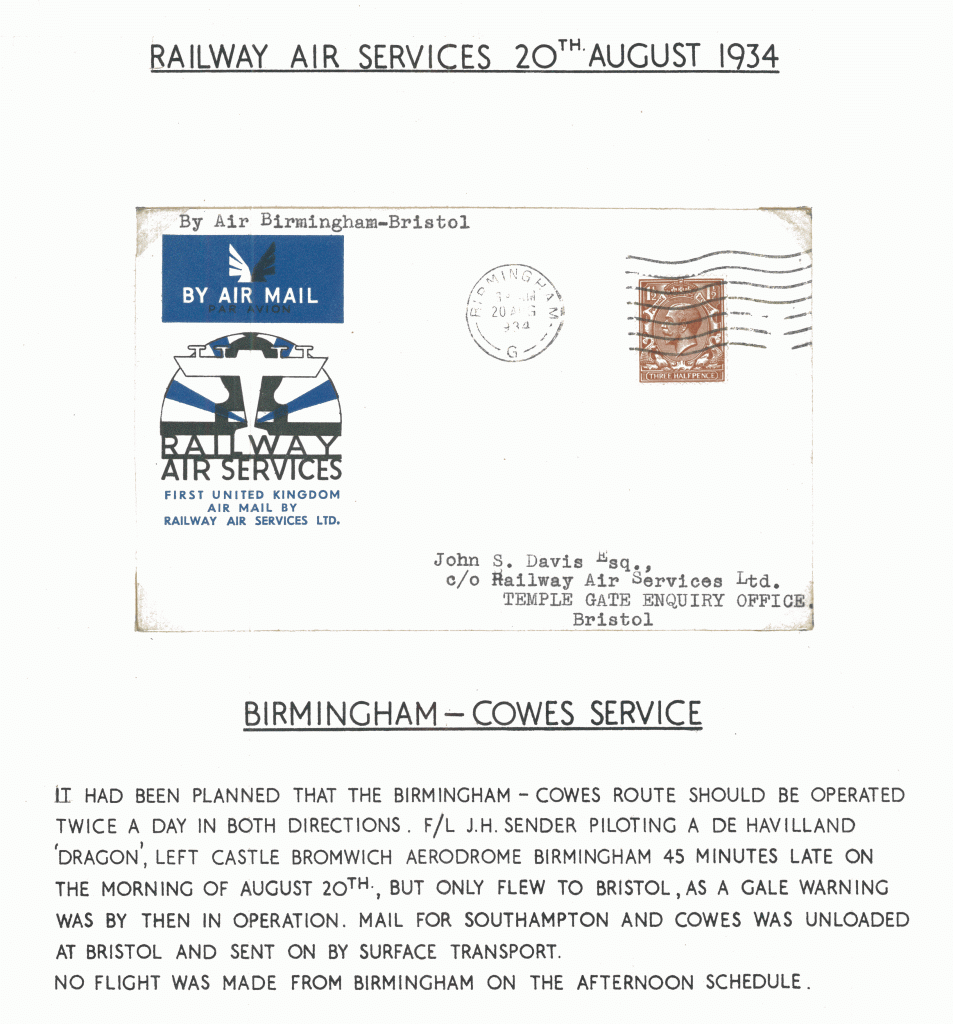
Toolkit: Collection Development

Return to Toolkit homepage

A quick reference guide to producing a Collection Development Policy for Local Studies Collections.

Collection Development Policies are an essential part of collection management. They guide the library’s selection of material, retention, disposal, weeding and maintenance. They provide a clear framework showing how the collection will move forward and remain sustainable. They give library staff the ability to measure progress and can demonstrate accountability to users and to upper management. Though they should be formally reviewed periodically, they should be well-thumbed working documents and, as such, should evolve over time.

Local Studies CDP can either be part of a wider authority policy or a document in its own right.

Creating a CDP

A CDP can be split into a number of sections. Johnson (2018) suggests:

  • Mission and Value
  • Purpose
  • Collection Development:
    • Collection Responsibilities
    • Scope of Collection
    • Selection Criteria
    • Selection Tools
    • Gift Policy
    • Reconsideration of Materials
  • Intellectual Freedom:
    • Access to Collections
  • Review of Policy

A useful CDP is specific but it should not be so detailed and ponderous that it is impractical to use. The content should not be over-generalised, idealistic, theoretical, rigid or vague.

When writing the statement, keep in mind the audience and tailor the document appropriately.

Contents

Mission Statement

The strength of a mission statement is that it describes, in a nutshell, the value and purpose of an organisation or department. This is helpful when it is necessary to explain or defend your aims and values. A statement should be aimed at both users and non-users and tells those who read the document about the organisation who looks after the collection, what they stand for, and why the collection matters.

Purpose

This can include types of user and limitations affecting collections development at the organisation. Include a statement of responsibility for collection building and management, including evaluation, selection, maintenance, promotion etc.

Scope of the Collection

A brief description of the library and its history. The quality, character and extent of the collection should be noted, alongside current collecting practice. For local studies collections particular attention should be paid to how ‘local’ is defined in this context. For example, does the library collect material relating only to the area covered by the present local authority and its predecessors, or to adjacent or wider geographical areas as well?

Selection Criteria

A guide to what is and is not collected. This section can be useful when being challenged over possible gifts and can encourage collecting which is relevant and meaningful to the organisation and its users. Also consider gaps in your collection and consider how to address this.

Selection Tools

A description of which measures are used for the selection and de-selection of material.

Gift Policy

A statement providing clear communication about how gifts will be assessed and the process involved in adding gifts to the collection, including retention. Additional statements can also be created regarding bequests.

Ideally, the copyright of unpublished materials should accompany the donation of the physical items, but failing that an agreement should be made on how the material could be copied for commercial and non-commercial purposes. The easiest way to record the copyright details of donation is by using a donation form.

Reconsideration of Materials

How and why de-selection will take place.

Access to Collections

Current policy regarding viewing items to include copying and promotion of material, including via social media.

Equality and Diversity

Efforts should be made to ensure that the collection is as diverse and inclusive as possible, and the Policy should include a commitment that the collection will be made accessible to all.

Review of Policy

A commitment to review after a certain period of time, perhaps three to five years to ensure that the collecting policies remain relevant due to changing user needs or requirements.

CPD for branches

As well as detailing holdings for your main collection, the process should also be repeated for branches.

Other considerations

Consideration should also be given to how your policy fits in with those of neighbouring local studies collections and other heritage organisations, such as the county archive and local museums.

Examples of CDPs

Cumbria County Council

Dún Laoghaire-Rathdown

Greater Manchester Collections Development Policy and Strategy

London Borough of Richmond Upon Thames

London Borough of Tower Hamlets

Sutherland Shire Council

Welcome Collection

Further Reading

Johnson, Peggy (2018) Fundamentals of Collection Development and Management: 4th Edition, Chicago: ALA Editions. ISBN 978-0-8389-1641-4

Got something to add?

Do you have any comments, suggestions or updates for this page? Add a comment below or contact us. This toolkit is only as good as you make it.

Return to Toolkit homepage
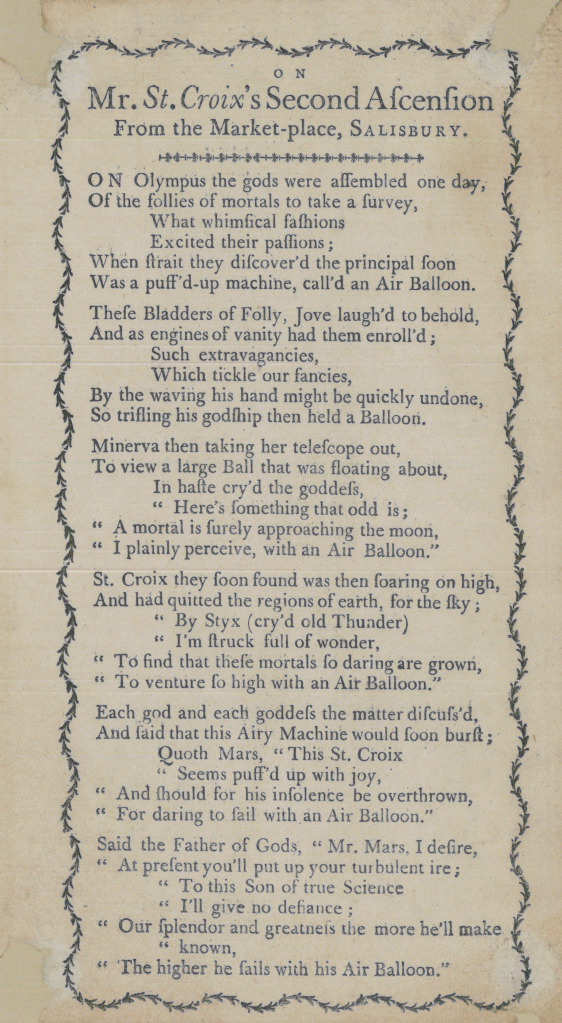
Toolkit: Local newspapers

Return to Toolkit homepage
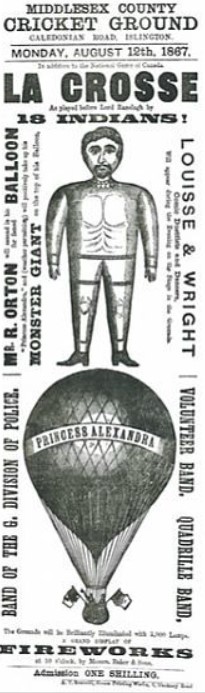
The local newspaper is one of the most useful resources for the capture and later research into the history of a locality. Almost every sizeable town in Britain has (or has had) a local paper, but regrettably the number of printed titles has dwindled in recent years. Some are now only available online.

Many local papers began publication in the mid -19th century at a time when print media was the way that most people received their news. In many instances, the newspaper will be the only place where information on a specific matter has been recorded.

Whilst each paper has its own character, they all contain the same elements; notices, articles and features:

  • National and international news in brief
  • Regional and local news
  • Local government and politics
  • Business
  • Education
  • Social welfare
  • Churches and clubs
  • Crime and court proceedings
  • Obituaries
  • Local events
  • Sport
  • Letters
  • Advertisements
  • Vacancies and jobs

In the early twentieth century the inclusion of photographs became more widespread, however many titles such as the Illustrated London News had already been using images to enhance features for several decades.

Indexing & newspaper cuttings

Local studies libraries have traditionally created indexes of articles to facilitate the use of newspapers and to increase their usefulness. These are invaluable resources, often giving valuable leads to complex enquiries. Such hard-copy general and obituary indexes to newspapers as well as cuttings should always be maintained. Adding to these indexes is time-consuming but is to be encouraged where staffing permits.

But be warned: other local government officers often do not understand what we are doing and why. In the wake of GDPR legislation some administrators have become over-anxious about online indexes. At the time of writing the online index to newspaper articles compiled by Medway Archives Centre has been removed by order of Medway Council’s GDPR compliance team.

Some authorities have made their newspaper indexes available online:

Preservation and availability to the user

Newspapers were not printed to last, rather to be read at the time of production. Newsprint paper is often of poor quality, highly acidic and likely to become brittle with handling; so some method of producing surrogates should be used. Surrogates are then made available for public consultation. It is recommended that newspapers should be repaired by professional conservators as often the pages will need to be fully covered by a thin layer of Japanese paper, though small repairs can be done in-house.

Microfilming has until recently been the preferred method of copying as it is a well-established and long-lasting solution. A number of suppliers will produce a master negative and a copy positive. The positive is used by libraries and a new copy is produced from the negative when required. The negative can be stored at another location for increased security.

Digitisation offers an excellent alternative. An advantage of the digital option is that it can include OCR (Optical character recognition). This form of indexing/searching is especially useful, but will of course increase the cost of the surrogate copy. However, OCR can be rather hit and miss for older typefaces, as software finds older typefaces hard to read. Some local newspapers may also supply you with electronic versions of their older newspapers, saving you the time, money and effort digitising paper versions.

Some recent editions of local newspapers are also available via newspaper e-resources. See below for more information. For more information on the discussion on whether to microfilm or scan, read this blog post. Whichever method is used the library needs to have suitable equipment for reading and printing copies for users.  

Wherever possible original copies of newspapers should be retained, both as a security measure and to enable images and high-quality text to be reproduced.

Traditionally newspapers have been bound to aid use, but they can also be kept flat in acid-free buffered boxboard boxes.

British Newspaper Archive & other online services

The British Library, until November 2013, offered access to nationwide newspapers at its Colindale site, but this option no longer exists. Original newspapers were moved to a purpose-built storage facility at Boston Spa and free access to papers, both microfilm or original hard copy, is available at the British Library’s St. Pancras site. For more information, read the British Library Newspaper Guide.

The BL has entered into a partnership with the subscription site FindmyPast which hosts the British Newspaper Archive, giving online access to newspapers and journals. The number of available titles is growing all the time, currently boasting over 37 million pages online dating from the 1700s to the present.

It would be fair to say however that coverage of the UK is somewhat patchy; some areas are much better served than others, and for the titles included there may be only a few editions. More recent decades are also less well represented due to copyright issues, with the bulk of their online collections having been published over a hundred years ago.

To view available titles go to https://www.britishnewspaperarchive.co.uk/home/NewspaperTitles

Many libraries already have access to FindmyPast. For further information on usage in libraries and education go to https://www.britishnewspaperarchive.co.uk/content/libraries_education

Libraries can also subscribe to local newspaper content, both recent and more historic, via a number of other products:

Other websites offering access to local papers:

  • Chronicling America – Historic American newspapers from 1836-1922, sponsored jointly by the National Endowment for the Humanities and Library of Congress (free)
  • Gale News Vault – A broad selection of international newspapers and periodicals (paywall)
  • Google News Archive – Google’s discontinued newspaper scanning project, whose content is still available to search (free)
  • Ireland Old News – Transcriptions of old Irish news articles (free)
  • Newspapers.com – Database of 3,400 newspapers, mainly American (paywall)
  • Trove – The National Library of Australia’s digitised newspaper collection (free)
  • UKpressonline (paywall)
  • Welsh Newspapers Online – Welsh and English-language newspapers from 1804-1919, digitised by the National Library of Wales (free).

Further reading:

Got something to add?

Do you have any comments, suggestions or updates for this page? Add a comment below or contact us. This toolkit is only as good as you make it.

Return to Toolkit homepage