
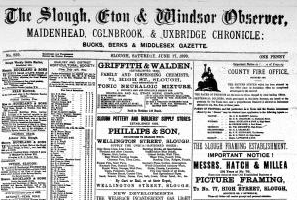
When the British Library closed its newspaper microfilming unit I huffed and I puffed whilst collecting together copies of all of our local newspapers. The puffing continued until I had sent them off to be microfilmed. I must admit that I was a bit happier when I discovered how much money we were saving!
5 or so year later things have moved on……
Access to old newspapers has got much easier as there is more and more material on some newspaper websites, including an ability to buy old photos from newspapers (including an embarrassing supply of photos of local studies librarians carrying our events in years gone by!) Our local newspaper sells its content to Newsbank so my local library gives access to post-2007 local newspaper via that platform.
The problem is that local studies guys should also ensure that these newspapers are available for researchers in hundreds of years, so microfilming still provides both access and preservation. However……
Costs of microfilming have gone up and library budgets have gone down…. plus the number of local studies guys to organise it has also gone down too.
Local newspapers have been hit by cuts as much as libraries. Newsrooms have shrunk, titles have dwindled and my local 50p per week newspaper is now delivered free and looks very similar to our old free newspapers. Though, I must say, that is not universally so.
It is still a right faff to ensure that every year you collect a complete set of newspapers with all the appropriate alternative editions, though, if you can persuade your local newspaper to give you pdfs of their old newspapers it should be, in theory, relatively easy to get microfilmed.
The new generation of microfilm readers/scanners which link into computers are really good and the quality of microfilming has come on leaps and bounds.
After all, do we need to worry about conservation and access? Are we in a position to rely on the BL to permanently conserve all of the key papers in our collection area and then make them available via one of their strategic partnerships?
So what are you doing and what do you think? I’m sure that local studies collections across the country would love to know the “right answer”. Please share your thoughts by putting a comment below and please help us to find out what is happening on the ground by filling in this three question survey. All contributions will be treated anonymously.
 CILIP Local Studies Group