Providing easy and effective access to collections is an essential part of any librarian’s role. The creation of coherent and consistent catalogue entries sited on web-based platforms will provide staff and users with a reliable point of entry to collections, plus enable a quicker response time to enquiries. Catalogued entries can also be used to highlight interesting features of content that may be of particular interest to local studies users.
When creating any catalogue entry, it is important to ensure that it meets international standards. In this way, the data can be updated, transferred, and migrated to other systems more easily.
The Cataloguer
Historically, large organisations employed professional cataloguers to create and amend records to ensure that all catalogue entries were fully compliant to industry standards. Developments in library stock management and Library Management Systems have led to greater automation and the creation of catalogue entries sent direct from suppliers to library stock controllers, dramatically reducing the amount of original cataloguing required.
Unfortunately, the professional cataloguer is often no longer employed, leaving library staff to undertake cataloguing work with minimal training. As has been shown in the book stock section of this toolkit, many local studies publications cannot be purchased from library suppliers and records for these entries will normally need to be created from scratch. As well as cataloguing books, local studies units will need to record details of non-book materials, such as photographs, maps and digital files.
Before you start cataloguing
Before they start cataloguing, a local studies librarian should be confident that they:
- Have a good grasp of relevant standards. A professional librarian should have received training on cataloguing as part of their CILIP accredited course, however the amount of training is different depending which library school they attended, skills may be rusty and international standards may have evolved. A brief description of how the relevant standards affect local studies can be found below, but staff fresh to local studies may benefit from refresher training.
- Have a good grasp of the authority’s cataloguing standards and procedures. Book material should be entered into the main library catalogue, so needs to meet the authority’s standards. This is especially important if the library authority is part of, or joins, a library consortium which shares a catalogue. Your authority should provide you with training before allowing you to make changes to the catalogue.
- Have policies and procedures on how local studies materials should be catalogued. As will be shown below, local studies catalogue records should be more detailed than standard library books. Some non-book cataloguing can be undertaken by volunteers and, as it is essential that cataloguing is consistent, written procedures should be in place which maintains high standards and control.
A local studies librarian will not be alone when they tackle these duties; there will be people in the authority who can provide help and support. Though your authority may not employ a professional cataloguer, they will employ staff within a stock unit whose main duties involve getting material onto library shelves and onto the catalogue. There will also be staff charged with selecting material, whether inside or outside of the stock unit, and these may include other non-standard materials, such as music scores.
Cataloguing standards
Cataloguing should adhere to standards developed to suit the need of their material and users. For heritage professionals, the main standards are ISAD(G) for archives, Spectrum for museums and RDA (Resource Description and Access) for libraries.
RDA
RDA was created to replace the second edition of the Anglo-American Cataloguing Rules (AACR2). Whilst AACR2 was designed for the paper age, RDA was designed to tackle the challenges of the digital age.
CILIP, the American Library Association and the Canadian Federation of Library Associations have published an RDA toolkit which includes the British Library’s RDA workflows and a guide to RDA name authority records. The toolkit www.rdatoolkit.org/ is subscription based but the Library of Congress’s Training modules are available here: https://www.loc.gov/catworkshop/rda/index.html.
For those trained in AACR2, the Library of Congress has some useful information on their website: https://www.loc.gov/catworkshop/RDA%20training%20materials/RDA-refresh/rdarefr-diffa2.pdf. For those trained in AACR2, the Library of Congress has some useful information on their website:
Other standards:
There are also specialist standards for particular content types developed by specialists in their field. Depending on the strengths and collection areas of a Local Studies Collections, some of these may be relevant. For example, rare books librarians use DCRB (Descriptive Cataloging of Rare Books): Descriptive Cataloging of Rare Materials | RBMS – Rare Books & Manuscripts Section. If you are creating a digital archive, you should ensure that your fields follow the Dublin Core principles: DCMI: Creating Metadata (dublincore.org).
See the following sections of the toolkit for advice on cataloguing and arranging specific media:
Cataloguing Software
A local studies collection’s main book stock should be recorded in a local studies subset of the main public library catalogue. Examples of Library Management Software are Civica’s Sydus, products produced by SirsiDynix and Axiell’s SPARK software for archives and libraries. Some library systems can provide a search screen where only local studies material can be searched, for example: https://buckinghamshire.spydus.co.uk/cgi-bin/spydus.exe/MSGTRN/LOCAL/BSEARCH.
Local studies collections that are part of archives and/or museum services may have material catalogued in the CALM archive systems or MODES. In smaller organisations it is often not possible to afford specialist cataloguing systems and other types of databases are used to catalogue collections, such as Access and Excel. Digitised collections may also be catalogued in online archives.
Book Cataloguing onto Library Management Systems.
RDA standards need to be translated into machine readable formats. The Library of Congress’ MARC 21 is the current standard used by public libraries for bibliographic data. MARC 21 is a communications and exchange format which provides the structure for encoding the content of bibliographic and authority data. The British Library leads and sets the standards for UK participation in MARC 21.
Local studies publications often come with a catalogue record that has been purchased with the book, but it is necessary to enhance records created by stock suppliers if there is one. In many cases local studies materials can be locally published or not formally published at all, so are not available via large stock suppliers such as Askews and Holts. Therefore, catalogue entries must be created locally.
The easiest way is to copy records from a reliable source, however older books are likely to have records that were produced using earlier standards so entries will have to be carefully reviewed, whilst others may not have been catalogued before. Some library management systems allow you to search and import records directly, while others may require you to import them manually or copy and paste them line-by-line.
The British Library’s British National Bibliography is also a good source for MARC records http://explore.bl.uk/primo_library/libweb/action/search.do?vid=BLVU1
The BNB enables you to freely download MARC 21 records.
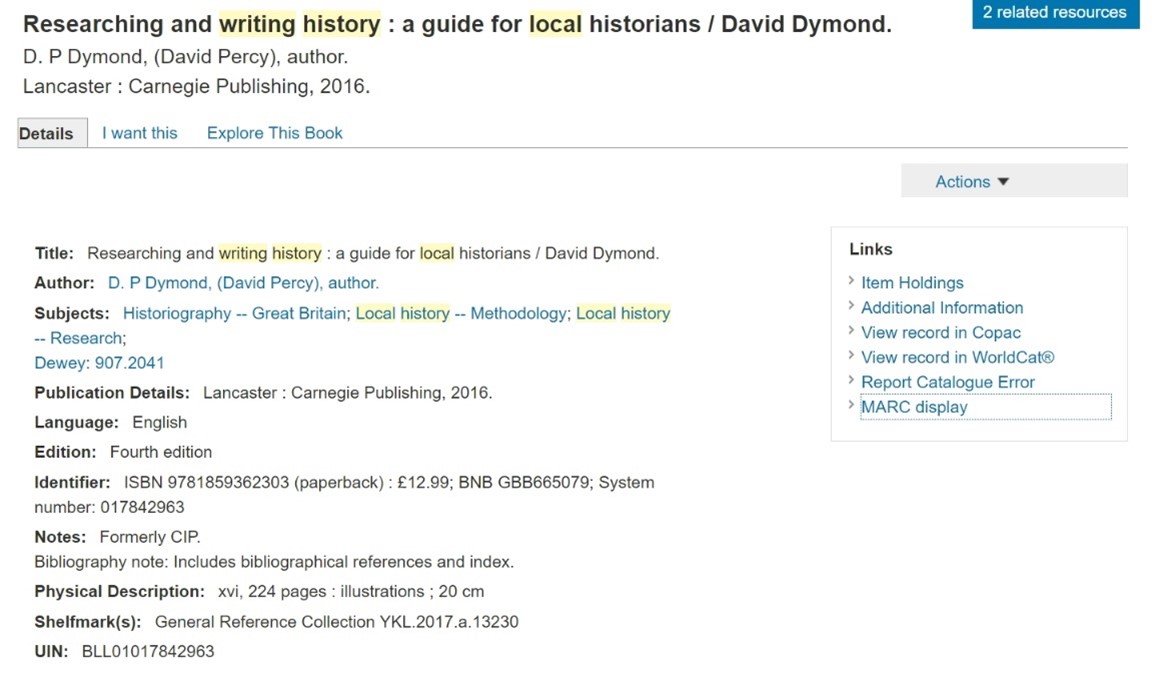
Entry on the British Library catalogue. You can see the option for MARC display for this item on the right.
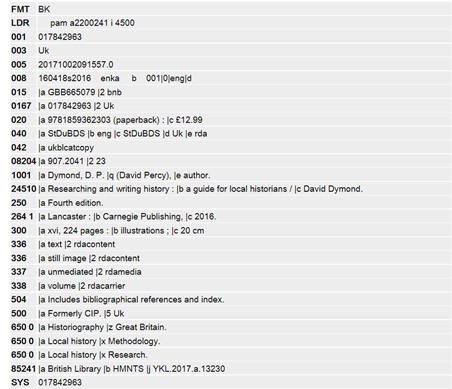
MARC display for the same item on the BNB
Library Hub, https://discover.libraryhub.jisc.ac.uk/, is also an excellent source of cataloguing information, but that site does not display records in MARC 21 format.
Key differences between a Local Studies and standard public library catalogue entry
The unique nature of local studies material requires a more thorough catalogue entry than, for example, a work of fiction on a general library shelf. The importance of person, place and community to local studies collections means that the item has been acquired for a specific reason; for the knowledge contained within it or for its association to the community the collection serves, and this must be reflected in the catalogue entry.
A suggestion for comprehensive catalogue entries for local studies items can be found on the table below and should be used in conjunction with the Library of Congress MARC standards available online:
| Description | MARC 21 identifier | See section below |
| ISBN plus type eg. hardback or paperback | 020 | |
| Dewey number | 082 | A |
| Local call/classification number (if applicable) | 090-099 | A |
| Author | 100/110 | B |
| Title | 245 | |
| Edition | 250 | |
| Publisher details (including publication date) | 264 | |
| Physical Description (number of pages, inclusion of illustrations, format and media type eg. map, CD, dimensions in cm) | 300 | |
| Sequential journal dates | 362 | |
| Series statement | 490 | |
| Note field | 500 | C |
| Bibliography/index (if present) | 504 | |
| Summary | 520 | D |
| Surname of Person/family | 600 | |
| Topic heading | 650 | |
| Local subject use eg. local place name and subject heading | 690-699 | E |
| Added name (for additional authors/editors) | 700 |
A: Dewey and Local call/classification number
Here you should detail how you arrange your books on the shelves. Your branch stock will very likely be catalogued in Dewey, which is a good method for a small number of books, but has challenges for specialist collections. For local studies the key problem is that Dewey does not allow a collection to combine subject and location into one short number, nor is if very good at dividing your collection area into the geographical areas. As a consequence, a large number of local collections have created their own classification schemes tailor-made for their area. For example:
The days of a library dedicating a member of staff to reclassify each book in a local studies collection are over, however small additions to numbering systems should be included as material using new areas are acquired. A scheme typically designed in the 1970s is likely to be strong in archaeology but not in social issues, let alone include new towns.
B: Personal, corporate and series names
An interesting recent development has been the spread of NACO (Name Authorities Co-operative). Members across the world have created an international standard that aims to create a unique entry for each name. Details of approved headings are available through the RDA toolkit and https://authorities.loc.gov/. However, local studies collections will be the first to catalogue many locally produced publications, so it is likely that many of the authors will yet to have reached NACO.
C: General notes
You can add miscellaneous information about the item in this field, such as whether your copy is part of a donation, part of a collection, information about previous owners or whether it contains any manuscript comments or annotations of note.
D: Summary
It is important to give potential local studies readers a flavour of the book and its strengths. It is also important to be aware that the library catalogue will interrogate this field when users search the catalogue, so make sure that you include keywords that will not be included in the title or subject fields.
E: Local subject use
Whilst field 082 (Dewey and Local call/classification number) forces you to pick one subject term, this field enables you to add multiple terms. Your authority is likely to use Library of Congress Subject Headings as its standard subject terms, but this is not detailed enough for British local studies, so you should use a specialist scheme.
Your authority may have its own local studies thesaurus, such as that produced by Berkshire.
Some local numbering schemes, such as that provided by Wiltshire above, will be thorough enough for use in this field.
Whichever classification scheme is used for this field, it is important that it captures both the subject and the geographical element. For example:
SMOKING PIPES – Slough – Cippenham
Though the subject can be taken from a generic list of local studies terms, the geographical element should be carefully considered at a local level.
Item record
A catalogue entry describes a certain publication, whilst the item record contains information relating to individual copies. Each copy must have its own item record describing the physical location of the item and its classification number. Information about the conservation work undertaken on the item can also be added onto the item record.
Contributing material to a county bibliography
Some counties have local history bibliographies, often compiled by county local history associations. Where possible, new additions to library stock should be added to these listings.
Contributing material to union catalogues
You can reach a bigger audience by contributing information about your holdings to collections of library catalogues: Your library authority may be part of a consortium so, for example, if a SELMS library user cannot find a book in their local library website, they can find holdings in other partner libraries by selecting a ‘Try this search in the SELMS Catalogue’ link. They may also contribute to WorldCat.
You can also contribute information about your pre-1800 holdings to the English Short Title Catalogue which, however you will need some understanding of DCRM to do this properly.
Got something to add?
Do you have any comments, suggestions or updates for this page? Add a comment below or contact us. This toolkit is only as good as you make it.
 CILIP Local Studies Group