
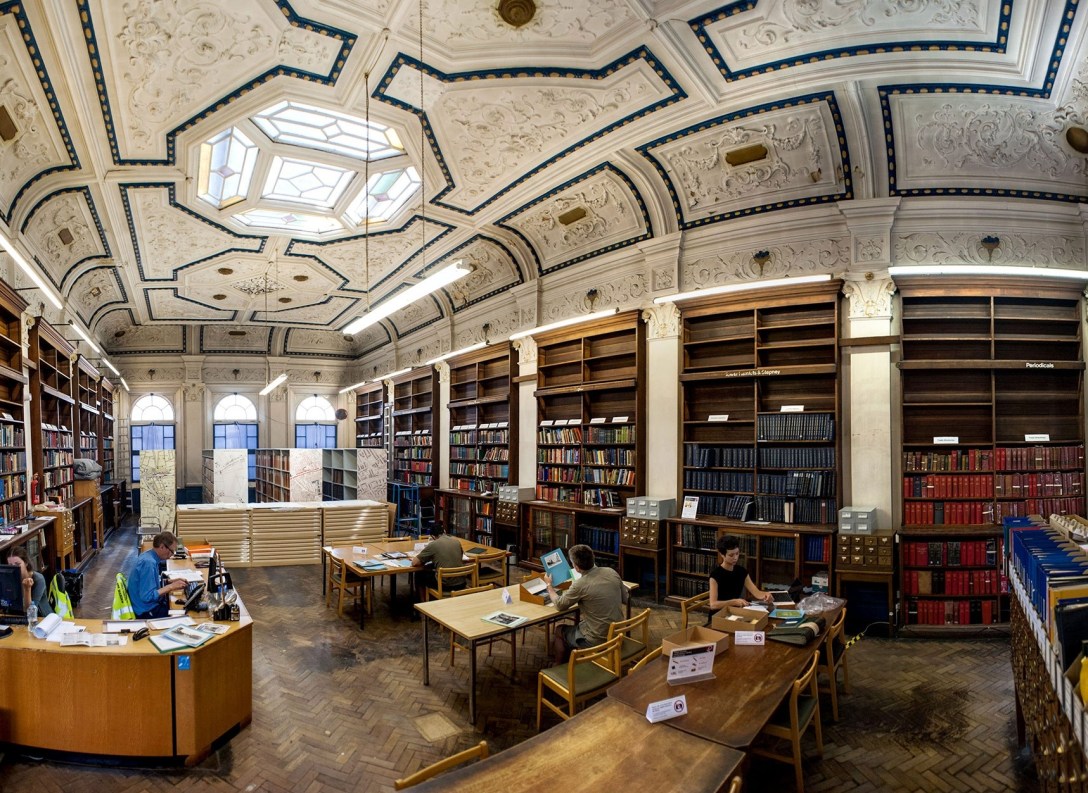
A local studies library should be a welcoming place for all members of society, ensure good working conditions for readers and staff, provide secure access to library materials, and be able to facilitate visits, events, meetings and group work.
The physical location of areas designed to house local studies collections should always be carefully planned. When library buildings are constructed or adapted the opportunity should be taken to provide accommodation of the highest standard, professionally space planned, in consultation with local studies staff.
Public areas
Areas designated for use by members of the public should be planned with both security and user convenience in mind. Considerations include:
- Adequate seating complete with a power supply to enable readers to plug in laptops and other devices.
- Access to wi-fi.
- Generous provision of large tables for consultation of maps, plans, broadsheet newspapers, newspaper volumes, and other large items.
- Design that allows for careful supervision of readers consulting irreplaceable materials.
- Space for specialist equipment such as computers, microform readers/scanners and printers.
- Lighting levels that are bright enough to enable readers to take digital photographs of material whilst protecting documents from over-intense exposure, and that permit the use of microforms without eye strain.
- A display area to promote the range of material in the collection.
- Adequate access and user facilities for disabled people.
- Flexible enough to allow group visits and, ideally, to enable events to be held when the library is closed.
Open access materials
If possible, a collection of local studies books and other materials should be provided on open access. This will be much appreciated by researchers, and indeed some users come into the local studies library simply for the pleasure of browsing among the materials. Unique items should never be put at risk, but duplicate copies can be purchased as funds allow. Sometimes even out-of-print items can be obtained from specialist sources, and bound photocopies of rarer material can be prepared to enable the development of an open access section. If an open-access collection is provided, appropriate shelving and storage furniture will need to be provided in the public study area, and space made available to accommodate these.
Public-access computers should also be accessible in the local studies area. Ideally, these should be used to signpost users to online local and national resources of interest to local history researchers, for example photographic collections, maps, directories, digitised newspapers and family history resources, and online indexes.
Storage areas
Secure storage must be provided and should be located close to the public study areas, but with adequate controls to prevent entry by members of the public.
Provision within the stores should include specialist shelving and furniture, such as non-standard sizes of shelving including closely-mounted shelving of appropriate length for horizontal storage of single newspaper volumes, “jumbo folio” volumes or large illustrations. A separate filing area for unbound copies of local newspapers and periodicals is desirable.
Care should be taken to acquire appropriate storage equipment for special materials such as maps, microforms, photographs, negatives, 35mm transparencies, cuttings and ephemera.
Storage should ideally conform to standards outlined in BS 4971:2017 Conservation and care of archive and library collections. Smoke detectors should be installed, and fire escape routes be planned to avoid public egress through the stores. Ideally service pipes should not be routed through the stores, and neither should inappropriate electrical or heating appliances be located here.
Monitoring storage conditions
Equipment should be installed to monitor the correct environmental conditions, for example, Tinytag data loggers can be used to monitor the temperature and relative humidity of different areas of the space, including inside boxes. Insect traps should also be used to monitor pests.
Office accommodation
There should be adequate office accommodation for local studies staff, plus tabletop space for processing newly-received local studies materials and storage for archival and other specialist stationery. There should also be room to enable the scanning of photographs and other material, and to accommodate any volunteers.
Got something to add?
Do you have any comments, suggestions or updates for this page? Add a comment below or contact us. This toolkit is only as good as you make it.
Image courtesy of Tower Hamlets Local History Library and Archives.
 CILIP Local Studies Group