
Posts

Toolkit: Local newspapers

Return to Toolkit homepage

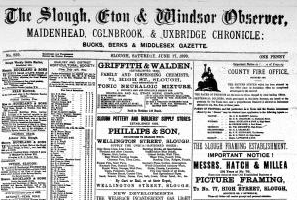
The local newspaper is one of the most useful resources for the capture and later research into the history of a locality. Almost every sizeable town in Britain has (or has had) a local paper, but regrettably the number of printed titles has dwindled in recent years. Some are now only available online.

Many local papers began publication in the mid -19th century at a time when print media was the way that most people received their news. In many instances, the newspaper will be the only place where information on a specific matter has been recorded.

Whilst each paper has its own character, they all contain the same elements; notices, articles and features:

  • National and international news in brief
  • Regional and local news
  • Local government and politics
  • Business
  • Education
  • Social welfare
  • Churches and clubs
  • Crime and court proceedings
  • Obituaries
  • Local events
  • Sport
  • Letters
  • Advertisements
  • Vacancies and jobs

In the early twentieth century the inclusion of photographs became more widespread, however many titles such as the Illustrated London News had already been using images to enhance features for several decades.

Indexing & newspaper cuttings

Local studies libraries have traditionally created indexes of articles to facilitate the use of newspapers and to increase their usefulness. These are invaluable resources, often giving valuable leads to complex enquiries. Such hard-copy general and obituary indexes to newspapers as well as cuttings should always be maintained. Adding to these indexes is time-consuming but is to be encouraged where staffing permits.

But be warned: other local government officers often do not understand what we are doing and why. In the wake of GDPR legislation some administrators have become over-anxious about online indexes. At the time of writing the online index to newspaper articles compiled by Medway Archives Centre has been removed by order of Medway Council’s GDPR compliance team.

Some authorities have made their newspaper indexes available online:

Preservation and availability to the user

Newspapers were not printed to last, rather to be read at the time of production. Newsprint paper is often of poor quality, highly acidic and likely to become brittle with handling; so some method of producing surrogates should be used. Surrogates are then made available for public consultation. It is recommended that newspapers should be repaired by professional conservators as often the pages will need to be fully covered by a thin layer of Japanese paper, though small repairs can be done in-house.

Microfilming has until recently been the preferred method of copying as it is a well-established and long-lasting solution. A number of suppliers will produce a master negative and a copy positive. The positive is used by libraries and a new copy is produced from the negative when required. The negative can be stored at another location for increased security.

Digitisation offers an excellent alternative. An advantage of the digital option is that it can include OCR (Optical character recognition). This form of indexing/searching is especially useful, but will of course increase the cost of the surrogate copy. However, OCR can be rather hit and miss for older typefaces, as software finds older typefaces hard to read. Some local newspapers may also supply you with electronic versions of their older newspapers, saving you the time, money and effort digitising paper versions.

Some recent editions of local newspapers are also available via newspaper e-resources. See below for more information. For more information on the discussion on whether to microfilm or scan, read this blog post. Whichever method is used the library needs to have suitable equipment for reading and printing copies for users.  

Wherever possible original copies of newspapers should be retained, both as a security measure and to enable images and high-quality text to be reproduced.

Traditionally newspapers have been bound to aid use, but they can also be kept flat in acid-free buffered boxboard boxes.

British Newspaper Archive & other online services

The British Library, until November 2013, offered access to nationwide newspapers at its Colindale site, but this option no longer exists. Original newspapers were moved to a purpose-built storage facility at Boston Spa and free access to papers, both microfilm or original hard copy, is available at the British Library’s St. Pancras site. For more information, read the British Library Newspaper Guide.

The BL has entered into a partnership with the subscription site FindmyPast which hosts the British Newspaper Archive, giving online access to newspapers and journals. The number of available titles is growing all the time, currently boasting over 37 million pages online dating from the 1700s to the present.

It would be fair to say however that coverage of the UK is somewhat patchy; some areas are much better served than others, and for the titles included there may be only a few editions. More recent decades are also less well represented due to copyright issues, with the bulk of their online collections having been published over a hundred years ago.

To view available titles go to https://www.britishnewspaperarchive.co.uk/home/NewspaperTitles

Many libraries already have access to FindmyPast. For further information on usage in libraries and education go to https://www.britishnewspaperarchive.co.uk/content/libraries_education

Libraries can also subscribe to local newspaper content, both recent and more historic, via a number of other products:

Other websites offering access to local papers:

  • Chronicling America – Historic American newspapers from 1836-1922, sponsored jointly by the National Endowment for the Humanities and Library of Congress (free)
  • Gale News Vault – A broad selection of international newspapers and periodicals (paywall)
  • Google News Archive – Google’s discontinued newspaper scanning project, whose content is still available to search (free)
  • Ireland Old News – Transcriptions of old Irish news articles (free)
  • Newspapers.com – Database of 3,400 newspapers, mainly American (paywall)
  • Trove – The National Library of Australia’s digitised newspaper collection (free)
  • UKpressonline (paywall)
  • Welsh Newspapers Online – Welsh and English-language newspapers from 1804-1919, digitised by the National Library of Wales (free).

Further reading:

Got something to add?

Do you have any comments, suggestions or updates for this page? Add a comment below or contact us. This toolkit is only as good as you make it.
Return to Toolkit homepage

Autumn online training

The Centre for the History of People, Place and Community have four online training workshops that may be of interest to local studies staff. All are in the Autumn. Free to attend, but you must book.

Cartography and Mapping for Publication – 9 September 2020

https://www.history.ac.uk/events/online-cartography-and-mapping-publication

Analysing Historic Settlement – 23 September 2020

https://www.history.ac.uk/events/online-analysing-historic-settlement

Reading and Writing Historic Buildings – 22 October 2020

https://www.history.ac.uk/events/online-reading-and-writing-historic-buildings

The National Archives, the Medieval State, Early Modern Litigation – 18 November 2020

https://www.history.ac.uk/events/online-national-archives-medieval-state-early-modern-litigation

Local Studies is democratic education

by Alice Lock, LSG Secretary

Now that I’ve become a library user (viruses permitting), rather than a staff member, I can’t help noticing how many events and initiatives are arts based. I suppose that this is partly because the Arts Council has national responsibility for libraries and grants for activities come from them. This must bring in new audiences who can make use of local studies collections in different ways, but I worry that it an emphasis on arts rather than learning might have its drawbacks.

I’ve always believed that local history and family history are important because they are the most democratic form of education available to anyone. Anybody can walk through the door and decide for themselves what they want to study and how. They can interact with other people through chatting to others in the library or through societies – or they can work completely on their own if they wish. They don’t have to pay fees to an educational organisation, they can pick whatever aspect of history that interests them – and, if they adopt proper research techniques, their work has equal value to professionals in the field. Very few subjects allow complete amateurs opportunities like this. In my working life I came across many people who had not done well at school and had come to regret their perceived “lack of education” – local history gave them a second chance to learn, on their own terms. I can’t count the number of people who complained that the history of “kings and queens” which they encountered in their young days at school was of no interest to them. Local and family history is not only of interest because it concerns our immediate environment but it also focusses on the past lives of people like us.

Many years ago family history was regarded as a rather pointless exercise of collecting names and dates. Nowadays its value as a way of learning about our past and how society works is as evident as in the study of local history. But students learn so much more – research techniques (both online and with documents), how to evaluate evidence, how to analyse evidence, how to present findings etc etc.

To me this is what makes local studies collections important.

UCL Local Studies Survey

Guest post by Ruth Long 

Do you work in the information, library or heritage sector? Do you work with local collections? 

Then I want to hear from you!

I’m an MA student at University College London, and I’m researching how local collections are managed across different institutions and sectors for my dissertation.  In addition, I hope I may be able to share some of my highlight findings either through an article or presentation.

There is little recent academic research in this area, so your responses to this survey will be especially valuable. I very much appreciate any time you can give. All of the questions are optional. You can complete the survey and remain anonymous.

Please click on the following link to access the survey – https://opinio.ucl.ac.uk/s?s=68662

The deadline for completing the survey is Friday 31st July.

Toolkit: Conservation

Return to Toolkit homepage

Local Studies is a blend of special collections and lending library work. As such you have to treat lending and branch stock completely differently to material found in a local studies hub.

There is always a tension between access and preservation. With use local studies materials will deteriorate, however there is no point keeping most material if it is not used. After all, a large amount of local studies material is not unique. Pragmatically, judgements will be made on an item by-item basis, however there is a lot we can do to extend the life of our collections.

Lending & branch stock

As with all other lending stock in public libraries, local studies lending material needs to be attractive and kept in good condition, but unlike the majority of lending books, it should be durable as the contents of the book are unlikely to be replaced by a newer version. You can extend life of a title by:

  • Bind likely to be well-used paperbacks. Get your binders to use the original covers as part of the new boards.
  • Ensuring that hard-back cover protectors are cleaned and, when necessary, replaced.
  • Ensuring that you buy a good quantity of new publications. If a title is going to have a short print run and will be a valuable resource, you should factor in that some copies will be damaged and lost in the years ahead.

Storage

Storing materials in appropriate conditions is the best way to ensure long-term survival of materials. Each format has its appropriate packaging and storage conditions and those are described in the appropriate parts of the toolkit.

High replacement cost or low availability of a replacement may suggest that access should be restricted, however if an item cannot be browsed easily, or if it is stored away from the main book stock, it will be used less often.

Format specific guidance

Advice on storing different types of library stock can be found in the appropriate parts of this toolkit, however the National Archives and the old British Library website has some useful general advice on storing delicate materials:

https://www.nationalarchives.gov.uk/information-management/browse-guidance-standards/?letter=c&keyword=conservationhttps://web.archive.org/web/20220306212848/https://www.bl.uk/conservation/guides

Repackaging

Repackaging collections is a very valuable activity, but can also be extremely time-consuming, however there are some other ways you can do it:

  • Get staff reassigned during computer outages.
  • Hold an annual local studies help day. Staff are asked to drop in for an hour during a day and give you a hand. This is a good marketing tool and good for staff bonding.
  • Many companies lend groups of staff to organisations for community days.

Storage conditions

The British Standard for archival and library storage is set out in BS 4971:2017. This standard is used by Special Collections and archives and gives guidance on ideal conditions for storing important parts of collections.

Material should be protected from direct sunlight, dust, pests and atmospheric conditions. If material has to be stored in direct sunlight, film can be placed on windows to filter-out harmful rays. Dust damage can be limited by using boxes and regular cleaning. Insects and atmospheric should be monitored using pest traps and the temperature and relative humidity should be tracked.

It is unlikely that local studies collection will be in ideal storage conditions, but a quick regular check of conditions can pay dividends. A lot of damage to collections can be avoided by moving material away from areas where roofs are known to leak, spotting when widows become damaged and spotting fire risks.

Handling:

To help reduce the amount of damage caused by readers and staff using delicate material, make sure that:

  • book pillows are available for readers using delicate books
  • weights are available for those using rolled maps
  • cotton gloves are available for those handling photographic material

More information on handling rare materials can be found here in the old British Library guide, courtesy of the Wayback Machine

National Archives also provides some interesting information on handling rare items in differing formats:

https://www.nationalarchives.gov.uk/about/visit-us/researching-here/handling-documents/rules-and-handling-aids/

Surrogates

If certain materials are delicate but of wide interest, can a surrogate be made? If it is that popular, should it be digitised and/or microfilmed and placed online? Has it already been digitised by someone else, such as Archive.org, Google Books or the Hathi Trust? Under copyright law, publications can be photocopied for preservation purposes if the copy is kept for reference only.

Conservation

Delicate materials can be stabilised. Local Studies materials should be conserved and not restored – you are not returning the item back to its former glory but stabilising the object and making it less likely that further damage will be made through handling. As such, any work undertaken on an object should not be hidden.

Using professional conservators

Local studies collections should enjoy some support from the conservation unit in their county record office. However, if extra support is required, you can find contact details of conservators via the Institute of Conservation’s register: https://www.conservationregister.com/

In-house conservation projects

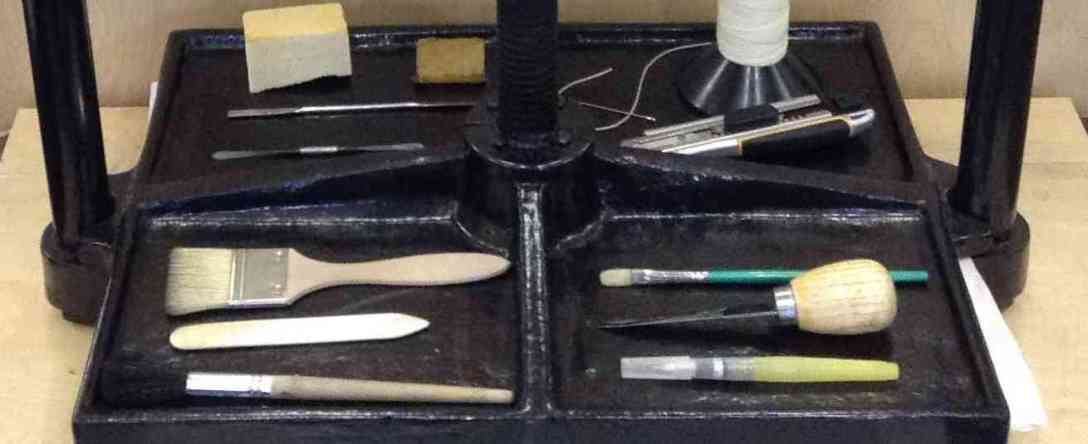
Repackaging should be the first conservation priority for a local studies collection. However, after receiving training from a conservator, members of staff and volunteers can undertake a range of basic conservation tasks. These can include:

  • Cleaning material using brushes and smoke sponges
  • Basic paper conservation, including using water pens to remove folds and using starch glue and Japanese paper to repair tears.
  • Re-sew pamphlets with rusting staples
  • Make phase boxes to protect delicate books

As with all projects, work has to be closely monitored. Conservation works should also be recorded, ideally on the item’s catalogue record.

Initial training for such projects may be available from your county record office, from free-lance conservators such as Caroline Bendix or through organisations such as the Historic Libraries Forum: https://historiclibrariesforum.com/events.

Rather than create an in-house volunteer project, you should consider approaching your local branch of The Art Society. Members of the Art Society can be trained to undertake paper conservation by in-house tutors. The upshot for collections is that, for the cost of travel plus tea and coffee, they can undertake conservation tasks for you. They also do a large amount of the volunteer management role too – the librarian’s job is to liaise with the volunteer leader.

For more information on the Arts Society, then known as NADFAS, read the second post on this page: https://www.webarchive.org.uk/wayback/archive/20130626183045/http://communities.cilip.org.uk/blogs/lsgblog/default.aspx

Conservation suppliers:

Got something to add?

Do you have any comments, suggestions or updates for this page? Add a comment below or contact us. This toolkit is only as good as you make it.

Return to Toolkit homepage

Social media

Return to Toolkit homepage

Social media are interactive computer-mediated technologies that facilitate the creation or sharing of information, ideas, career interests and other forms of expression via virtual communities and networks. Wikipedia 

Why use it?

Most of us will be familiar with social media and use it personally so know the benefits (and problems!). Social media is also a way of publicising your service and resources. Increasingly it is where people look for latest information, and some organisations and companies now see this as their main way of communication with users rather than websites. You can get your service out among users and seen by hundreds if not thousands of users. Social media can be seen as more personal than a website, and people can respond to what you’ve posted and you can then respond to them.

It allows quick distribution of information, for instance if the library has to close early in an emergency. It also provides an easy way to share stories and images, whereas sometimes it takes a long time to get things added to corporate websites.

Journalists often search social media for stories, so media enquiries can come from reading something you’ve posted.

Local Studies collections are a fantastic resource for social media.

Main types

Blog – allows longer articles to be shared. There is often a comment facility although it is best to enable moderation on this.

Facebook – individuals join and then request friends, join groups and follow organisation pages. People (or groups) post stories, images and videos.

Twitter (now X) – sharing 240 character tweets (posts). Threads and BlueSky are alternatives which work on similar principles.

Instagram – photo (and video) sharing platform.

LinkedIn – a professional networking platform. You can create you own personal profile and engage with others and make contacts, and share stories about your service with potential partners. You can also create a profile for your library/service.

There are various others such as Tik Tok, Tumblr, Mastadon, Flickr. Each has their own character and focus, so will vary as to whether they are suitable for your purpose. Social Media trends change rapidly, and what was popular one year may wane the next, and there will be new platforms launched. Keeping track of everything is hard.

Account options

Do you have Local Studies account or just contribute to a wider library account? Check with your Comms Unit for advice as each organisation will have different policies. Some may allow numerous accounts to be set up across Libraries, with each library having their own account and a local studies account may be possible. Other may restrict, so local studies will feed into a larger account. The latter may have benefit of introducing new users to local studies and requires less content to be created.

If an account is shared by several administrators, then co-ordination is needed as to what is posted and when.

If there is a generic account for your parent organisation (e.g. Local Authority) make contact and let them know any good content they might like, as they are often looking for interesting content. Tag them in so they can reshare. Some Comms Units may not know you so it is a chance to let them know the treasures available.

Social Media Policy

Your organisation may have policies about social media so check with your Comms department. If you are contributing to another account they may also have a policy so you will need to be aware of it and fit in with their ‘style’. Most accounts have more than one Admin so the usually policy is that they all conform to the same style so people don’t know the difference.

It is best to stay clear of controversial topics and think if something could be misinterpreted. For instance if you are posting a photo of a past flood because there are current floods then be aware people may have been badly affected and phrase accordingly. If a local council scheme is controversial you may want to stay clear of posting something linked to it, or get advice. 

If people comment you should try to comment, if relevant, acknowledging comments and providing more detail if available. Most libraries and heritage organisations have very few nasty/angry/controversial comments, but if you do you may want to get advice as to whether to ignore them or to engage and explain. Some organisations, though, have found an increase in negative posts on some platforms in recent years, so have decided to close some accounts.

Posts

These are some suggested advice for some of the most used platforms. You can usually get a feel for these and others through reading posts from others, and there is plenty of advice online.

Blogs – longer articles, normally a few a week maximum and not more than one a day. Takes time to write and research so post less frequent.

Facebook – No limit to text but usually 3 or 4 images maximum and a couple of paragraphs. May link to a blog. Usually only post one or two a day at most, and need to do at least one a week. Can link to a blog so people can read the longer article.

Twitter (X) – 240 characters so short and sharp, with maximum 4 images. Can tag other organisations in who may reshare. Can share link to blog. Most people see tweets in chronological order and there’s no problem in posting numerous tweets in a day, and repeating tweets to ensure as many people as possible read them. You can now link tweets as well, so if you need longer than 240 characters you can have a thread of several tweets, but it is still good to be as concise as possible.

Instagram – Photos/Videos are the main focus, so choose eye catching images.

Content

The best way to see what is good content is to look at similar organisations. You can get lots of ideas from them so have a browse. Local Studies, as you may be aware, have fantastic resources for social media as we have amazing collection. Keep an eye on the stat pages on the platform to see how well different posts are doing, which is also important to record to show your managers. Quite often you’ll be surprised at what is popular.

  • Service updates – new additions, changes to access, opening hours, sudden closures or still open in bad weather. Many organisations don’t update their website now with this information and just update social media.
  • Topical – is it a frosty/rainy/snowyday? It is the budget, Sports Relief, has a popular TV series just started or something just hit the headlines?
  • Hashtag Days – Just every day is a particular day, such as Biscuit Day, Handwriting day, as well as other more well known days such as Shrove Tuesday, St Patrick’s Day, World Book day or May Day. 
  • Anniversaries – VE Day, Birth/death of a monarch, local anniversaries can all be the focus of a post
  • People are also interested in old photos (you may well have plenty in your collection), especially if they can reminisce.
  • Funny/Strange stories or enquiries
  • Oldest/Biggest in your collections
  • Subjects people are in studying (with their permission if mentioned)
  • Famous people in the archives
  • Events – advertise your workshops/talks and other events

Examples

These are a few Worcestershire examples, posted by Worcestershire Archive & Archaeology Service (posting under the Explore the Past brand) which have proven to be very popular and may inspire you.

Image

A frosty morning inspired this photo being shared of the frozen River Severn.

Image

When we saw this 1890 newspaper story of a hairdresser letting off a cannon in their bedroom we knew it would be popular. A host of questions spring to mind!

A sales catalogue for Bag End is always popular when it has been shared whenever there is a Tolkien anniversary or a film is released.

Image

This Fish & Chip shop in 1968 on #NationalFishAndChipDay (7 June) caused a lot of reminiscing about going to the chippy in the past.

Copyright / Permissions

Putting images on social media is publishing so make sure you have permission for anything you post!

You may want to ensure images are lower resolution (but enough to look ok) and post your library name on along with any reference (in case people follow up and ask for it) in case people cut and paste or copy which they may do. Many people think if it’s on the web they can feely use it, so will use on their own websites and social media without permission or acknowledgement. Another option is watermarking.

Check you have people’s permission before posting photos of them online.

Evaluation

If you’re spending time on social media then you want to see how successful it is, for yourself and to show others. Again there’s plenty of advice online about measuring it. Views are good to record, but they are part of the story. Interactions, such as sharing, likes or replies, can be more useful to show how much interest it’s generated. Some statistics need interrogating further. For instance a 10 minute YouTube video may have 100 views, but when you check only 50 views were over 1 minute, and only 10 were for more than 5 minutes, giving an indication of how many people took an active interest.
Another indication is whether people responded in a way you wanted them to. Did they supply information requested, follow a link to complete a survey, or attend an advertised event? It may be that a post advertising a tour of the local studies library was really popular and reshared and liked many times, but very few people actually book.

Beware!

It can be very time consuming, and responding to messages can be one of the hidden extra tasks. Have a plan for what you will do, and revisit it, to help avoid being overwhelmed. Ensure your manager is aware of how long it takes too. Being part of a larger team can help.

Remember that some elderly or disadvantaged customers do not use social media (but don’t assume, as lots of older people use it) – ensure other methods of communication are also used such as local newspapers, council flyers and posters.

There are many forms of social media and people have different preferences, and each has a different audience profile. So you may either just reach a proportion or have to use several platforms.

The social media landscape changes rapidly. Remember when young people were using Bebo, and having a MySpace account was the in thing? Then in late 2024/early 2025 quite a few organisations starting to switch from Twitter/X to BlueSky or just coming off it altogether, due to concerns over the toxic nature, and also the decline on people on that platform. You may be reading this article and thinking how out of date it sounds! So you will need to keep re-evaluating you social media policy which is of course is extra work.

Got something to add?

Do you have any comments, suggestions or updates for this page? Add a comment below or contact us. This toolkit is only as good as you make it.

Return to Toolkit homepage

Toolkit: Archives

Return to Toolkit homepage

Local authorities have discretionary powers under the Local Government (Records) Act 1962 (LGRA 1962) to provide archive services. Most councils have taken up these powers and provide public archive services at either a county or city/town level. Since the 1980s/1990s, the tendency has been for archives services to operate jointly with local studies services, particularly in unitary authorities.

Some smaller unitary authorities have not taken up the discretionary powers to provide archive services themselves, in which case there may be an agreement with a neighbouring authority to provide archive services. The library service may hold some types of archives as part of its local studies service. 

Archive collections

Libraries are empowered to hold archives under the Public Libraries and Museums Act 1964, provided that this does not become their dominant function. Typically, archive collections held by libraries include personal papers, records of local organisations, and records of the council such as minutes of meetings. 

Libraries may also create “artificial collections” of material. These collections comprise items that have deliberately been collected according to format or subject rather than records that have accumulated as a result of particular functions or processes. Examples of “artificial collections” often collected by library staff include photographs, newspaper cuttings or maps. In many cases, these items have lost details of any provenance and original order so care should be taken by library staff in adding to these artificial collections. Archival integrity should be a paramount consideration.

Archival integrity

Archival integrity means that records are identified and maintained according to their provenance, not intermingled with records from other creators, and maintained in their original order (this is known as the principle of “respect des fonds”). Ideally, there should be documented evidence of an unbroken chain of custody. 

Public records

Unless the library service has been appointed a place of deposit, any archives held by libraries must not include records such as public records or most manorial courts records. These are covered by specific legislation.

Public records are records created in central government departments or agencies, the courts and the National Health Service. Where these are administered locally or regionally – e.g. hospitals, courts, coroner’s service – it may be that the National Archives has authorised local record offices as places of deposit for these records.

The Keeper of Public Records has responsibility for the day-to-day management of public records, which may only be held by The National Archives or by a place of deposit appointed under the Public Records Act 1958. 

Where local authorities have not taken up discretionary powers to provide archive services and/or have not been appointed a Place of Deposit, responsibility for relevant public records, including those created locally, is retained by the Keeper of Public Records. 

The Archive Service Accreditation Scheme is used to ensure appropriate standards are maintained by Places of Deposit. 

Further information on public records, including a list of Places of Deposit, is available on The National Archives website: 

http://www.nationalarchives.gov.uk/archives-sector/legislation/approved-places-of-deposit/

Archival Description

Staff in libraries holding any archive collections should be particularly mindful of archival principles of provenance and arrangement by original order. Archival collections must not be catalogued or classified as if they were library materials. The usual terminology is that archives are listed or described, rather than being catalogued.

Library cataloguing typically treats materials as individual items and classifies them according to subject, regardless of where they originated.  By contrast, an archive collection needs to be listed as a whole, with its provenance and custodial history recorded, and the arrangement of items reflecting the context and hierarchy of the collection. 

The General International Standard for Archival Description (ISAD(G)) defines the elements that should be included in any archive listing. Encoded Archival Description (EAD) is closely mapped to ISAD(G) and uses mark-ups or tags to distinguish elements of archive descriptions in a way that can be interpreted and processed by computer systems. ISAD(G) is a structure standard, not a content standard, so it defines which fields should be included, not what the content of those fields should be.

There is no archival equivalent of a library classification scheme because archives are arranged as far as possible in the order by which the creator kept the records, rather than having an arrangement imposed by an archivist. As each individual creator of records is likely to have a different way of organising records, it is not possible or desirable to have a standard scheme of arrangement by archives. 

In practice, many archive collections may arrive as unstructured piles of documents in boxes or bags, but the principle remains that the arrangement should not be imposed by an archivist but should reflect the organisation, functions and processes that produced the records.

The closest to a standard scheme of arrangement is the Local Government Functional Classification Scheme (LGFCS), which was developed by the Information & Records Management Society in February 2019 to replace the previous Local Government Classification Scheme (LGSS). This is often used by records management staff in local authorities as the basis on which to organise current council records. In this case, the LGFCS may be a useful starting point. Check with your authority’s Records Manager if you find yourself in a position of having custody of local authority records. The  2019 version of LDFCS is available to IRMS members only, but the 2006 version of the LGSS is freely available:

https://irms.org.uk/resource/collection/1F3924BE-78BA-49E2-906B-1E5B672687A2/lgcsword2.03.doc

Most library management systems are unable to cope adequately with archive collections and attempting to include archives in a standard LMS should be avoided. The National Archives has a list of suppliers of collections management systems (CMS) and digital asset management systems (DAMS) that are suitable for listing archives and storing/managing digital assets:

https://www.nationalarchives.gov.uk/archives-sector/advice-and-guidance/managing-your-collection/cataloguing/cataloguing-and-archives-networks/

If you are a librarian responsible for looking after archives and do not have access to a professionally qualified archivist, then it would be advisable to consider undertaking a basic archives awareness course. Training courses and other events are often advertised on the Archives-NRA mailing list.

The Community Archives and Heritage Group has developed a set of guidelines for community archives, which have been designed to meet the minimum standard for archival description whilst being straightforward and accessible.

Got something to add?

Do you have any comments, suggestions or updates for this page? Add a comment below or contact us. This toolkit is only as good as you make it.

Return to Toolkit homepage

Toolkit: Directories

Return to Toolkit homepage

Trade Directories are an early form of Yellow Pages, providing names of tradespeople, and also giving a brief summary of each town and village. They were published from the late 18th to mid 20th centuries.

Guide to resources inside and outside your collection

Trade and street directories are well-used sources of information by family and local historians. They can be used to find out where someone lived and what they did for a living. Their strong commercial focus means that they are an important source for the economic and business history of towns or regions. Their topographical information provide important clues on the built environment and geography of the past.

The first directories were published in the late 18th century. As Britain’s economy and urban areas grew in the 19th century, so did the publication of directories. They remained an important genre of reference information into the mid- 20th century. The best-known trade directory is Kelly’s, a London publisher who issued county directories from the late 1830s. They also published the Post Office Directories. Pigot and Slater, based in Manchester, were Kelly’s main national rivals until they were taken over in 1853.

Some publishers produced directories for particular professions or industries e.g. Jones’s Mercantile Directory of the Iron District of South Staffordshire and East Worcestershire … [1865]. The focus on commercial information means that many directories carried advertising (usually in a section towards the back), and they are a great source for images and illustrations.

There were also many regional publishers and some towns had their own directories. These provide even greater detail on local people and institutions. For instance, some will list the head of household at each address in the town.

The need for timely commercial information meant that directories were regularly updated. If you have a run of directories in your collection, then you can document changing information over many decades.

Trade Directories are usually arranged by town/village, with a section arranged by trade and one by tradesperson in alphabetical order sometimes included. There are normally useful classified indexes at the back of each volume too.

The town/village summary will list all the different administrative areas the location is part of (helpful for guiding where to look for other sources), brief history/summary of church and manor, key crops and industries, soil, population and key landowners. Public institutions are listed with the contact name. Private residents are listed, although just the wealthy ones, and then tradespeople.

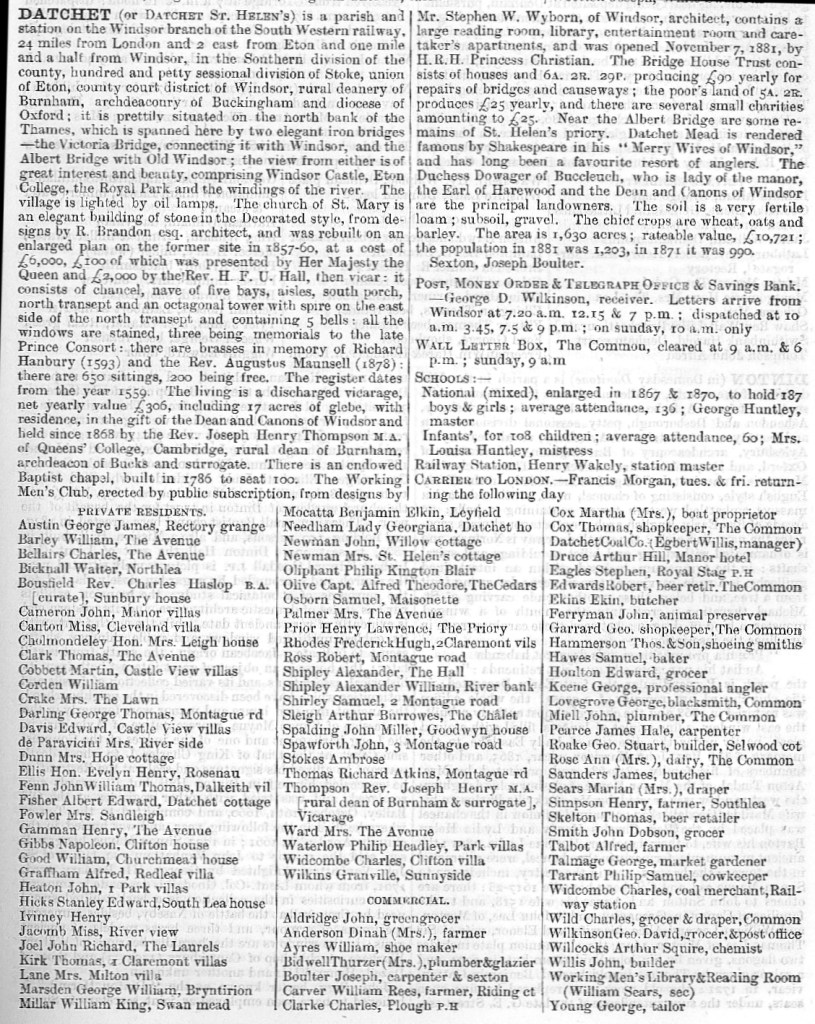
(above, extract from Kelly’s Directory of Buckinghamshire, 1887)

Town directories will provide the same information, but with more detail. However, as the name suggests, they only cover some towns rather than a more thorough survey provided by the County directories. Some have a street directory with the head of household listed. They will go in house order, indicating side streets, so can be helpful for pinpointing a property if you think numbering has changed. The detail of the building and street information has made directories an invaluable source for investigating how pub names have changed over time!

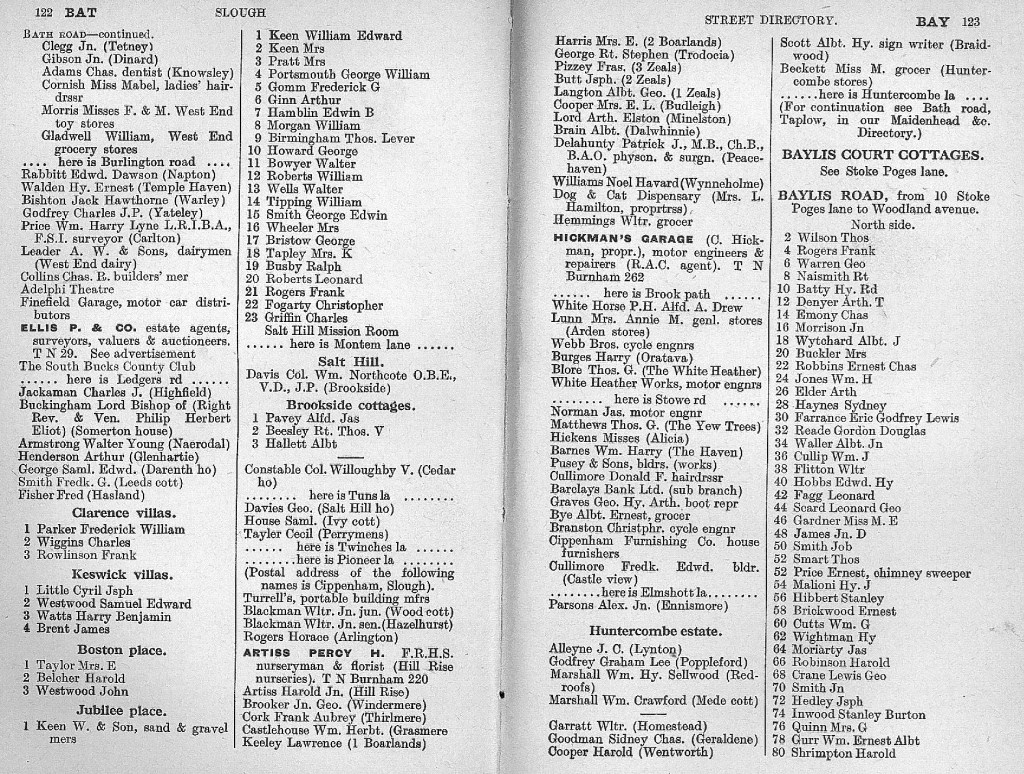
(Section from the Kelly’s Directory to Slough, 1932 edition)

Telephone directories, including Yellow Pages, are also available. They get bigger as more people get telephones.

Online collections

Some trade directories can be found on Ancestry and Find My Past. Ancestry also took part in a project to digitise British Phone Books from 1880-1984, however the indexing is very poor. Often it is worth searching for a common name and then scrolling through pages until you reach the appropriate page.

Back in 2002, the University of Leicester digitised over 600 English and Welsh directories in a searchable format. There is at least one directory for every English and Welsh county for the 1850s, 1890s and 1910s. The current version can be accessed: http://specialcollections.le.ac.uk/digital/collection/p16445coll4

The background pages and online bibliography are good starting points for general contextual information. The collection has been added to Ancestry and family historians may find this version easier to search. For further guidance on using the website, watch the video below:

The National Library of Scotland has digitised over 700 directories dating from 1773 to 1911. Again the background pages are a very useful starting point. The collection is available here: https://digital.nls.uk/directories/

Preservation and storage

Trade directories are books, so preservation and storage should be the same as other books. Some have maps folded in the back or other extras which may need extra care or storing separately. They can be very thick so that can cause problem with the spine.

Directories can be valuable, collectable and irreplaceable so may need extra security. Early examples from the 18th and early 19th centuries should not be on open shelves.

Physical arrangement and cataloguing

Trade Directories can be stored on the bookshelves of Local Studies collections, although as mentioned they can be valuable, so some choose to have them in locked cabinets or on demand.

Most directories can be added to library catalogues along with other books.

Innovative projects

Dig Lich Street was the public engagement of an archaeological project in Worcester. The road by the cathedral was being altered to allow the creation of a new public square, and a roadabout was being removed. Excavations took place on the roundabout in advance of the new road being built over it, and the old Lich Street was uncovered. Directories were really important in enabling the story of site to be told, alongside the archaeology. The history of each property, whose foundations and cellars were uncovered, could be told. Directories provided names of occupiers, and occupations, over many years. Although around 1905 the numbering system changed which caused a bit of confusion to the project team until this was realised!

Got something to add?

Do you have any comments, suggestions or updates for this page? Add a comment below or contact us. This toolkit is only as good as you make it.
Return to Toolkit homepage

Toolkit: Copyright

Return to Toolkit homepage

Intellectual property

Local studies librarians must be aware of the implications of copyright and other intellectual property rights relating to the material held in local studies collections.

Intellectual property rights include trademarks, patents and copyright. In practice, it is usually copyright that has the most impact on local studies materials and it is important for local studies staff to have a sound understanding of copyright in order to be able to manage the use of materials and the supply of copies.

Copyright

The principle behind copyright legislation is to protect works of the mind for a certain period of time. During the time that these works are protected, only the copyright owner has the exclusive right to copy the work, distribute it to the public, rent or lend it to the public, broadcast it or send it via electronic transmission.

The aim of copyright legislation is to balance the moral and economic rights of creators of intellectual works with the needs of users to access and copy material. The guiding principle is that the legitimate rights of copyright owners should not be unduly prejudiced by works being copied in whole or in part without their permission.

What does copyright cover?

The Government website has a simple guide to what’s covered by copyright.

For something to be protected by copyright, it has to be original and must be fixed in some way, e.g. by being written down or recorded. An idea in itself is not protected by copyright.

Copyright is an automatic right so there is no formal registration process.

How long does copyright last?

The main legislation governing copyright in England & Wales is the Copyright, Designs and Patents Act 1988 (as amended).

Copyright always expires at midnight on 31st December in any given year.

A work may have multiple copyrights that each expire at different times. For example, the rights holders of a published book may include the author(s) of the words, the artist(s) who created the illustrations, and the photographer(s) of any images. In addition, the publisher also has copyright in the typographical layout of the book.

Standard copyright terms are:

  • Literary, Artistic and Dramatic works are in copyright for the lifetime of the author, plus 70 years after the author’s death
  • Typographical arrangement is in copyright for 25 years from the end of the year of publication
  • Sound recordings are in copyright for 50 years from creation (or when first released to the public if within 50 years of creation). Note that this relates to the recording only, not the work itself which may have its own separate copyright.

There are a number of exceptions to these standard terms, particularly for works created before 1957, or between 1957 and 1969, or works that were unpublished by 1st August 1989.

The duration of copyright in these cases depends on whether the name of the creator is known, when the work was first made available to the public, and when the creator died in relation to when the work was published.

Many works, including some that are more than 100 years old, are in copyright until 31st December 2039 because they were unpublished by 1989. Prior to the 1988 Act, unpublished works were in perpetual copyright. When published, they then received copyright protection for 50 years from publication date. The 1988 Act stated that any unpublished works were deemed published on 1st August 1989 (the date the Act came into force) meaning that copyright will expire after 31st December 2039.

Many documents that are held by local history libraries and archives were unpublished by 1989 and are therefore in copyright until 2039.

The National Archives has produced a really useful copyright flow chart that enables you to work out whether or not copyright in a particular work is likely to have expired.

The duration of copyright in a work is not affected by who owns the copyright (e.g. the right could be owned by an employer rather than an individual employee).

Who owns the copyright?

The first copyright owner would normally be the person who created the work, unless it was created by an employee during the course of their employment, in which case the employer will own the copyright.

For photographs taken between 1st July 1912 and 31st July 1989, the first copyright owner was the person who owned the negative at the time the picture was taken.

The present copyright owner may be a direct descendant of the first copyright owner but copyright may also have been assigned to a third party or have been bequeathed to someone in a will. It could also be gifted or sold by the originator and local studies collections should normally seek to be gifted the copyright if they accept a donation of non-published material. If the copyright is owned by a company and the company has been dissolved, then copyright may be bona vacantia unless separate provision has been made.

Tracing the present copyright owner may be very difficult – see the section “If a copyright owner can’t be found”.

The National Archives guide to copyright includes more details of the first owners of copyright as well as information on Crown Copyright.

When is copying permitted?

If you want to copy something and you are not the copyright owner, you first need to establish whether it’s still in copyright and, if so, whether copying the amount you want for the purpose you intend falls within an existing copyright exception.

The National Archives has a really useful copyright flow chart that should enable you to check whether or not something is in copyright.

If it is in copyright, and there is no Creative Commons licence or other permission already assigned to it, then you either need to:

  • ask the copyright owner for permission to use it (which may involve paying a licence fee)
  • check whether the copying you want to do falls within an existing exception to copyright (this includes limited copying for ‘fair dealing’ for non-commercial research or private study, as well as copying for teaching). Librarians and archivists in some institutions also have additional permissions to make copies for particular purposes under the ‘library regulations’ or ‘library privilege’ (SI 1989:1212).

Libraries and other cultural heritage institutions also have permission under Orphan Works legislation. The Government’s guide to their replacement to the EU’s Orphan Works directive can be found here: https://www.gov.uk/guidance/copyright-orphan-works. The scheme allows a diligent search which finds no know copyright owner of an item to be checked and registered by the Intellectual Property Office and the fees for non-commercial applications are modest, but some have questioned how much use registering a diligent search would be.

Guidance on the changes to copyright exceptions in 2014 for particular types of users (e.g. researchers, teachers, librarians and archivists) is at:
https://www.gov.uk/government/publications/changes-to-copyright-law

The Copyright Licensing Agency offers licences to copy that are tailored for businesses, charities, educational institutions, and public sector organisations.

LACA and CILIP have produced free posters for libraries to display near self-service copiers to explain what copying may be permitted.

Infringing copies

If you copy something that is in copyright without permission from the rights owner, and it’s not covered by a copyright exception or licence, then it is an infringing copy and you are at risk of potential legal action.

The Intellectual Property Office has a list of offences and potential punishments for infringement of intellectual property law, including copyright.

Photographs and other artistic works

In practice, it’s usually images that cause the most difficulties as these are often the items that people most want to copy and reuse.

Artistic works were not included in the fair dealing provisions of the original 1988 Act, but were included in regulations that came into force in October 2014.

It would be unwise to assume that images on the internet have been lawfully copied and are automatically available for reuse. There is a cautionary tale from a blogger who had thought that the widespread reuse of images online meant that there was no problem in using images from other sites on her blog provided that credit was given and images were taken down promptly if requested. This proved not to be the case.

DACS (the Design and Artists Copyright Society) has a section of their advice portal relating to exemptions for the reuse of artistic works: https://www.dacs.org.uk/advice/articles/copyright-infringement/permitted-uses.

If the copyright owner can’t be found

If it’s known that something is in copyright but the current copyright owner isn’t known or can’t be found, then the work is deemed to be an “orphan work.”

Copying an orphan work without the permission of the rights holder would be a copyright infringement (unless covered by an existing exemption). However, the Copyright and Rights in Performances (Licensing of Orphan Works) Regulations 2014 introduced a UK government licensing scheme that enables orphan works to be used without permission from the rights holder, provided that a diligent search is carried out and a licence is issued by the government.

Further information on the scheme is at: https://www.gov.uk/government/collections/orphan-works-guidance

Assessing copyright risk

The National Library of Scotland and the National Library of Wales have developed and adopted a Copyright Assessment Framework for Libraries. This is designed to be a practical tool to assist in assessing copyright risk and making decisions relating to the copying of literary, dramatic and artistic works. It does not cover sound recordings, films, broadcasts or database rights.

It is likely to be of particular use for libraries and collecting organisations undertaking mass digitisation projects.

Further details are available by emailing the National Library of Scotland – copyright@nls.uk

Right of access charge

Libraries may levy a fee for use of material from library stock by authors, publishers, broadcasters, compilers of educational packages and other commercial interests.

This should be regarded as a ‘right of access’ fee and should not be confused with copyright payments. It would be advisable for the wording of any acknowledgement to be “images courtesy of x library” rather than any wording that suggests the library holds the copyright if it does not do so.

‘Right of access’ may not be granted in this way to items still held in unexpired copyright by external agencies or individuals, unless the library has written permission from the copyright holder. Some libraries also derive income from copyright fees for media use of material from library staff as part of local surveys, and other items for which the library holds full copyright.

Further Reading

Got something to add?

Do you have any comments, suggestions or updates for this page? Add a comment below or contact us. This toolkit is only as good as you make it.
Return to Toolkit homepage

e

Event: Heritage Interpretation Workshop

Next Tuesday, University of Leicester Special Collections are running a free, public webinar looking at key ideas for interpreting and exhibiting archives.

Dr Peter Lester (School of Museum Studies) will lead a workshop looking at different types of exhibitions and a selection of interpretation techniques, as well as some thoughts around writing effective exhibition labels. The workshop will use examples of online exhibitions from archives and museums around the world, with the aim of inspiring you to start exploring these exciting resources. For participants planning and working on interpretation, the workshop will also help you to start thinking creatively about designing exhibitions. There will be opportunities to ask questions and to share your own examples of exhibitions you have visited.

Details

Heritage Interpretation Workshop

Tuesday 14 July 2020

10:30 – 12:00 BST

Sign-up via Eventbrite.