In this guest post, Roger Penny looks back at his work in The Postcard Museum, Holmfirth, West Yorkshire.
After seven years as a Librarian with the County of Avon, I joined Kirklees Cultural Services in November 1988 in the new post of Community Officer. This post had responsibility for managing the Library, Postcard Museum and Civic Hall in the Pennine town of Holmfirth, home of the popular TV Series Last of the Summer Wine and of Bamforth & Co. Founded in 1870, Bamforth & Co became best known for their ‘saucy’ seaside postcards through to the 1980s. They were also one of the first companies to make silent films as well as magic lantern slides and sentimental postcards. The Postcard Museum had opened several years earlier after being planned and displayed by the Museum Service working closely with Jane Helliwell, Kirklees Local Studies Librarian. With a museum shop on the ground floor, the first floor gallery featured displays of magic lantern slides and a selection of sentimental and comic postcards by Bamforth & Co. On the second floor there was a seated area where visitors could watch early silent films by Bamforth & Co.
Visitors to The Postcard Museum came mainly by coach on Summer Wine pilgrimages from across the Pennines. People living in Holmfirth seemed to have lost interest in the Postcard Museum. After one visit there was little reason to come for a second look unless you were a Bamforth & Co enthusiast. One of my agreed goals was to encourage people to come again through putting together a series of temporary exhibitions of postcards, enhancing their experience when watching the silent films, and organising events. Over the next three years, we put on a series of temporary exhibitions of postcards in display cases on the landings before you entered the first and second floor galleries. Keep Smiling: Picture Postcards of World War 11 was the first temporary exhibition, followed by Fancy Ladies: Picture Postcards of Society Women on the Edwardian Stage by Bamforth & Co. I was fortunate to receive the continuing support of Jane Helliwell, who looked after and maintained the collection of Bamforth & Co postcards.
For Keep Smiling I wrote an exhibition brief that identified my target audience and marketing strategy, the steps in sourcing and displaying the objects to be included in the exhibition, and the budget. The postcards seemed to fall into three categories: The Home Front, Patriotism and Propaganda, and Humour. There were also photographs of the artists Douglas Tempest and Arnold Taylor. I had already been given leave to write my own press releases and was very encouraged by the level of interest shown by the Huddersfield Examiner and Radio Leeds. I was blown away when I was invited by BBC Look North to do a television interview in the museum about the Fancy Ladies exhibition, which was broadcast after the early evening news. To launch Keep Smiling, we held a 1940s evening with the staff serving a homemade supper to everyone who came, using authentic wartime recipes. A local community theatre company set the scene and led a sing-along.
After having gained some prior experience of working with video, my interest was aroused when I heard tell of a pianist accompanying the showing of silent films at a film festival in Leeds. He readily agreed to be recorded playing along to the Bamforth & Co silent films in the museum. I was fortunate to secure additional funding to pay the Production House in York to produce a new series of videos with dubbed piano soundtrack, which encouraged visitors to the Postcard Museum to extend their visits and watch the films. I undertook a second silent film project after the retired company secretary at Bamforth & Co handed me several reels of nitrate film that he’d been keeping in an old tool box in his garage. After having them collected by the National Film Archive, I eventually received back videos of lost Bamforth & Co films, including a procession by trades unions and churches through the streets of Holmfirth around the end of the Great War. A silent film evening was held to show the new films to local people and invite their comments as to the significance of the procession, which had culminated in a gathering in the local park.
One last area in which I made a particular contribution to the Postcard Museum was in respect of the museum shop. This had tended to sell confectionary and some Bamforth & Co postcards still in print to generate income and help balance the budget. After approaching the Managing Director of Dennis’s of Scarborough (the company that had bought Bamforth & Co in the 1980s), he agreed to reprint two sets of historic comic cards from Kirklees collection so they could be sold through the museum shop. I had the fun task of choosing the twelve cards, which became best sellers in the shop. Another commercial project was undertaken with the help of the Holmfirth Choral Society which recorded a music cassette for sale in the museum shop, featuring some of the songs featured on Bamforth & Co’s sentimental postcards.
Roger Penny was Community Officer for Holmfirth, and subsequently Marsden as well, from 1988 until 1993. He was Hon Publications Officer of the Association of Assistant Librarians and President of the AAL in 1990.
Readers may be interested in the following event in Manchester.
Celebrate the launch of Arthur der Weduwen and Andrew Pettegree’s new book The Library: A Fragile History, under The Portico Library’s famous dome.
“Featuring the Portico Library, The Library: A Fragile History is the first major history of its kind, exploring the contested and dramatic history of the library, from the famous collections to the embattled public resources we cherish today.”
Event Details
Day: Wednesday, 10 November, 2021
Time: 6:30 PM – 8:00 PM
Venue: The Portico Library, 57 Mosley Street, Manchester, M2 3HY
The bulk of local studies and archive holdings have so far been received in traditional formats, such as paper, parchment and photographic material, and this may well continue indefinitely. However, an increasing quantity of decisions and transactions are now being recorded in electronic format thus creating digital records to transfer to Local Studies and Archive collections. In addition to these so-called ‘born digital’ records are digital copies of hard copy originals, but these are being created as facsimiles to enhance access and should not be seen as a substitute for maintaining the original.
The challenges of digital preservation centre on how best to preserve not only the information itself long-term, but also its associated evidential value, without which it is not necessarily worth preserving. Challenges include: the rapid obsolescence of hardware, software and storage media.
Services should seek to create a digital preservation strategy to address both short-term and long-term solutions to these challenges.
Examples of digital material and their sources
Transfers from your own local authority departments mainly relate to archives and records management, for example, databases in a variety of formats, CAD drawings, Microsoft Office documents, spreadsheets, e-mails and so on. Some of these records will be held in other software packages such Sharepoint; some on network drives. Neither Sharepoint nor network drives are suitable for long-term storage of electronic archives (i.e. records selected for permanent preservation), due to limitations on space, obsolescence of software formats, and problems caused by staff accessing out-dated information.
Acquisitions from many and varied external sources, including other local authorities, official organisations, groups and individuals, can include: e.g. digital photographs, millennium scrapbooks, e-publications and so on.
Records created in-house as accessible surrogates for use in and beyond the local studies library for example the TIFF and JPEG digital photographs created as part of projects.
Audio-visual material kept in digital form, such as cinefilm or sound recordings which have been transferred to DVD or CD.
Preservation of electronic records
Short term strategies
Some of the fundamental challenges for Local Studies collections and Archives include:
Preserving not only raw data – the ‘bits’ – but also the contextual information (metadata) vital to their interpretation.
Preventing tampering or distortion (whether deliberate or accidental), in order to give evidential value to the electronic data, which will act as the modern equivalent of the seal or the signature on a hard-copy record.
Inability to access material, whether through media failure, lack of compatible hardware or lack of compatible software, especially for complex specialist software such as CAD drawings etc.
Ideally a digital preservation system should be considered. Without this there is no guarantee that records once received by the Local Studies collection or Archive will have the necessary audit trail of access and usage required for legal admissibility and historical authenticity.
In the absence of a reputable digital preservation system an interim policy might be to copy records from portable storage media onto the relevant dedicated read-only drive where they can be backed up by the corporate back-up system, but this is purely a short-term solution as it will not tackle the evidential value issues mentioned above. However, this does not address the needs of more complex digital records such as databases or websites.
The portable media on which the records were received should be kept short-term to give access to them for the public, but they will not be able to be kept permanently in that format due to obsolescence of hardware and software.
For digital records created by the local studies library gold-quality DVDs should be used and stored in optimal temperature and humidity conditions, (18-22 degrees centigrade, 35-45% RH), but again this cannot guarantee longevity beyond 25 years.
Longer term strategies
Investment is required by a parent authority or usually an archive service in a digital preservation system which can manage the complex needs of digital records and ensure their integrity and authenticity over time. The system needs to comply with the ISO standard Open Archives Information System (OAIS) model for the acquisition and storage of digital records and to facilitate public access to electronic archives via the internet. Such a system will ensure that when records are received into the system (ingest) metadata is captured to help with their long-term interpretation, and that once ingested the records can be monitored to ensure they have not been damaged or tampered with. Public inquiries such as the Hillsborough disaster inquiry show how important such transparency and reliability of record-keeping is. The system will also flag up when record formats are becoming obsolete and suggest pathways for onwards migration.
There are various solutions now available on the market which could fulfil these requirements. Most also have a secure public front end. This is important for public access and it means that the public do not need to have access to your organisation’s internal systems to access relevant information. For local studies libraries it is worth considering whether your archive service or parent authority has invested in a digital preservation system and if so, how might you be able to contribute to the content?
Recommended formats
For images, it is recommended to use TIFFs (for master copies) and JPEGs (for access copies). For audio files it is recommended to use WAV files (for master copies) and MP3 or MP4 (for access.)
For other documents, Microsoft formats are recommended at present, as this is usually a preferred supplier, but this should be discussed with relevant ICT teams. Therefore, any upgrade or change could be managed as part of work on other organisational files.
Adobe Acrobat files can be read by many systems, too, and this format may be useful for preserving e-publications.
Examples of formats which are unsuitable for long-term preservation are proprietary software, e.g. family history programs. This is because the information value doesn’t warrant the expenditure required to monitor and migrate a large number of very specific programs for which only a limited number of examples may be held. The results could be rendered in an alternative format, for example Adobe, if necessary.
Disaster Recovery
In the short-term it is the responsibility of your organisation’s information management team to ensure that electronic records held in the Local Studies and Archive service’s network storage folders can be restored from back-ups where needed, and to use systems to make sure there is more than one copy of every record. In the long-term a future digital preservation system may exist off-premise (e.g. in Cloud storage) and it will be the responsibility of the supplier to ensure that there are adequate disaster recovery procedures.
Preservation of records held elsewhere
Local Studies libraries should encourage good practice and provide advice to owners of digital archives on the care of their digital records. If you do have access to a digital preservation system it is always worthwhile enquiring if owners of large digital records could consider contributing to the costs.
Traditionally a mainstay of local studies and family history society projects, indexes and transcriptions give us access to high quality and obscure information contained in valuable sources. Current digitisation projects build on these techniques to make digitised material more searchable.
Collection and retention:
Local Studies Collections should collect and retain high-quality indexes and transcriptions relating to material held within their collection area. These include:
Newspaper indexes and cuttings files – often created by local studies staff and contain high quality information not easily found anywhere else, but the decline in local print media and a lack of time and resources may make these difficult to keep updated.
Parish registers – often undertaken by local history societies and volunteers, these include the names, dates and other details found in registers of baptisms, marriages and burials.
Monumental inscriptions – often undertaken by churches.
Census transcripts – some of the first transcriptions were undertaken by local history societies and these are often of a higher quality than later versions found on genealogy websites like Ancestry.
Microfiche copies of the IGI (International Genealogical Index) – Although largely superseded by Familysearch, the IGI is still a high-quality though selective index to parish records.
Many index creators have digitised their work and local studies staff should also consider doing so. One service which has done so for many years is Hertfordshire Archives & Local Studies, who started by digitising their parish record indexes and then asked volunteers to create new name indexes from other records in their collection. Users from all over the world can now use their Hertfordshire Names Online database to order copies of records and newspaper articles.
Why create indexes and transcription in the digital age?
Computers cannot be relied on to interpret digital copies of text… yet. OCR software can often create excellent transcriptions of books and pamphlets. Free software, such as that provided by Google and other providers can do a good job of interpreting newer material, though pay-for programmes, such as ABBYY FineReader, produce better quality results.
OCR software has not yet mastered older typefaces, including some newsprint, nor most handwritten material, so the services of volunteers or external suppliers are still of value. As those who have struggled with family history resources know, the quality of an online resources is only as good as the information that gets placed into it, so large amounts of data checking is often required to ensure a good result.
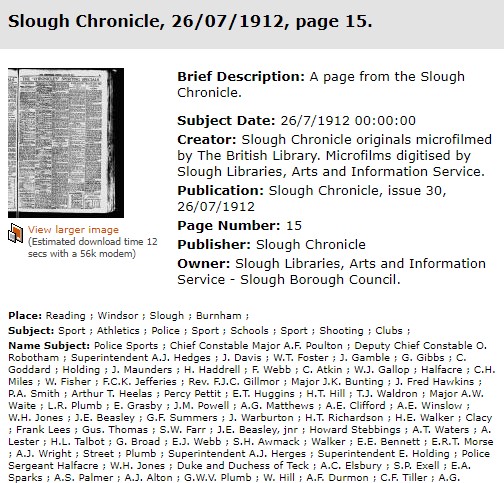
Libraries and archives traditionally invite readers into their libraries to transcribe material, however once material has been digitised volunteers can volunteer from the comfort of their own home. The great advantage is that much more work can take place, for example, virtually all the main newspaper pages from Slough History Online were indexed by one volunteer. However, the amount of work produced by such enthusiastic volunteers can be a challenge for smaller units.
Archive projects, such as AnnoTate have used crowdsourcing as a way of transcribing large amounts of archive material:
Online activities can be an accessible and practical way of promoting services and collections to new audiences, particularly those who are unable to attend in-person events due to other commitments or accessibility issues.
This has particularly been the case since March 2020: “The digital switch happened quickly when lockdowns were first introduced. Libraries were able to offer their users alternatives to physical [services] and many people made use of these digital services in ways they had not done before.” (‘Service Recovery Hub – stay on top of the latest developments,’ Information Professional, April-May 2021, p.31)
While online activities have been the default method of delivery during the COVID-19 pandemic, they will likely remain a useful tool in the arsenal of all librarians going forward.
Online local studies events have proved particularly popular since March 2020, perhaps because audiences spending more time at home have been looking at community and individual identities with fresh eyes, (re)discovering a passion for heritage and family history.
Although it is tempting to simply think of online events as a straightforward recreation of an in-person event, there are several factors that have to be taken into account, many unique to online activities. These can be framed in three overlapping categories: planning, delivery and evaluation.
Planning
Identifying the best platforms to use
Librarians can face several barriers to setting-up online events: uncertainty around platforms – which to use and how to use them; whether there is an audience that will (a) find and be interested in the events being set-up and (b) understand the technology needed to access those activities. Much more so than traditional in-person events, online activities can involve many ‘unknown unknowns’ – at least initially.
Support can be found, whether internally – from colleagues in other areas of your service – or externally: e.g. online guides to choosing the best platform, or social media conversations and mailing lists, both of which can be used to identify the platforms external colleagues have found most librarian and user-friendly.
Which platform will you choose? Zoom was the early leader, but Microsoft Teams is often free at the point of use for local authorities so is the preferred option. YouTube and Twitch are also available.
Test the available platforms for yourself before deciding – become familiar with the systems for admitting users, turning on/off user cameras and sound, removing attendees from the session in cases of disruptive behaviour.
Content
Online activities can range from lectures to interactive workshops, but most often follow the classic format of a speaker delivering a talk to a listening audience.
You may discover that some events are more difficult and challenging for online platforms – e.g. workshops with interactive elements. Keeping it simple is key: it is much harder to intervene and correct an event that is going wrong online than it is in person. Communication with audiences is much harder as the usual visual cues are more difficult to read – e.g. body-language – and it can be more difficult to speak to audience members with particular issues privately on a 1-1 basis.
Tips for hosting such sessions successfully would include ensuring more than one member of staff is present – attendees who are struggling with the material, or who are being ‘disruptive’ (whether intentionally or not) can be spoken to privately by one librarian, while the other continues to lead the session. Most platforms for hosting online events will have an equivalent of Zoom’s ‘break out room’: a discrete digital space where a customer (or customers) can be placed with a host to discuss any problems that have arisen.
Many considerations for choosing the topic of online activities are the same as those for in-person events – e.g. an exploration of library collections from a staff member, or a talk by a local historian. Tying talks to anniversaries and significant local, national and international events – including awareness days/weeks/months – can be a useful way of populating a calendar and will help generate publicity and engagement. Some tie-in events could prove controversial, however, with particular implications for online activities (see the delivery section below).
Bear in mind that online events can potentially help library services to reach audiences who would not normally use local studies resources and can aid wider organisation aims around diversity and representation – it’s worth casting your net wider for online event content than you may for in-person ones; you may find a new audience easier to reach with the former than the latter.
Many attendees at online events since March 2020 are local and family history afficionados who are no longer based in the region (or even the UK at all), and so unable to attend in-person events. Many local history librarians will find they are hosting events for audience members from as far afield as Australia and the USA.
Of particular importance for online events is finding speakers who are not only comfortable talking in front of an audience, but who are familiar with and happy to use the necessary technologies – while this is perhaps less of an issue in a post-March 2020 world, it is still a consideration to take into account.
Events may increasingly be delivered in-person and online simultaneously, even now that COVID-19 restrictions have been lifted. Not all attendees or potential attendees are yet comfortable attending in-person events – a situation likely to persist for some time to come. Getting technical advice and support from colleagues, social media, mailing lists or user guides on how to do this effectively will be key.
Marketing
Organisations may require all librarians across the service to use one account for running online events (i.e. including non-local studies ones); coordination is therefore required to ensure platforms are not double-booked before any marketing is started.
The usual publicity channels for in-person events – mailing lists, printed and digital programmes of organisation events, social media, blogs and posters – remain relevant for online events.
It is advisable to make entry to online events available through booking a ticket: unlike in-person events, where attendees can sometimes (though not always) make a casual decision to attend on the day, that is less useful for online events in which a login code often needs to be sent to attendees in advance of the session.
Online methods of booking tickets include Eventbrite and Ticketsource – your organisation may have a preference for which platform you use.
You will have to, however, ensure there is a process for those attendees who are unable to book online themselves, but who still wish to attend (or are purchasing tickets on behalf of someone else): an alternative contact method should be provided – an email address and, crucially, a telephone number to a department where staff can book tickets on behalf of customers.
Administration
Once an event has been successfully booked and tickets have been sold, it is usually necessary to send login details to attendees ahead of the allocated start date and time. This often consists of a link to the session itself, and a password or code to grant entry, usually sent in an email.
Each platform differs, however, and some offer different methods of online delivery even within the same package: e.g. the difference in Zoom between meetings (where an access password is required) and webinars (where only a link to the session is needed – access is automatically granted when an attendee clicks the webinar link).
Sending access details to attendees is also a good time to remind customers of the likely set-up in your event – are cameras disabled on entry? Is attendee sound muted? How do attendees ask questions? If you’re intending to record the event, it might also be necessary to send attendees a statement relating to their GDPR rights – your organisational GDPR officers will be able to advise.
Some external speakers may not be familiar with the platforms you are using, and may benefit from a pre-event run through of what is likely to happen on the day – the order actions will happen in, how to share screens, confirming that monitoring questions and chat boxes will be the host’s responsibility, and so on.
Delivery
Hosting events
The host is a key role when delivering online events; this is likely to be a librarian when an external speaker is present. If a staff member is the speaker, it is a good idea to have a colleague present who can handle hosting and administrative duties; it can be difficult to manage speaking and administration simultaneously. In any case, your organisational safeguarding guidelines may stipulate that two staff members have to be present when delivering online events, particularly if they are not being recorded.
Hosting duties usually involve admitting ticketholders from a waiting room (where relevant), followed by a general introduction to the event, the speaker and then any housekeeping – including brief information for attendees about video and sound being on/off and signposting to how and where customers can ask questions (e.g. by text in the platform chat box at any time or orally at designated periods if sound is muted by default).
It can be helpful to pre-write a script for a host’s introduction, and to have that on your screen alongside the platform window (or printed) – improvising in the moment is rarely a good idea!
During the actual event, the host’s duties generally involve monitoring comments and questions in the chat box, which can include technological queries – some of which may need subtly relaying to the speaker, e.g. volume too low. Agree a method of communicating with the speaker beforehand – e.g. by text message, or verbally interrupting the event.
At the end of the event the host will usually thank the speaker and field questions on their behalf – by, for example, reading questions or comments from the chat box. Online events can occasionally include difficult or controversial questions or comments from attendees – the host can pre-filter these if they are relaying to the speaker. Obvious trolling can be more easily ignored (unlike in-person events).
Your organisations should have training or advice available to help staff deal with particularly difficult online situations, e.g. ‘Zoom-bombing’ (defined by Wikipedia as “the unwanted, disruptive intrusion, generally by Internet trolls, into a video-conference call”) – such situations can be traumatic; another reason to have several staff members present at events, where possible.
Delivering events
Many librarians will already be familiar with delivering live events to audiences; online events do not differ hugely from in-person events in terms of the actual delivery. Some general advice, however, would be to undertake plenty of practice on the platform you’ll be using before the event takes place: know how all the icons and tools work, and exactly how they integrate with your preferred delivery method (e.g. slide show, video, etc).
Test sound and video several times before the event is live. A good host should ensure you have to do the bare minimum of administrative work when delivering an event – but it pays dividends to have a good awareness of how to resolve any issues that may arise.
Even more so than in-person events, audience attention may waver during online activities – keep the content flowing from section to section, with plenty of visuals and a mixture of sincerity and humour.
Recording events
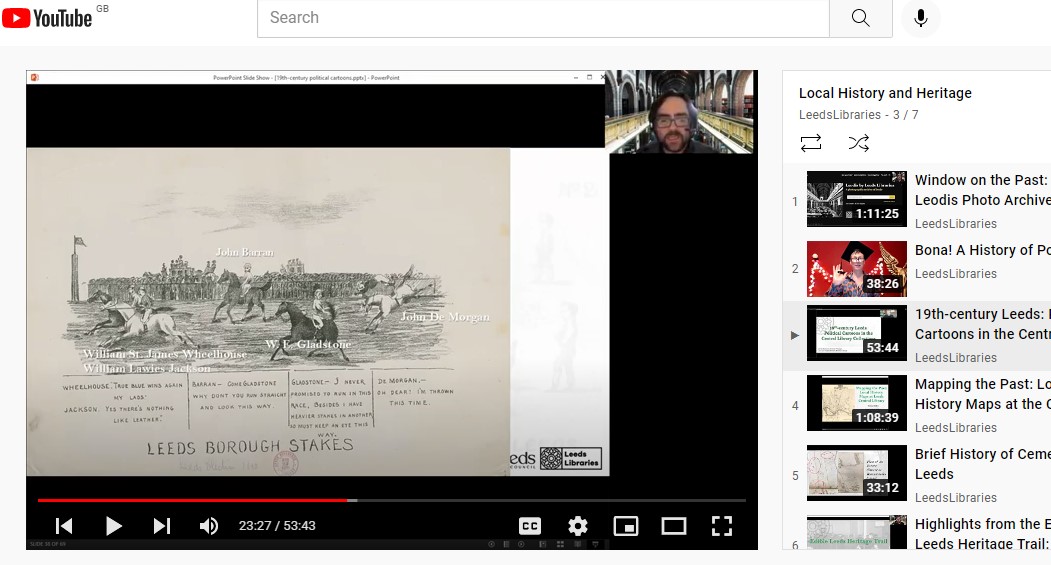
Recording events is a great way of ensuring as wide an audience as possible can engage with the content at a time of their choosing. Copies of the recording can be sent to everyone who initially booked a ticket, including those who were not able to attend. Recordings of some events – e.g. talks – might be suitable for uploading to a video-sharing website, e.g. YouTube.
Uploaded talks can be made available for as long as you or your organisation wants them to be – a way of ensuring the permanent (or, at least, long-term) preservation of the research and material covered in the talk or event. Check if your organisation has an institutional preference for which hosting site is used (if any).
If you are recording any online events you may need to read a GDPR statement to attendees before beginning, making them aware the recording is happening and of their right to remove themselves from the session if they do not wish to be captured during the recording (though most platforms only capture the speaker and attendees if they make a comment or other intervention). Delivering GDPR statements is generally the duty of the host during any introductory speech.
Accessibility
Online events will be attended by customers who are partially-sighted or hard of hearing: closed-captions can usually be added to events, or you can pre-emptively ask speakers to ensure they are providing good descriptions of any images they are showing.
Bear in mind the diverse needs of customers before setting up online events – consider whether an online event’s format means it will be inaccessible to some audience members – see YouTube’s guide to adding closed captions for more information: https://support.google.com/youtube/answer/2734796?hl=en#zippy=. Can some events be in-person instead, or a mixture of live-streaming and in-person?
Evaluation
Demonstrating the impact of online events uses the same primary metric as in-person events: how many attendees were present? It may be a good idea to send a survey to attendees afterwards, asking how many customers had attended online who had not previously attended in-person library events. Similarly, a comparison of in-person with online attendee figures may yield informative data about the intrinsic benefits of the latter.
A mixture of in-person and online events is perhaps the future for library services, though as yet largely untried. Additional technical support from relevant organisational departments may be required, at least on the first few instances.
Positives and negatives
Online activities allow your service to reach a much wider range of people than in-person events, where someone’s attendance can be limited by physical proximity, accessibility needs, etc.
Online events can remove some of those barriers – but be aware that they can add others, most especially barriers for those who lack digital skills or access to technologies. Signposting to colleagues who deliver digital skills sessions may be useful in these situations.
Another disadvantage of online events compared to in-person is that it is harder to showcase relevant stock or resources at the event, and audiences who do not usually use your library building no longer have a reason to enter the space.
There is much less personal interaction, whether between patrons and patrons, or patrons and librarians – often further projects and activities are developed from conversations and encounters before and after physical events; something much less common, possibly non-existent, at online activities.
Nevertheless, online events have come of age since March 2020 and are clearly here to stay – they are now, and will remain, a key tool in the modern local studies librarian’s toolkit.
Got something to add?
Do you have any comments, suggestions or updates for this page? Add a comment below or contact us. This toolkit is only as good as you make it.
We are pleased to announce that nominations are now open for the Alan Ball Awards for local history publication of the year. The criteria and categories have slightly changed this year in order to be as inclusive as possible. We have also increased the date range under consideration due to the impact of lockdown.
The award, which is organised by the Local Studies Group of CILIP on behalf of the Library Services Trust, is open to all heritage and community organisations, and individuals that have self-published. Our criteria for assessing the award is not just about the quality and content of a publication, but its whole journey i.e. how it was conceived, who is involved and how it was funded. Therefore we especially welcome submissions from: libraries, archives, museum and archaeology services; small local museums and heritage centres; Local History societies; community history projects; local authors.
We have three categories:
Print publication – for best hardcopy publication
E-publication – for best digital publication (e-books, journals, websites or virtual exhibitions, blogs and apps. Please note: we are unable to include digital installations within heritage or museum sites)
Community Award – for best community publication in either category.
The publication needs to have appeared between July 2019 and December 2021.
Nominations, including a copy of the publication or link to e-content, should be submitted by January 2022.
Further details and application forms are at the bottom of this page.
Many older members of the Local Studies Group will be sad to hear that Morris Garratt died on 5th September at the age of 84. He was a founder member of the North West Branch of LSG and served on the committee until it was wound up a few years ago. His unfailing good nature and extensive knowledge of the history of the area was a great support to the group. He was Local Studies Librarian in Middleton, a district of Rochdale MBC, until retirement.
He was born in Warrington and arrived in Middleton with limited knowledge of its history – so every weekend he took home a bound volume of the local newspaper to read through and get a sense of the area. A sign of his conscientiousness and commitment – and of the more relaxed attitudes of a previous era! After retirement he was active in many local history societies in the north west and, until recent years, seemed to have endless energy to study and promote local history. Many people involved in these societies remember his welcoming attitude and his books and articles in many journals will benefit local historians of the future.
Wiltshire & Swindon History Centre have kindly shared a new case study with us. It will be of interest to anyone working with volunteers remotely and/or with online resources, particularly maps.
In 2020-21 a group of 4 volunteers worked from home during the lockdowns to pinpoint a collection of historic postcards to the Know Your Place historic maps website. By the end of the project, 324 historic postcards were geotagged to their relevant locations and added to the online maps. The work is a double first for Wiltshire Council’s History Centre – the first of its photographic collections to be added to the Wiltshire section of the Know Your Place (KYP) website and its first volunteer project to be completed remotely and online.
You can read the full report below. Thank you to Max Parkin (Archivist) and Julie Davis (County Local Studies Librarian) for sharing their work with CILIP LSG.
The Local Studies Group of CILIP are looking to recognise an outstanding local studies librarian.
The McCulla award is usually given for a recent major project, or as a lifetime award for someone near the end of their career. It comes with a prize of £200. Re-submissions from previous years are very welcome.
The prize is in memory of Dorothy McCulla who was the Head of the Local Studies Department at Birmingham Central Library, a post she held from 1969 until her untimely death in 1981.
We welcome nominations from colleagues, local historians, family historians and anyone who knows a local studies professional who has made a difference.
To nominate, please complete the form at the bottom of this page.
Any questions? Please contact Alice Lock via alicelocalstudies@outlook.com
This year nominations close on 31 October 2021. Nominations received after that would be considered for the next award.

 CILIP Local Studies Group