Posts

My all expenses paid trip to….Stoke-on-Trent!

Gosh, I hear you cry, why did you get an all expenses paid trip to the Potteries? Was it to judge the Staffs Oatcakes served at the museum? Was it to enjoy Virgin Train’s hope that you would not wash your “goldfish, hopes and dreams” down the toilet? Or was it the challenge to eating you pork pied lunch behind you laptop screen without the devout Muslims opposite seeing? No, none of that, it was to attend the last LSG Committee Meeting.

Hoping that you might be interested in hearing what I thought of the famous oatcakes at the end of this post, I thought I would fill in a bit of time by saying how interesting the session was. Top news includes the next copy of Local Studies Librarian will be landing on your door mat any time soon and will be followed after Easter with a version of the e-newsletter, Local Studies Librarian+.

The next conference is being planned for late 2017/early 2018, with LSG South’s Study day taking shape for the other spot, while as always, LSG NW is planning an amazing set of events, this time keep you diaries free for 14th June…..not to mention the amazing work being done by LOCSCOT. Work is also under way to review the old Local Studies Guidelines – lots more info to follow.

Of course, none of this amazing work could be done without those volunteers who do the work and, for the lucky ones, those whose employers allow them to attend the meetings in work time.

Does this sound just a little bit fun….. because it is! Do you want to give back to the profession? Play your part in helping to spread great ideas/best practice across the world of local studies ? Plus, you can always influence those doing most of the work at conferences to include speakers and projects that interest you. In part of the profession when you are often the sole local studies professional in your unit or even organisation, it is sometimes a life saver to have chance for a good gossip with great groups of heritage professionals from across the UK. As well as giving your view at a meeting or two, you’d be welcome to do a little more, such as writing blog posts, a bit of tweeting, helping to arrange speakers for conferences of venues for visits, or, if you like adding up a few rows of figures, help with the accounts. Plus, this type of work is excellent material for job interviews and chartership applications! You don’t even have to be a member of CILIP.

So have a tempted you a little? Can you tempt your employer to give you a couple of afternoons to go to meetings each year? Why not find out a little more, or even coming to a meeting to see what it is like? After all, your travel costs are reimbursed. If so, you have a number of options. LSG South helps with things in London, the South East and a little further afield and they generally meet in Woking – email Norma Crowe.  If you are north of the boarder you contact Nicola via nmcowmeadow@pkc.gov.uk, if you are west of the Pennines contact Alice Lock or if you fancy helping the national group, who normally meet in the Midlands, contact Alice Lock.

Ah, nearly forgot, the Oat Cakes….. sorry, I decided to take an earlier train home, but the other  Committee members thought they were excellent!
To microfilm, or not microfilm, that is the question

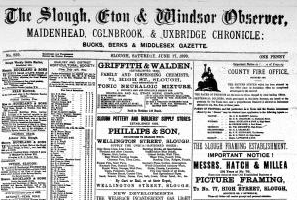
When the British Library closed its newspaper microfilming unit I huffed and I puffed whilst collecting together copies of all of our local newspapers. The puffing continued until I had sent them off to be microfilmed. I must admit that I was a bit happier when I discovered how much money we were saving!

sl-ol-slough_observer17061899083901-e-00-000
Image courtesy of http://www.SloughHistoryOnline.org.uk


5 or so year later things have moved on……

Access to old newspapers has got much easier as there is more and more material on some newspaper websites, including an ability to buy old photos from newspapers (including an embarrassing supply of photos of local studies librarians carrying our events in years gone by!) Our local newspaper sells its content to Newsbank so my local library gives access to post-2007 local newspaper via that platform.

The problem is that local studies guys should also ensure that these newspapers are available for researchers in hundreds of years, so microfilming still provides both access and preservation. However……

Costs of microfilming have gone up and library budgets have gone down…. plus the number of local studies guys to organise it has also gone down too.

Local newspapers have been hit by cuts as much as libraries. Newsrooms have shrunk, titles have dwindled and my local 50p per week newspaper is now delivered free and looks very similar to our old free newspapers. Though, I must say, that is not universally so.

It is still a right faff to ensure that every year you collect a complete set of newspapers with all the appropriate alternative editions, though, if you can persuade your local newspaper to give you pdfs of their old newspapers it should be, in theory, relatively easy to get microfilmed.

The new generation of microfilm readers/scanners which link into computers are really good and the quality of microfilming has come on leaps and bounds.

After all, do we need to worry about conservation and access? Are we in a position to rely on the BL to permanently conserve all of the key papers in our collection area and then make them available via one of their strategic partnerships?

So what are you doing and what do you think? I’m sure that local studies collections across the country would love to know the “right answer”. Please share your thoughts by putting a comment below and please help us to find out what is happening on the ground by filling in this three question survey. All contributions will be treated anonymously.

Fancy a #uklibchat about Local and Family History?

Gaby Koenig talks to the LSG Blog as UK Libchat turns it’s mind to local studies………

For those of you not familiar with #uklibchat it’s a monthly live chat held on twitter talking about library and information topics. People taking part will follow the hashtag #uklibchat at the set time (6.30pm UK time, mostly the first Tuesday of the month) and will be guided through questions they have helped set on a shared agenda published in advance. The chat leader is one of a small group of volunteers who facilitates questions and keeps things moving. This month is my turn!

libchat

We’ve covered a wide range of topics across all library sectors and this month we are turning to a topic requested by one of our participants – Penny Allen – Family History and we’ve also added in Local History to the discussion. We would like people who work in libraries, archives and other sources of family and local history to come and join and talk about the challenges and solutions of answering enquiries from people in this field.

If you would like to add questions to be discussed please do on our googledoc – anyone can add questions even without a google account Supporting Local and Family History Enquiries #uklibchat Agenda 6th December 2016

And if you can come and join in and discuss the topic, please do! The chat will be on Tuesday 6 December at 6.30pm.

E-Local History Publication of the Year Award – nominations close on Monday 31st October

Have you been part of a group that has produced an electronic local studies project? Was it funded by local government or the national lottery? Was is launched between January 2015 & June 2016.

If the answer is yes, nominate your project for the electronic category of the Alan Ball Awards.

Projects could include websites, apps, video, animation and some aspects of social media, such as blogs. We are interested in both the quality and usefulness of the content, and also how it engages the reader or user, especially new users.

Winners will be given a certificate and accorded the title of Alan Ball Award winner, which can be used on promotional material. Sadly, there is no trophy or cash prize, but as previous award winners will confirm, it is a prestigious award that is very meaningful within Local History community.

To nominate your web-based project, please complete the form below, but be quick, nominations close on Monday 31st October 2016:

← Back

Thank you for your response. ✨

Any questions? Please contact Terry Bracher via terry.bracher@wiltshire.gov.uk.

Nomination for the hard print prize also close on Monday 31st October. As with the e-prize, the project needs to have been funded by local government or the national lottery and had to be launched between January 2015 & June 2016.  To entre the hard print category, send a hard copy of your publication together with a paper entry form to: Terry Bracher (Chairman of CILIP LSG) c/o Wiltshire and Swindon History Centre, Cocklebury Road, Chippenham. SN15 3QN.

A look into Lancaster Libraries, 16/11/16

Join CILIP Local Studies Group NW to peer into three library collections at the University of Lancaster.

The Ruskin Library is the home of the Whitehouse Collection of Ruskin materials. The award-winning building was designed to house the collection and was opened in 1998.The collection is a fascinating mixture of pictures, books, manuscripts and photographs relating to the great Victorian writer and artist John Ruskin (1819-1900) who spent his later life at Brantwood, near Coniston.

Lancaster University Library is a stunning newly refurbished space designed with input from staff and students. Special collections range from the Jack Hylton collection through 1930s Cinema and Culture to the 2001 Foot and Mouth Archive.

11.00 A tour of the Ruskin Library with Diane Tyler and Rebecca Patterson

There will be a chance to look at the current exhibition which will be Gilded shadows: The stones of Ruskin’s Venice,  an exhibition of Ruskin’s drawings of Venice, with recent photographs by Sarah Quill

Lunch – there are numerous cafes on the Lancaster University campus

1.30 Special collections at Lancaster University Library

2.00 Tour of Lancaster University Library with Lynne Pickles

There is a regular bus service to the University from the train station. Detailed advice on travelling to the university can be found here –  –http://www.lancaster.ac.uk/contact-and-getting-here/maps-and-travel/

Map of campus at http://www.lancaster.ac.uk/media/lancaster-university/content-assets/documents/maps/campus-map.pdf which includes Ruskin Library and University Library

Please email Linda Clarke to book a place linda.clarke@cheshiresharedservices.gov.uk

Come and find out more about Local Studies Group

Do you fancy finding out more about what Local Studies Group is doing for you? Then come an join LSG for its annual meeting at Nottingham Central Library  on Thursday 20th October at 1pm. If you want to find out more but cannot make the meeting, contact our Chair, Terry Bracher, at terrybracher@wiltshire.gov.uk.

You can also join LSG South for its annual meeting at the Surrey History Centre on Wednesday 2nd November at 2pm. If you want to find out more but cannot make the meeting, contact our Vice Chair, Norma Crowe, at norma.crowe@medway.gov.uk.

Nominate your Local Studies Librarian of the Year – entries close this Friday

Do you know a Local Studies Librarian that has gone the extra mile? Have they pioneered an amazing project or given a career of excellent service to their community?

If you do, nominate them for the 2016 McCulla Prize, the annual Local Studies Librarian of the Year Award.

We welcome nominations from colleagues, local historians, family historians and anyone who knows a local studies professional who has made a difference.

To nominate, please complete form below.

Any questions? Please contact Alice Lock via alicelocalstudies@outlook.com

Nominations close on 30th September 2016 and nominations received after this date will be considered for the 2017 award.

← Back

Thank you for your response. ✨

Local History Publication & e-Publication Awards – nominations open now

It is that time of year again when the CILIP Local Studies Group start calling for submissions for the Alan Ball Award for Local History publishing. Once again there are categories for the best printed and the best digital publications released, this time published in 2015 and the first half of 2016.

Last year, we judged entries for 2013 and 2014, catching up after a hiatus in the award. There were 5 high quality entries in the hard copy category, and 16 exceptional and innovative entries in the e-publication category. The winners of the hard copy award were Martin Hayes and Emma White (ed), West Sussex Remembering 1914-18, History Press in Association with West Sussex County Council, 2014, ISBN 978-0-7509-6065-6. Joint winners of the e-publication were The Buxton Museum App, produced by Derbyshire County Council’s Buxton Museum & Art Gallery & Milford Street Bridge Project Website – produced by the Milford Street Bridge Community Project.

Background

The Alan Ball Local History Awards were established by the Library Services Trust in 1985 to encourage local history publishing by public libraries and local authorities. The awards were named after Alan W. Ball, a former Chief Librarian of the London Borough of Harrow, and author of many local history publications.

CILIP LSG has taken on the administration, judging and promotion of the award. This has always been a prestigious award within the library and information community, especially for Local Studies services, and the LSG is honoured to be involved with it. Traditionally, the award had been for printed materials, although more recently electronic information such as websites was considered. It is now updated, with expanded the criteria, so like last year we are hoping for a bumper crop of submissions! It is a great opportunity for the heritage community to celebrate and promote so many wonderful activities and research. Last year there were no submissions from Scotland and Northern Ireland, so it would be great to see the whole of the UK represented.

Criteria 

Once again, there will be two awards this year, one for printed material and another for digital. Printed material might include books, pamphlets and guides etc.; while digital submission might include websites, apps, video, animation and some aspects of social media, such as blogs. We are interested in both the quality and usefulness of the content, and also how it engages the reader or user, especially new users.

The award is now be open to all heritage and community organisations involved with some aspect of Local History and who receive or have received public funding. This also includes lottery funding, e.g. Heritage Lottery Fund and Awards for All. In addition to local authority libraries, archives, museum and archaeology services; it includes small local museums, heritage centres and community history projects.

Submitting your entry

We will need submissions to be with us by 31st October 2016.

For the hard print prize, we would like a hard copy of any printed item you submit together with a paper entry form to: Terry Bracher (Chairman of CILIP LSG) c/o Wiltshire and Swindon History Centre, Cocklebury Road, Chippenham. SN15 3QN

For online resources, please complete this e-form, or send any CDs or DVDs together with a paper entry form to Terry Bracher (Chairman of CILIP LSG) c/o Wiltshire and Swindon History Centre, Cocklebury Road, Chippenham. SN15 3QN

The Prize

Winners will be given a certificate, the use of a winner’s logo and accorded the title of Alan Ball Award winner, which can be used on promotional material. Sadly, there is no trophy or cash prize, but as previous award winners will confirm, it is a prestigious award that is very meaningful within Local History community.

We expect judging to take place in November 2016.

Any other questions?

Contact Terry Bracher (Chairman of CILIP LSG) c/o Wiltshire and Swindon History Centre, Cocklebury Road, Chippenham. SN15 3QN, email: terry.bracher@wiltshire.gov.uk or telephone: 01249 705515.

Local Studies Librarian of the Year 2016 – nominations now open

Do you know a Local Studies Librarian that has gone the extra mile? Have they pioneered an amazing project or given a career of excellent service to their community?

If you do, nominate them for the 2016 McCulla Prize, the annual Local Studies Librarian of the Year Award.

We welcome nominations from colleagues, local historians, family historians and anyone who knows a local studies professional who has made a difference.

To nominate, please complete form below.

Any questions? Please contact Alice Lock via alicelocalstudies@outlook.com

Nominations close on 30th September 2016 and nominations received after this date will be considered for the 2017 award.

← Back

Thank you for your response. ✨

Top tips on Reminisence work for local studies and archive professionals

On 12 April 2016 LSG and ARA NW held a joint training session on reminiscence work and dementia awareness. It was run by Libby Lawrence who gave us plenty of practical advice on how to run a reminiscence session and how to use our resources.

Libby stressed that the most important thing to remember when we’re dealing with people with memory problems is that they may be in a different timespace and we have to accept their truth not try to force them into ours. We shouldn’t be afraid of people becoming upset as it may be helping them to express some buried emotion. It is most important to listen properly (and she described some of the ways of developing listening skills), to be non judgmental and genuine. The session included lots of practical tips on managing groups or one-to-one sessions.

It would be difficult to run a reminiscence session without training, not least because you need something like this to give you confidence, but there are many other ways that local studies collections can be vital. Libby suggested that sessions should be themed and that trigger items are needed. Our collections include plenty of trigger items such as old photographs and adverts, music or other sounds, newspapers etc. There should be a set of prompt questions with each item which may, or may not, be needed and our collections will be a source of information for these questions to be compiled. Libby stressed that trigger items should be multi-sensory so that people who can’t see can hear or smell, and there should be a chance to do something, even if it’s just stirring a cake mixture, as that can trigger memories for people who are less able to participate in a group. Many will be objects (easily available from car boot sales) but a local studies collection could provide useful information about objects which would help in compiling prompt questions.

For libraries who wish to get involved in reminiscence but don’t have the skills – or staff time – to run sessions creating a few themed boxes of trigger items and prompt questions might be a possibility. Libby was adamant that only a few items are needed per session.

Many care homes now try to provide Life Story Books for their residents so that their memories are validated and they can show other people. If they don’t have their own photographs and other material it may be possible to compile something from a local collection.

Libby recommended the book The Reminiscence Skills Training Handbook by Ann Rainbow (2003). The Age Exchange Reminiscence Centre at Blackheath can also advise and provide resources – http://www.age-exchange.org.uk