Posts

Fancy a free ticket to CILIP Conference 2018???

Never been to the CILIP Conference and always fancied having a look? If you are a CILIP LSG member, why not apply for our Bursary place as this year’s conference in sunny Brighton, 4-5th July? If you are not a CILIP LSG member, why not join. It is free for CILIP members!

The CILIP Conference is a great to place to hear about what is going on in the wider profession and to borrow some of the best ideas from the top people in their part of our world. Plus, if it is anything like the 2016 conference, the food is excellent, especially the Fish & Chips!

So what do you get in exchange for a free ticket to both days of the conference, lunch, refreshments and access to all sessions? All we ask is for the lucky winner to promote the conference on social media and to write a report for our journal, Local Studies Librarian.

If you are interested please submit up to 200 words on why the place would benefit you to Alice Lock (alicelocalstudies@outlook.com) before 13 April 2018.

Booking now open for LSG Conference 2018: Oral History and Sound Heritage

LSG Conference 2018: Oral History and Sound Heritage

Date: 9/7/2018

Time: 10:00 – 16:30

Venue: University of Leicester, University Road, Leicester, LE1 7RH

Description:

This year’s CILIP Local Studies Group conference is all about oral history. Hosted by the University of Leicester Library, our conference is for anyone involved in collecting oral history and managing collections, or who would like to work in this area in the future. The program is designed to help you keep up to date with best practice, find out about new initiatives, and meet other people in this field.

Programme:

  • Introducing Unlocking Our Sound Heritage – Sue Davies, British Library
  • Running an oral history project – Colin Hyde, East Midlands Oral History Archive
  • Tour of the Library’s Special Collections & Sound Heritage project facilities
  • Oral history and communities – Stephanie Nield, Leonard Cheshire Archive & Ahmed Iqbal Ullah Race Relations Resource Centre, University of Manchester.
  • Cataloguing oral history and sound collections.

As part of the event, we will be inviting interest in a local studies network for librarians, archivists and heritage professionals in the Midlands.

To book tickets, please go to: https://www.eventbrite.co.uk/e/lsg-conference-2018-oral-history-and-sound-heritage-tickets-44260327832

For further information, please email William Farrell: wjbf1@le.ac.uk

To whom it may concern: letters and log books, diaries and dispatches. LSG South Study Day, Wednesday 21 March

Join us for the CILIP Local Studies Group South Study Day 2018, which shows how fellow library, archive & heritage professionals have used innovative ways to highlight letters and log books, diaries and dispatches within their collections.

Date: Wednesday 21 March, 10.30am – 4.30pm

Cost: £40.00 + VAT  CILIP members; £50.00 +VAT non members

Buffet lunch and refreshments included.

Location: CILIP, the library and information association, 7 Ridgmount Street, London WC1E 7AE

Book now via Eventbrite.


Speakers/participants:

Jane Bramwell: Increasing access to Tate Archive: AnnoTate – A tool for crowdsourcing transcriptions

Frank James, Royal Institution, MOOCing Humphry Davy and editing his correspondence

Liz Finn, Kent Archives Service: Anna Maria Hussey; mycological illustrator: a project to transcribe and publish an e-book of a little-known diary of a holiday in Dover in 1836.

Norma Crowe, Medway Archives Office.  Insights into the Darnley family of Cobham Hall through their letters. Dramatised readings presented by Norma Crowe, Jean Lear and Christoph Bull.

Plus a break-out session on your projects, problems and solutions & the LSG South AGM


To book your place visit our via Eventbrite.

For more information contact Tony Pilmer via tony.pilmer@aerosociety.com.

Open access & local studies

Just over a year ago at the University of Leicester Library, we were looking at the download stats for our online PhD theses and noticed that a study of the village of Wrangle in the early modern period was the most downloaded item that month.

This got us thinking. Of all the open access theses and research publications in our online archive what is actually popular with users? Medicine and health related items do well, presumably from people searching for information on illnesses and conditions. The other studies that consistently attract downloads are those about a particular place. Broadly speaking these are from geography, archaeology and history.

Open access policy has been driven by the sciences and has tended to assume that freely available publications are an unproblematic ‘good thing’. It has paid less attention to what is popular, with whom and why.

Inspired by the example of Wrangle, we decided to explore creating a new resource to promote the open access local history material we had. The Centre for English Local History Theses Collection is the result. The website makes available all the PhD theses completed by students at the Centre for English Local History. The collection comprises 100 theses covering subjects from medieval moats to hunting in Northamptonshire. The full text is available to read and download in the majority of cases. Founded in 1948, the Centre pioneered local history as an academic discipline in Britain. Research students have been central to its activities, and the theses are important research publications in their own right. We hope that improved access and discovery tools make this collection a useful resource for local studies librarians, among others.

In design it is similar to the concept of an overlay journal which has been kicking around for some years. The challenge was to present the theses in an attractive and coherent way. We decided to use Omeka, a platform designed to publish digitised primary source material. However, we found it worked well for our purposes. As the pdfs were already hosted on another site, we could just point readers to the existing full text rather than uploading lots of files. This made the site much ‘lighter’ as a result. A range of plug-ins allows you to add extra features to aid discovery and interpretation, the most useful being the interactive map.

There are great free resources for local studies, but they tend to be collections of primary sources (like British History Online) or long-standing publication series (like Victoria County History). Recent research publications can be harder for the public to access, due to the cost of books and journal subscriptions. Some areas, such as archaeology, are also ‘messy’ with a large amount of grey literature and small society publication. There are journals like the Local Historian and Local Population Studies who made their archives freely available, but the discipline as a whole could have better coordination.

In principle then, the model we used could be applied more widely. Could we have a single website that allowed people to search and browse all the local studies publications in university repositories? It would need more people and resources that were used for this project, but it does seem feasible.

I would be interested to hear if others think this would be a useful resource, particularly for users of Local Studies Collections.

Dr William Farrell
Research Information Advisor
University Library,
University of Leicester

History is Revealed… at Bremhill

I had a room full of interested attendees for my first History Revealed day. For those of you who are familiar with our Interpretation courses at the History Centre, this is a variation on a theme. I would like to extend the scope of this type of event which to date has been reliant on the morning study session being within easy reach of the field visit in the afternoon, tying us to the Chippenham area. My grand plan is to use our wonderful public libraries as a base for the study session to allow us to explore further afield.
This was our first ‘test case’, although not much further afield I grant you! However, it did coincide with Calne Heritage week which was very fitting.

Calne Library proved a great venue for hosting the morning session where attendees enjoyed a presentation beginning with guidance on what to think about when tracing the origins of a village. I continued by explaining how to make the most of secondary sources, including material by local authors, academic works, the census, local directories and much more. Bremhill was used as a case study with examples and details highlighted to prove how much can be gleaned from these types of sources. They are a good place to start as the legwork has already been done for you!

I continued with a look at maps – the enclosure award was a big hit and rightly so, the field names in particular are fascinating to look at, especially when studied in conjunction with older and more recent written and map sources.

Bremhill Enclosure Award - small

My colleague, Archivist Ally McConnell, then shared a number of archive sources for Bremhill with the group, explaining just how they can be utilised for local history research. These included plans, school records, sales particulars and more.

We concluded the session with a look at a number of online sources which can aid research into village history and attendees got hands-on with a number of books available at Calne Library which can help with local history research in general and at Bremhill.

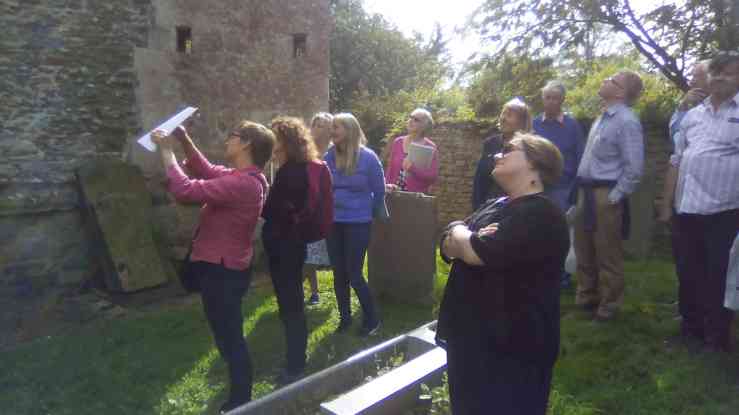
St. Martin’s Church was the site for us to reconvene and conduct our field visit in the afternoon, using the skills learnt to study the development of the village at first hand. It was a great opportunity to view the topography and see how it shaped the settlement, and to hear about the architectural history of the buildings from Dorothy Treasure of the Wiltshire Buildings record who joined us for the afternoon session.

IMG_20170906_150101 -small
The day was very well received with comments including “fascinating,” “very informative,” “useful guidance for future research,” with the attendees enjoying finding out about new sources that would be of use to them.

The morning session proved extremely successful, although it would have been nice to allow more time and have more space for people to view the library books and small amount original material brought over from the History Centre at the end of the presentation. The afternoon sessions always prove difficult to manage; people tend to congregate and chat in groups, but herding them along officiously doesn’t really seem appropriate! I’m not sure if there is a solution to this problem and if anyone out there has discovered one I’d love to know… However, it was a sign that everyone was enjoying the tour.

Many thanks also go to Calne’s Community Library Manager Jo Smith who helped organise the venue.

I hope to run two further History Revealed days next year in the spring and autumn but I haven’t yet planned which will be my next location – what do you think?

Julie Davis
County Local Studies Librarian
Wiltshire & Swindon History Centre

Designing e-learning packages on local history topics – advice needed

Just had this request for info from Julie Davis from Wiltshire…..

I am currently working with Wiltshire Libraries to design e-learning packages on local history topics such as finding maps and online resources to help refresh and train library staff. Have you or anyone you know tried to develop e-learning for local history? If so what were the pitfalls and where the courses useful?

Share your thoughts via the comments below, via Twitter, or contact Julie directly via @LibLocalStudies or Julie.Davis@wiltshire.gov.uk.

Alan Ball Awards 2016 book nominations

In the last three blog post on the 2016 Alan Ball Award nominees, LSG Chair Terry Bracher outlines the other excellent entries for the 2016 printed book awards.

Nomination for the 2017 awards closed a few weeks ago, so look out for more info on the 2017 winners and nominees in future posts.


Lambeth Architecture 1965-99; Edmund Bird and Fiona Price, with photographs by John East; -Lambeth Archives (London Borough of Lambeth) and Lambeth local History forum; 2015; ISBN 978-0-9926695-3-9

This is the fourth volume in a series on the architectural history of Lambeth. This publication records 260 notable buildings erected in the borough between1965 and 1999. The buildings are grouped by themes including public buildings, health, culture, transport, housing, commercial, ecclesiastical, public art, lost buildings and un-built post-war Lambeth. An introduction provides a sweeping context for the buildings; while entries include short histories, contemporary and modern photographs, architectural designs and models. The book is comprehensive guide to the building of this period that contributed to Lambeth’s rich and varied built heritage.


Redbridge and the First World War; Richard Greene; Redbridge Musuem; 2015;

A beautifully designed and illustrated book that uncovers some of the impacts of the First World War in Ilford, Wanstead and Woodford, in what is now the London Borough of Redbridge. It is based on research by the Redbridge Musuem, using local archives, photographs and family papers; and explores how the war affected local life, the international nature of the conflict, family histories of local residents and how people coped with the transition to peace. The book also follows the lives of local soldiers, but also provides space to consider the home front. It includes the local airfield used in the defence of London against Zeppelin raids, factories involved in the war effort, hospitals that treated wounded soldiers and the residents who provided homes for Belgian refugees; and insights into how the war affected the roles of women and the lives of children.

There is also an accompanying website www.rebridgefirstworldwar.org.uk which explores in greater depth different aspects of the war. This includes information on war memorials, local soldiers and the collections of archives, objects and photographs at Redbridge Museum.


Making Cars at Longbridge, 1905 to the Present Day; Gillian Bardsley and Colin Corker, British Motor Industry Heritage Trust; History Press; 2016; ISBN: 978-0-7509-6529-3

This book was originally published in 2005, but it was re-written, reshaped and updated in 2016. The factory was a major employer and an integral part of the community since Herbert Austin founded the Austin motor Company at Longbridge, near Birmingham, in 1905. It was subsequently the home to the British Motor company, British Leyland, Rover Group and MG Rover. The book focuses on the people that worked at Longbridge, their contribution to the factory and the factory’s role in shaping their working and social lives. It also charts the regeneration of the area since the closure of the factory in 2005, the rebuilding of both the community and economy. This publication contains many unique images from the official company archive.


From Riga to Rock Street and Other Journeys: A history of the Oldham Jewish community; Hilary Thomas in partnership with Oldham Local Studies and Archives; 2016.

This is the third in a series of publications about the Jewish community in the North West. In this book Hilary Thomas uncovers the hidden history of Oldham’s Jewish community form around 1870 to the present day. It presents histories and biographies of Jewish families and individuals connected to the local synagogue, businesses and professions, wartime and refugees; detailing their contribution to Oldham’s rich and diverse economic and social history.


The Accessibles; Manchester City Council and the Greater Manchester Coalition of Disabled People; 2015.

In the summer of 2015, Greater Manchester Coalition of Disabled People were approached by Manchester City council in partnership with Manchester Central Library to create a piece of work to celebrate UK Disability History Month. It focused on working with the young Disables People Taking Action Group, who decided to produce a comic that would look at disabled people’s contribution to Manchester and explore how disabled people are represented in the media. Working with local artist Jim Medway, members of the group portrayed themselves as characters in the book and used the notion of time travel to observe key events and visit people who had contributed to the understanding and portrayal of disability today. The result is a creative and engaging format that provides an introduction to the history of disability in the city.

One participant said “We’ve leant all about disability history, stories we didn’t know before. I liked research on where disability has come from, how it used to be viewed 100 years ago,” while others added “The team spirit has been great, and good how the comic book story has reflected our personalities and ideas … I’ve leant so much” and “I find history fascinating, so I’ve really enjoyed the research, especially the Victorian era and its use of language to describe disability. So different form today which is good.”


A History of Harrison, McGregor and Guest of Leigh; Tony Ashcroft and Becky Farmer; Wigan Archives Service; 2015

Leigh in the county of Lancashire became known for its coalmining, cotton production industries and agricultural machinery. The most recognised agricultural engineering business was Harrison, McGregor and Company, founded, in 1872, based at the Albion works. The company achieved a worldwide reputation for manufacturing mowing machines and other farm machinery.

This book was produced using company’s archive, held by the Wigan Archive Service, and gives insight into how Harrison and McGregor’s successful business was established and how it evolved in making the company a success – from directors to employees – and gives an overview of the types of machinery produced by the business. Although nothing remains of the Albion works today, this book ensures that Harrison, McGregor and Company’s contribution to the economy and heritage of Leigh is documented for future researchers.

The book was created by Tony Ashcroft (former Leigh Local Studies Officer) and Becky Farmer, Wigan Archive’s Skills for the Future Digital Archives Trainee.

One day left to nominate your project for the Local Studies e-publication of the Year Award

Just enough time to put your project forward for the Alan Ball Award for Local History publishing. Though you could get a courier to submit you book and entry entry form, it is much easier to nominate your e-project. Just complete this entry form.

The award is open to all heritage and community organisations involved with some aspect of Local History and who receive or have received public funding for the publication. This year, the project need to be launched between July 2016 and June 2017.. This also includes lottery funding, e.g. Heritage Lottery Fund and Awards for All. In addition to local authority libraries, archives, museum and archaeology services; it includes small local museums, heritage centres and community history projects.

Want some inspiration for your next project- read about last year’s nominations for the e-prize:

Wigan and Leigh Archives Online
Wigan Archives and Local Studies.
http://archives.wigan.gov.uk/

The first local history collections to go live on the site were First World War documents and research. Local newspapers, military tribunal records, record of inquests and diaries are just some of the local First World War artefacts that have been digitised and put onto the website. The research was conducted by volunteers and we recorded that over 1000 hours of volunteer time was spent researching the soldiers who died during the war. Names from local war memorials have been transcribed and added to the website.

Since the launch, more collections have been added and it is now possible for users to explore the heritage of their borough through newspapers, manuscripts, estate papers, photographs, maps and museum objects. The focus of the website is not solely on the First World War. Over periods have now been added allowing users to explore different periods of their local history digitally. For example, selections of the Anderton papers from the English Civil War are now available online and Egyptology artefacts once collected by local people are now also available to view.

The website has also been used as a platform for other projects. The Civic Histories project has recently been added. This project aims to explore and capture the names and biographies of past mayors and chairs of the different townships of the Wigan Borough. Even though this is a relatively new project, around 50 biographies have already been added to the website. We have also been able to add a local history trail.

Collections and research provided by staff, volunteers and residents are added to Wigan and Leigh Archives Online almost everyday thereby allowing local people to tell their local history.

Essex Record Office Blog
 http://www.essexrecordofficeblog.co.uk/ Essex Record Office has been using the blog to share highlights from its collections and advice for researchers, and to encourage people to use and enjoy our collections, both online and in person. The blog is a real team effort with colleagues across the organisation contributing. It provides good quality, engaging content and is very popular with thousands of page views.

Derbyshire & Nottinghamshire Medieval Graffiti Survey
 http://www.dnmgs.wordpress.com This web platform serves as a volunteer HUB, dissemination tool and point of reference for researchers. It is designed to operate like a website, but allows blog posts, research content, news on upcoming events/training workshops/public activities and the ability to upload digital images from our survey work. The project itself seeks to explore, identify, survey and record examples of Medieval and Post-Medieval graffiti in churches and other buildings across the two counties, and provide training and support for the local community to be involved. This is groundbreaking survey work that is identifying and recording historical data that has never been done before in either of the two counties, all done by the local communities. It feeds into the National Database of Medieval Graffiti, and allows national and international researchers to compare localised data on a much wider scale. The Survey Results page – https://dnmgs.wordpress.com/survey-results-2/ – gives a full write-up of the graffiti discovered at each site surveyed so far, with a selection of annotated images from each venue.

The Nunney Hoard
http://www.visitnunney.com/index.php/nunney-hoard/ The Nunney Hoard is an article on the visit Nunney website written by Adrie van der Luijt. The Nunney coin hoard was discovered in 1860 and was considered to be one of the most interesting discovery of ancient British coins placed on record. It consisted of 249 Roman coins dating back to the reign of Emperor Claudius, 41-54AD, discovered at West Down Farm in Nunney, Somerset. The article explores the history of the hoard; its discovery and excavation, and what happened to the coins thereafter

Bradford Local Studies Blog
https://bradfordlocalstudies.wordpress.com/
The blog hopes to bring insights into the history of Bradford, a behind the scenes look at the Local Studies Library, showcasing resources and providing highlights from its special collections, including rare books hiding in the stacks. The blog also shares highlights from collections in other libraries, including Keighley Library. Articles are written by staff and volunteers.

St Helens Through The Lens
http://sthelenslens.wordpress.com St Helens Through The Lens was a 10 month Heritage Lottery Fund supported project, exploring the George Street Photography Collection through community events and creative workshops. The collection includes over 3000 glass plate negatives that were originally discovered in a former photography studio in St Helens in 1984. The images include weddings, portraits, sporting occasions, events, hospitals, factories, buildings, community celebrations and more. A real snapshot of local life in mid 1950s St Helens. 3000 glass plate negatives from the collection have been digitised; while a team of 6 local volunteers who have been trained by the project archivist sorted, described and catalogued the collection, which will be available online by the end of the project. A project blog is constantly being updated and the website includes downloadable resource packs for schools, interactive worksheets and downloadable walks. The St Helens Thorough The Lens project is physically based in the Local History & Archives area of St Helens Central Library, however having an online hub has helped the project reach a wider, global community with visitors from all over the world. A real buzz has developed around the project, with many people visiting the library because of the blog, and to see more images from the collection. Visits included a women from Devon who was a key performer in the St Helens ‘Pilkington Players’ in the 1950s. She had seen images of herself from a performance featured on the St Helens Through The Lens blog (https://sthelenslens.wordpress.com/2016/10/06/performances-by-the-pilkington-players/), and she visited the library to offer stories and memories of her experiences. The online blog has not only reached new users, but has also encouraged these users to visit the library and engage with other areas of local history and heritage.

Memories Shared (North Somerset)
For further information contact Frances Tout frances.tout@n-somerset.gov.uk Memories Shared is a digital reminiscence project where historic images of North Somerset, from library local studies collections, have been digitised and stored on tablets. The tablets are then used with older people and those living with dementia. Reminiscence activities can contribute to improve the wellbeing of people with dementia. The photographs used for the project are of towns and villages across North Somerset and are photographs that have been taken between the 1930s and 1980s, so they are within people’s living memories. The tablets can be used in a variety of ways, including:

By staff and volunteers taking the tablets into lunch clubs, memory cafés and group settings for use in reminiscence sessions with older people.

By partners such as AgeUK befriending volunteers and lunch clubs.

By staff and volunteers running reminiscence sessions in libraries, using the tablets with community groups.

Loaned to care homes. The project aims to digitise historic images from library collections and develop a series of eBooks, stored on tablets and used in reminiscence sessions with older people and those living with dementia. Its objective is to encourage interaction and increase self-esteem by enabling older people and those living with dementia to share memories about the local area.; break down barriers to ICT and build confidence in using technology by stimulating interest through reminiscence; expand access to local studies resources held in North Somerset Libraries through digitisation. It also hopes to reach older people and groups in the community who may not usually use the library and have a positive impact on the health and wellbeing of older people. At the time of submission to the Alan Ball Award library staff and volunteers had delivered 20 reminiscence sessions to groups in community settings. Reminiscence sessions use the Memories Shared tablets and Books on Prescription (Dementia Offer) Pictures to Share books. All library staff are Dementia Friends trained. Groups and partners visited include: • AgeUK • The Stroke Association • Memory cafés (Nailsea and Portishead) • Residential care homes • Church groups • Lunch clubs • Retirement groups Some of the participants have said:

“Looking at photos from my childhood as a visitor to Weston – realising that my memory had not all gone” “Brilliant – shared memories! I managed a shop in Hill Road, Clevedon!” “I haven’t talked so much, for ages!” Jan Macmillan – Library Assistant after delivering a Memories Shared session said: “What a brilliant day I had today: It started with holding a Memories shared session with some very feisty Octogenarians at the Stroke survivor’s club in Nailsea. They were wonderfully enthusiastic and really participated with using the tablets. We had some great conversations from reminiscing about the shops on Hill Road, Clevedon to chatting about the different sorts of Bridal bouquets the ladies had for their wedding. One couple had been married for 61 years and first met in the Music Room at Shirehampton Library! The library really does offer such a lot to all ages and ours is such a rewarding job.” The project has achieved:   469 historic images from collections digitised 10 eBooks produced 30 tablets procured for project 25 reminiscence sessions held with older people 365 older people attended reminiscence sessions Increased interest and awareness of local studies collections 13 library staff received tablet training – cascade to others All 80 library staff trained as Dementia Friends Increased community engagement Feedback from sessions overwhelmingly positive, improving staff morale Staff gained skills and confidence Project now embedded as part of the library service Memories Shared was funded by two internal North Somerset Council teams. £5k from Early Intervention and Prevention Manager for a tablet project with older people and £4.75k from People and Communities Directorate project funding. The project was developed and produced during 2015 by Frances Tout, Community Librarian for Outreach, and Sarah Bowen, Community Librarian for Information and Local Studies.

Nominations for Local Studies book and e-publication Awards close on Halloween

Just enough time to put your project forward for the Alan Ball Award for Local History publishing. Once again there are categories for the best printed and the best digital publications released, this time published between July 2016 and June 2017.

The award is open to all heritage and community organisations involved with some aspect of Local History and who receive or have received public funding for the publication. This also includes lottery funding, e.g. Heritage Lottery Fund and Awards for All. In addition to local authority libraries, archives, museum and archaeology services; it includes small local museums, heritage centres and community history projects.

For the hard print prize, we would like a hard copy of any printed item you submit together with a paper entry form to: Terry Bracher (Chairman of CILIP LSG) c/o Wiltshire and Swindon History Centre, Cocklebury Road, Chippenham. SN15 3QN

For online resources, please complete this e-form, or send any CDs or DVDs together with a paper entry form to Terry Bracher (Chairman of CILIP LSG) c/o Wiltshire and Swindon History Centre, Cocklebury Road, Chippenham. SN15 3QN.

Want some inspiration for your next project- read about last year’s winners and look out for more info on the runners up from last year……..

Winner of best Local history E-Publication 2016:

Peterborough and the Great War

http://www.peterboroughww1.co.uk/ Thanks to a grant from the Heritage Lottery Fund, Peterborough Local Studies and Archives Service has produced an interactive website based on two visitors’ books from the collection. These originate from a tea room at Peterborough’s East Station set up during the Great War. The tea room was run by the ‘Women’s United Total Abstinence Council’ (WUTAC), a group of temperance ladies who wanted to provide a place of rest for servicemen travelling through the city on their way to and from the front.

These slim volumes from 1916 and 1917 provide a unique insight into the servicemen who used the tea room as they wrote poems, messages and drew sketches to express their gratitude to the ladies serving them tea and cake.

The visitors’ books have been digitised and transcribed and a team of dedicated volunteers are researching the 590 servicemen who signed the books. Each entry is updated on the website and the information is then released in real time, 100 years to the day that the serviceman signed the book, via Facebook, Twitter and on a digital screen at Peterborough Station.

The aim of the website is to enable people browse through the books, or alternatively to search for a relative. Anyone can then register an account on the site and add information to the biographies. The project has crowdsourced information, photographs and documents from across the world. The books not only provide tangible evidence of where a relative was on a particular day, they also reveal some of the thoughts and feelings of the men as they waited for their trains.

Other elements of the website include histories of Peterborough in the Great War written by local historians which includes articles on Peterborough East Station, the WUTAC ladies and Edith Cavell. There is also a digital teacher’s pack together with creative writing sessions and WW1 walking tours of the city.


Winner of best hardcopy publication 2016:

Ightham at the Crossroads; Ightham Parish Council, Jean Stirk and David Williams; Red court Publishing, 2015; ISBN 978-0-9930828-0-1.

This book is a detailed and fascinating history of the parish of Ightham from the formation of the local landscape and earliest human settlement to the present day. It is a fantastically well researched publication by Local Historians Jean Stirk and David Williams, funded by Ightham Parish council. Previously, no full history of this Kent parish has been written, while other article and booklets about Ightham had concentrated on archaeology, the church, manor and Ightam Mote, a medieval moated manor house, thought to be the largest of its kind in England. This current publication also covers a broad range of subjects relating to the parish’s history, notably the everyday lives of the people who inhabited the area and the things that affected them such as agriculture, work, communications, war and poverty; and much more. It includes both colour and black and white illustrations of paintings, prints, maps and photographs; and is supplemented by detailed appendices, including transcripts and indexes to original documents. It is also accompanied by a companion CD containing further transcripts of original records relating to the parish.

Inspirational Local Studies Librarian awareded Honorary Fellowship

Marin Hayes, the excellent County Local Studies Librarian for West Sussex, was awarded a well deserved Hon FCLIP last Thursday.

For those who did not get to the CILIP AGM (yes, I’m guilty too), here is what Martin said……

Thank you so much to colleagues involved in Local Studies for the nomination and to CILIP for this Fellowship award. Although I’m truly touched and proud of this personal achievement, it’s equally an award for my authority West Sussex County Library Service, my brilliant colleagues and our 150+ local history volunteers. They’ve provided the environment and support by which we’ve been able to achieve improvements to our Local Studies service.

Public libraries are, of course, at the heart of many communities and their existence is an important opportunity to engage people with their local heritage. Local history documents, books and secondary sources are unique assets owned by local authorities. They have been collected by specialists for over a century and the vast majority of this content is not yet on the internet nor likely to be so for some decades. Every civilized society should be preserving books and other published sources on the history of local communities and employing Local Studies librarians is the only way to insure this material is collected comprehensively.

An appeal to Heads of Library & Archive Services: Local Studies librarians are among your most committed and knowledgeable staff members. We know our users, we know our sources and we know our communities. Lose this expertise at your peril!

An appeal to my Local Studies colleagues: in these difficult days of public spending reviews and staffing cuts, never has there been more of a need to prove our worth to our employers. We need to seize the day, be proactive, imaginative, try to make time for external funding bids and really prove our value. We need to analyse how we envisage our services developing, and find out not just what our current users want, but what non-users may want, now and in the future. Once funding is in place and staff are running projects, it becomes possible to make real improvements to our services and engage the public as users and volunteers.

Finally, although I’m the fortunate recipient of this award, it really is, in my eyes, a tribute to the hundreds of hard-working librarians in Local Studies Libraries and History Centres across the UK.

And this is what CILIP said….

Martin’s work is vital in helping local people to learn about where they live and their community. He is known for his commitment to supporting other professionals and for bringing the subject of local studies to life. He has helped colleagues at all levels of Local Government to see the value of local studies, developing exhibitions and materials to inspire and engage the public. In his role he has carried out 30 years of pioneering work that has helped develop the field.

He is known for his commitment to supporting other professionals and for bringing the subject of local studies to life. He has helped colleagues at all levels of Local Government to see the value of local studies, developing exhibitions and materials to inspire and engage the public. In his role he has carried out 30 years of pioneering work that has helped develop the field. The honour recognises his enthusiasm and comprehensive expertise.

Martin has led recent projects that enable local volunteers to document and digitise their heritage, leading to donations of new material, helping to enrich the documentary record for West Sussex county.

There were a few other people who became Hon FCLIPs… more info about them here: https://archive.cilip.org.uk/news/cilip-honorary-fellows-2017