Event: Archives and Learning for All – Engaging Diverse Communities

A date for your diaries in 2019. The ARA are holding a free event on the 29 January  on how to engage diverse communities with archives.  This is a topic of interest to many involved in local studies collections, and would also be an good CPD opportunity.

Speakers and topics include: 

Penny Allen (The Courtyard Hereford) & Elizabeth Semper O’Keefe (Herefordshire Archives and Records Centre)

Who lived in a house like this: creatively engaging care home residents’

Julie Melrose (Islington Local History Centre)

‘Lost Trades of Islington: a collaborative and cross-general project’

Paul Dudman,  University of East London

‘Archives, Activism and Action: Participatory Cultural Heritage and Hidden Voices – the Role of Civic Engagement in Enhancing Archives?’

See the full program and book details  here. 

Report back: History Day 2018

Stella Wentworth reports back on History Day 2018 in London 

After eight months of semi-retirement and occasional judicious use of off-peak rail transport, catching the 07:25 train on a foggy morning in late November came as a bit of a shock to the system.  The friendly welcome from the reception team at Senate House when I arrived an hour and a half later with bicycle, heavy pannier bag and A3-sized portfolio case, followed shortly afterwards by a reviving tea and instant porridge from the Senate House cafe, were therefore very welcome. 

CILIP LSG (and CILIP Library & Information History Group) were among the 66 organisations attending this year’s History Day at Senate House, a one-day event bringing researchers together with information professionals from libraries, archives and research organisations. In addition to the ‘history fair’, there is a series of drop-in talks throughout the day.  To see this year’s talks programme and list of participants, go to https://historycollections.blogs.sas.ac.uk/history-day-archive/history-day-2018/ . 

LSG’s representatives are, naturally, multi-talented.  Will Farrell was also promoting the local history collections of the University of Leicester whose table we were sharing.  I was quickly trained in the key message: their large specialist collection covers the historic counties of England, not just Leicestershire.  If you are not already familiar with this collection, do have a look at https://le.ac.uk/english-local-history/about/collections and their various online collections https://elhleics.omeka.net/ and http://specialcollections.le.ac.uk to find out more. 

Our other rep, Tony Pilmer, collected our new banner and some bookmarks from Ridgmount Street then spent the morning as an advocate for the Engineering Institutions’ Libraries before taking over on the LSG stand, allowing me to attend the series of talks on ‘Digital tools and methods’.  I was interested to hear about the online, map-based history project Layers of London (www.layersoflondon.org ) and about “training” computers with Transkribus software to transcribe handwritten historical documents as part of the UCL’s Bentham project (www.ucl.ac.uk/bentham-project/ ).

Will Farrell from LSG/Leicester in action

We had fairly detailed conversations with around thirty enquirers – probably more. Recurring themes included the value of local newspapers as contemporary sources of social and historical information, and the advisability of contacting specialist local history collections in the local authorities adjacent to the area you are primarily researching as well, because of boundary changes and anomalies over the years. 

To give some idea of the breadth of topics mentioned, they included: 

  • the post-1964 diaspora from Tanzania
  • a “lost” Oxfordshire ancestor
  • women’s history and women pioneers with particular reference to Croydon 
  • the Burma Campaign and its impact on Yorkshire 
  • advice on routes to a career in archives management 
  • population movement in WWII and its impact on Worcestershire 
  • the suffragette movement in south-east London 
  • statistics and pre-war experiences of BME communities 
  • history of medicine 
  • Occupations and industries: blacksmiths, knitting, the fur trade 
  • trade union records for tin and aluminium foundry workers 
  • navvies’ accommodation while building the Bridgewater Canal. 

London-based research facilities, including the Guildhall Library and London Metropolitan Archives, were naturally well represented, but the day was a useful opportunity for LSG to promote local studies collections from further afield.  We spoke to people with research interests relating to Croydon, Dorset, Ealing, Hounslow, Leicester, south east London, the Midlands, Worcestershire and Yorkshire over the course of the day. 

It’s important to have a “hook” to encourage passers-by to come close enough to your stand to engage in conversation.  Will had brought a range of postcards and some pencils which were invaluable in this respect, as had quite a few other stands (if the collection of postcards and bookmarks I came away with is any indication). A number of tables had tubs of sweets; one had a free quiz (to be done on the spot for a prize draw); another had a free raffle for a copy of one of their publications.  The Geological Society’s Library had a “lucky dip” in a catalogue card drawer with beautifully-folded notes labelled “Discovery of Dinosaurs”, “Earth’s History” and so on, which unfolded to reveal several paragraphs of interesting facts about a scientist and their work in the appropriate geological sector.  I was intrigued to learn that the most well-known historical example of an early dinosaur bone appeared in the 17th century antiquary Robert Plot’s book “The natural history of Oxfordshire”. 

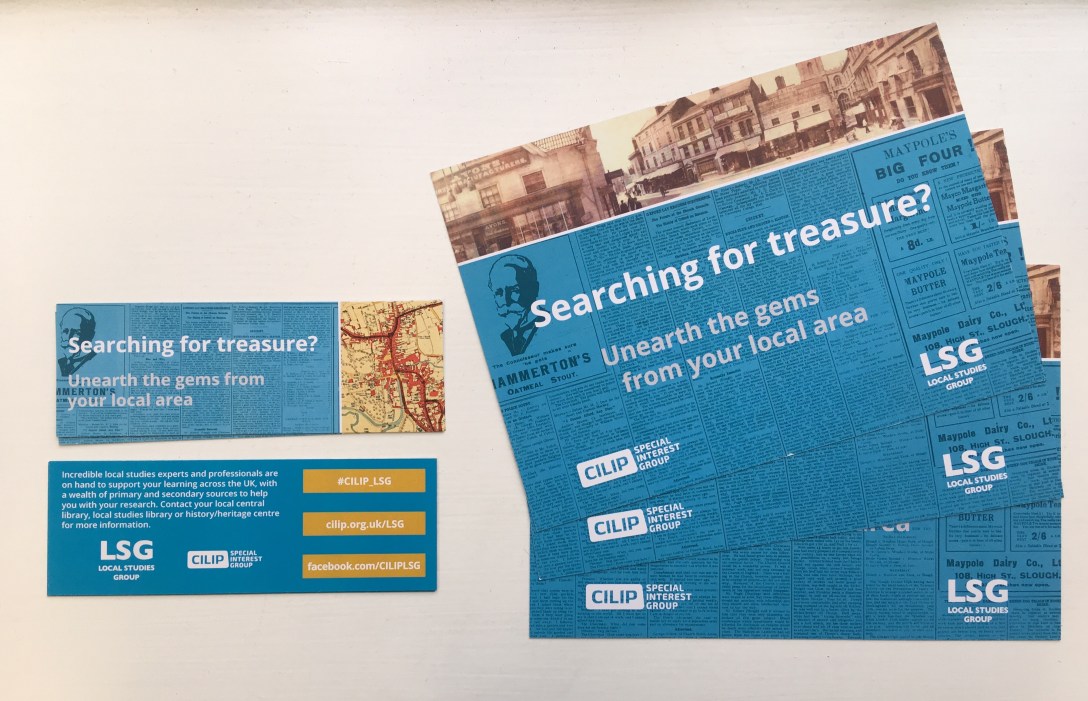
Our new bookmarks and postcards.

I had taken a selection of books and pamphlets, wondering whether they would justify the effort (weight?) of doing so, and was pleased to find that several did catch people’s eyes sufficiently for them to make a note of the titles.  Most frequently commented on was Historical research using British newspapers by Denise Bates (Pen & Sword 2016, ISBN 9781473859005), but Catherine Exley’s diary: the life and times of an army wife in the Peninsular War edited by Rebecca Probert (Brandram 2014, ISBN 9780956384799) also attracted attention. Joan Grundy’s Dictionary of medical and related terms for family historians (Swansong 2006, ISBN 9780955345005) was spotted by someone who exclaimed “that’s just what I need!”. 

I had also put together a portfolio of photocopies and leaflets to try to show the range of resources typically available in local studies collections.  With hindsight this probably took up rather too large a share of the limited space available, and it was a serious embarrassment when the handle broke just as I was lifting it up to the luggage rack on the train home, but I did refer to items in it myself quite a few times as examples, and Tony said people were browsing through it in the afternoon. 

We did not have access to electricity so my multi-way extension and numerous chargers were redundant, but I was pleased to find that my tablet connected to the wifi with no problem, the connection speed was good and the tablet’s battery held up well.  I forgot to take a tablecloth (useful for concealing surplus baggage and boxes) but fortunately Will had brought one with him – an additional advantage of the table-sharing arrangement!   

Hearty thanks are due to Tony for all his efforts beforehand in arranging for our new publicity material, and to the graphic design expert at CILIP who devised an attractive banner which won’t date too easily and which should help us to promote local studies libraries at this and similar events for several years to come.  We also now have a supply of bookmarks and postcards with the slogan “Searching for treasure? Unearth the gems from your local area”. 

They would be even more useful as outreach resources if they could cite a single gateway web address leading to a list of all the local studies collections / libraries / history centres in the country, or if there could be an obvious button on www.cilip.org.uk/LSG linking to a directory of local studies libraries etc., but that’s a whole new challenge – particularly in keeping such a list up-to-date! [Editor’s note: see a forthcoming blog post on this issue.]

I was let down by my usually-trusty bicycle which picked up a puncture on the way back to the station, but nevertheless I enjoyed the day. It was good to exchange ideas and enthusiasm both with researchers and fellow-practitioners from a wide range of institutions, and a useful opportunity to publicise local studies collections to researchers who might otherwise have overlooked their potential value.

Stella Wentworth 

Local Studies Librarian, Oxfordshire History Centre.

Local Studies for National Libraries Week


Julie Davis reports back on Libraries Week in Wiltshire 

I jumped at the fantastic opportunity to show case local history on a larger scale during Libraries Week at the beginning of October this year.

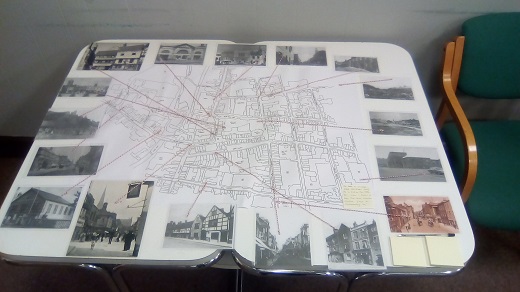
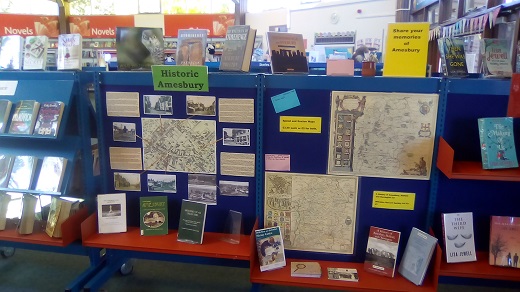
The week was centred around local history displays at many of Wiltshire’s public libraries with larger libraries making the most of the reproduction Goad Town Plans provided by the History Centre along side copies of photographs from our Historic Photograph and Print Collection which really brought back memories and brought the maps to life.

Our display in Amesbury

A small selection of local history material was also made available to purchase at some libraries which drew interest and sales.

There was a positive response to our call for comments and memories from local people which proved popular in many libraries– some of which are still ongoing.

Map and photographs of Salisbury 

The maps caused a lot of chatter amongst library customers, many enjoying recalling old shops and haunts. Caroline, Local Studies Champion for Westbury noted; “Many people have been fascinated to see old photos of the streets in which they live. The display is bringing back memories for our older customers.” I plan to create a permanent record of the comments by making memory books using quotes and images.

Local Studies has an amazing power to excite, energise and share; for individuals in communities to discover commonalities and make connections which enrich and aid their health and well being.

It’s been a pleasure to for me and my colleagues at the History Centre to work with Wiltshire Libraries staff as one team to deliver local history to the heart of communities – one of the many, many reasons why our libraries are so special.

Julie Davis

County Local Studies Librarian

Wiltshire & Swindon History Centre

http://wshc.eu/

Get Inspired … Alan Ball 2017 Award Winners and Entries


Alan Ball Awards 2017

Winner Hardcopy:

Alan Roby ed.; Miss Weeton, Governess and Traveller; Wigan Archives, 2016.

(Hardback, ISBN 978-1-5262-0553-7)

A skilfully edited, beautifully produced and illustrated volume containing the letters, journal entries and other autobiographical writings of Miss Nelly Weeton (1776-1849) providing a vivid insight into Georgian England. Born in Lancaster, the daughter of a sea captain who was mortally wounded in the American War of Independence, Nelly grew up in the village of Up Holland, near Wigan. At the age of 31 she left her family home to take up employment in the houses of the gentry. She became a governess and a traveller, moving to Liverpool and the Lake District; while her writings include accounts of a journey to London, excursions to the Isle of Man and North Wales, including lone ascents of Snaefell and Snowdon.


Winner E-publication:

Spratton Local History Society website http://www.sprattonhistory.org/

The society’s new website was launched in November 2016 with the aim to make 17 years of research by its members available to local people and the wider public. It is part of a much larger First World War projected aided by an award from the Heritage Lottery Fund. Members researched all the men of the village who served during the war. It included the first airman to be awarded the Victoria Cross, Lt William Rhodes-Moorehouse VC RFC.

Basing research on the 1911 census, local researchers identified where each person who served lived in the village, supported by an interactive map. This research was also inked to a searchable genealogical database (6,000 names) of 2,000 families living in Spratton in the nineteenth century. The society continues to add to the website, which includes villagers who were at the Battle of Waterloo, 2000 photographs including some previously unpublished images, and a Spratton Heritage Trail.

The project enabled volunteers to develop new skills and engage with the history of their local community; while it has also connected the community to descendants of those who served and their families, who live elsewhere in the UK and around the world. It is a fantastic example of an accessible, engaging and informative online community history archive, and of the wider impact such projects can achieve.

Other Hardcopy nominations

Emma Worrall, Amy Perry and Martin Hayes ed.; Military Voices Pat and Present: West Sussex Veterans in the 20th Century; West sussex County Council Library Service; 2017.

(Hardback, ISBN 978-0-86260-593-3)

The idea for this publication came out of a previous project on the Great War when Worthing History Teacher Peter Baker offered his collection to the library service for research. It contianed 32 interviews with 1914-18 veterans. The collection is now preserved at the West sussex Record Offcice. In addiotn, project staff and 45 volunteers conducted 63 interviews with 29 Second World War and 33 post war veterans. All the interviews are available indigital form at the West Sussex Record Office. Extracts from the interviews and biographical research have been combined skillfuly into this wonderful volume of military voices recording the contribution of some of the men and women from West sussex who served thier country.


 Edmund Bird and Fiona Price; Lambeth’s Victorian Architecture; London Borough of Lambeth and the Lambeth Local History Forum; 2017. With photographs by Harry Orseni.(Paperback, ISBN 978-0-9926695-4-6)

This is the firth volume in the excellent series on the architectural history of Lambeth. It provides a fascinating pictorial and written record of Victorian buildings in Lambeth. These include public buildings and those relating to health, education, parks, shops, banks, transport, industry, pubs, housing and churches; with colour images and architectural summaries of hundreds of properties, sculptures and structures. There is also an introduction to Victorian Lambeth and a section on Lambeth’s lost Victorian buildings.


Doncaster Times, At Home At War. Issue 2: November 2016; Doncaster Library Service (Paperback)

Under the editorship of Helen Wallder, Local Studies Officer, Doncaster Local Studies Library, this local history journal was established via a HLF funded project, Doncaster 1914-18: At Home At War, supplementing a website and aimed at audiences who engage less with digital outputs. The journal is produced twice a year and this edition was submitted for the Alan Ball Award. THe journal is a great concept, containing article reserached and written by member sof the public, volunteers, local historians and staff at Doncaster Library. It covers all aspects of Doncaster’s history during the First World War. With a wide range of topics and illustrations, it helps to highlight items in the Doncaster Local Studies Collection. It has engaged a wide range of communities and individuals, and not just in Doncaster, but as far away as Europe and New Zealand.


Ellesmere Port Local and Family History Society, Ellesemere Port Town Centre Memories; 2016 (Paperback)

With the support of Cheshire West and Chester Libraries, the Ellesmere Port Local and Family History Society compiled this fourth booklet in the ‘Memories’ series, charting the history of the development of Ellesemere Port Town Centre, from its origins as a single farm known as Stud Farm to the present day. The memories include the local school, football ground, shops, arcades and the market; together with other developments in the civic and commercial areas of the town. It is a 104 page limited edition publication, which includes 250 photographs, maps and diagrams. It is an excellent example of community history being made accessible by dedicated group of volunteers.


Other E-nominations

Know Your Place South West http://www.kypwest.org.uk/

Know Your Place is a digital heritage mapping project designed to help you explore your neighbourhood online through historic maps, collections and linked information. It was initially developed by Bristol City Council in 2011, primarily as a planning tool. In 2015, funding was granted from the Heritage Lottery Fund to extend the map across six further counties in the West of England: Gloucestershire, Somerset, Wiltshire and the former Avon area (the unitary authorities of South Gloucestershire, Bath & North East Somerset and North Somerset). It received Heritage Lottery funding to run an extension project from June 2015 to the end of July 2017. This was added to by match-funding and in-kind support from local authorities and heritage groups in the region.

The project has been delivered through a complex partnership involving Museums, Bristol’s Know Your Place team, Archives and HER Officers in the six counties, and national partners including the British Library, who have supported the project by making available and digitising some of the maps. Other partners have included exhibition hosts, and smaller organisations which have provided match funding.

This funding and support has enabled the project to build a mapping resource that covers 4689 square miles (12,149 km), using maps from nine separate national, regional and local map collections and archives, and now makes the archaeological records, listed buildings and monuments data for those areas more publicly available. A notable feature of Know Your Place is its presentation of comparative historical maps for each area, making it possible for the site user to “whizz through history” looking at maps from different periods on the same screen.

The Know Your Place team also carried out an outreach programme to extend awareness of the site, that was made up of exhibitions, events and workshops. An online and touring exhibition was developed with content from 22 collections, while a range of outreach events attracted over 2,000 people. These were a combination of drop-in events and more structured workshops. 107 people were trained in using Know Your Place to map their organisation’s heritage information. The tangible outcome from these workshops is becoming apparent, as more information from the workshop locations appears online. 100 volunteers supported the project, including 70 people who helped crop or geo-reference maps. By the end of the project, 35 people were continuing to work regularly to ensure that new maps continued to appear on the website.


Flintshire War Memorials http://www.flintshirewarmemorials.com/

This is a community website on which the stories behind the names on Flintshire’s WW1 memorials are told. The project is ‘staffed’ by volunteer researchers – all amateur historians – who take on responsibility for a particular memorial and research the stories of those named on that memorial. (There are currently 24 researchers). Each researcher has a password and user name and has received training in how to add their research to the website. Once a story is posted on the website, members of the public can contact the website via the contact page and send in additional details and scanned images of documents, photographs personal memorabilia. These are added to the relevant pages and so the stories grow almost organically.

The project is managed by the two founders of the website who began by researching their own local memorial (Eifion and Viv Williams). It was financially supported in its early days by Flintshire Local Voluntary Council and by Heritage Lottery Wales. It has also been financed through a programme of talks to various community groups where a fee is charged. Some volunteer researchers have raised funds in other ways. Throughout the centenary period there has been an annual study visit to France/Flanders for researchers and other interested Flintshire residents.

Why not enter for the 2018 award … see details posted on this site

 

Oral History and Sound Heritage Conference – Philippa Lewis

We thought we would do a report on our conference, but then we found Philippa from ARA did if for us:

josephhettrick's avatarThe New Archivist

At the beginning of July I attended the ‘Oral History and Sound Heritage Conference’ hosted by University of Leicester Library.

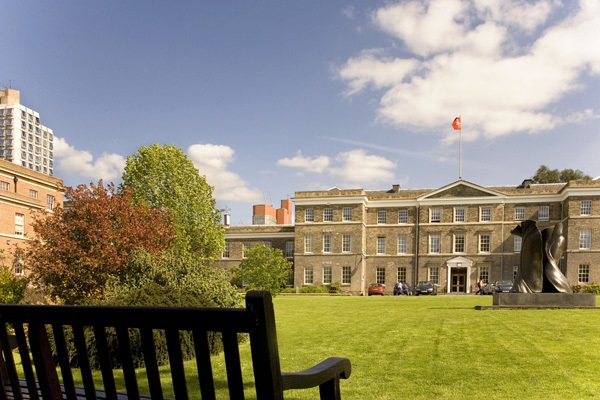
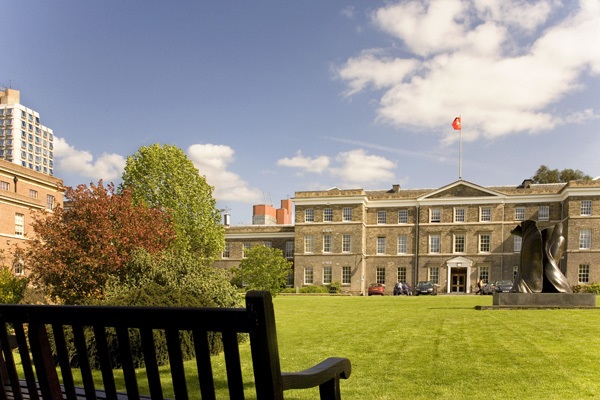
University of Leicester campus - (copyright University of Leicester) University of Leicester (image courtesy of University of Leicester).
Although presented by CILIP (Chartered Institute of Library and Information Professionals) Local Studies Group, the conference was intended as an opportunity for those working with oral history and sound collections across libraries, museums and archives to get together and share their experience.

I was keen to attend this conference having conducted a number of oral history interviews as part of my role as Project Archivist for the ‘Working Together’ project based at the National Co-operative Archive in Manchester. This project aims to capture and preserve the heritage of the workers’ co-operative movement 1970s-1990s, with a key part of this focusing on recording the memories and experiences of individuals involved in the movement. As this was my first time working…

View original post 590 more words

To whom it may concern: letters, log-books, diaries and dispatches, a report from the 2018 LSG South Study Day

What do an amateur mycologist, a brilliant early 19th century lecturer, dozens of British artists, a keen explorer & botanist, and a leading cricketer all have in common, apart from appearing in the Oxford Dictionary of National Biography?

Well, they all featured in the 2018 Study Day organised by CILIP Local Studies Group South, because local studies librarians and archivists have been inspired to devise innovative ways of making their lives and times as revealed in the letters and note-books they left behind better known to a wider audience.

Through the AnnoTate project (https://anno.tate.org.uk), the diaries, letters and sketchbooks held in the Tate Archives have been digitised and are now being transcribed by volunteers so that the wealth of information they contain about the lives of these artists and their creative processes can be made more widely available.

While mycologist and botanical artist Anna Maria Hussey was on holiday in Dover in 1836 with her two small children and sister Kate, she kept a diary which she illustrated with sketches to entertain another sister, Henrietta. The diary has survived and is now in the Kent History and Library Centre. When looking through the diary to catalogue it, archivist Liz Finn quickly realised that it would appeal to a wider audience and embarked on a quest to get it published. Sad to say, her original vision of a printed publication has yet to be realised, but Kent’s library users can now borrow Botany, boats and bathing machines as an e-book. Liz also appealed successfully for an article about Anna Maria to be included in ODNB – see https://doi.org/10.1093/ref:odnb/96688. Liz’s account of her project is due to be published in the Summer 2018 edition of Local Studies Librarian.

Joseph Dalton Hooker (1817-1911) was an important but often overlooked botanist and explorer who in later life succeeded his father as Director of Kew Gardens. His personal and scientific correspondence is being conserved, digitised, transcribed and made available online by the Kew Archives and we were fortunate that one of their team was attending the Study Day and told us about this project during the Open Forum. To find out more about the Joseph Hooker Correspondence Project, visit the RBG Kew blog.

The inventor Sir Humphry Davy, who became Professor of Chemistry at the Royal Institution when he was in his early twenties, was one of the most popular lecturers of his time. Some of Davy’s chemistry lectures would probably fail H&S scrutiny today, and perhaps as a result of this, the re-creation of some of his most famous experiments for the Royal Institution’s MOOC (Massive Open Online Content) online learning course about Sir Humphry Davy has attracted over 2000 subscribers since the course was launched in Autumn 2017. The Humphry Davy MOOC is on https://www.mooc-list.com/course/humphry-davy-laughing-gas-literature-and-lamp-futurelearn ; information about the Davy Letters Project is on www.rigb.org/about/heritage-and-collections/heritage-projects/davy-letters; and the database of letters written by Sir Humphry Davy and his circle is on http://www.davy-letters.org.uk.

The Study Day concluded with two dramatic performances based on resources from the Darnley Archive 1537-1974 now held at Medway Archives. The first, Little Lord Clifton, is based on letters exchanged in 1775 between the young heir at boarding school and his parents. The second tells the story behind the origins of The Ashes, with which cricketer Ivo Bligh, eighth earl of Darnley (1859–1927) was associated. An article about this project is due to be published in the Summer 2018 edition of Local Studies Librarian.

If you have suggestions about topics or projects which might be of interest for future Study Days, do please contact the LSG South committee via the blog contact us page.

Want to find out more about the LSG South Study Day? View the speakers’ slides online or read the Report on CILIP LSG Sth Study Day 2018.

Stella Wentworth

July 2018

To whom it may concern: letters and log books, diaries and dispatches. LSG South Study Day, Wednesday 21 March

Join us for the CILIP Local Studies Group South Study Day 2018, which shows how fellow library, archive & heritage professionals have used innovative ways to highlight letters and log books, diaries and dispatches within their collections.

Date: Wednesday 21 March, 10.30am – 4.30pm

Cost: £40.00 + VAT  CILIP members; £50.00 +VAT non members

Buffet lunch and refreshments included.

Location: CILIP, the library and information association, 7 Ridgmount Street, London WC1E 7AE

Book now via Eventbrite.


Speakers/participants:

Jane Bramwell: Increasing access to Tate Archive: AnnoTate – A tool for crowdsourcing transcriptions

Frank James, Royal Institution, MOOCing Humphry Davy and editing his correspondence

Liz Finn, Kent Archives Service: Anna Maria Hussey; mycological illustrator: a project to transcribe and publish an e-book of a little-known diary of a holiday in Dover in 1836.

Norma Crowe, Medway Archives Office.  Insights into the Darnley family of Cobham Hall through their letters. Dramatised readings presented by Norma Crowe, Jean Lear and Christoph Bull.

Plus a break-out session on your projects, problems and solutions & the LSG South AGM


To book your place visit our via Eventbrite.

For more information contact Tony Pilmer via tony.pilmer@aerosociety.com.

Local studies publication and e-publication of the year award – nominations open now

It is that time of year again when the CILIP Local Studies Group start calling for submissions for the Alan Ball Award for Local History publishing. Once again there are categories for the best printed and the best digital publications released, this time published between July 2016 and June 2017.

The award is open to all heritage and community organisations involved with some aspect of Local History and who receive or have received public funding for the publication. This also includes lottery funding, e.g. Heritage Lottery Fund and Awards for All. In addition to local authority libraries, archives, museum and archaeology services; it includes small local museums, heritage centres and community history projects.

Last year’s winners of the hard copy award were Ightham at the Crossroads by Jean Stirk and David Williams, whilst winners of the e-publication were Peterborough Local Studies and Archives Service for their interactive website Peterborough in the Great War

Background

The Alan Ball Local History Awards were established by the Library Services Trust in 1985 to encourage local history publishing by public libraries and local authorities. The awards were named after Alan W. Ball, a former Chief Librarian of the London Borough of Harrow, and author of many local history publications.

CILIP LSG has taken on the administration, judging and promotion of the award. This has always been a prestigious award within the library and information community, especially for Local Studies services, and the LSG is honoured to be involved with it. Traditionally, the award had been for printed materials, although more recently electronic information such as websites was considered. It is now updated, with expanded the criteria, so like last year we are hoping for a bumper crop of submissions! It is a great opportunity for the heritage community to celebrate and promote so many wonderful activities and research. Last year there were no submissions from Scotland and Northern Ireland, so it would be great to see the whole of the UK represented.

Criteria 

Once again, there will be two awards this year, one for printed material and another for digital. Printed material might include books, pamphlets and guides etc.; while digital submission might include websites, apps, video, animation and some aspects of social media, such as blogs. We are interested in both the quality and usefulness of the content, and also how it engages the reader or user, especially new users.

The award is now be open to all heritage and community organisations involved with some aspect of Local History and who receive or have received public funding. This also includes lottery funding, e.g. Heritage Lottery Fund and Awards for All. In addition to local authority libraries, archives, museum and archaeology services; it includes small local museums, heritage centres and community history projects.

Submitting your entry

We will need submissions to be with us by 31st October 2017.

For the hard print prize, we would like a hard copy of any printed item you submit together with a paper entry form to: Terry Bracher (Chairman of CILIP LSG) c/o Wiltshire and Swindon History Centre, Cocklebury Road, Chippenham. SN15 3QN

For online resources, please complete this e-form, or send any CDs or DVDs together with a paper entry form to Terry Bracher (Chairman of CILIP LSG) c/o Wiltshire and Swindon History Centre, Cocklebury Road, Chippenham. SN15 3QN

The Prize

Winners will be given a certificate, the use of a winner’s logo and accorded the title of Alan Ball Award winner, which can be used on promotional material. Sadly, there is no trophy or cash prize, but as previous award winners will confirm, it is a prestigious award that is very meaningful within Local History community.

We expect judging to take place in November 2017.

Any other questions?

Contact Terry Bracher (Chairman of CILIP LSG) c/o Wiltshire and Swindon History Centre, Cocklebury Road, Chippenham. SN15 3QN, email: terry.bracher@wiltshire.gov.uk or telephone: 01249 705515.

To whom it may concern: letters and log books, diaries and dispatches. LSG South Study Day, Friday 3 November

Join us for the CILIP Local Studies Group South Study Day 2017, which shows how fellow library and archive professionals have used innovative ways to highlight letters and log books, diaries and dispatches within their collections.


Date: Friday 3 November, 10.30am – 4.30pm

Cost: £40.00 + VAT  CILIP members; £50.00 +VAT non members

Buffet lunch and refreshments included

Location: Medway Archives Centre, 32 Bryant Road, Strood, Rochester Kent ME2 3EP malsc@medway.gov.uk,  01634 332714

Book now via Eventbrite.

Speakers/participants:

Hannah Barton, Tate Galleries, AnnoTate : Tate Gallery’s Archives & Access project -developing and using a transcription tool to transcribe letters and notebooks of British and émigré artists.

Beverley Jones, Vivacity Peterborough: 2016 Alan Ball Award winning Peterborough and the Great War project

Liz Finn, Kent Archives Service: Anna Maria Hussey; mycological illustrator: a project to transcribe and publish an e-book of a little-known diary of a holiday in Dover in 1836.

Norma Crowe, Medway Archives Office.  Insights into the Darnley family of Cobham Hall through their letters. Dramatised readings presented by Norma Crowe, Jean Lear and Christoph Bull

Agenda:

10.30                Registration/coffee

11.00                Welcome

11.05 – 12.00   session1    Liz Finn: Botany boats and bathing machines: Anna Maria Hussey’s diary of 1836

12.05 – 13.00   session 2   Hannah Barton:  AnnoTate and the Archives & Access project

13.00 – 14.00 lunch with LSG South AGM at 13.30

14.00 – 14.50  session 3 Beverley Jones: Just passing through: the Peterborough Great War Project

14.50 – 15.20  tours of the Medway Archives Centre

15.20 – 16.10  session 4 Norma Crowe:  The Darnleys of Cobham Hall and their letters.

16.10 – 16.30 Tea, Summing up, thanks and close

To book your place visit our via Eventbrite.

For more information contact Tony Pilmer via tony.pilmer@aerosociety.com.

Fancy a #uklibchat about Local and Family History?

Gaby Koenig talks to the LSG Blog as UK Libchat turns it’s mind to local studies………

For those of you not familiar with #uklibchat it’s a monthly live chat held on twitter talking about library and information topics. People taking part will follow the hashtag #uklibchat at the set time (6.30pm UK time, mostly the first Tuesday of the month) and will be guided through questions they have helped set on a shared agenda published in advance. The chat leader is one of a small group of volunteers who facilitates questions and keeps things moving. This month is my turn!

libchat

We’ve covered a wide range of topics across all library sectors and this month we are turning to a topic requested by one of our participants – Penny Allen – Family History and we’ve also added in Local History to the discussion. We would like people who work in libraries, archives and other sources of family and local history to come and join and talk about the challenges and solutions of answering enquiries from people in this field.

If you would like to add questions to be discussed please do on our googledoc – anyone can add questions even without a google account Supporting Local and Family History Enquiries #uklibchat Agenda 6th December 2016

And if you can come and join in and discuss the topic, please do! The chat will be on Tuesday 6 December at 6.30pm.