The 2024 Alice Lock Memorial Volunteer Award (Under 25 Category)
Winner: Jegan Jatta, Nottinghamshire Archives
Jegan volunteered whilst studying at university in a project aiming to create activities for 18-25 year olds in the form of escape room activities using historical documents, followed by murder mystery events which he took part in delivering. Staff acknowledged his dedication to participate whilst balancing work and study commitments.
General information about Nottinghamshire Libraries and Archives can be found at:
The 2024 Alice Lock Memorial Volunteer Award (Over 25 Category)
Winner: Peter Slater, Leeds Libraries
Peter volunteered to assist in research on a British Library/ Leeds Libraries project to record local football fanzines. However, his enthusiasm didn’t stop there and he has now completed a survey of national significance, covering all UK fanzines which has already been useful to researchers.
Heritage resources can make a difference to individuals: the young couple in their first house who visited because they had chopped down some trees which were inside their fence only to find that their neighbour claimed the land and the trees; the schoolteacher who said that her students’ A level results had improved as a result of class visits to the local studies library; the family who were helped to find essential evidence about a local company and were able to obtain compensation for the loss of a loved one.
Heritage projects have the power to engage people from widely different backgrounds and generations. Interesting and creative projects have the power to motivate individuals to overcome barriers to learning, to experience digital technologies, to build new social networks (combatting isolation, depression and related health issues) and to rekindle an in interest in life through informal learning opportunities.
Heritage people working creatively, and in partnership with a wide range of educational providers, facilitators and artists, and others, can ensure that opportunities exist to engage different levels of ability and ranges of interest.
But how do you do this? Some of the finest and most experienced local studies librarians have come together to form a free online resource, The Local Studies Toolkit, that can help guide heritage people to the right answer for them.
In this session, we will explore the toolkit and hear some top tips from those who wrote some of its sections.
Speakers include:
Terry Bracher, Heritage Services Manager, Wiltshire& Swindon History Centre
Tracey Williams, Heritage & Local Studies Librarian, Solihull (Recorded)
Tony Pilmer, Librarian & Archivist, Royal Aeronautical Society & formerly Local Studies Librarian, Slough (Chair)
José Luiz Pederzoli Jr., Unit Manager – Strategic Planning, ICCROM (Recorded)
Heritage resources can make a difference to individuals: the young couple in their first house who visited because they had chopped down some trees which were inside their fence only to find that their neighbour claimed the land and the trees; the schoolteacher who said that her students’ A level results had improved as a result of class visits to the local studies library; the family who were helped to find essential evidence about a local company and were able to obtain compensation for the loss of a loved one.
Heritage projects have the power to engage people from widely different backgrounds and generations. Interesting and creative projects have the power to motivate individuals to overcome barriers to learning, to experience digital technologies, to build new social networks (combatting isolation, depression and related health issues) and to rekindle an in interest in life through informal learning opportunities.
Heritage people working creatively, and in partnership with a wide range of educational providers, facilitators and artists, and others, can ensure that opportunities exist to engage different levels of ability and ranges of interest.
But how do you do this? Some of the finest and most experienced local studies librarians have come together to form a free online resource, The Local Studies Toolkit, that can help guide heritage people to the right answer for them.
In this session, we will explore the toolkit and hear some top tips from those who wrote some of its sections.
Speakers include:
Terry Bracher, Heritage Services Manager, Wiltshire& Swindon History Centre
Tracey Williams, Heritage & Local Studies Librarian, Solihull (Recorded)
Tony Pilmer, Librarian & Archivist, Royal Aeronautical Society & formerly Local Studies Librarian, Slough (Chair)
José Luiz Pederzoli Jr., Unit Manager – Strategic Planning, ICCROM (Recorded)
We are excited to announce two new pilot awards for library or archive volunteers. We are looking for an outstanding volunteer under the age of 25, and a volunteer who is over 25 years of age, who have contributed to a local studies library or archive project.
We welcome nominations from a library or archive professional for a volunteer who has developed their own skills significantly or has shared their skills with others.
I am Darren Edwards, an MA Library and Information Services Management student at the University of Sheffield.
For my dissertation research I am studying the representation of diverse communities in local studies collections, focused on the representation of LGBTQ+ and ethnic minority communities. I am looking to recruit participants who work in English local studies libraries to complete an online questionnaire. The questionnaire asks you to reflect upon your local studies collection and the representation of diverse communities within it. The questionnaire is anonymous and asks for no personal data.
This study will help to improve understanding of how well diverse communities are represented in local studies collections and by encouraging reflection on collections will lead to an improvement in this representation. Your participation will benefit my dissertation research and the completion of my degree.
For further information or questions, please contact me on dledwards1@sheffield.ac.uk. The project has received ethical approval from the Information School at the University of Sheffield and is being supervised by Dr. Sara Vannini.
In this guest post, Roger Penny looks back at his work in The Postcard Museum, Holmfirth, West Yorkshire.
After seven years as a Librarian with the County of Avon, I joined Kirklees Cultural Services in November 1988 in the new post of Community Officer. This post had responsibility for managing the Library, Postcard Museum and Civic Hall in the Pennine town of Holmfirth, home of the popular TV Series Last of the Summer Wine and of Bamforth & Co. Founded in 1870, Bamforth & Co became best known for their ‘saucy’ seaside postcards through to the 1980s. They were also one of the first companies to make silent films as well as magic lantern slides and sentimental postcards. The Postcard Museum had opened several years earlier after being planned and displayed by the Museum Service working closely with Jane Helliwell, Kirklees Local Studies Librarian. With a museum shop on the ground floor, the first floor gallery featured displays of magic lantern slides and a selection of sentimental and comic postcards by Bamforth & Co. On the second floor there was a seated area where visitors could watch early silent films by Bamforth & Co.
Visitors to The Postcard Museum came mainly by coach on Summer Wine pilgrimages from across the Pennines. People living in Holmfirth seemed to have lost interest in the Postcard Museum. After one visit there was little reason to come for a second look unless you were a Bamforth & Co enthusiast. One of my agreed goals was to encourage people to come again through putting together a series of temporary exhibitions of postcards, enhancing their experience when watching the silent films, and organising events. Over the next three years, we put on a series of temporary exhibitions of postcards in display cases on the landings before you entered the first and second floor galleries. Keep Smiling: Picture Postcards of World War 11 was the first temporary exhibition, followed by Fancy Ladies: Picture Postcards of Society Women on the Edwardian Stage by Bamforth & Co. I was fortunate to receive the continuing support of Jane Helliwell, who looked after and maintained the collection of Bamforth & Co postcards.
For Keep Smiling I wrote an exhibition brief that identified my target audience and marketing strategy, the steps in sourcing and displaying the objects to be included in the exhibition, and the budget. The postcards seemed to fall into three categories: The Home Front, Patriotism and Propaganda, and Humour. There were also photographs of the artists Douglas Tempest and Arnold Taylor. I had already been given leave to write my own press releases and was very encouraged by the level of interest shown by the Huddersfield Examiner and Radio Leeds. I was blown away when I was invited by BBC Look North to do a television interview in the museum about the Fancy Ladies exhibition, which was broadcast after the early evening news. To launch Keep Smiling, we held a 1940s evening with the staff serving a homemade supper to everyone who came, using authentic wartime recipes. A local community theatre company set the scene and led a sing-along.
After having gained some prior experience of working with video, my interest was aroused when I heard tell of a pianist accompanying the showing of silent films at a film festival in Leeds. He readily agreed to be recorded playing along to the Bamforth & Co silent films in the museum. I was fortunate to secure additional funding to pay the Production House in York to produce a new series of videos with dubbed piano soundtrack, which encouraged visitors to the Postcard Museum to extend their visits and watch the films. I undertook a second silent film project after the retired company secretary at Bamforth & Co handed me several reels of nitrate film that he’d been keeping in an old tool box in his garage. After having them collected by the National Film Archive, I eventually received back videos of lost Bamforth & Co films, including a procession by trades unions and churches through the streets of Holmfirth around the end of the Great War. A silent film evening was held to show the new films to local people and invite their comments as to the significance of the procession, which had culminated in a gathering in the local park.
One last area in which I made a particular contribution to the Postcard Museum was in respect of the museum shop. This had tended to sell confectionary and some Bamforth & Co postcards still in print to generate income and help balance the budget. After approaching the Managing Director of Dennis’s of Scarborough (the company that had bought Bamforth & Co in the 1980s), he agreed to reprint two sets of historic comic cards from Kirklees collection so they could be sold through the museum shop. I had the fun task of choosing the twelve cards, which became best sellers in the shop. Another commercial project was undertaken with the help of the Holmfirth Choral Society which recorded a music cassette for sale in the museum shop, featuring some of the songs featured on Bamforth & Co’s sentimental postcards.
Roger Penny was Community Officer for Holmfirth, and subsequently Marsden as well, from 1988 until 1993. He was Hon Publications Officer of the Association of Assistant Librarians and President of the AAL in 1990.
Online activities can be an accessible and practical way of promoting services and collections to new audiences, particularly those who are unable to attend in-person events due to other commitments or accessibility issues.
This has particularly been the case since March 2020: “The digital switch happened quickly when lockdowns were first introduced. Libraries were able to offer their users alternatives to physical [services] and many people made use of these digital services in ways they had not done before.” (‘Service Recovery Hub – stay on top of the latest developments,’ Information Professional, April-May 2021, p.31)
While online activities have been the default method of delivery during the COVID-19 pandemic, they will likely remain a useful tool in the arsenal of all librarians going forward.
Online local studies events have proved particularly popular since March 2020, perhaps because audiences spending more time at home have been looking at community and individual identities with fresh eyes, (re)discovering a passion for heritage and family history.
Although it is tempting to simply think of online events as a straightforward recreation of an in-person event, there are several factors that have to be taken into account, many unique to online activities. These can be framed in three overlapping categories: planning, delivery and evaluation.
Planning
Identifying the best platforms to use
Librarians can face several barriers to setting-up online events: uncertainty around platforms – which to use and how to use them; whether there is an audience that will (a) find and be interested in the events being set-up and (b) understand the technology needed to access those activities. Much more so than traditional in-person events, online activities can involve many ‘unknown unknowns’ – at least initially.
Support can be found, whether internally – from colleagues in other areas of your service – or externally: e.g. online guides to choosing the best platform, or social media conversations and mailing lists, both of which can be used to identify the platforms external colleagues have found most librarian and user-friendly.
Which platform will you choose? Zoom was the early leader, but Microsoft Teams is often free at the point of use for local authorities so is the preferred option. YouTube and Twitch are also available.
Test the available platforms for yourself before deciding – become familiar with the systems for admitting users, turning on/off user cameras and sound, removing attendees from the session in cases of disruptive behaviour.
Content
Online activities can range from lectures to interactive workshops, but most often follow the classic format of a speaker delivering a talk to a listening audience.
You may discover that some events are more difficult and challenging for online platforms – e.g. workshops with interactive elements. Keeping it simple is key: it is much harder to intervene and correct an event that is going wrong online than it is in person. Communication with audiences is much harder as the usual visual cues are more difficult to read – e.g. body-language – and it can be more difficult to speak to audience members with particular issues privately on a 1-1 basis.
Tips for hosting such sessions successfully would include ensuring more than one member of staff is present – attendees who are struggling with the material, or who are being ‘disruptive’ (whether intentionally or not) can be spoken to privately by one librarian, while the other continues to lead the session. Most platforms for hosting online events will have an equivalent of Zoom’s ‘break out room’: a discrete digital space where a customer (or customers) can be placed with a host to discuss any problems that have arisen.
Many considerations for choosing the topic of online activities are the same as those for in-person events – e.g. an exploration of library collections from a staff member, or a talk by a local historian. Tying talks to anniversaries and significant local, national and international events – including awareness days/weeks/months – can be a useful way of populating a calendar and will help generate publicity and engagement. Some tie-in events could prove controversial, however, with particular implications for online activities (see the delivery section below).
Bear in mind that online events can potentially help library services to reach audiences who would not normally use local studies resources and can aid wider organisation aims around diversity and representation – it’s worth casting your net wider for online event content than you may for in-person ones; you may find a new audience easier to reach with the former than the latter.
Many attendees at online events since March 2020 are local and family history afficionados who are no longer based in the region (or even the UK at all), and so unable to attend in-person events. Many local history librarians will find they are hosting events for audience members from as far afield as Australia and the USA.
Of particular importance for online events is finding speakers who are not only comfortable talking in front of an audience, but who are familiar with and happy to use the necessary technologies – while this is perhaps less of an issue in a post-March 2020 world, it is still a consideration to take into account.
Events may increasingly be delivered in-person and online simultaneously, even now that COVID-19 restrictions have been lifted. Not all attendees or potential attendees are yet comfortable attending in-person events – a situation likely to persist for some time to come. Getting technical advice and support from colleagues, social media, mailing lists or user guides on how to do this effectively will be key.
Marketing
Organisations may require all librarians across the service to use one account for running online events (i.e. including non-local studies ones); coordination is therefore required to ensure platforms are not double-booked before any marketing is started.
The usual publicity channels for in-person events – mailing lists, printed and digital programmes of organisation events, social media, blogs and posters – remain relevant for online events.
It is advisable to make entry to online events available through booking a ticket: unlike in-person events, where attendees can sometimes (though not always) make a casual decision to attend on the day, that is less useful for online events in which a login code often needs to be sent to attendees in advance of the session.
Online methods of booking tickets include Eventbrite and Ticketsource – your organisation may have a preference for which platform you use.
You will have to, however, ensure there is a process for those attendees who are unable to book online themselves, but who still wish to attend (or are purchasing tickets on behalf of someone else): an alternative contact method should be provided – an email address and, crucially, a telephone number to a department where staff can book tickets on behalf of customers.
Administration
Once an event has been successfully booked and tickets have been sold, it is usually necessary to send login details to attendees ahead of the allocated start date and time. This often consists of a link to the session itself, and a password or code to grant entry, usually sent in an email.
Each platform differs, however, and some offer different methods of online delivery even within the same package: e.g. the difference in Zoom between meetings (where an access password is required) and webinars (where only a link to the session is needed – access is automatically granted when an attendee clicks the webinar link).
Sending access details to attendees is also a good time to remind customers of the likely set-up in your event – are cameras disabled on entry? Is attendee sound muted? How do attendees ask questions? If you’re intending to record the event, it might also be necessary to send attendees a statement relating to their GDPR rights – your organisational GDPR officers will be able to advise.
Some external speakers may not be familiar with the platforms you are using, and may benefit from a pre-event run through of what is likely to happen on the day – the order actions will happen in, how to share screens, confirming that monitoring questions and chat boxes will be the host’s responsibility, and so on.
Delivery
Hosting events
The host is a key role when delivering online events; this is likely to be a librarian when an external speaker is present. If a staff member is the speaker, it is a good idea to have a colleague present who can handle hosting and administrative duties; it can be difficult to manage speaking and administration simultaneously. In any case, your organisational safeguarding guidelines may stipulate that two staff members have to be present when delivering online events, particularly if they are not being recorded.
Hosting duties usually involve admitting ticketholders from a waiting room (where relevant), followed by a general introduction to the event, the speaker and then any housekeeping – including brief information for attendees about video and sound being on/off and signposting to how and where customers can ask questions (e.g. by text in the platform chat box at any time or orally at designated periods if sound is muted by default).
It can be helpful to pre-write a script for a host’s introduction, and to have that on your screen alongside the platform window (or printed) – improvising in the moment is rarely a good idea!
During the actual event, the host’s duties generally involve monitoring comments and questions in the chat box, which can include technological queries – some of which may need subtly relaying to the speaker, e.g. volume too low. Agree a method of communicating with the speaker beforehand – e.g. by text message, or verbally interrupting the event.
At the end of the event the host will usually thank the speaker and field questions on their behalf – by, for example, reading questions or comments from the chat box. Online events can occasionally include difficult or controversial questions or comments from attendees – the host can pre-filter these if they are relaying to the speaker. Obvious trolling can be more easily ignored (unlike in-person events).
Your organisations should have training or advice available to help staff deal with particularly difficult online situations, e.g. ‘Zoom-bombing’ (defined by Wikipedia as “the unwanted, disruptive intrusion, generally by Internet trolls, into a video-conference call”) – such situations can be traumatic; another reason to have several staff members present at events, where possible.
Delivering events
Many librarians will already be familiar with delivering live events to audiences; online events do not differ hugely from in-person events in terms of the actual delivery. Some general advice, however, would be to undertake plenty of practice on the platform you’ll be using before the event takes place: know how all the icons and tools work, and exactly how they integrate with your preferred delivery method (e.g. slide show, video, etc).
Test sound and video several times before the event is live. A good host should ensure you have to do the bare minimum of administrative work when delivering an event – but it pays dividends to have a good awareness of how to resolve any issues that may arise.
Even more so than in-person events, audience attention may waver during online activities – keep the content flowing from section to section, with plenty of visuals and a mixture of sincerity and humour.
Recording events
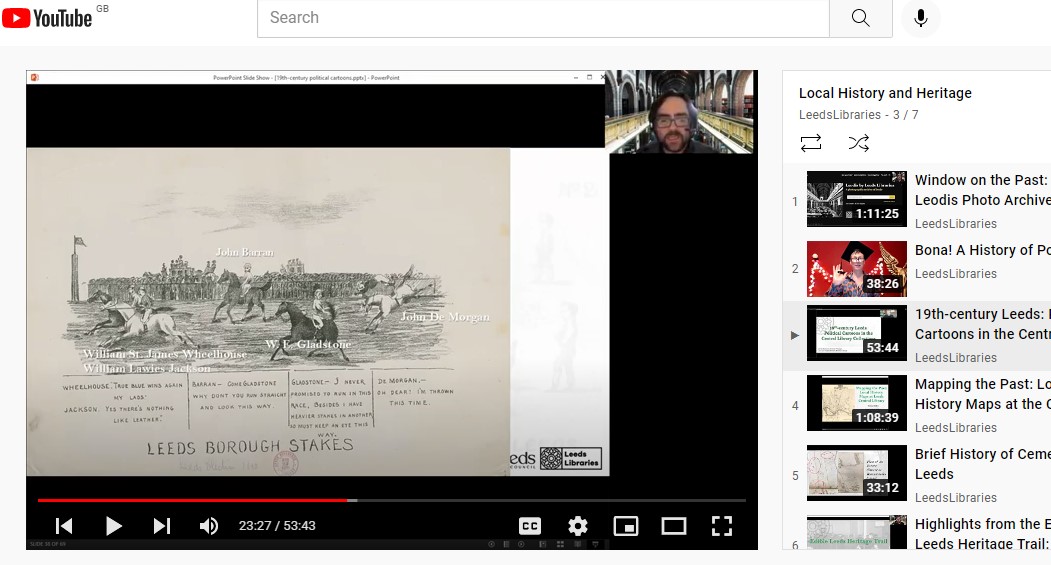
Recording events is a great way of ensuring as wide an audience as possible can engage with the content at a time of their choosing. Copies of the recording can be sent to everyone who initially booked a ticket, including those who were not able to attend. Recordings of some events – e.g. talks – might be suitable for uploading to a video-sharing website, e.g. YouTube.
Uploaded talks can be made available for as long as you or your organisation wants them to be – a way of ensuring the permanent (or, at least, long-term) preservation of the research and material covered in the talk or event. Check if your organisation has an institutional preference for which hosting site is used (if any).
If you are recording any online events you may need to read a GDPR statement to attendees before beginning, making them aware the recording is happening and of their right to remove themselves from the session if they do not wish to be captured during the recording (though most platforms only capture the speaker and attendees if they make a comment or other intervention). Delivering GDPR statements is generally the duty of the host during any introductory speech.
Accessibility
Online events will be attended by customers who are partially-sighted or hard of hearing: closed-captions can usually be added to events, or you can pre-emptively ask speakers to ensure they are providing good descriptions of any images they are showing.
Bear in mind the diverse needs of customers before setting up online events – consider whether an online event’s format means it will be inaccessible to some audience members – see YouTube’s guide to adding closed captions for more information: https://support.google.com/youtube/answer/2734796?hl=en#zippy=. Can some events be in-person instead, or a mixture of live-streaming and in-person?
Evaluation
Demonstrating the impact of online events uses the same primary metric as in-person events: how many attendees were present? It may be a good idea to send a survey to attendees afterwards, asking how many customers had attended online who had not previously attended in-person library events. Similarly, a comparison of in-person with online attendee figures may yield informative data about the intrinsic benefits of the latter.
A mixture of in-person and online events is perhaps the future for library services, though as yet largely untried. Additional technical support from relevant organisational departments may be required, at least on the first few instances.
Positives and negatives
Online activities allow your service to reach a much wider range of people than in-person events, where someone’s attendance can be limited by physical proximity, accessibility needs, etc.
Online events can remove some of those barriers – but be aware that they can add others, most especially barriers for those who lack digital skills or access to technologies. Signposting to colleagues who deliver digital skills sessions may be useful in these situations.
Another disadvantage of online events compared to in-person is that it is harder to showcase relevant stock or resources at the event, and audiences who do not usually use your library building no longer have a reason to enter the space.
There is much less personal interaction, whether between patrons and patrons, or patrons and librarians – often further projects and activities are developed from conversations and encounters before and after physical events; something much less common, possibly non-existent, at online activities.
Nevertheless, online events have come of age since March 2020 and are clearly here to stay – they are now, and will remain, a key tool in the modern local studies librarian’s toolkit.
Got something to add?
Do you have any comments, suggestions or updates for this page? Add a comment below or contact us. This toolkit is only as good as you make it.
Most of us will have examples where items in our collections aren’t what they seem – a photo is not of the place where it says it does on the back; a book has a map which may be a little dubious and fanciful; or a book may have information which isn’t backed up by footnotes or other indications where it came from
I’ve been caught out a few times at events. In Derby I was showing a group round on a tour and had photos of their village out to show them examples of what we held in the library, but they immediately said some of Well Dressing photos I had out couldn’t be their village as the theme was religious and their village never did those, even if the back of the photo said it was that village.
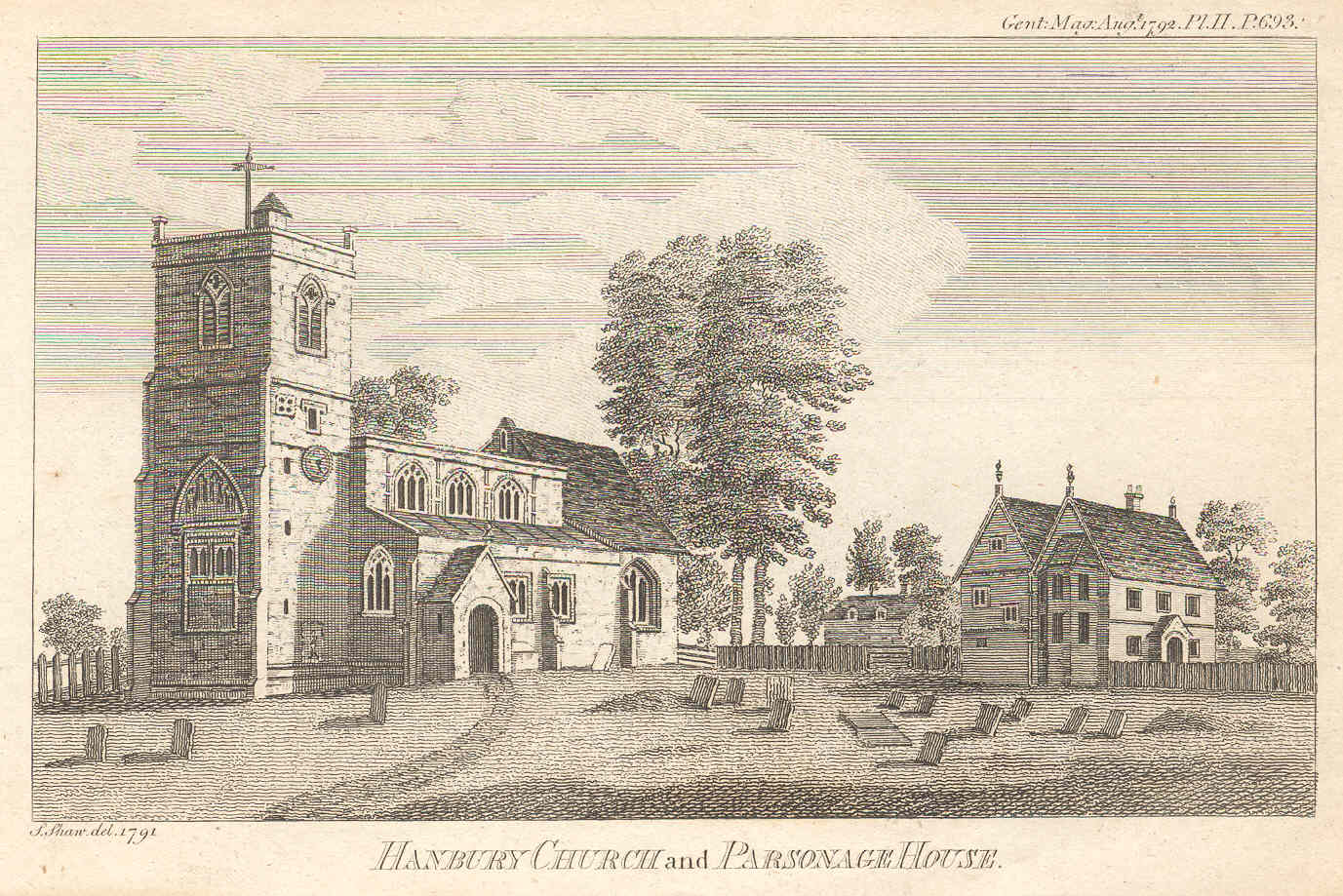
Speaking to Hanbury WI in Worcestershire I showed them various images on powerpoint, including an engraving of their church (which also doubles as St Stephen’s in The Archers!), which they all insisted wasn’t Hanbury Church. A little embarrassing! This was a bit strange because the actual engraving said it was. Was it pre Victorian alterations, with a bit of artistic licence thrown in? Then someone, when I mentioned this story to them later, said they wondered if it was a different Hanbury. I searched the internet, and yes it is Hanbury Church in Shropshire, not Worcestershire. Someone obviously came across the engraving and passed it to us, assuming it was our Hanbury and we added it!
Hanbury Church in Shropshire, not Worcestershire
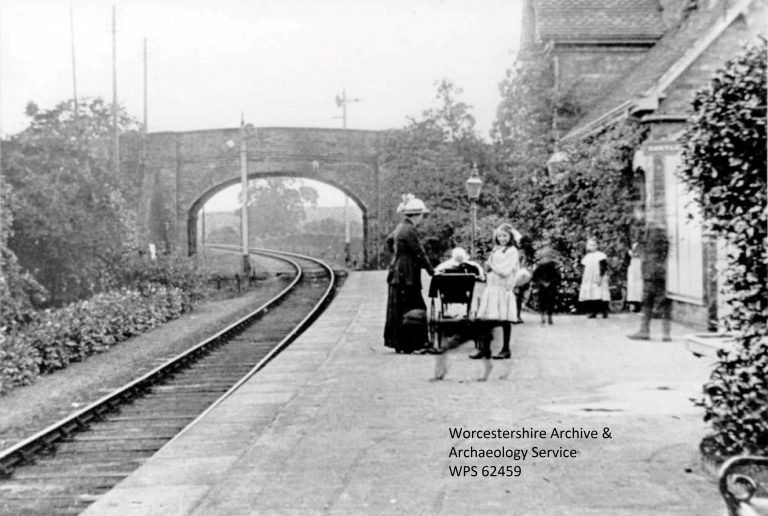
Sharing on social media opens up the possibility of people sharing their knowledge and letting us know if we’ve got anything wrong. What we thought was a photo of Broadway Railway Station which we put online is in fact Harvington Railway Station – the former was double lined and the latter single lined, so the description was obviously wrong and we’ll update.
Listed as Broadway Station, it’s actually Harvington.
As none of us are experts on our entire area we’ll all have plenty of times when we need to go with what something is labelled as.
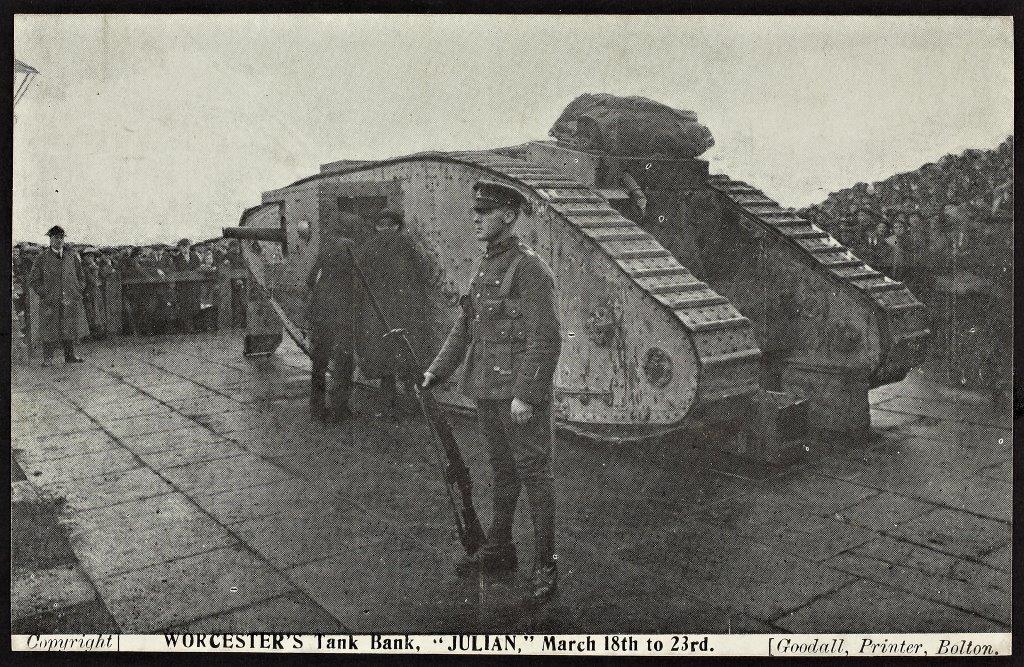
I recently came across another image wrongly titled, but one created 100 years ago and with the location printed on a published postcard. For the WWI Centenary in among the many images we used during exhibitions and projects was one of the Julian Tank in Gheluvelt Park Worcester. The Julian tank toured round the country helping to collect money from the public for the war effort. It would attract big crowds who flocked to see this new-fangled contraption, and it was ideal for encouraging donations to the Tank Fund.
Postcard which claims to be of the Julian tank in Worcester
Goodalls of Bolton produced postcards of the visits of the tank to the different towns. Except… they are not Julian and they are not of the place they say they are. I came across this when researching it to add information alongside the photo recently. The full story can be found on a website (warning – rather colourful language!). It seems Goodalls did the 100 year old version of photoshop, taking out distinctive backgrounds, and adding names of places and dates to the image to sell as postcards around the country! Apparently, the exact same image can be found with numerous town names printed on. You may have one in your collection! It shows you can’t always take what is printed on a postcard at face value. So it looks like we’d been incorrectly using it during centenary events.
So, as we have probably all found out, things aren’t always as they are described.
Now that I’ve become a library user (viruses permitting), rather than a staff member, I can’t help noticing how many events and initiatives are arts based. I suppose that this is partly because the Arts Council has national responsibility for libraries and grants for activities come from them. This must bring in new audiences who can make use of local studies collections in different ways, but I worry that it an emphasis on arts rather than learning might have its drawbacks.
I’ve always believed that local history and family history are important because they are the most democratic form of education available to anyone. Anybody can walk through the door and decide for themselves what they want to study and how. They can interact with other people through chatting to others in the library or through societies – or they can work completely on their own if they wish. They don’t have to pay fees to an educational organisation, they can pick whatever aspect of history that interests them – and, if they adopt proper research techniques, their work has equal value to professionals in the field. Very few subjects allow complete amateurs opportunities like this. In my working life I came across many people who had not done well at school and had come to regret their perceived “lack of education” – local history gave them a second chance to learn, on their own terms. I can’t count the number of people who complained that the history of “kings and queens” which they encountered in their young days at school was of no interest to them. Local and family history is not only of interest because it concerns our immediate environment but it also focusses on the past lives of people like us.
Many years ago family history was regarded as a rather pointless exercise of collecting names and dates. Nowadays its value as a way of learning about our past and how society works is as evident as in the study of local history. But students learn so much more – research techniques (both online and with documents), how to evaluate evidence, how to analyse evidence, how to present findings etc etc.
To me this is what makes local studies collections important.
Creating Local Linkages is a free online course for library staff to develop skills in research and digital local history. It has been designed by the Institute of Museum and Library Services and the Roy Rosenzweig Center for History and New Media. Originally run as a credit-bearing course, it is now available for free, self-taught learning.
The five modules cover topics including:
developing research/public history projects
locating and understanding primary sources
using Omeka to publish digital collections
copyright, permissions and re-use
understanding the Dublin Core Metadata Schema
planning outreach activities.
Although it has an American focus, it would be suitable for library, archive and museum staff in Britain. It would particularly suit members of staff new to digital history or public history projects. Start here: https://locallinkages.org/course/ and work through at your own pace.
 CILIP Local Studies Group