Toolkit – Indexes & Transcriptions

Return to Toolkit homepage

Traditionally a mainstay of local studies and family history society projects, indexes and transcriptions give us access to high quality and obscure information contained in valuable sources. Current digitisation projects build on these techniques to make digitised material more searchable.

Collection and retention:

Local Studies Collections should collect and retain high-quality indexes and transcriptions relating to material held within their collection area.  These include:

  • Newspaper indexes and cuttings files – often created by local studies staff and contain high quality information not easily found anywhere else, but the decline in local print media and a lack of time and resources may make these difficult to keep updated.
  • Parish registers – often undertaken by local history societies and volunteers, these include the names, dates and other details found in registers of baptisms, marriages and burials.
  • Monumental inscriptions – often undertaken by churches.
  • Census transcripts –  some of the first transcriptions were undertaken by local history societies and these are often of a higher quality than later versions found on genealogy websites like Ancestry.
  • Microfiche copies of the IGI (International Genealogical Index) – Although largely superseded by Familysearch, the IGI is still a high-quality though selective index to parish records.
  • Other archive material books – companies such as the EurekA Partnership (The Eureka Partnership – Family History, Ancestry, Family Tree | The Eureka Partnership) still produce amazing publications from primary sources locked away in Record Offices.

Digitisation of paper indexes

Many index creators have digitised their work and local studies staff should also consider doing so. One service which has done so for many years is Hertfordshire Archives & Local Studies, who started by digitising their parish record indexes and then asked volunteers to create new name indexes from other records in their collection. Users from all over the world can now use their  Hertfordshire Names Online database to order copies of records and newspaper articles.

Why create indexes and transcription in the digital age?

Computers cannot be relied on to interpret digital copies of text… yet. OCR software can often create excellent transcriptions of books and pamphlets. Free software, such as that provided by Google and other providers can do a good job of interpreting newer material, though pay-for programmes, such as ABBYY FineReader, produce better quality results.

OCR software has not yet mastered older typefaces, including some newsprint, nor most handwritten material, so the services of volunteers or external suppliers are still of value. As those who have struggled with family history resources know, the quality of an online resources is only as good as the information that gets placed into it, so large amounts of data checking is often required to ensure a good result.

Examples of transcription guidelines include:

US National Archives transcription guidelines

Smithsonian ‘s transcription Guidelines

In house or crowdsourcing?

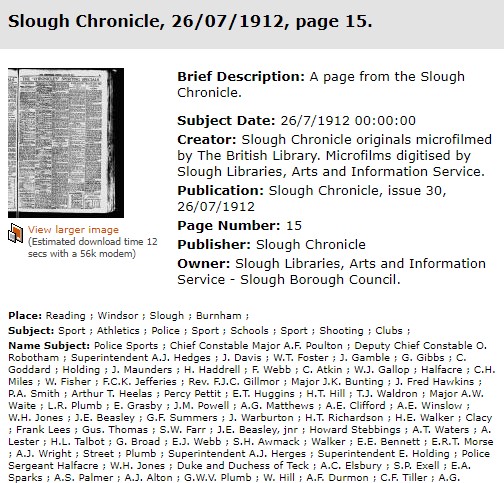
Libraries and archives traditionally invite readers into their libraries to transcribe material, however once material has been digitised volunteers can volunteer from the comfort of their own home. The great advantage is that much more work can take place, for example, virtually all the main newspaper pages from Slough History Online were indexed by one volunteer. However, the amount of work produced by such enthusiastic volunteers can be a challenge for smaller units.

Archive projects, such as AnnoTate have used crowdsourcing as a way of transcribing large amounts of archive material:

Of course, like the National Archives, the answer could be a blend of the two: Current opportunities – Get involved (nationalarchives.gov.uk)

Got something to add?

Do you have any comments, suggestions or updates for this page? Add a comment below or contact us. This toolkit is only as good as you make it.
Return to Toolkit homepage

One million pages made free on British Newspaper Archive

The British Library have announced that around a million pages have been made free on British Newspaper Archive. This is thanks to a new agreement between the British Library and Findmypast, who manage the British Newspaper Archive

A million new pages will added every year for the next four years. The focus will be on titles well out copyright in the years 1720 to 1880. Users will still need to create an account with BNA to view the titles, but will not be charged. Titles of interest to local studies professionals include:

  • British Miner and General Newsman
  • Cobbett’s Weekly Political Register
  • The Poor Man’s Guardian
  • The Atherstone, Nuneaton, and Warwickshire Times
  • The Barrow Herald and Furness Advertiser
  • The Dorset County Express and Agricultural Gazette
  • The Potteries Examiner 
  • Shropshire Examiner and all round the Wrekin Advertiser
  • Stockton Herald, South Durham and Cleveland Advertiser 

The full list can be found here: https://blogs.bl.uk/files/free-to-view-british-library-newspapers-list-9-august-2021.pdf

Event: How to share Public Library digital collections with People’s Collection Wales

Delivering culture and heritage to audiences online has become increasingly important in 2020.

CILIP Cymru Wales (CCW), CILIP Metadata & Discovery Group (MDG), CILIP Local Studies Group and People’s Collection Wales (PCW) invite librarians across Wales to an online PCW session, which will show librarians how to share digital content, re-purpose it via the Hwb and Living memory initiatives, and measure its impact – all via the PCW site

This webinar will be followed up with bespoke training to help libraries in Wales get their collections online.

Details

Join via Zoom on Friday 20 November, 12-1pm.

The session is free and open to all. Register via the event page.

Session outline

  • About us: People’s Collection Wales
  • An introduction to uploading digital content to PCW
  • An introduction to linking content from PCW to Hwb Learning and teaching for Wales
  • An introduction to linking content from PCW with the Living Memory initiative
  • An introduction to measuring digital impact
  • Discussion: what next?

At the end of this session participants will be able to:

  • Identify materials for uploading to PCW
  • Describe materials for upload to PCW
  • Identify opportunities to develop new resources for Hwb and Living Memory
  • Identify opportunities to promote and evaluate your users’ digital activities on PCW
  • Tailor subsequent training sessions around what you need to start sharing content via PCW.

The webinar will provide a useful oversight for all library and information professionals in Wales hoping to improve user engagement with digital collections. It will be particularly useful for public library and archives staff with local studies collections.

Presenters

People’s Collection Wales: Tom Pert, Gruffydd Jones, Rheinallt Ffoster-Jones Jessica Roberts

Facilitators: Amy Staniforth (CILIP Cymru Wales), Jane Daniels (CILIP Metadata & Discovery Group)

That gem of local studies just starting to be found by Google: local history society journal backruns

You know when somebody comes up with a statement and, later on you think of the perfect answer but, by then, it is far too late….. this is the one I was given together with what I should have said

You know, when I started working at the history centre, I thought I would much prefer working in the library, but I’ve really like working with the archives.

Yes, who can resist historic old documents, plus the very old books in the bookstore. But it is very hard work. Somebody might have done all of the hard graft already and, if they have, the answer would be in local studies.

Of course, the bibles of local history are the ones that you always refer too, such as The History of Slough by Maxwell Fraser. Though the real gems to less common answers, I often found, were in the journals written by enthusiastic historians – some of which go back to the nineteenth century. In those days, unless catalogued, indexed separately or browsed through by curious library staff, they just sat there gathering dust.

Imagine my delight when, being lazy, I did a google search for a 1930s map I once saw, and up came this…..

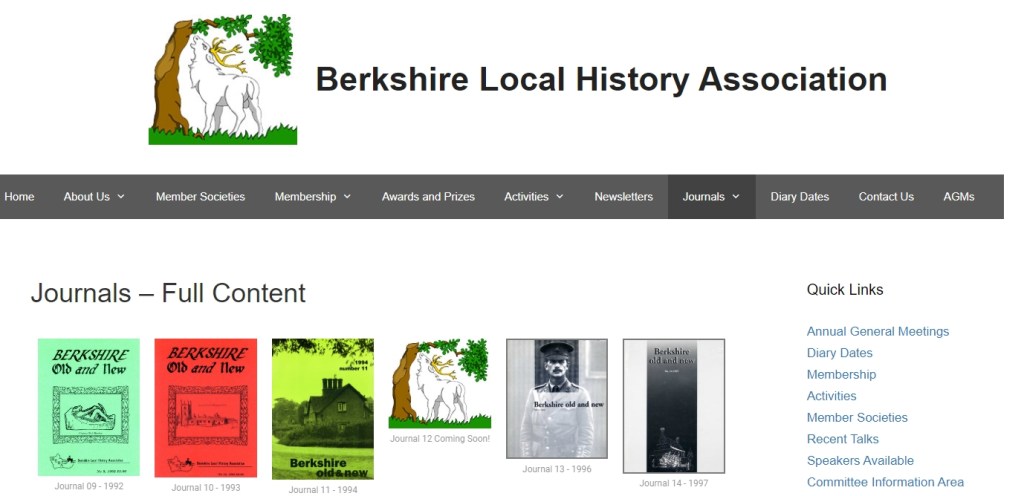
http://www.blha.org.uk/journals-full-content/

BLHA had digitised the vast majority of their journals, the articles are all searchable and can all be found by Google (or your own Google custom search engine or a site search e.g. by putting slough site:blha.org.uk into your google search box).

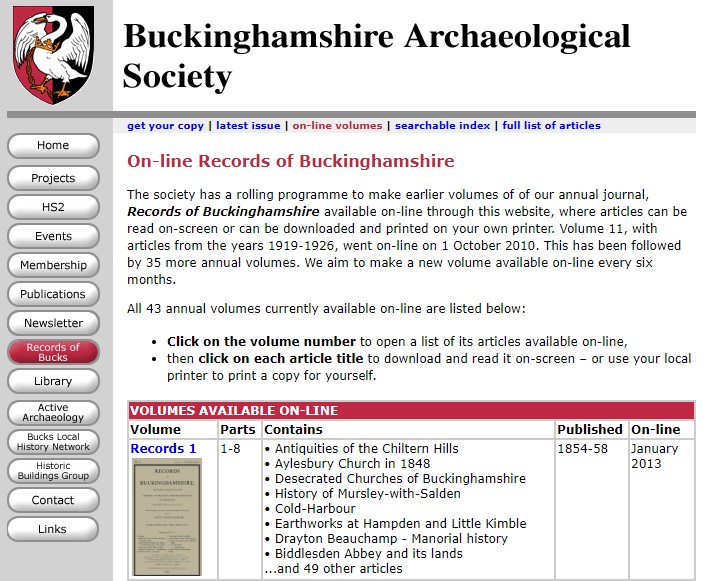
I won’t tell you how happy I was to see that Buckinghamshire Archaeological Society have gone back to 1854……..

http://www.bucksas.org.uk/onlinerecords.html

[Thanks to their volunteers, John Dodd, Peter Marsden, Jeff Pepper, Ken Wallis and Marion Wells, who have heroically digitised 35 of the 43 volumes so far!]

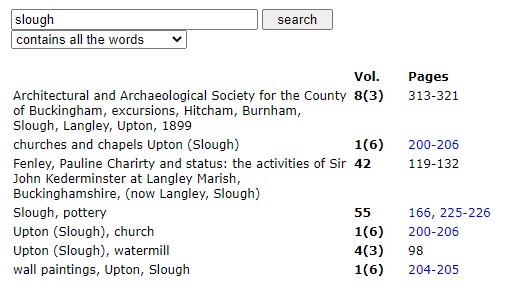
But Records of Bucks hasn’t stopped there – they have an index with hot links to the digitised articles!

http://www.bucksas.org.uk/list.php

Of course, it has only taken eight years to come up with this very long riposte to that pro-archives comment. But, if the person who said that statement ever stumbles over these words, I hope I have gone a little way to change their mind.