A couple of months ago I asked local studies guys whether we they do and whether we should continue to microfilm local newspapers. I kicked off discussion with a blog post. Well the results are in! Thank you to the Eight Scottish and Eight English library authorities answered my call and the results are…
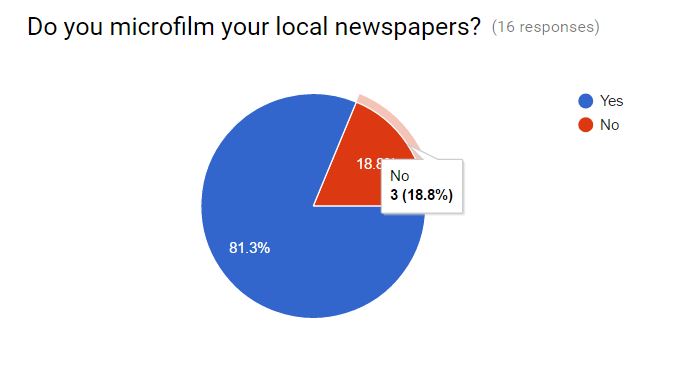
I hear what you cry…. well that it not a very good sample. I agree. Plus it is going to be rather skewed towards those authorities that still have enthusiastic local studies librarians who read blogs like this or subscribe to the right twitter accounts.
What was much more interesting was the opinions of those guys who left comments. They group into themes:
- Still relevant to the twenty-first century local studies library…
We absolutely want to continue providing our customers with microfilm archives of the local newspapers. They are an essential local and family history resource which we want to continue to update as one of our remits is to “preserve for the future”. Many of our customers just want to browse through the old newspapers as opposed to looking for individual items, and they are an essential tool for our social historians, students, etc.
We are aware that more and more newspapers are becoming available online, usually with a cost involved to the customer (i.e., via ancestry and find my past), but microfiche newspapers are also an invaluable tool for our own staff members to be able to carry out research quickly and efficiently within our own premises.
Our microfilm newspapers are the most popular resource besides Family History indexes – without microfilming we would not have a service.
We have a straight run of [out local newspapers]…. This means we have ownership, and unlimited pubic access. These are heavily used.
2. But there are technical considerations…..
My concern is how much longer we can afford to service the microform machines (and how much longer replacement parts will be available) and how access to them will be limited when we are open to the public but unstaffed. Regular users know how to use the machines but first time users are often very rough with the machines causing damage to them and the microfilm/fiche.
3. Though on the other side……
Since we still had other material on microfilm and fiche, including parish registers, census information etc we also needed to ensure that we still had equipment which enabled this to be available for our customers. We have not regretted this decision as the added benefit has been that customers and staff remain confident using the equipment and only new staff require training.
4. But it is rather expensive in a time of financial constraint….
I will try and keep the filming continuing for as long as possible, although the recent announcement of still further cuts to our budget may make that more difficult
5. It is still the trusted long-term answer
We also film our principal local paper for the paper itself. I do believe that filming still has a place even with the move towards digitisation; it’s a proven, stable format that also has the benefit of simplicity.
I know the British Library does provide the security of someone else making copies of our papers, but there’s no guarantee that we would have money available to access their resources (we only subscribe to the Gale C19 newspapers at present, and cannot afford to extend this to the newer and wider coverage British Library Newspapers) in the future.
6. Alternatives are not necessarily the prefect answer….
Whilst the growth in online access is on the whole good, especially if searches are available, there is still a problem of the quality of what is on offer. One of our local titles recently made available by the British Library is so poorly executed that searching frequently results in a list of gobbledygook. With the added cost which adds insult to injury. Known items not being found at all. So yes microfilming still has its place.
There is now free access online to our local newspapers going back to 2007 but searching can only be carried out on each individual issue.
7. You can try and fudge the answer……
Only microfilming negatives so public don’t get access, and get annoyed they can’t see them
8. Top tip…..
UK Archiving provides the service – so we don’t have to send them hard copy of current newspapers – they have their own mysterious ways of getting the copy.
9. There is still work to be done by the professional bodies……
I think it would be better to have pdfs of the more recent copies although I would want there to be support from the ARA or CILIP for standardised rights agreements with local newspapers, and guidance on how to manage digital copies.
10. But on the other hand…..
We never used to microfilm anyway – local paper used to do it. We still keep hard copy of everything, plus cuttings files though.
The one big conclusion is that it a fascinating subject which would make an excellent topic for a MA dissertation…….. LSG might even be able to help with publicity and some expenses.
Did you miss adding your views to the debate? If you did, leave a comment below.

 CILIP Local Studies Group