Toolkit: Conservation

Return to Toolkit homepage

Local Studies is a blend of special collections and lending library work. As such you have to treat lending and branch stock completely differently to material found in a local studies hub.

There is always a tension between access and preservation. With use local studies materials will deteriorate, however there is no point keeping most material if it is not used. After all, a large amount of local studies material is not unique. Pragmatically, judgements will be made on an item by-item basis, however there is a lot we can do to extend the life of our collections.

Lending & branch stock

As with all other lending stock in public libraries, local studies lending material needs to be attractive and kept in good condition, but unlike the majority of lending books, it should be durable as the contents of the book are unlikely to be replaced by a newer version. You can extend life of a title by:

  • Bind likely to be well-used paperbacks. Get your binders to use the original covers as part of the new boards.
  • Ensuring that hard-back cover protectors are cleaned and, when necessary, replaced.
  • Ensuring that you buy a good quantity of new publications. If a title is going to have a short print run and will be a valuable resource, you should factor in that some copies will be damaged and lost in the years ahead.

Storage

Storing materials in appropriate conditions is the best way to ensure long-term survival of materials. Each format has its appropriate packaging and storage conditions and those are described in the appropriate parts of the toolkit.

High replacement cost or low availability of a replacement may suggest that access should be restricted, however if an item cannot be browsed easily, or if it is stored away from the main book stock, it will be used less often.

Format specific guidance

Advice on storing different types of library stock can be found in the appropriate parts of this toolkit, however the National Archives and the old British Library website has some useful general advice on storing delicate materials:

https://www.nationalarchives.gov.uk/information-management/browse-guidance-standards/?letter=c&keyword=conservationhttps://web.archive.org/web/20220306212848/https://www.bl.uk/conservation/guides

Repackaging

Repackaging collections is a very valuable activity, but can also be extremely time-consuming, however there are some other ways you can do it:

  • Get staff reassigned during computer outages.
  • Hold an annual local studies help day. Staff are asked to drop in for an hour during a day and give you a hand. This is a good marketing tool and good for staff bonding.
  • Many companies lend groups of staff to organisations for community days.

Storage conditions

The British Standard for archival and library storage is set out in BS 4971:2017. This standard is used by Special Collections and archives and gives guidance on ideal conditions for storing important parts of collections.

Material should be protected from direct sunlight, dust, pests and atmospheric conditions. If material has to be stored in direct sunlight, film can be placed on windows to filter-out harmful rays. Dust damage can be limited by using boxes and regular cleaning. Insects and atmospheric should be monitored using pest traps and the temperature and relative humidity should be tracked.

It is unlikely that local studies collection will be in ideal storage conditions, but a quick regular check of conditions can pay dividends. A lot of damage to collections can be avoided by moving material away from areas where roofs are known to leak, spotting when widows become damaged and spotting fire risks.

Handling:

To help reduce the amount of damage caused by readers and staff using delicate material, make sure that:

  • book pillows are available for readers using delicate books
  • weights are available for those using rolled maps
  • cotton gloves are available for those handling photographic material

More information on handling rare materials can be found here in the old British Library guide, courtesy of the Wayback Machine

National Archives also provides some interesting information on handling rare items in differing formats:

https://www.nationalarchives.gov.uk/about/visit-us/researching-here/handling-documents/rules-and-handling-aids/

Surrogates

If certain materials are delicate but of wide interest, can a surrogate be made? If it is that popular, should it be digitised and/or microfilmed and placed online? Has it already been digitised by someone else, such as Archive.org, Google Books or the Hathi Trust? Under copyright law, publications can be photocopied for preservation purposes if the copy is kept for reference only.

Conservation

Delicate materials can be stabilised. Local Studies materials should be conserved and not restored – you are not returning the item back to its former glory but stabilising the object and making it less likely that further damage will be made through handling. As such, any work undertaken on an object should not be hidden.

Using professional conservators

Local studies collections should enjoy some support from the conservation unit in their county record office. However, if extra support is required, you can find contact details of conservators via the Institute of Conservation’s register: https://www.conservationregister.com/

In-house conservation projects

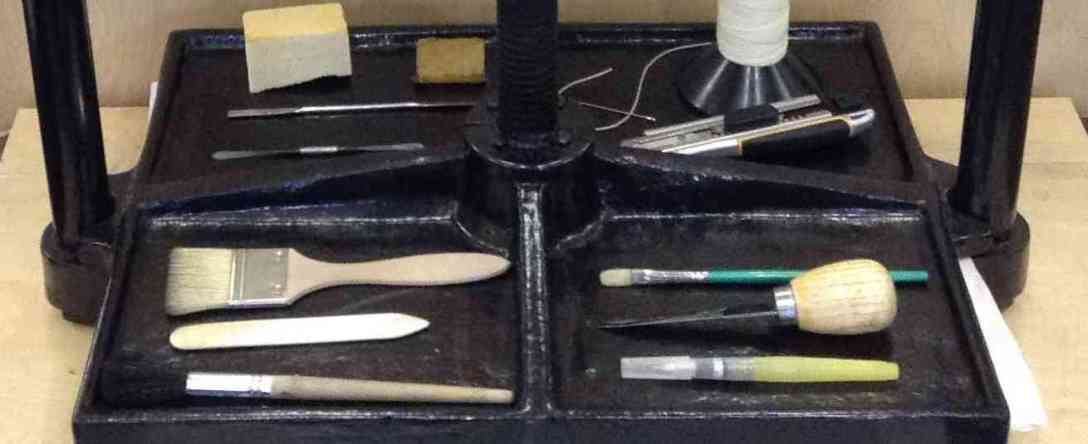
Repackaging should be the first conservation priority for a local studies collection. However, after receiving training from a conservator, members of staff and volunteers can undertake a range of basic conservation tasks. These can include:

  • Cleaning material using brushes and smoke sponges
  • Basic paper conservation, including using water pens to remove folds and using starch glue and Japanese paper to repair tears.
  • Re-sew pamphlets with rusting staples
  • Make phase boxes to protect delicate books

As with all projects, work has to be closely monitored. Conservation works should also be recorded, ideally on the item’s catalogue record.

Initial training for such projects may be available from your county record office, from free-lance conservators such as Caroline Bendix or through organisations such as the Historic Libraries Forum: https://historiclibrariesforum.com/events.

Rather than create an in-house volunteer project, you should consider approaching your local branch of The Art Society. Members of the Art Society can be trained to undertake paper conservation by in-house tutors. The upshot for collections is that, for the cost of travel plus tea and coffee, they can undertake conservation tasks for you. They also do a large amount of the volunteer management role too – the librarian’s job is to liaise with the volunteer leader.

For more information on the Arts Society, then known as NADFAS, read the second post on this page: https://www.webarchive.org.uk/wayback/archive/20130626183045/http://communities.cilip.org.uk/blogs/lsgblog/default.aspx

Conservation suppliers:

Got something to add?

Do you have any comments, suggestions or updates for this page? Add a comment below or contact us. This toolkit is only as good as you make it.

Return to Toolkit homepage

Social media

Return to Toolkit homepage

Social media are interactive computer-mediated technologies that facilitate the creation or sharing of information, ideas, career interests and other forms of expression via virtual communities and networks. Wikipedia 

Why use it?

Most of us will be familiar with social media and use it personally so know the benefits (and problems!). Social media is also a way of publicising your service and resources. Increasingly it is where people look for latest information, and some organisations and companies now see this as their main way of communication with users rather than websites. You can get your service out among users and seen by hundreds if not thousands of users. Social media can be seen as more personal than a website, and people can respond to what you’ve posted and you can then respond to them.

It allows quick distribution of information, for instance if the library has to close early in an emergency. It also provides an easy way to share stories and images, whereas sometimes it takes a long time to get things added to corporate websites.

Journalists often search social media for stories, so media enquiries can come from reading something you’ve posted.

Local Studies collections are a fantastic resource for social media.

Main types

Blog – allows longer articles to be shared. There is often a comment facility although it is best to enable moderation on this.

Facebook – individuals join and then request friends, join groups and follow organisation pages. People (or groups) post stories, images and videos.

Twitter (now X) – sharing 240 character tweets (posts). Threads and BlueSky are alternatives which work on similar principles.

Instagram – photo (and video) sharing platform.

LinkedIn – a professional networking platform. You can create you own personal profile and engage with others and make contacts, and share stories about your service with potential partners. You can also create a profile for your library/service.

There are various others such as Tik Tok, Tumblr, Mastadon, Flickr. Each has their own character and focus, so will vary as to whether they are suitable for your purpose. Social Media trends change rapidly, and what was popular one year may wane the next, and there will be new platforms launched. Keeping track of everything is hard.

Account options

Do you have Local Studies account or just contribute to a wider library account? Check with your Comms Unit for advice as each organisation will have different policies. Some may allow numerous accounts to be set up across Libraries, with each library having their own account and a local studies account may be possible. Other may restrict, so local studies will feed into a larger account. The latter may have benefit of introducing new users to local studies and requires less content to be created.

If an account is shared by several administrators, then co-ordination is needed as to what is posted and when.

If there is a generic account for your parent organisation (e.g. Local Authority) make contact and let them know any good content they might like, as they are often looking for interesting content. Tag them in so they can reshare. Some Comms Units may not know you so it is a chance to let them know the treasures available.

Social Media Policy

Your organisation may have policies about social media so check with your Comms department. If you are contributing to another account they may also have a policy so you will need to be aware of it and fit in with their ‘style’. Most accounts have more than one Admin so the usually policy is that they all conform to the same style so people don’t know the difference.

It is best to stay clear of controversial topics and think if something could be misinterpreted. For instance if you are posting a photo of a past flood because there are current floods then be aware people may have been badly affected and phrase accordingly. If a local council scheme is controversial you may want to stay clear of posting something linked to it, or get advice. 

If people comment you should try to comment, if relevant, acknowledging comments and providing more detail if available. Most libraries and heritage organisations have very few nasty/angry/controversial comments, but if you do you may want to get advice as to whether to ignore them or to engage and explain. Some organisations, though, have found an increase in negative posts on some platforms in recent years, so have decided to close some accounts.

Posts

These are some suggested advice for some of the most used platforms. You can usually get a feel for these and others through reading posts from others, and there is plenty of advice online.

Blogs – longer articles, normally a few a week maximum and not more than one a day. Takes time to write and research so post less frequent.

Facebook – No limit to text but usually 3 or 4 images maximum and a couple of paragraphs. May link to a blog. Usually only post one or two a day at most, and need to do at least one a week. Can link to a blog so people can read the longer article.

Twitter (X) – 240 characters so short and sharp, with maximum 4 images. Can tag other organisations in who may reshare. Can share link to blog. Most people see tweets in chronological order and there’s no problem in posting numerous tweets in a day, and repeating tweets to ensure as many people as possible read them. You can now link tweets as well, so if you need longer than 240 characters you can have a thread of several tweets, but it is still good to be as concise as possible.

Instagram – Photos/Videos are the main focus, so choose eye catching images.

Content

The best way to see what is good content is to look at similar organisations. You can get lots of ideas from them so have a browse. Local Studies, as you may be aware, have fantastic resources for social media as we have amazing collection. Keep an eye on the stat pages on the platform to see how well different posts are doing, which is also important to record to show your managers. Quite often you’ll be surprised at what is popular.

  • Service updates – new additions, changes to access, opening hours, sudden closures or still open in bad weather. Many organisations don’t update their website now with this information and just update social media.
  • Topical – is it a frosty/rainy/snowyday? It is the budget, Sports Relief, has a popular TV series just started or something just hit the headlines?
  • Hashtag Days – Just every day is a particular day, such as Biscuit Day, Handwriting day, as well as other more well known days such as Shrove Tuesday, St Patrick’s Day, World Book day or May Day. 
  • Anniversaries – VE Day, Birth/death of a monarch, local anniversaries can all be the focus of a post
  • People are also interested in old photos (you may well have plenty in your collection), especially if they can reminisce.
  • Funny/Strange stories or enquiries
  • Oldest/Biggest in your collections
  • Subjects people are in studying (with their permission if mentioned)
  • Famous people in the archives
  • Events – advertise your workshops/talks and other events

Examples

These are a few Worcestershire examples, posted by Worcestershire Archive & Archaeology Service (posting under the Explore the Past brand) which have proven to be very popular and may inspire you.

Image

A frosty morning inspired this photo being shared of the frozen River Severn.

Image

When we saw this 1890 newspaper story of a hairdresser letting off a cannon in their bedroom we knew it would be popular. A host of questions spring to mind!

A sales catalogue for Bag End is always popular when it has been shared whenever there is a Tolkien anniversary or a film is released.

Image

This Fish & Chip shop in 1968 on #NationalFishAndChipDay (7 June) caused a lot of reminiscing about going to the chippy in the past.

Copyright / Permissions

Putting images on social media is publishing so make sure you have permission for anything you post!

You may want to ensure images are lower resolution (but enough to look ok) and post your library name on along with any reference (in case people follow up and ask for it) in case people cut and paste or copy which they may do. Many people think if it’s on the web they can feely use it, so will use on their own websites and social media without permission or acknowledgement. Another option is watermarking.

Check you have people’s permission before posting photos of them online.

Evaluation

If you’re spending time on social media then you want to see how successful it is, for yourself and to show others. Again there’s plenty of advice online about measuring it. Views are good to record, but they are part of the story. Interactions, such as sharing, likes or replies, can be more useful to show how much interest it’s generated. Some statistics need interrogating further. For instance a 10 minute YouTube video may have 100 views, but when you check only 50 views were over 1 minute, and only 10 were for more than 5 minutes, giving an indication of how many people took an active interest.
Another indication is whether people responded in a way you wanted them to. Did they supply information requested, follow a link to complete a survey, or attend an advertised event? It may be that a post advertising a tour of the local studies library was really popular and reshared and liked many times, but very few people actually book.

Beware!

It can be very time consuming, and responding to messages can be one of the hidden extra tasks. Have a plan for what you will do, and revisit it, to help avoid being overwhelmed. Ensure your manager is aware of how long it takes too. Being part of a larger team can help.

Remember that some elderly or disadvantaged customers do not use social media (but don’t assume, as lots of older people use it) – ensure other methods of communication are also used such as local newspapers, council flyers and posters.

There are many forms of social media and people have different preferences, and each has a different audience profile. So you may either just reach a proportion or have to use several platforms.

The social media landscape changes rapidly. Remember when young people were using Bebo, and having a MySpace account was the in thing? Then in late 2024/early 2025 quite a few organisations starting to switch from Twitter/X to BlueSky or just coming off it altogether, due to concerns over the toxic nature, and also the decline on people on that platform. You may be reading this article and thinking how out of date it sounds! So you will need to keep re-evaluating you social media policy which is of course is extra work.

Got something to add?

Do you have any comments, suggestions or updates for this page? Add a comment below or contact us. This toolkit is only as good as you make it.

Return to Toolkit homepage

Toolkit: Archives

Return to Toolkit homepage

Local authorities have discretionary powers under the Local Government (Records) Act 1962 (LGRA 1962) to provide archive services. Most councils have taken up these powers and provide public archive services at either a county or city/town level. Since the 1980s/1990s, the tendency has been for archives services to operate jointly with local studies services, particularly in unitary authorities.

Some smaller unitary authorities have not taken up the discretionary powers to provide archive services themselves, in which case there may be an agreement with a neighbouring authority to provide archive services. The library service may hold some types of archives as part of its local studies service. 

Archive collections

Libraries are empowered to hold archives under the Public Libraries and Museums Act 1964, provided that this does not become their dominant function. Typically, archive collections held by libraries include personal papers, records of local organisations, and records of the council such as minutes of meetings. 

Libraries may also create “artificial collections” of material. These collections comprise items that have deliberately been collected according to format or subject rather than records that have accumulated as a result of particular functions or processes. Examples of “artificial collections” often collected by library staff include photographs, newspaper cuttings or maps. In many cases, these items have lost details of any provenance and original order so care should be taken by library staff in adding to these artificial collections. Archival integrity should be a paramount consideration.

Archival integrity

Archival integrity means that records are identified and maintained according to their provenance, not intermingled with records from other creators, and maintained in their original order (this is known as the principle of “respect des fonds”). Ideally, there should be documented evidence of an unbroken chain of custody. 

Public records

Unless the library service has been appointed a place of deposit, any archives held by libraries must not include records such as public records or most manorial courts records. These are covered by specific legislation.

Public records are records created in central government departments or agencies, the courts and the National Health Service. Where these are administered locally or regionally – e.g. hospitals, courts, coroner’s service – it may be that the National Archives has authorised local record offices as places of deposit for these records.

The Keeper of Public Records has responsibility for the day-to-day management of public records, which may only be held by The National Archives or by a place of deposit appointed under the Public Records Act 1958. 

Where local authorities have not taken up discretionary powers to provide archive services and/or have not been appointed a Place of Deposit, responsibility for relevant public records, including those created locally, is retained by the Keeper of Public Records. 

The Archive Service Accreditation Scheme is used to ensure appropriate standards are maintained by Places of Deposit. 

Further information on public records, including a list of Places of Deposit, is available on The National Archives website: 

http://www.nationalarchives.gov.uk/archives-sector/legislation/approved-places-of-deposit/

Archival Description

Staff in libraries holding any archive collections should be particularly mindful of archival principles of provenance and arrangement by original order. Archival collections must not be catalogued or classified as if they were library materials. The usual terminology is that archives are listed or described, rather than being catalogued.

Library cataloguing typically treats materials as individual items and classifies them according to subject, regardless of where they originated.  By contrast, an archive collection needs to be listed as a whole, with its provenance and custodial history recorded, and the arrangement of items reflecting the context and hierarchy of the collection. 

The General International Standard for Archival Description (ISAD(G)) defines the elements that should be included in any archive listing. Encoded Archival Description (EAD) is closely mapped to ISAD(G) and uses mark-ups or tags to distinguish elements of archive descriptions in a way that can be interpreted and processed by computer systems. ISAD(G) is a structure standard, not a content standard, so it defines which fields should be included, not what the content of those fields should be.

There is no archival equivalent of a library classification scheme because archives are arranged as far as possible in the order by which the creator kept the records, rather than having an arrangement imposed by an archivist. As each individual creator of records is likely to have a different way of organising records, it is not possible or desirable to have a standard scheme of arrangement by archives. 

In practice, many archive collections may arrive as unstructured piles of documents in boxes or bags, but the principle remains that the arrangement should not be imposed by an archivist but should reflect the organisation, functions and processes that produced the records.

The closest to a standard scheme of arrangement is the Local Government Functional Classification Scheme (LGFCS), which was developed by the Information & Records Management Society in February 2019 to replace the previous Local Government Classification Scheme (LGSS). This is often used by records management staff in local authorities as the basis on which to organise current council records. In this case, the LGFCS may be a useful starting point. Check with your authority’s Records Manager if you find yourself in a position of having custody of local authority records. The  2019 version of LDFCS is available to IRMS members only, but the 2006 version of the LGSS is freely available:

https://irms.org.uk/resource/collection/1F3924BE-78BA-49E2-906B-1E5B672687A2/lgcsword2.03.doc

Most library management systems are unable to cope adequately with archive collections and attempting to include archives in a standard LMS should be avoided. The National Archives has a list of suppliers of collections management systems (CMS) and digital asset management systems (DAMS) that are suitable for listing archives and storing/managing digital assets:

https://www.nationalarchives.gov.uk/archives-sector/advice-and-guidance/managing-your-collection/cataloguing/cataloguing-and-archives-networks/

If you are a librarian responsible for looking after archives and do not have access to a professionally qualified archivist, then it would be advisable to consider undertaking a basic archives awareness course. Training courses and other events are often advertised on the Archives-NRA mailing list.

The Community Archives and Heritage Group has developed a set of guidelines for community archives, which have been designed to meet the minimum standard for archival description whilst being straightforward and accessible.

Got something to add?

Do you have any comments, suggestions or updates for this page? Add a comment below or contact us. This toolkit is only as good as you make it.

Return to Toolkit homepage

Toolkit: Directories

Return to Toolkit homepage

Trade Directories are an early form of Yellow Pages, providing names of tradespeople, and also giving a brief summary of each town and village. They were published from the late 18th to mid 20th centuries.

Guide to resources inside and outside your collection

Trade and street directories are well-used sources of information by family and local historians. They can be used to find out where someone lived and what they did for a living. Their strong commercial focus means that they are an important source for the economic and business history of towns or regions. Their topographical information provide important clues on the built environment and geography of the past.

The first directories were published in the late 18th century. As Britain’s economy and urban areas grew in the 19th century, so did the publication of directories. They remained an important genre of reference information into the mid- 20th century. The best-known trade directory is Kelly’s, a London publisher who issued county directories from the late 1830s. They also published the Post Office Directories. Pigot and Slater, based in Manchester, were Kelly’s main national rivals until they were taken over in 1853.

Some publishers produced directories for particular professions or industries e.g. Jones’s Mercantile Directory of the Iron District of South Staffordshire and East Worcestershire … [1865]. The focus on commercial information means that many directories carried advertising (usually in a section towards the back), and they are a great source for images and illustrations.

There were also many regional publishers and some towns had their own directories. These provide even greater detail on local people and institutions. For instance, some will list the head of household at each address in the town.

The need for timely commercial information meant that directories were regularly updated. If you have a run of directories in your collection, then you can document changing information over many decades.

Trade Directories are usually arranged by town/village, with a section arranged by trade and one by tradesperson in alphabetical order sometimes included. There are normally useful classified indexes at the back of each volume too.

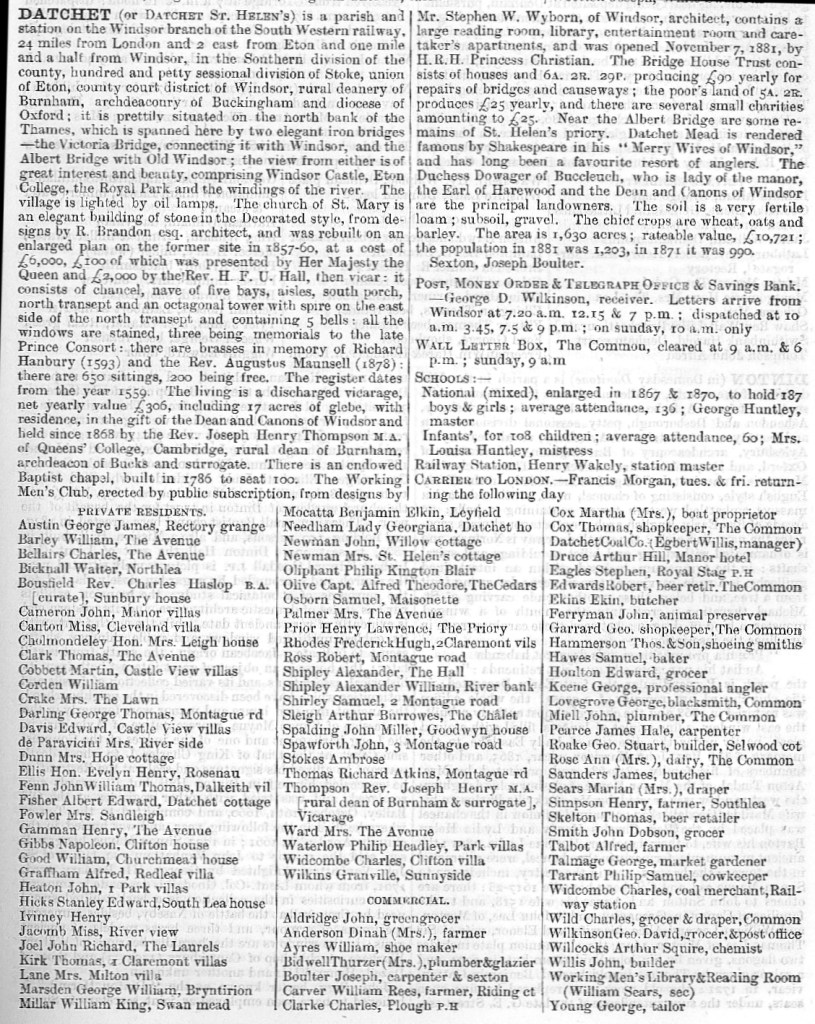
The town/village summary will list all the different administrative areas the location is part of (helpful for guiding where to look for other sources), brief history/summary of church and manor, key crops and industries, soil, population and key landowners. Public institutions are listed with the contact name. Private residents are listed, although just the wealthy ones, and then tradespeople.

(above, extract from Kelly’s Directory of Buckinghamshire, 1887)

Town directories will provide the same information, but with more detail. However, as the name suggests, they only cover some towns rather than a more thorough survey provided by the County directories. Some have a street directory with the head of household listed. They will go in house order, indicating side streets, so can be helpful for pinpointing a property if you think numbering has changed. The detail of the building and street information has made directories an invaluable source for investigating how pub names have changed over time!

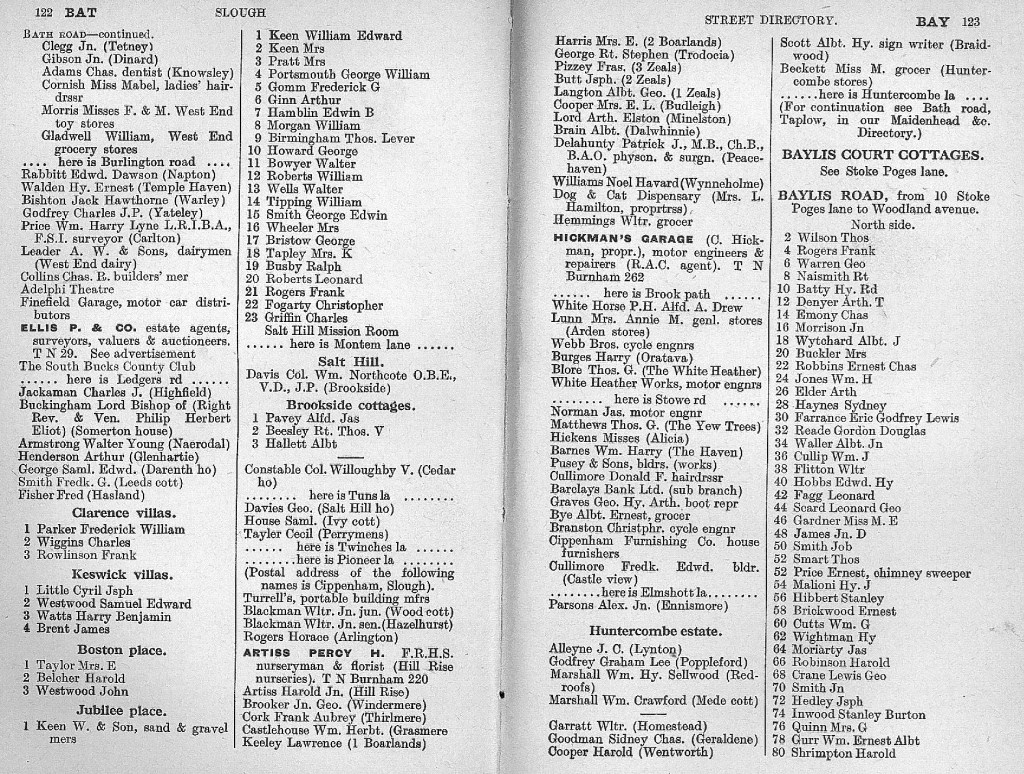
(Section from the Kelly’s Directory to Slough, 1932 edition)

Telephone directories, including Yellow Pages, are also available. They get bigger as more people get telephones.

Online collections

Some trade directories can be found on Ancestry and Find My Past. Ancestry also took part in a project to digitise British Phone Books from 1880-1984, however the indexing is very poor. Often it is worth searching for a common name and then scrolling through pages until you reach the appropriate page.

Back in 2002, the University of Leicester digitised over 600 English and Welsh directories in a searchable format. There is at least one directory for every English and Welsh county for the 1850s, 1890s and 1910s. The current version can be accessed: http://specialcollections.le.ac.uk/digital/collection/p16445coll4

The background pages and online bibliography are good starting points for general contextual information. The collection has been added to Ancestry and family historians may find this version easier to search. For further guidance on using the website, watch the video below:

The National Library of Scotland has digitised over 700 directories dating from 1773 to 1911. Again the background pages are a very useful starting point. The collection is available here: https://digital.nls.uk/directories/

Preservation and storage

Trade directories are books, so preservation and storage should be the same as other books. Some have maps folded in the back or other extras which may need extra care or storing separately. They can be very thick so that can cause problem with the spine.

Directories can be valuable, collectable and irreplaceable so may need extra security. Early examples from the 18th and early 19th centuries should not be on open shelves.

Physical arrangement and cataloguing

Trade Directories can be stored on the bookshelves of Local Studies collections, although as mentioned they can be valuable, so some choose to have them in locked cabinets or on demand.

Most directories can be added to library catalogues along with other books.

Innovative projects

Dig Lich Street was the public engagement of an archaeological project in Worcester. The road by the cathedral was being altered to allow the creation of a new public square, and a roadabout was being removed. Excavations took place on the roundabout in advance of the new road being built over it, and the old Lich Street was uncovered. Directories were really important in enabling the story of site to be told, alongside the archaeology. The history of each property, whose foundations and cellars were uncovered, could be told. Directories provided names of occupiers, and occupations, over many years. Although around 1905 the numbering system changed which caused a bit of confusion to the project team until this was realised!

Got something to add?

Do you have any comments, suggestions or updates for this page? Add a comment below or contact us. This toolkit is only as good as you make it.
Return to Toolkit homepage

Toolkit: Copyright

Return to Toolkit homepage

Intellectual property

Local studies librarians must be aware of the implications of copyright and other intellectual property rights relating to the material held in local studies collections.

Intellectual property rights include trademarks, patents and copyright. In practice, it is usually copyright that has the most impact on local studies materials and it is important for local studies staff to have a sound understanding of copyright in order to be able to manage the use of materials and the supply of copies.

Copyright

The principle behind copyright legislation is to protect works of the mind for a certain period of time. During the time that these works are protected, only the copyright owner has the exclusive right to copy the work, distribute it to the public, rent or lend it to the public, broadcast it or send it via electronic transmission.

The aim of copyright legislation is to balance the moral and economic rights of creators of intellectual works with the needs of users to access and copy material. The guiding principle is that the legitimate rights of copyright owners should not be unduly prejudiced by works being copied in whole or in part without their permission.

What does copyright cover?

The Government website has a simple guide to what’s covered by copyright.

For something to be protected by copyright, it has to be original and must be fixed in some way, e.g. by being written down or recorded. An idea in itself is not protected by copyright.

Copyright is an automatic right so there is no formal registration process.

How long does copyright last?

The main legislation governing copyright in England & Wales is the Copyright, Designs and Patents Act 1988 (as amended).

Copyright always expires at midnight on 31st December in any given year.

A work may have multiple copyrights that each expire at different times. For example, the rights holders of a published book may include the author(s) of the words, the artist(s) who created the illustrations, and the photographer(s) of any images. In addition, the publisher also has copyright in the typographical layout of the book.

Standard copyright terms are:

  • Literary, Artistic and Dramatic works are in copyright for the lifetime of the author, plus 70 years after the author’s death
  • Typographical arrangement is in copyright for 25 years from the end of the year of publication
  • Sound recordings are in copyright for 50 years from creation (or when first released to the public if within 50 years of creation). Note that this relates to the recording only, not the work itself which may have its own separate copyright.

There are a number of exceptions to these standard terms, particularly for works created before 1957, or between 1957 and 1969, or works that were unpublished by 1st August 1989.

The duration of copyright in these cases depends on whether the name of the creator is known, when the work was first made available to the public, and when the creator died in relation to when the work was published.

Many works, including some that are more than 100 years old, are in copyright until 31st December 2039 because they were unpublished by 1989. Prior to the 1988 Act, unpublished works were in perpetual copyright. When published, they then received copyright protection for 50 years from publication date. The 1988 Act stated that any unpublished works were deemed published on 1st August 1989 (the date the Act came into force) meaning that copyright will expire after 31st December 2039.

Many documents that are held by local history libraries and archives were unpublished by 1989 and are therefore in copyright until 2039.

The National Archives has produced a really useful copyright flow chart that enables you to work out whether or not copyright in a particular work is likely to have expired.

The duration of copyright in a work is not affected by who owns the copyright (e.g. the right could be owned by an employer rather than an individual employee).

Who owns the copyright?

The first copyright owner would normally be the person who created the work, unless it was created by an employee during the course of their employment, in which case the employer will own the copyright.

For photographs taken between 1st July 1912 and 31st July 1989, the first copyright owner was the person who owned the negative at the time the picture was taken.

The present copyright owner may be a direct descendant of the first copyright owner but copyright may also have been assigned to a third party or have been bequeathed to someone in a will. It could also be gifted or sold by the originator and local studies collections should normally seek to be gifted the copyright if they accept a donation of non-published material. If the copyright is owned by a company and the company has been dissolved, then copyright may be bona vacantia unless separate provision has been made.

Tracing the present copyright owner may be very difficult – see the section “If a copyright owner can’t be found”.

The National Archives guide to copyright includes more details of the first owners of copyright as well as information on Crown Copyright.

When is copying permitted?

If you want to copy something and you are not the copyright owner, you first need to establish whether it’s still in copyright and, if so, whether copying the amount you want for the purpose you intend falls within an existing copyright exception.

The National Archives has a really useful copyright flow chart that should enable you to check whether or not something is in copyright.

If it is in copyright, and there is no Creative Commons licence or other permission already assigned to it, then you either need to:

  • ask the copyright owner for permission to use it (which may involve paying a licence fee)
  • check whether the copying you want to do falls within an existing exception to copyright (this includes limited copying for ‘fair dealing’ for non-commercial research or private study, as well as copying for teaching). Librarians and archivists in some institutions also have additional permissions to make copies for particular purposes under the ‘library regulations’ or ‘library privilege’ (SI 1989:1212).

Libraries and other cultural heritage institutions also have permission under Orphan Works legislation. The Government’s guide to their replacement to the EU’s Orphan Works directive can be found here: https://www.gov.uk/guidance/copyright-orphan-works. The scheme allows a diligent search which finds no know copyright owner of an item to be checked and registered by the Intellectual Property Office and the fees for non-commercial applications are modest, but some have questioned how much use registering a diligent search would be.

Guidance on the changes to copyright exceptions in 2014 for particular types of users (e.g. researchers, teachers, librarians and archivists) is at:
https://www.gov.uk/government/publications/changes-to-copyright-law

The Copyright Licensing Agency offers licences to copy that are tailored for businesses, charities, educational institutions, and public sector organisations.

LACA and CILIP have produced free posters for libraries to display near self-service copiers to explain what copying may be permitted.

Infringing copies

If you copy something that is in copyright without permission from the rights owner, and it’s not covered by a copyright exception or licence, then it is an infringing copy and you are at risk of potential legal action.

The Intellectual Property Office has a list of offences and potential punishments for infringement of intellectual property law, including copyright.

Photographs and other artistic works

In practice, it’s usually images that cause the most difficulties as these are often the items that people most want to copy and reuse.

Artistic works were not included in the fair dealing provisions of the original 1988 Act, but were included in regulations that came into force in October 2014.

It would be unwise to assume that images on the internet have been lawfully copied and are automatically available for reuse. There is a cautionary tale from a blogger who had thought that the widespread reuse of images online meant that there was no problem in using images from other sites on her blog provided that credit was given and images were taken down promptly if requested. This proved not to be the case.

DACS (the Design and Artists Copyright Society) has a section of their advice portal relating to exemptions for the reuse of artistic works: https://www.dacs.org.uk/advice/articles/copyright-infringement/permitted-uses.

If the copyright owner can’t be found

If it’s known that something is in copyright but the current copyright owner isn’t known or can’t be found, then the work is deemed to be an “orphan work.”

Copying an orphan work without the permission of the rights holder would be a copyright infringement (unless covered by an existing exemption). However, the Copyright and Rights in Performances (Licensing of Orphan Works) Regulations 2014 introduced a UK government licensing scheme that enables orphan works to be used without permission from the rights holder, provided that a diligent search is carried out and a licence is issued by the government.

Further information on the scheme is at: https://www.gov.uk/government/collections/orphan-works-guidance

Assessing copyright risk

The National Library of Scotland and the National Library of Wales have developed and adopted a Copyright Assessment Framework for Libraries. This is designed to be a practical tool to assist in assessing copyright risk and making decisions relating to the copying of literary, dramatic and artistic works. It does not cover sound recordings, films, broadcasts or database rights.

It is likely to be of particular use for libraries and collecting organisations undertaking mass digitisation projects.

Further details are available by emailing the National Library of Scotland – copyright@nls.uk

Right of access charge

Libraries may levy a fee for use of material from library stock by authors, publishers, broadcasters, compilers of educational packages and other commercial interests.

This should be regarded as a ‘right of access’ fee and should not be confused with copyright payments. It would be advisable for the wording of any acknowledgement to be “images courtesy of x library” rather than any wording that suggests the library holds the copyright if it does not do so.

‘Right of access’ may not be granted in this way to items still held in unexpired copyright by external agencies or individuals, unless the library has written permission from the copyright holder. Some libraries also derive income from copyright fees for media use of material from library staff as part of local surveys, and other items for which the library holds full copyright.

Further Reading

Got something to add?

Do you have any comments, suggestions or updates for this page? Add a comment below or contact us. This toolkit is only as good as you make it.
Return to Toolkit homepage

e

Toolkit: Maps & plans

Return to Toolkit homepage

The perfect tool for showing how a geographic location changes through time and a useful tool to interpret other resources, including directories and photographs. 

“All good adventures begin with a map”, Treasure Island

Guide to resources inside and outside your collection

There are a wide variety of maps, although most people think of Ordnance Survey, and that is usually what they want.

Printed – engravings of town plans, Ordnance Survey and other published maps which are sold and for which there are numerous copies. Some may be annotated by their owner before being passed on e.g by the planning department

Manuscript – one off maps surveyed and drawn by mapmakers (although a few copies may have been made). These would normally be in an archive, although copies may have been made digitally or on microfilm, or in a printed volume, so there may be access to copies in a library.

Early mapping:

  • Mapping as we understand it goes back to 16th century although very few maps from the period.
  • County maps – maps were made of the county, often more for decoration so can have limited detail, and there may be errors.
  • Town Plans – large towns and cities began to have town plans produced from 17th century onwards, the first often being Speed maps c1605.
  • Maps can also come in all sorts of other formats. Local maps are useful for enquiries and finding where places are just as much as for information for customers. 

Ordnance survey:

  • Ordnance Survey began mapping the UK by targeting key military locations in Southern England in the Napoleonic wars. Over the early nineteenth century they slowly created county based surveys across the UK at 1” to the mile.
  • In the 1880s they published maps of the whole country at 6” (1:10,000) and 25” (1:2500), which were revised for a 2nd edition c1900 and 3rd edition c1914. Later editions were created, and in 1950s they resurveyed using a new grid system.
  • Most Libraries will also have the 1:25,000 and 1:50,000 and similar folded maps both current and historical.
  • More information about the history of the Ordnance survey can be found here: https://www.ordnancesurvey.co.uk/about/history 
1876 OS map, central Slough
1932 OS Map, central Slough

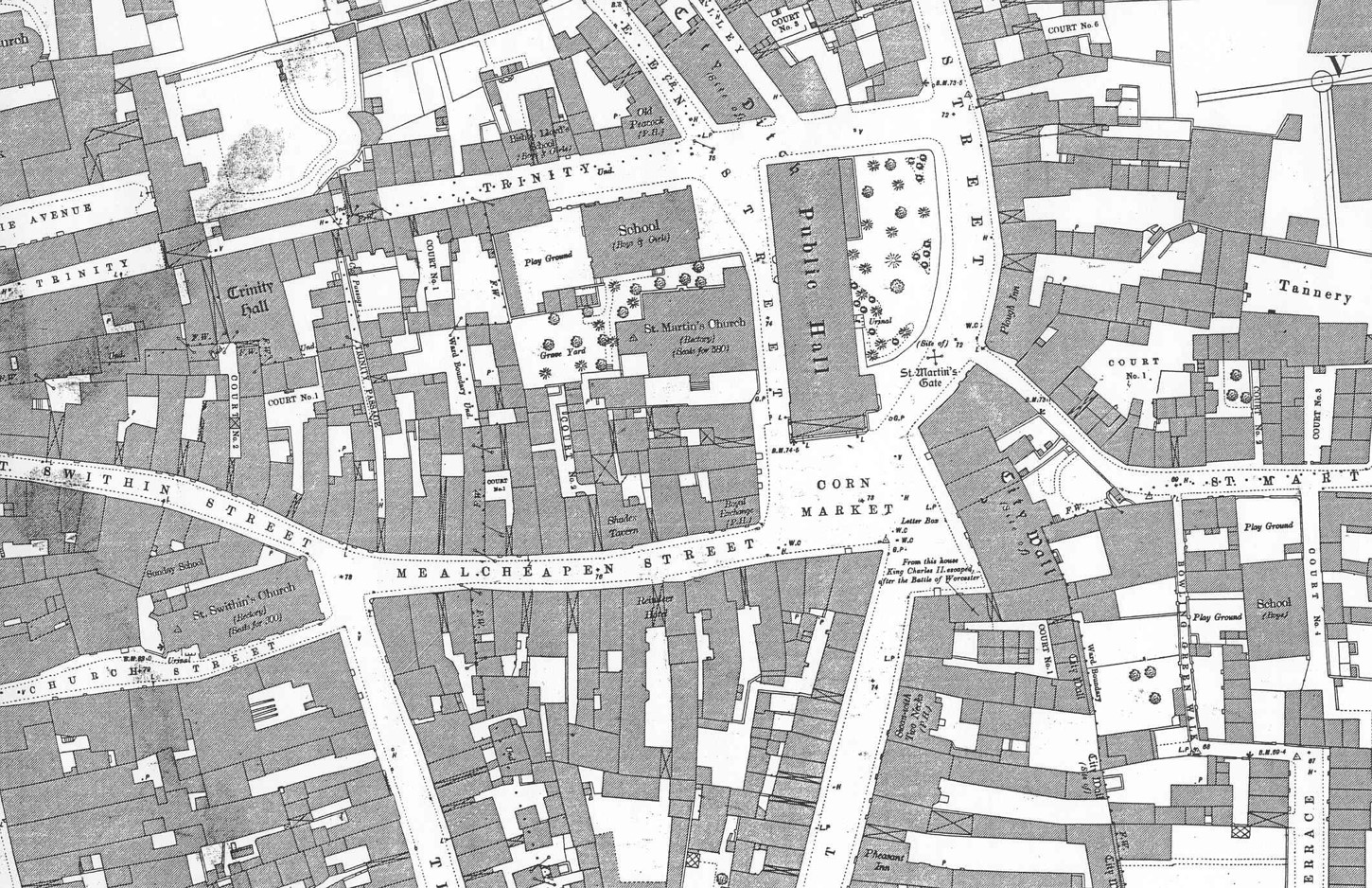
1888 25″ Ordnance Survey map of Worcester – note how much detail it includes

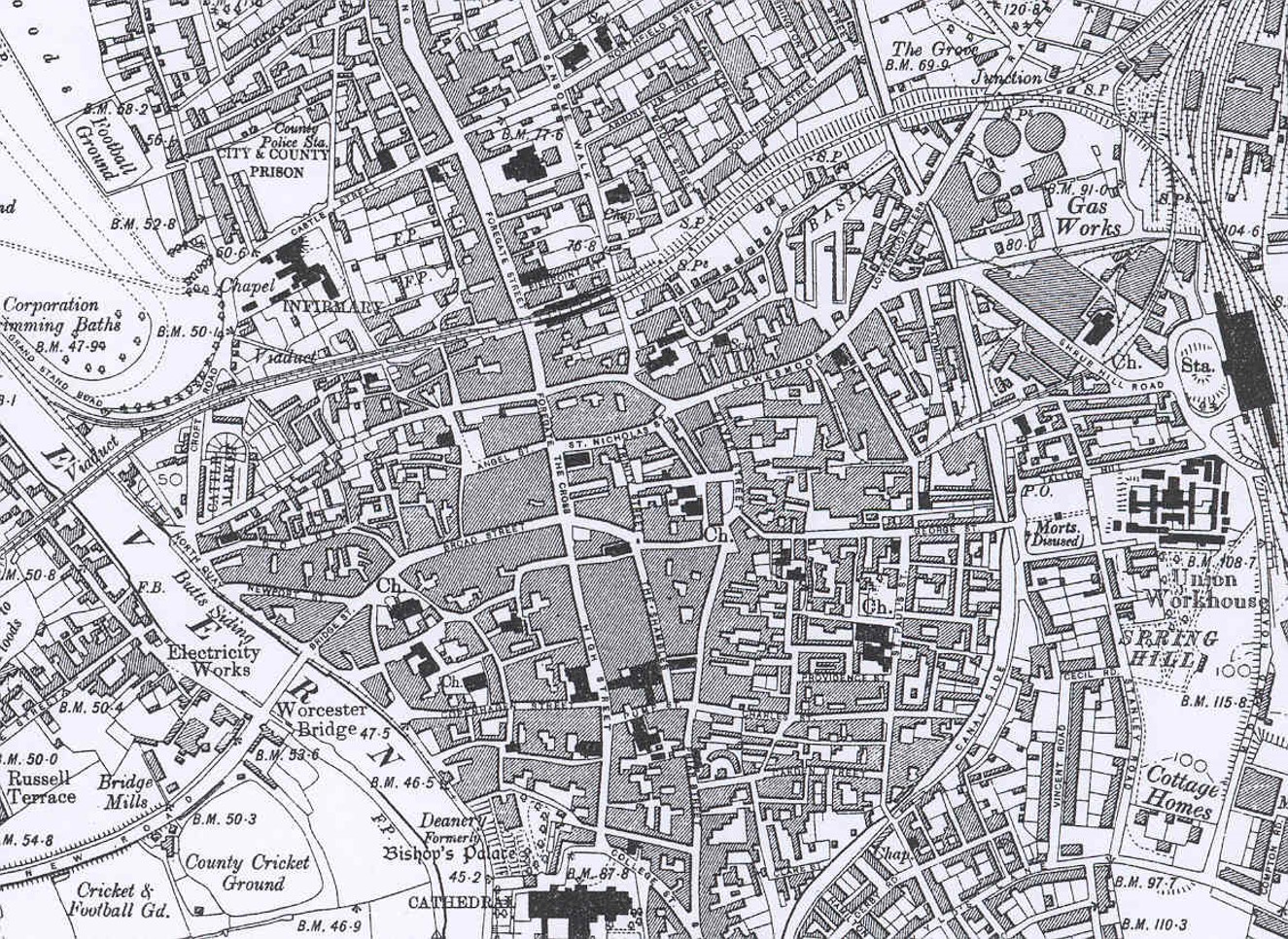
1901 6″ Ordnance Survey map of Worcester – to include all the buildings in the city centre some are merged together

Manuscript:

Manuscript maps are usually found in archives although some have been digitised or printed and are also available in libraries. Coverage will vary a lot as maps were expensive to create, some have not survived, whilst other may be other record offices or still in private hands. The main types are:

  • Estate – created by an estate owner so they can manager their land and also to show off their wealth so they are usually nicely decorated. May have tenant details. Very expensive so only shows land belonging to owner and infrequently created.
  • Enclosure (late 18th-mid 19th century) – map created to show new landscape after land was Enclosed. 
  • Tithe – early 1840s, produced to go alongside apportionment when system of Tithes was changed. Apportionments have landowners, tenants, land name, use and size included, related to numbered pieces of land on the map.
  • Inland Revenue Valuation Office Survey of 1910 (sometimes called New Domesday), which was a national land survey, so gives similar information to the earlier tithe survey.
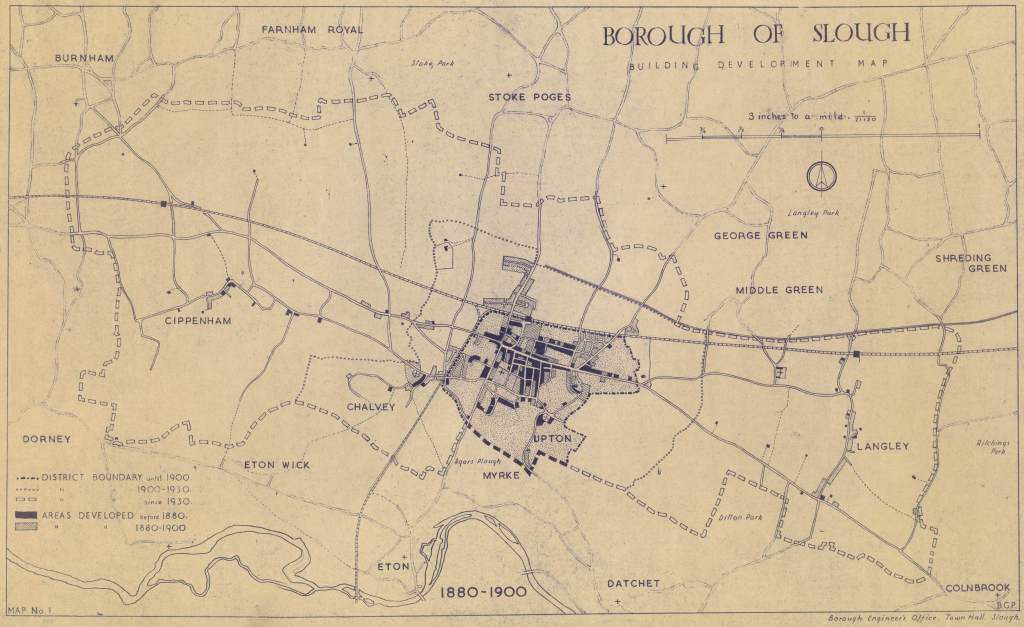
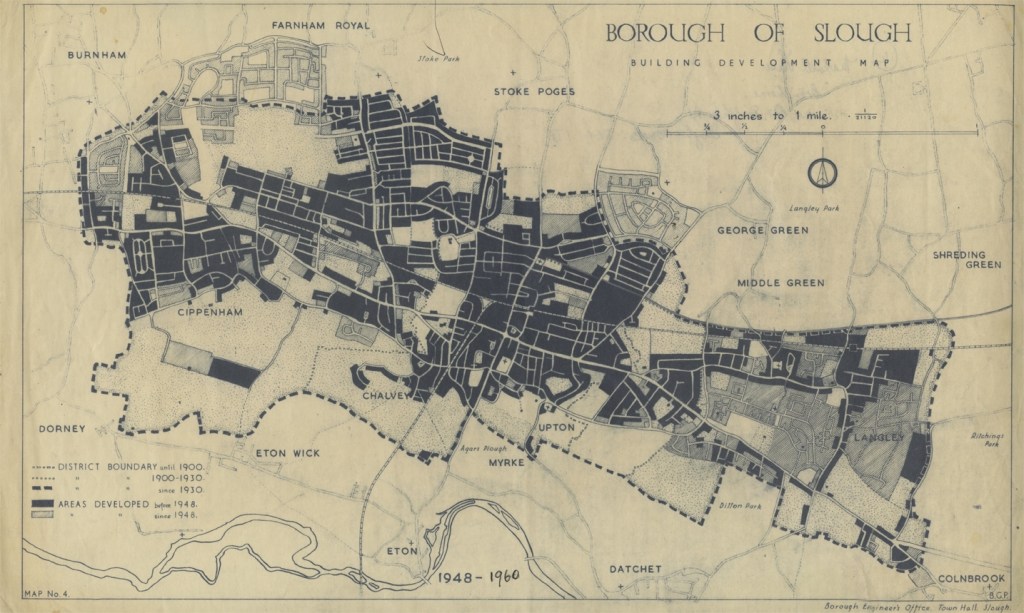
  • Local Authority development maps: Local authorities produce mapping, many of which were commissioned for reports and consultations. These can be goldmines of local information.
Above & below, courtesy of http://www.SloughHistoryOnline.org.uk

Others:

  • Street Atlas – most towns have street atlases such as A-Z or published by the local council
  • Goad – maps of town and city centres showing the occupants of shops. Originally for fire insurance purposes mostly used today by geography students! Part of the Experian group now so now officially called Experian-Goad maps.
  • Geology – maps of underlying geology published by British Geological Survey (www.bgs.ac.uk).
  • Other maps may cover electoral divisions, land use, streets, services, sewers etc.

Online mapping:

National Library of Scotland has digitised large numbers of UK maps: http://maps.nls.uk/index.html including

Prints of current mapping can often be accessed via local authority webpages, for example https://mol.rbwm.gov.uk/mol/map/. Check with you own local authority to see what is available to you and your users.

Gazetteer of British Place Names is a free resource that allows you to search for a British place name and the gazetteer will tell you the historic and current county, OS grid reference and longitude and latitude. Very useful for researching places and cross-referencing with old maps and other sources.

Other good older map websites include:

Historic Environment Records (archaeological databases for counties and unitary authorities, previously called Sites and Monuments records) are GIS based and have access to historic digital OS maps and sometimes other historic maps, as well as aerial photos and LiDAR data so it is worth checking with your local HER so you can advise what they have.

Modern maps are widely available online, though Bing https://www.bing.com/maps also gives you access to smaller scale OS mapping.

Obtaining new mapping

Local authority licenses often allow them to print maps for use by the local authority. Your planning office may be able to supply you with a set inexpensively. Though online versions of mapping can be updated easily, obtaining printed sets captures your area in time and users can then compare maps over time to see how areas have developed. Due to changes in how maps were published, many archives and local studies libraries will have stopped acquiring 1:1250 and 1:2500 OS maps in the 1990s.

Microfilm copies of the first and second editions of the County Series 1:2,500 is available from the British Library. 

Preservation & storage

Maps can be stored vertically in hanging cabinets, with strips attached with holes in from which they are hung, or else in flat map cabinets. Each has pros and cons. Vertical cabinets can be easier to go through.

Maps should not be folded as they will create weaknesses, although this can be hard due to space.

Some local studies libraries have maps on open access in cabinets, whilst others need staff to get them out. If open access please be aware of risk of public using big heavy map cabinets, and how to reduce maps being replaced in the wrong order.

Well used maps should be covered in conservation grade plastics. Conservation suppliers sell this plastic in rolls which can be folded and cut to size and then sealed with double-sided tape or sealed using special equipment. You can also purchase also sell large wallets made in common sizes.

Physical arrangement and cataloguing

OS maps have two different grid systems depending on whether they were produced before or after World War II.

Pre-World War II maps are numbered using a county-based two-level grid system whilst the post-war maps use the same latitude and longitude grid system OS uses today.

OS maps are not always easy for the pubic to use, and often need maps with the grids and map references marked on. They can be a struggle for staff too! Indexes can be produced which can make it easier for customers to find the right map.

Copyright

Maps are considered as artistic works, some of which have been published and some of which have not. Many maps are also based on OS mapping which makes life more complicated. See our copyright pages for further information.

Maps usually cannot be copied for planning applications, and people will need to buy and official copy. Although since most libraries don’t have 1:1250 and 1:2500 maps from the past 30 years there will be fewer people asking for them for that purpose.

Innovative projects

History Pin uses maps to connect places to stories and images: https://www.historypin.org/community 

Similar regional projects have been created, including Know your place West of England http://www.kypwest.org.uk/.

Know your place West of England includes the KYPWilts Postcards Project:

Bombs over Bucks uses the County’s mapping to show where bombs fell during World War II: https://buckscouncil.maps.arcgis.com/apps/webappviewer/index.html?id=6ab95f847d364d7597517809f7ffd2ac

For a historic orchards projects copies of maps were created which people coloured in the areas of orchards in an area, which conveyed the local importance as people could see how much land was used for this purpose at a glance. On similar principles you can use copies of maps for all sorts of base layers, annotating or colouring in items.

Further reading

JISCMail map curators group: https://www.jiscmail.ac.uk/cgi-bin/webadmin?A0=lis-maps 

Return to Toolkit homepage

Toolkit: Crowdfunding

Return to Toolkit homepage

Return to previous section of the toolkit: Larger projects –setting budgets

A quick reference guide to using crowdfunding (also known as crowdsourcing) for Local Studies Collections.

Crowdfunding is a way for organisations to quickly raise money for a given item or project. Examples include money to acquire or conserve a specific item, or for running a project, event or exhibition.

Types of Crowdfunding

Individuals can invest in a scheme in four ways:

  • Investment based – you invest in a business and receive a stake in return (normally shares).
  • Loan based – you lend money to individuals or companies in return for a set interest rate (peer-to-peer business lending).
  • Donation based – you donate to a person or charity (you may be promised something in return).
  • Reward based – you give money in return for a reward linked to the project or cause you’re supporting.

Only investment-based crowd funding is regulated by the Financial Conduct Authority.

There are a number of Crowdfunding websites to use such as Kickstarter, Crowdfunder and Fundable. Crowdfunder UK had been cited by Townsweb Archiving as the most popular and it is now in partnership with the National Lottery Heritage Fund.

When you have registered, set up your project page and once you’ve made it live, people can begin donating.

The National Archives ran a fundraising project between 2015 and 2018, providing training and support for those looking to grow the funding opportunities for their archive service. The legacy of this project has been to create e-learning packages on topics including Crowdfunding.

Points to Consider

The Stirling University fundraising team noted that one of the key advantages of crowdfunding is its potential reach. By using social media you can spread the word about your project far and wide, identifying and connecting with communities of interest around the world. Choose a collection with broad international appeal – a collection with an interesting story behind it, a connection to a major anniversary or event; use any hooks which might generate interest.

When designing the project for which you are seeking funding you should keep in mind the need to show supporters a return for their contributions. Your project should include work that makes a visible difference to your collection, something you can promote and share further down the line to demonstrate value. Remember the fundraising phase is only the beginning of your relationship with your supporters.

Not every collection you hold will be suited to a crowdfunding campaign.

As part of the local government, you should also have a persuasive case why people should pay extra money on top of their council tax.

Entrepreneur Europe notes that it takes a lot of time and resources to create a campaign. As already mentioned, you must have a handle – an engaging story to tell; a call to arms. The perks to sell must be tempting too. You must also persuade people that their money will be made good use of and will be safe. Include a ‘view pitch’ which is short and concise with a call to action. Spend an ‘amazingly’ long time on social media sites until the campaign is complete. Do your research before you begin. Be sure to know your target audience and have a clear and meaningful message and offer in place.

The Jenner Museum note that you need to constantly review your message as you receive feedback from those who have donated, altering your message to relate to what people are attracted to, which works as a kind of stakeholder consultation. Seeing how people responded to your initial message enables you to flesh it out further and translate into a better targeted campaign.

Developing your plan

What should your plan include? There should be an understanding of the external and internal situation and a goal. Donation and reward tiers can entice; include a well-developed case, campaign publicity, a plan to build ongoing relationships and to grow supporters for the long-term.

Do you have enough staff, senior management support, volunteers to do this?

  • Do you have a budget?
  • Do you have the technical capacity to do this? How best to keep a track of the donors?
  • Are you clear what you want to achieve?
  • Do you have the right processes in place? eg. gift aid or the ability to say thank you to donors?

Building your Crowd

How do you bring together a crowd to launch your project to?

What websites/social media channels would they use?

Think about your social media followers, friends and members, local networks, email lists, volunteers, community groups etc.

Working influencers

80% of people buy something recommended by an influencer. These ‘micro-influencers’ are people with expertise in a field but have thousands of followers. Target them to amplify your message and to help advertise and promote it. Try to build closer relationships with these people, even give them advance warning of news etc. Identify who your key influencers are. The Jenner Museum found a micro-influencer who spotted their campaign and sent it to his medical students in Canada. They built a local campaign for the museum there using a hashtag they designed themselves which proved very successful.

What are the key success factors?

  • Exciting design
  • Telling a story
  • Using a platform that makes the most of your material in an interesting format
  • Clearly showing the difference the money can make
  • Timing – tie it in to an event or centenary
  • Use feedback from initial supporters to help build your case and promote the message in an even more engaging way

What does a successful campaign need?

  • audience
  • short videos, images and external links improve success
  • website (for credibility)
  • perks or rewards and tiers (reward levels)
  • pictures
  • testimonials
  • multiple ways to contact you
  • the right ask/how their gift could make a difference
  • a short and intensive campaign
  • regular updates
  • sustainability projects are more likely to be successful
  • higher goals are less successful on average
  • provision of good quality information
  • You have to develop a powerful, tangible appeal which should feature on your website too, so that anyone who is visiting the site and considers making a donation has a strong reason for doing so.
  • Identify a need – eg. digitising a film collection
  • Find a solution – you need equipment, to pay for the cost of digitising, volunteers to help…
  • Impact – this will provide better access, a better understanding of history and connection to the local area, hidden stories to uncover – WHAT DIFFERENCE WILL IT MAKE TO THE DONOR?
  • Highlight strong individuals or stories in the history of the collection and why needs help/why it is important to help.

Case Studies

Peoples’ Museum, Manchester

https://www.crowdfunder.co.uk/bring-manchesters-suffragette-banner-home

A Suffragette banner was discovered in a charity shop. It was auctioned off and went to a private bidder. The successful bidder agreed to sell it to the People’s Museum, Manchester for £20,000 but they did not have this kind of money available.

They decided to crowdsource with pledges from just £1. The rest of the money was found via the Arts Council, V&A Purchase Grant Fund and the National Lottery Heritage Fund.

Site used: Crowdfunder

Rewards were offered:

  • £5 or more – to receive information and updates on the banner and their 2018 programme via our e-newsletter.
  • £25 or more – as above plus a private museum tour focusing on the suffrage movement.
  • £150 or more – as above plus invite to the private view of the centenary exhibition, 2018.
  • £1,000 or more – as above plus a day’s experience with their Conservation team, gaining insight into the process of examination and investigation, and the preparations for the display of the banner.

The funding page went live in August 2017. The Museum created a YouTube video which they uploaded onto the site to explain what they needed the money for and why. Text on the crowdfunding site included: Project aim, About the Project.

The Peoples’ Museum managed to surpass their target by 7 September 2017. By 18 September they had raised £5,710 from 175 supporters in 28 days.

Getting publicity was key – the news went from the local press to the One Show on Friday 13 October 2017 which raised their profile further.

Women’s Royal Voluntary service

Hidden Histories of a Million Wartime Women

Their archive holds hundreds of ‘fragile bits of paper’ which together form a diary of life during WWII. Their aim is to get help to preserve and publish the material. Their goal was £25,000.

They used a variety of photographs, videos and quotes from their archive material to create emotive content that would appeal to different audiences. They also highlighted the unique aspects of the collection and its importance.

Site used: Kickstarter

Rewards offered:

  • £10 or more – name placed on a roll of honour
  • £20 or more – set of ten limited edition postcards
  • £60 or more – full set of captured stories from a WVS centre of your choice
  • £80 or more – postcards and print, or postcards and stories
  • £120 or more – print and stories
  • £140 or more – all of the above
  • £1,000 or more – all of the above plus a day at the archives, including a personal tour, research opportunity and lunch with the archive team.

The funding page went live on 7 May 2016 and ran until 7 June 2016. The campaign raised £27,724 with over 750 backers. 7 donors pledged £1,000 or more.

British Culture Archive from Manchester

https://www.crowdfunder.co.uk/thepeoplesarchive

A non-profit resource working to document everyday life, society and culture in the UK who wanted to establish a People’s Archive. This would be a permanent free gallery space and community hub in the North West; an accessible space to showcase their archive documenting working class society and culture in the UK.

Site used: Crowdfunder

Page included: About us, Why we are Crowdfunding, The People’s Archive, Gallery Space with slogan “Let’s make A Permanent Space for British Culture Archive Happen”.

They raised £11,609 in 89 days via 488 supporters, reaching their target and announcing their first exhibition to take place in London. They offered lots of updates with thanks to everyone who’d supported, shared and commented on the project; it had driven and cemented their belief in the work they were doing.

3 Nov 2019 BBC News online picked up the story https://www.bbc.co.uk/news/uk-england-manchester-50004473

Peter Mackay Archive Digitisation Project

https://blog.townswebarchiving.com/2017/02/crowdfunding-cultural-heritage-digitisation-peter-mackay-archive

Townsweb Archiving worked with the University of Stirling on a project to digitise this archive relating to the independence movements of Zimbabwe and Malawi.

Following an effective promotional campaign across various media platforms they surpassed their target raising £8,100 of their £8,000 goal with 64 supporters in 56 days. Twitter in particular was very useful for the campaign. Key groups and organisations were identified and targeted alongside existing supporters. Key hastags helped to reach unknown interested audiences.

Land of the White Horses Project (Development Stage)

https://app.thegoodexchange.com/project/17352/north-wessex-downs-area-of-outstanding-natural-beauty-unit/land-of-the-white-horses-project-development-stage

The North Wessex Downs Area of Outstanding Natural Beauty was crowdfunding as of October 2019 for the funds to engage a project officer to manage and submit the development stage of a National Lottery Heritage Fund bid.

Site used: The Good Exchange

They included text and an image.

References

Money Advice Service https://www.moneyadviceservice.org.uk/en/articles/crowdfunding–what-you-need-to-know

TNA https://www.nationalarchives.gov.uk/archives-sector/projects-and-programmes/fundraising-for-archives/

Entrepreneur.com https://www.entrepreneur.com/article/307250

Jenner Museum – content in webinar run by the Digital Archives Learning Exchange at the TNA, 2/6/2020

TNA Crowdsourcing webinar modules 1-4 by Claire Routley, June 2020.

Return to previous section of the toolkit: Larger projects – before you start……

View the next section of the toolkit: Evaluating larger projects

Return to Toolkit homepage

Toolkit: Linking with local authority priorities

Return to Toolkit homepage

Business or service plans

Every local authority is likely to produce a Council Plan that sets out its vision and strategy for the next two to ten years.     

Common priorities, which local studies services may be able to link with, include:

  • Promoting stronger, safer and healthier communities
  • Increasing educational attainment and skills development
  • Developing the visitor economy
  • Celebrating diversity
  • Encouraging sustainable economic growth and regeneration
  • Protecting and enhancing the environment
  • Reducing economic, educational and health inequality and improving the lives of the most vulnerable
  • Increasing organisational efficiency 

Increasingly, as financial pressures continue, there may be a focus on collaboration and partnerships as many councils aim to reduce direct delivery of services and, instead, to use their resources to enable, influence and facilitate delivery by others.

The Council Plan should form the basis of the library service’s strategic plan and trickle down to inform objectives for teams and individual staff. In this way, it shouldn’t be too difficult for local studies services to align their services with council aims.

However, this shouldn’t be a tick-box exercise but should involve real alignment and be backed up by evidence including measurable outputs and outcomes. 

It may be advisable to concentrate on one or two target areas and demonstrate real impact, rather than making broad claims that are not backed up by robust and specific evidence.

Learning, wellbeing and community

Particular themes where local studies has the potential to make a real difference include learning (formal and informal, across all age groups), health and wellbeing, and supporting the development of stronger communities through helping to foster a sense of place and the strengthening of community networks.

Learning though using local studies resources isn’t only a matter of acquiring local or family history knowledge. It’s unlikely that anyone will be motivated to increase their IT skills in order to access official government information. However, learning how to research family history may motivate the digitally diffident to use a computer, thereby also enabling them to be more confident in using government services that are increasingly digital by design.

To have the most impact, a joined-up approach to activities and events is likely to be most effective. For example, a library service may run family history courses as a means of income generation. The income target could be met and the learners could all go their separate ways at the end of the course. The library service may achieve its income target and it could be considered that the activity was a success on this basis.

However, added value could be created by aligning the activity to priorities relating to wellbeing and stronger communities. For example, the family course participants could be encouraged to stay in touch with the library service and to join or form a self-organised family history group that continues to meet in the library once the course ends. This creates an ongoing relationship between the library and the learners, in a way that’s not likely to happen if the course were run in a more traditional education setting. 

Over time, members of the group are likely to develop friendships and the group then becomes a source of emotional support for its members in addition to being a means of staying motivated to continue learning. 

The group may also become a source of support and a resource for the library service – for example, members may be willing to assist with family history drop-in events or focus groups, encouraging more take-up of the family history courses and becoming advocates for the library service in general.

An activity that started out as a means of income generation can thus develop into a virtuous circle that may be life-changing for participants, by increasing IT skills, reducing isolation through developing community networks, and sharing their skills and knowledge to help others to learn.

Measuring impact

It’s easy to claim that local studies libraries are contributing to broad service priorities, such as increasing the visitor economy. However, making a claim that can’t be backed up by strong evidence runs the risk of undermining the credibility of the service with decision-makers within the authority.

More information on this topic can be found in the measuring your impact section of the toolkit.

Useful tips

  • Keep a list of potential projects
    Most local studies librarians have more ideas for projects and initiatives than they have capacity to implement them. It can be handy to have a note of these so that if the opportunity arises – e.g. for an external funding bid, or to meet a corporate requirement – they can be tweaked to fit the funding criteria or relevant requirement. 
  • Be aware of forthcoming anniversaries or awareness days/months
    Many local studies libraries keep lists of local anniversaries or significant dates which may be of use for community engagement activities. Awareness days/months – e.g. Black History Month – may be an opportunity for the library service to make an important contribution to council activities marking the event.
  • Case studies and inspiration
    The CILIP Local Studies Group blog and Twitter feed aim to feature news and ideas that may provide inspiration for activities and events. The UK Web Archive also includes an archive of case studies from the old CILIP LSG website. 

Further reading

Case study from the Greater Manchester Archives & Local Studies Partnership, 2015

Got something to add?

Do you have any comments, suggestions or updates for this page? Add a comment below or contact us. This toolkit is only as good as you make it.

Return to Toolkit homepage

Toolkit: Subscription websites

Return to Toolkit homepage

Many public libraries have subscriptions to websites such as Ancestry, Find My Past, The Genealogist, and the British Newspaper Archive.

Sometimes, library subscriptions are part of a contract between the website and the library or archives service as part of an agreement to digitise name-rich records. Alternatively, libraries may subscribe by paying an annual fee directly to the company or via a licensing agent. 

All of the sites apart from The Genealogist offer a pricing module for unlimited concurrent access. The Genealogist’s pricing module is on a “per seat” basis so is limited to a particular number of concurrent logins. 

Access is usually via IP address (networked computers and WiFi) rather than logging on via a user name and password. 

Ancestry, Find My Past and The Genealogist all have birth, marriage and death indexes and UK census records. If you have to choose one site, it may be sensible to select the one that has the best coverage of parish registers for your local area.

Ancestry Library Edition

Probably the best known of the family history subscription sites, Ancestry was founded in 1996 and has its headquarters in the United States.

Individual personal subscribers to Ancestry have different subscription levels available – Essentials (Key UK records), Premium (All UK & Ireland records), Worldwide, and All Access (includes external sites Fold3 (military records) and Newspapers.com). 

Libraries are able to subscribe to Ancestry Library Edition, which is similar to a personal Worldwide subscription, but gives read-only access to family trees (it’s not possible to contact other users) and it’s not possible to submit corrections of transcribed data.

New military records are being indexed on Ancestry but transcriptions and images are only available on the separate Fold3 website, which is not included with Ancestry Library Edition.

Its particular strength is the number of databases, including its wide geographic coverage. It has different search functionality from Find My Past, notably allowing more search options for co-resident family member on census returns. Unlike Find My Past, it doesn’t have a separate address search for census returns, but it does have a census browse feature which also includes the enumerator’s sheet at the beginning of each enumeration district (unlike the census images on Find My Past).

Ancestry provides various resources, including posters and online training guides – LibGuides – on its Resources page.

How to subscribe? 

Ancestry Library Edition is exclusively available via subscription agent ProQuest and a free trial is available before purchase. 

Find My Past Community Edition 

Find My Past (FMP) is a UK-based site and is owned by DC Thompson.

Individual personal subscribers to Find My Past (FMP) have the options of three different subscriptions – Starter (basis records such as birth, marriage and death indexes and census returns), Plus (all GB records) and Pro (worldwide records, plus the British Newspaper Archive, searchable only from within FMP).

The Community Edition available to libraries is offered as UK only (excluding Irish records) or Worldwide. Neither of the options includes the British Newspaper Archive (BNA), although a discount to the BNA is usually available for subscribers to the Community Edition of FMP.

Find My Past has greater search functionality for the 1939 Register, including a map/address search, and also allows address search for census records. It also has some of the revised GRO birth and death indexes, which include additional information such as middle names rather than initials, mother’s maiden name before 1911 and age at death before 1866. Find My Past also includes the GRO overseas indexes.

New record sets are announced each week as Find My Past Fridays on the Find My Past blog. 

Find My Past will have exclusive access to the 1921 census when it becomes available in January 2022. However, if previous pricing models are followed, it is likely that this will not be included in any subscription packages to begin with and that all users, even individual personal subscribers, will have to pay to view records.

How to subscribe?

Find My Past offers two levels of Community Edition – UK records (excluding Ireland) or Worldwide (including Ireland, USA, Canada and Australia).

Library subscriptions are via JCS Online: email info@jcsonlineresources.org or phone: 01865 987211

British Newspaper Archive Community Edition

Find My Past is a sister site to the British Newspaper Archive (BNA) and a discount to the BNA may be available to library subscribers of Find My Past.

Unlike all of the other sites, library customers have to have register with the BNA and log in with their own account, even when connected to the library’s computer network. 

Although this may be irritating for some customers, it does mean that customers can log into the site from home, search the site and bookmark any articles that look useful. Then, on their next visit to the library, customers can log into their BNA account and then view their bookmarked articles.

Library subscriptions are via JCS Online: email info@jcsonlineresources.org or phone: 01865 987211

The Genealogist

The Genealogist is run by Genealogy Supplies (Jersey) Ltd, which is part of Wiltshire-based S&N Genealogy Supplies. The company was founded in 1992 and became a publisher of family history data on CD. The Genealogist was established in 2006 as a subscription site.

Individual personal subscribers may choose from three levels of subscription – Starter, Gold, and Diamond, with the first two being available as a six- or 12-month subscription, but the Diamond subscription is only available as a 12-month subscription. 

Libraries may opt for a Gold or Diamond subscription, with the latter being the one most likely to include databases not available on other sites, notably tithe records, map explorer. The site also has a range of wills and non-conformist records.

Library subscriptions are available by contacting The Genealogist directly: https://www.thegenealogist.co.uk/contact/

A month’s free trial is available to public libraries and archives.

FamilySearch

Although not a subscription site, as such, FamilySearch offers additional functionality to researchers accessing the site at a Family Search Affiliate Library. 

FamilySearch is part of the genealogical arm of the Church of Jesus Christ of Latter-day Saints (LDS), often called the Mormon church. The church has been microfilming and, more recently, digitising name-rich records from around the world and making them available to researchers. Most of the records are searchable on www.familysearch.org.

Individual researchers need to have their own free account with FamilySearch and may search transcribed and indexed records free of charge from any location. However, when searching at a FamilySearch Affiliate Library, researchers have access to many (though not all) digitised records as well as the searchable indexes and transcripts. These images are otherwise only accessible at one of the church’s Family History Centres.

Affiliate Libraries used to have the facility of ordering copies of LDS microfilms, but this ordering service was withdrawn in 2017. Since this date, Affiliate Libraries have been able to access digitised images on FamilySearch, provided that the custodian of the original records has not restricted access to Family History Centres only.

Public libraries may become FamilySearch Affiliate Libraries free of charge on completion of  a signed contract and giving details of a static IP address to FamilySearch. Further details are at https://www.familysearch.org/blog/en/familysearch-affiliate-libraries/

A list of FamilySearch Affiliate Libraries is at https://www.familysearch.org/wiki/en/FamilySearch_Affiliate_Libraries

Other useful subscription websites

Your authority’s online reference libraries may also subscribe to subscription services that will help with family and local history research. These include national newspapers, such as the Times Digital Archive and the Illustrated London News, the Oxford Dictionary of National Biography, the Oxford Dictionary of Family Names in Britain and Ireland, Who’s Who, and Who Was Who, many of which will can be accessed from home.

Got something to add?

Do you have any comments, suggestions or updates for this page? Add a comment below or contact us. This toolkit is only as good as you make it.
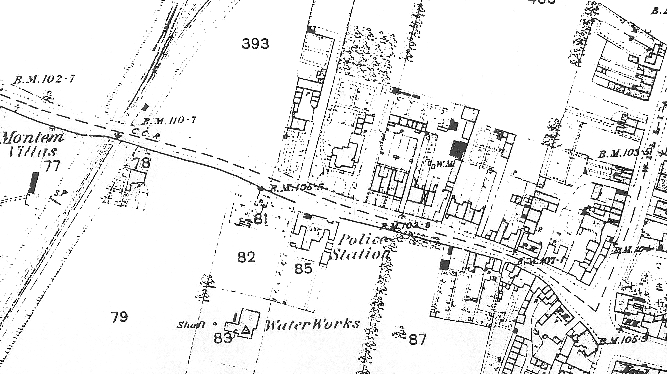
Return to Toolkit homepage

Toolkit: Exhibitions

Return to Toolkit homepage

Exhibitions within the library building may be a useful way of promoting services and collections, especially if exhibitions integrate with wider cross-platform promotional campaigns.

In practice, library staff often have to create exhibitions with limited display equipment, few financial resources, and limited time. Fortunately, much can be achieved even with these constraints.

Collaboration with local historians or groups may be an effective use of resources, but make sure everyone involved has a clear understanding of the exhibition aims, content and budget.

Choosing a topic

It’s often useful to tie in an exhibition with an anniversary, whether this is the anniversary of a local, national, or international event. By doing this, media coverage may be greatly increased and it can also raise the library service’s profile within the overall organisation, particularly if it helps the organisation to do something to mark an event.

Local anniversaries, or a local connection with a national anniversary or event, may be the most likely to achieve publicity and engagement.

National awareness days/weeks/months (e.g. Black History Month in October, LGBTQ+ History Month in February, Local & Community History Month in May) may also be a useful theme for exhibitions. Libraries Connected produces an annual calendar with relevant awareness campaigns that may inspire events and activities in libraries linked to the universal offers: https://www.librariesconnected.org.uk/resources

Other ideas that could be useful to inspire exhibitions are:

  • The launch of a new local book
  • The promotion of new service/resource/collection
  • Supporting a new tourism initiative – e.g. guided walks
  • A seasonal tie-in – e.g. Christmas, summer holidays

It’s as well to be mindful of the wider context of your exhibition. What may seem to be fairly innocuous can turn out to be controversial if there is a local or political sensitivity about the topic.  It may be advisable to check with your organisation’s press office or communications team to make sure there are no issues with the topic you are proposing.

Arranging content

Images attract more attention than text so, depending on the theme of your exhibition, it may be worth considering large images and small amounts of text.

As most photographs held by local studies services are likely to be smaller than would ideally be required for an exhibition, it may be worth considering copying the image and then printing it as a larger photograph or print (copyright permitting). As well as having greater impact, this also creates a surrogate that means the original image is protected from any damage during display.

If you are doing a display on traditional display boards, try not to cram too much onto the boards. Small images with lots of small text may only engage those who are already engaged, rather than having the eye-catching appeal to attract wider interest. It may be more effective to have fewer, but larger, images, or to use graphic software to create content the same size as each exhibition board. If you have the facility to print larger than A3, you can then print this as one sheet. If not, then, depending on your software, it may be possible to print the content as tiled sheets that may then be stuck together.

Copyright

In terms of copyright, the Intellectual Property Office issued a copyright notice (copyright notice 5/2015) aimed at museums, galleries, libraries, archives and other institutions that may wish to exhibit copyright works. The notice stated that: 

“In the UK, public exhibition is not an act restricted by copyright. This means that it is not an infringement of copyright to put a literary, dramatic, musical or artistic work on public display (for example, in a display cabinet in a museum or gallery).” This relates to original documents and artefacts, and would not in itself permit the making of a copy for exhibition purposes.

Moving images

Moving images also attract interest and it is possible to create short videos from still images, with or without audio. If you have a TV screen available in your exhibition space, it should be possible to produce short video clips to play on a loop, as well as to upload to video-sharing sites and social media platforms.

Whilst Adobe Premiere Pro is the full-featured industry standard, much can be achieved with the more budget-friendly Adobe Premiere Elements. There are also free alternatives, such as DaVinci Resolve, Kdenlive and Lightworks. 

Be aware that, according to the Intellectual Property Office (notice 2015/5) “playing or showing a sound recording, film or broadcast in a public place [without permission from the rights holder(s)] would usually be an infringement of copyright.”

Writing content

Simply exhibiting documents or artefacts is unlikely to engage casual interest. Generally, it is stories that engage people, so exhibitions should be planned with a particular theme, and content should be selected or created so that it contributes to a coherent narrative. 

Ask yourself what is the unique story that your exhibition will tell. It may be useful to outline your narrative e.g. as bullet points, on post-it notes or as a mind map, and then select relevant resources from your collection.

Original documents and artefacts should be accompanied by explanatory captions. Captions need to convey a key message rather than be a description of the item. They must be short – ideally 14-21 words – and they need to communicate something to readers, rather than just describe what visitors can see for themselves.

People generally don’t read large blocks of text. Their eyes are drawn to images, headings, sub-headings, bulleted lists, and short captions. Any blocks of text may only be skimmed, so be mindful of this when writing content.

William Strunk, in his guide The Elements of Style in 1918, wrote:

Vigorous writing is concise. A sentence should contain no unnecessary words, a paragraph no unnecessary sentences, for the same reason that a drawing should have no unnecessary lines and a machine no unnecessary parts. This requires not that the writer make all his sentences short, or that he avoid all detail and treat his subjects only in outline, but that he make every word tell.

Write in a natural way that will resonate with your audience. Clear and precise language is usually more effective than flowery prose, which tends to distract from the exhibition content. Take care with typing, grammar and spelling. If possible, ask a colleague to proof read any content you create. Alternatively, printing proof copy and slowly reading it aloud to yourself may help you to spot any errors.

Remember the well-known design principle “KISS” – Keep It Simple, Stupid!

Environment and security

The safety and security of exhibition materials should be a paramount consideration when planning an exhibition of original documents or artefacts.

Original items should not normally be displayed without appropriate security – e.g. locked in a display cabinet – to protect against theft or damage, whether wilful or accidental.

The other main threat to display materials is the risk of damage as a result of inappropriate conditions in the display environment. In particular, the potential damage from light, heat, and humidity should be assessed before original sources are displayed.

British Standard 4971:2017 (Conservation and care of archive and library collections) offers guidance on exhibiting original items. It recommends that:

  • Objects should not be placed on permanent display
  • The duration of a display should be calculated with an understanding of the impact of the display environment on the objects
  • The display period calculated should be based on a safe level of light exposure of the material displayed, depending on the sensitivity of the materials. Background lighting in the display area should also be assessed.
  • The temperature should not exceed 24 degrees
  • Relative humidity levels should be within recommended levels (see section 5.1.3 of BS 4971)
  • Exhibition light sources either emit no UV or UV radiation emitted should be removed by the use of filters

It would be advisable to carry out a condition survey before exhibiting original items.

Borrowing artefacts

It may be worth considering asking to borrow artefacts or documents from other museums or repositories, if this is appropriate for the theme of your exhibition. Depending on the items, this may only be possible if you have secure exhibition facilities that meet the environmental conditions recommended in BS 4971. 

Some museums offer loan services to schools and cultural institutions, so it is worth checking with the relevant museum. Be aware that if you are borrowing original items, you are likely to have to:

  • Ensure that you have sufficient insurance cover for an agreed minimum amount
  • Comply with security, display and handling requirements of the loaning institution
  • Pay a loan and administration fee
  • Pay for a condition survey and any pre-loan conservation of the items
  • Arrange for suitable secure transport for the items

Publicity

Be mindful of copyright, especially in images. Make sure that you know the copyright status of any items you are using, particularly images, and ensure that you have assessed the risk of using the material for the purposes you wish. This is essential if you don’t have written permission from the rights holder(s) or a licence to use an orphan work.

Use your existing publicity channels to good effect, and try to include images that can be issued with press releases as this will make them more attractive to media organisations. If you have a blog, it can be useful to create a blog post that tells the story in more detail, and includes images of the exhibition.

If you have social media channels, rather than posting a standard poster, you are likely to have more impact by creating properly-sized images for each channel. 

  • Twitter
    The size of inline images on Twitter in 2020 should be in a ratio of 16:9 so the suggested optimum size is 1200 x 675 pixels. Any images taller than this 16:9 proportion will be cropped on mobile and desktop feeds.
  • Facebook
    The recommended size for shared images on Facebook is 1200 x 630 pixels
  • Instagram
    The recommended size is of images for Instagram is a square 1080 x 1080 pixels.

It may be worth considering events that link with the exhibition, for example, a formal launch with an opening by the Mayor, and/or a brief introduction or lecture about the topic. 

Demonstrating impact

If your exhibition is part of a grant-funded project, you may have a requirement to collect evidence to justify the use of external funding. Even if your exhibition is not grant-funded, it may still be useful to collect evidence of impact so that you can use this, if needed.

More formal evaluation can include the Generic Learning Outcomes (GLOs) and/or Generic Social Outcomes (GSOs) which were developed to provide practitioners, government and funders with a meaningful way of reporting on the impact of engagement with visitors to museums, libraries and archives. Find out more at www.artscouncil.org.uk/measuring-outcomes/generic-learning-outcomes

At the very least, try to capture comments from visitors and any engagements on social media.

The CILIP Marketing & Communications Group (formerly Publicity & Public Relations Group (PPRG)) has an annual Marketing Excellence Award. If your exhibition has met or exceeded your aims and objectives, and includes marketing approaches that you want to share with other organisations, it may be worth entering the annual awards.

Useful tips

  • If your organisation needs to print large-format documents such as architects’ plans or maps, then it is worth finding out whether there is a large-format plotter within the organisation.
    Depending on your setup, it may be possible to print directly to this if it is networked, or a colleague may be willing to send through prints on your behalf. Even if there is an internal recharge to your budget, this is likely to be significantly cheaper than using a commercial printer, and will give much more professional results than sticking multiple smaller sheets together.
  • Microsoft OneNote is usually included in the Microsoft Office software suite and seems to be a much overlooked and under-used programme. It is the electronic equivalent of a tabbed paper notebook and is very useful for gathering together ideas and drafting content. It may be a useful tool for collaboration, as a notebook can be shared with others.
  • Consider learning to use graphic design software such as Adobe Photoshop CC (or the more budget-friendly Adobe Photoshop Elements or Corel Paintshop Pro) or an open source free alternative such as GIMP. Even if you have no artistic or drawing skills, you can create professional-looking exhibitions using graphic design software.
  • Bear in mind the diverse needs of customers when creating an exhibition – text size, colour, height of displays, language, physical accessibility – should all be considered with your potential audience in mind.

Suppliers

Return to Toolkit homepage

Got something to add?

Do you have any comments, suggestions or updates for this page? Add a comment below or contact us. This toolkit is only as good as you make it.
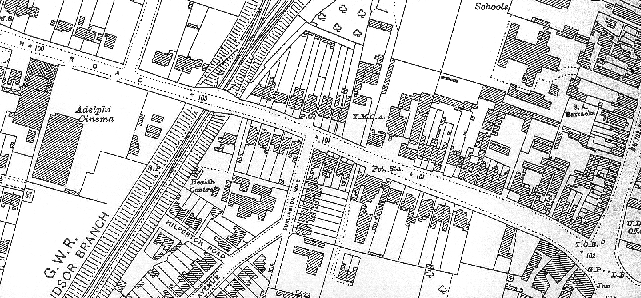
Return to Toolkit homepage