Want to know more about the CILIP Local Studies Toolkit? Last year Terry Bracher & Tony Pilmer gave a presentation to the The Historic Society of Lancashire & Cheshire. It included excellent presentations from Tracey Williams on not just ticking to box & Local Studies in an international context by José Luiz Pederzoli and a Q&A that also included Lancashire’s Louise Turner. Watch the record here:
Local Studies Group are proud to publish this talk based on Tracey’s section on Linking with local authority priorities in Local Studies Toolkit. A must watch for all librarians, archivists and other heritage professionals.
What did you think? Let us know by leaving a comment.
The well-deserved winner of the McCulla Award 2022 is Tony Pilmer. At present he is Librarian and Archivist at the Royal Aeronautical Society, but has had a long career in local studies in Slough and Hertfordshire. He has been active in CILIP’s Local Studies Group and the South sub-group for many years and also belongs to CILIP’s Rare Books Group. He has shared his enthusiasm for local studies through the organisation of study days, visits and contributions to the LSG blog, but most outstanding has been his work over the last four years on the Local Studies Toolkit, an online resource for all who work with local studies collections. Tony developed the initial plan and recruited a group of contributors, proof readers and checkers. He promoted the project and managed the volunteers. It is in a format, devised by him, which allows easy updating and contribution from users and will be an invaluable tool for those who work in the field.
Local Studies projects, collections and staff have the power to engage people from widely different backgrounds and across the generation. They can also meet the priorities of library, archive and heritage services in innovative ways.
To help guide and inspire those who work in our field, CILIP Local Studies Group are launching the Local Studies Toolkit, a free online guide containing nearly fifty sections written and peer reviewed by some of the best local studies professionals in the country. View it now at https://lslibrarians.wordpress.com/toolkit/.
The programme for the day is:
10am Reception open & tea and coffee available
10.25am Welcome, Terry Bracher, Chair LSG & Tina Morton, Head of Archives Sector Development, The National Archives.
10.30am Why local studies matters, Norma Crowe, formerly Local Studies Librarian, Medway
10.50am Launch of the Local Studies Toolkit, Tony Pilmer, Librarian & Archivist, Royal Aeronautical Society & formerly Local Studies Librarian, Slough (Editor-in-Chief of the toolkit)
11am Community Archives, Terry Bracher, Heritage Services Manager, Wiltshire
11.20am Oral history projects, Martin Hayes, County Local Studies Librarian, West Sussex
11.40am Delegates can choose from three of the following options:
1921 Census
Maps & plans
Directories
Ephemera
Discussion on doing Local Studies after COVID
Who uses a local studies library?
Copyright Discussion
Collection Development
12.50pm LSG AGM
1.00pm Lunch
2pm Not ticking the box: local studies and meaningful impact, Tracey Williams, Library Specialist: Heritage & Local Studies, Solihull
2.20pm Creating Online Events and Website Resources, Tudor Allen, Senior Archivist, Camden Local Studies and Archives Centre
2.40pm Opportunities for funding, Eloise Kane, Engagement Manager, London and South, National Lottery Heritage Fund
Local Studies projects, collections and staff have the power to engage people from widely different backgrounds and across the generation. They can also meet the priorities of library, archive and heritage services in innovative ways.
To help guide and inspire those who work in our field, CILIP Local Studies Group are launching the Local Studies Toolkit, a free online guide containing nearly fifty sections written and peer reviewed by some of the best local studies professionals in the country. View it now at https://lslibrarians.wordpress.com/toolkit/.
Join us at the National Archives to formally launch the CILIP LSG Local Studies Toolkit, explore inspirational projects and find out more about the nuts and bolts of local studies and heritage work in the post-COVID world including:
Oral history
Virtual events
Making a meaningful impact
Community archives
Attracting funding.
Speakers include former CILIP Local Studies Librarians of the Year, Martin Hayes, Tracey Williams & Norma Crowe, speakers from the National Lottery Heritage Fund together with staff from two of the UK’s most innovative collections: Wiltshire and Swindon History Centre & Camden Local Studies and Archives Centre.
There will also be an opportunity for you to choose from a number of workshops that will enable you to explore and discuss areas of heritage work that interest you, including:
1922 Census
Copyright
Collection development
Local Studies after COVID
Heritage users and their needs
Ephemera
Maps
Directories
You can also finish the day with a Tour of the National Archives and take part in the 2022 CILIP Local Studies AGM.
Cost: £25 plus VAT (£30 inc VAT) including lunch & drinks
Local Studies projects, collections and staff have the power to engage people from widely different backgrounds and across the generation. They can also meet the priorities of library, archive and heritage services in innovative ways.
To help guide and inspire those who work in our field, CILIP Local Studies Group are launching the Local Studies Toolkit, a free online guide containing nearly fifty sections written and peer reviewed by some of the best local studies professionals in the country. View it now at https://lslibrarians.wordpress.com/toolkit/.
Join us at the National Archives to formally launch the CILIP LSG Local Studies Toolkit, explore inspirational projects and find out more about the nuts and bolts of local studies and heritage work in the post-COVID world including:
Oral history
Virtual events
Making a meaningful impact
Community archives
Attracting funding.
Speakers include former CILIP Local Studies Librarians of the Year, Martin Hayes, Tracey Williams & Norma Crowe, speakers from the National Lottery Heritage Fund together with staff from two of the UK’s most innovative collections: Wiltshire and Swindon History Centre & Camden Local Studies and Archives Centre.
There will also be an opportunity for you to choose from a number of workshops that will enable you to explore and discuss areas of heritage work that interest you, including:
1922 Census
Copyright
Collection development
Local Studies after COVID
Heritage users and their needs
Ephemera
Maps
Directories
You can also finish the day with a Tour of the National Archives and take part in the 2022 CILIP Local Studies AGM.
It is important to build relationships with a wide circle of fellow professionals, so you can identify potential areas of joint working and refer enquiries to useful services. Local Studies staff also need an understanding and awareness of other heritage professionals’ practices, especially as the divisions between fellow heritage professionals are narrowing and users will not be aware that priorities, attitudes and training in these professions are quite different.
These can include visits, meetings and temporary exchanges in staff. Key groups include:
Neighbouring collections, especially those with overlapping collections. These include collections both inside and outside your authority. Local networks of local studies librarians include:
Archaeological services, especially the Site and Monuments Officers.
Other important relationships within your local authority network includes:
Planning offices (Especially the Buildings Conservation Officer and the guys who produce all of the maps for the Council)
Parks departments.
IT
Arts Development
Conservators
Communications & Social Media Officers.
Tourist information officers
Registrars and cemetery staff
You also need an understanding of roles of those organisations on the national stage. In England, Local Studies sits uneasily between the remits of the Arts Council and the National Archives, so an awareness of their priorities is important. The British Library also plays a key role and the Society of Antiquaries of London, the learned society for our area, also has some interesting resources.
There are a number of national heritage organisations you need to know about. These include:
Your local area history and traditions will also dictate which specialist regional and national heritage organisations you need to know about.
Museum of English Rural Life (though they also have a lot of material on the growth of towns and cities, as they care for the archive of the Council for the Protection of Rural England)
A Service Business Continuity plan (BCP) provides a standardised business disruption plan for all services. The plan provides key service information to support the Head of Service (or nominated deputy) in returning the service to business as usual following a disruption. Larger collections may have a stand-alone policy, while smaller collections may find their plan is part of a service-wide policy. This can sometimes be deployed together with your emergency plan and there will be some overlap. But whereas the business continuity plan enables you to maintain your service during a period of disruption; an emergency is defined as any incident which cannot be contained, or which threatens any part of the Local Studies building / space or its holdings and therefore should be kept as a separate document (see Toolkit chapter on Emergency Planning).
The need for BCP has never been more apparent than during the Covid-19 pandemic, where Local Studies Libraries found themselves unable to provide direct access to their unique resources, but still managed to employ creative ways to continue engaging audiences and providing essential information. Other likely scenarios include loss of power supply, loss of IT and telephony networks, and adverse weather conditions.
Definition of Business Continuity
The definition of Business Continuity is the capability of the organisation to continue the delivery of products and services at acceptable predefined levels following a disruptive incident. It is a set of documented procedures that guide services to respond, recover, resume and restore to a predefined level of operation following a disruption.
Objectives of a BCP
A plan should:
Establish key service information
Detail the activation process for the plan
Identify priority functions undertaken by the service and the resources and timescales associated with their recovery
Outline the incident management procedures and key staff
Show how a local studies service should coordinate its response with other library and organisational services to reduce business disruption.
Quick steps to create a BCP:
A basic BCP should contain the following elements:
Create a contents sheet for quick reference
Establish within your organisation what is the priority level of your service, this will determine how many days you can be without essential operations such as ICT, desk space etc.
Who is the owner/s of the plan
Create a distribution list to relevant staff
List key contacts for your service – include both internal and external suppliers, with the most important during an emergency at the top.
Activation – what are the steps in your organisation to activate your plan e.g. who do you need to inform, what is the escalation process. It is also worth keeping this as a separate quick reference document or card
Communications – what are the key ways of communicating to your customers?
Key functions – List the key functions of your service, prioritise them and then decide how long you can be without them
Staff – list the points of risk if you lose staff and what is the contingency for this
ICT – what are your key ICT requirements / software, e.g. library catalogue, payment devices; decide how long you can be without each piece. What are the short-term and long-term workarounds? e.g., if part or the whole of telecommunications are disrupted can you use emergency mobile phones / mobile hotspots etc; are there alternative hardcopy catalogues?
Facilities – what are your workplace requirements? Can your team work elsewhere? If so what office requirements do you need – list the number of computers, desks, chairs etc.; what about specialist equipment – printers, scanners, card payment machines etc.
Work from home – work out how many staff could work from home if needed or if this is feasible. Do they have access to all the equipment they require?
Transport – list any specific transport requirements.
Fuel – are there any staff who require priority access to fuel if there are shortages to enable them to carry out essential roles e.g. do you have a duty manager who needs to access your site on a daily or weekly basis to check buildings and ensure they are maintained?
Scenario planning – list different scenarios and consider creating a flow chart of what might be affected, how you will respond e.g. to extreme weather event, pandemic; loss of: ICT, energy supply, essential supplier or partner, key staff, workspace, fuel.
What is your worst case scenario?
Reputation – Consider the effect on your organisation’s service loss – this will help you prioritise services
Flow charts and diagrams – where possible think about creating charts and diagrams for responses and communications
Templates – create standard templates / forms for providing situation reports and incident logs so they are ready to use
What should a BCP contain?
Below is a more detailed checklist of some of the things you may wish to consider and include in your plan:
Scope: The plan should enable your Local Studies service to continue to deliver priority functions, at a minimum acceptable level of service, throughout a business disruption, as far as is reasonably practicable.
Links: Your BCP should link to your Corporate BCP, your service Emergency Plan, local and corporate communications plans.
Activation: Who activates your BCP? The Head of Service or nominated deputy is usually tasked with this.
Where is advice available? For example, this might include departments within your own organisation such as an emergency planning team or incident room; external support such as software providers, suppliers, other libraries; CILIP and other professional networks.
What is the impact of an interruption to your service? It is useful to quickly supply information to stakeholders on the likely impact on your service and how the reduced services might impact on others that might rely on you, such as planning officers, rights of way teams and schools.
Details of key activities, withminimum number of staff needed for each function and timescale of when services should be re-started:This would include:
Access to Local Studies collections
Place for study & tutoring
Meetings – formal & informal
Room hire
Volunteer projects
Activities & events for all ages
Access to computers:
Public access to the Internet via PCs and Wi-Fi
Support to get online, access digital services
Respond to requests for information
Printing & photocopying
Details of key social outcomes, withminimum number of staff needed for each function: These may include
Local Studies as a trusted source of information
Informal reassurance – place of safety
Community space
Overcoming social isolation
Delivering other LA and service priorities – e.g. for delivering core organisational goals such as well-being, essential information for daily lives, education
Essential information: Details of key information and how it can be accessed, including
What documents will you need to access e.g. Policy documents, Service/ Team plans, Emergency Plan, Risk register
Which partners do you rely on? Which partners rely on you? What is the regularity of contact – e.g. daily / weekly / monthly?
Who are your Key contacts? Within the organisation this might include key staff, ICT, HR, Facilities Management; external contacts might include suppliers, contractors and partners.
Communications: How will you notify service users of a disruption to the service?
Help on activating and using the BCP: Think about creating an activation card or flow chart.
Model procedures to respond to likely scenarios:
Loss of workspace
Do you need to provide a public service – how will you do this from alternative spaces?
Are there alternative locations where your service can be delivered? If so, what additional resources do you need to use this space, for example, do you need desks and chairs, computers, photocopiers, key resources?
Can some staff work from home?
What constraints are there preventing staff from working at a different location?
Loss of public access
Are there alternative collections, such as in other libraries or the county archive, that customers could use if your main collection is unavailable?
Can staff access collections and provide a remote enquiry service?
Are there any online resources e.g. photo collections, family history collections, that can be highlighted and accessed at home? If there is a pay wall are there mechanisms to provide any free access?
What are the alternative ways to continue to engage with local communities, e.g. social media, podcasts and videos, blogs etc.
Do you have volunteers, if so, can they undertake work from home or alternative venues? How will you communicate with them?
Loss of ICT – computer technology and telephony.
What impact would a lack of access to the phone network have on your service?
Do you have phone lines that are essential in an emergency such as from strong rooms?
Do you have systems in place to maintain business without access to phones?
What alternative methods of communication, do you have access to, mobile phones etc
What systems are there in place to update messages to your website, can this be done remotely using a different network?
What services can you operate without access to the computer network?
Do you have systems in place to maintain business without access to the network?
What duties can staff and volunteers undertake without access to the network? If they are undertaking computerised tasks, how will you ensure that material is added to the normal systems once you regain access to them?
Staff shortage / skills:
How many / which staff are needed to complete essential functions?
Are you dependent on staff with specialist knowledge? Can these skills be shared / what contingency / training is in place?
Do you have duty managers or staff with specific skills that can enable BCP to come into force?
What needs to happen when you activate your business continuity plan?
Start a log of the incident and record the information on the options available, decisions on actions to take and justification of those decisions.
Report details of activation, additional staff and resources to your organisational leads in emergency planning etc.
Determine services to be provided / recovered in priority order e.g. do you need to prioritise access to physical collections, is browsing essential or can you create other ways to access material? Are online resources and access to digital a greater priority than physical access?
Allocate staff to priority roles and notify all service staff of the disruption, identify additional staff e.g. can staff provide Local Studies service from other libraries, answer enquiries from home or via other mechanisms? What access do they need to Local Studies material?
Consider whether the disruption will lead to local, regional or national media interest.
Contact contractors / partner organisations / your own organisation’s services and inform them that you are activating your business continuity procedures.
Identify gaps in critical service provision by checking with other Council services including other libraries, archives, museums etc., and partner organisations to ensure they are still able to deliver services.
Provide mutual aid to other service areas, as required/requested.
Consider messages that are required for the public e.g. opening times (if relevant) and where to send their enquiries.
Got something to add?
Do you have any comments, suggestions or updates for this page? Add a comment below or contact us. This toolkit is only as good as you make it.
Providing easy and effective access to collections is an essential part of any librarian’s role. The creation of coherent and consistent catalogue entries sited on web-based platforms will provide staff and users with a reliable point of entry to collections, plus enable a quicker response time to enquiries. Catalogued entries can also be used to highlight interesting features of content that may be of particular interest to local studies users.
When creating any catalogue entry, it is important to ensure that it meets international standards. In this way, the data can be updated, transferred, and migrated to other systems more easily.
The Cataloguer
Historically, large organisations employed professional cataloguers to create and amend records to ensure that all catalogue entries were fully compliant to industry standards. Developments in library stock management and Library Management Systems have led to greater automation and the creation of catalogue entries sent direct from suppliers to library stock controllers, dramatically reducing the amount of original cataloguing required.
Unfortunately, the professional cataloguer is often no longer employed, leaving library staff to undertake cataloguing work with minimal training. As has been shown in the book stock section of this toolkit, many local studies publications cannot be purchased from library suppliers and records for these entries will normally need to be created from scratch. As well as cataloguing books, local studies units will need to record details of non-book materials, such as photographs, maps and digital files.
Before you start cataloguing
Before they start cataloguing, a local studies librarian should be confident that they:
Have a good grasp of relevant standards. A professional librarian should have received training on cataloguing as part of their CILIP accredited course, however the amount of training is different depending which library school they attended, skills may be rusty and international standards may have evolved. A brief description of how the relevant standards affect local studies can be found below, but staff fresh to local studies may benefit from refresher training.
Have a good grasp of the authority’s cataloguing standards and procedures. Book material should be entered into the main library catalogue, so needs to meet the authority’s standards. This is especially important if the library authority is part of, or joins, a library consortium which shares a catalogue. Your authority should provide you with training before allowing you to make changes to the catalogue.
Have policies and procedures on how local studies materials should be catalogued. As will be shown below, local studies catalogue records should be more detailed than standard library books. Some non-book cataloguing can be undertaken by volunteers and, as it is essential that cataloguing is consistent, written procedures should be in place which maintains high standards and control.
A local studies librarian will not be alone when they tackle these duties; there will be people in the authority who can provide help and support. Though your authority may not employ a professional cataloguer, they will employ staff within a stock unit whose main duties involve getting material onto library shelves and onto the catalogue. There will also be staff charged with selecting material, whether inside or outside of the stock unit, and these may include other non-standard materials, such as music scores.
Cataloguing standards
Cataloguing should adhere to standards developed to suit the need of their material and users. For heritage professionals, the main standards are ISAD(G) for archives, Spectrum for museums and RDA (Resource Description and Access) for libraries.
RDA
RDA was created to replace the second edition of the Anglo-American Cataloguing Rules (AACR2). Whilst AACR2 was designed for the paper age, RDA was designed to tackle the challenges of the digital age.
CILIP, the American Library Association and the Canadian Federation of Library Associations have published an RDA toolkit which includes the British Library’s RDA workflows and a guide to RDA name authority records. The toolkit www.rdatoolkit.org/ is subscription based but the Library of Congress’s Training modules are available here: https://www.loc.gov/catworkshop/rda/index.html.
There are also specialist standards for particular content types developed by specialists in their field. Depending on the strengths and collection areas of a Local Studies Collections, some of these may be relevant. For example, rare books librarians use DCRB (Descriptive Cataloging of Rare Books): Descriptive Cataloging of Rare Materials | RBMS – Rare Books & Manuscripts Section. If you are creating a digital archive, you should ensure that your fields follow the Dublin Core principles: DCMI: Creating Metadata (dublincore.org).
See the following sections of the toolkit for advice on cataloguing and arranging specific media:
A local studies collection’s main book stock should be recorded in a local studies subset of the main public library catalogue. Examples of Library Management Software are Civica’s Sydus, products produced by SirsiDynix and Axiell’s SPARK software for archives and libraries. Some library systems can provide a search screen where only local studies material can be searched, for example: https://buckinghamshire.spydus.co.uk/cgi-bin/spydus.exe/MSGTRN/LOCAL/BSEARCH.
Local studies collections that are part of archives and/or museum services may have material catalogued in the CALM archive systems or MODES. In smaller organisations it is often not possible to afford specialist cataloguing systems and other types of databases are used to catalogue collections, such as Access and Excel. Digitised collections may also be catalogued in online archives.
Book Cataloguing onto Library Management Systems.
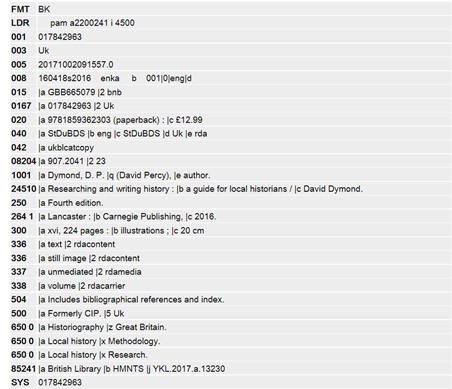
RDA standards need to be translated into machine readable formats. The Library of Congress’ MARC 21 is the current standard used by public libraries for bibliographic data. MARC 21 is a communications and exchange format which provides the structure for encoding the content of bibliographic and authority data. The British Library leads and sets the standards for UK participation in MARC 21.
Local studies publications often come with a catalogue record that has been purchased with the book, but it is necessary to enhance records created by stock suppliers if there is one. In many cases local studies materials can be locally published or not formally published at all, so are not available via large stock suppliers such as Askews and Holts. Therefore, catalogue entries must be created locally.
The easiest way is to copy records from a reliable source, however older books are likely to have records that were produced using earlier standards so entries will have to be carefully reviewed, whilst others may not have been catalogued before. Some library management systems allow you to search and import records directly, while others may require you to import them manually or copy and paste them line-by-line.
The BNB enables you to freely download MARC 21 records.
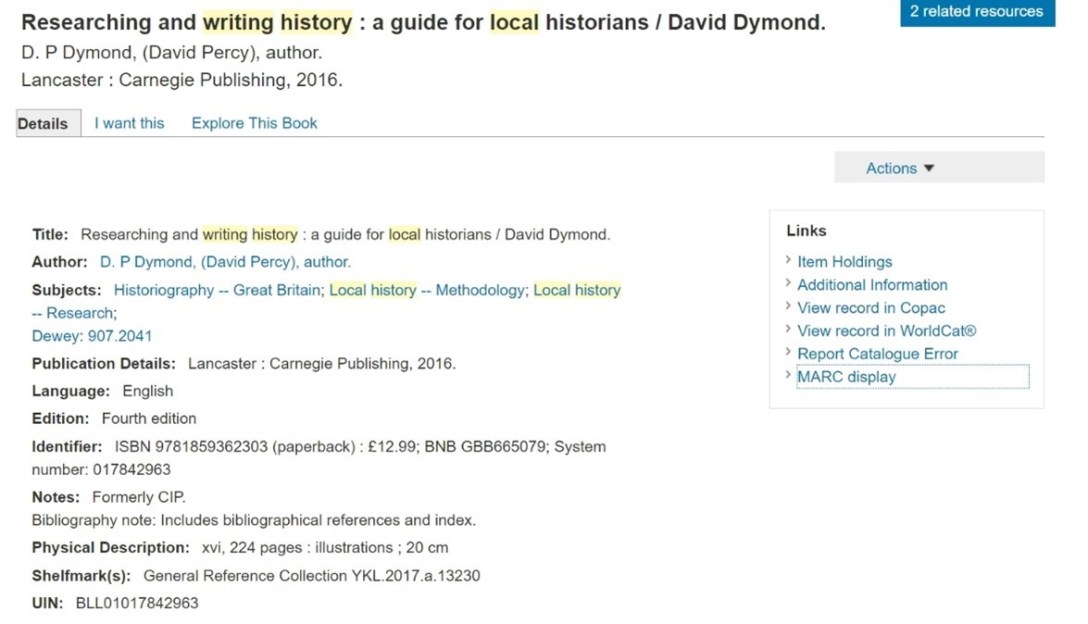
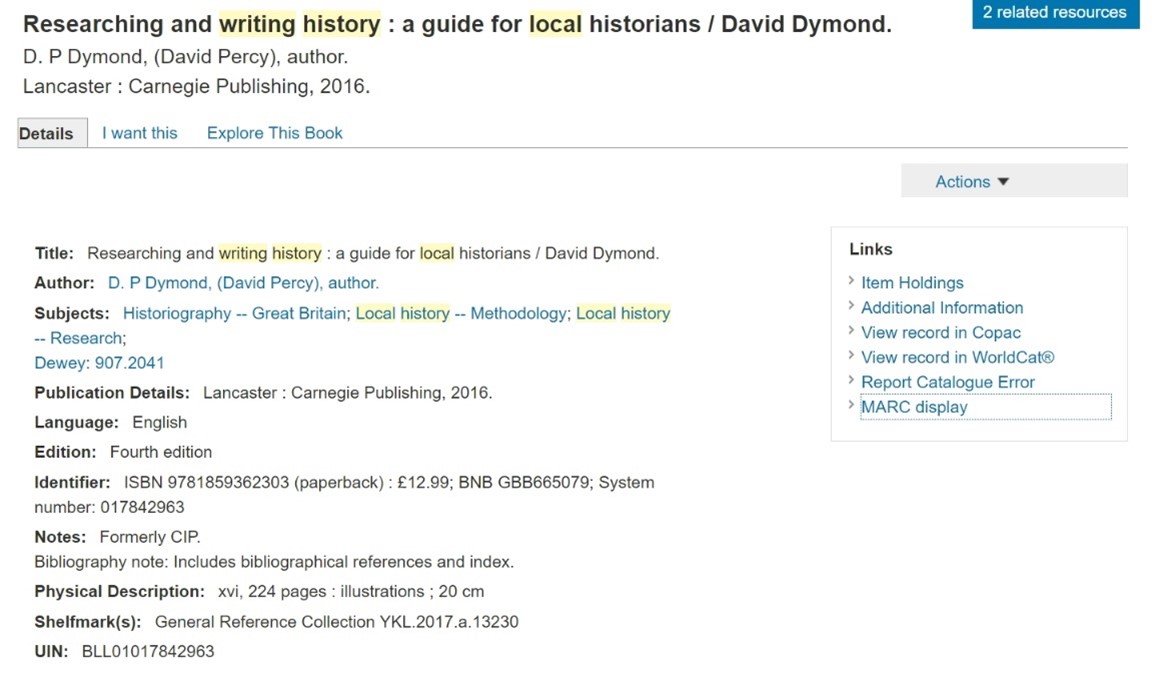
Entry on the British Library catalogue. You can see the option for MARC display for this item on the right.
MARC display for the same item on the BNB
Library Hub, https://discover.libraryhub.jisc.ac.uk/, is also an excellent source of cataloguing information, but that site does not display records in MARC 21 format.
Key differences between a Local Studies and standard public library catalogue entry
The unique nature of local studies material requires a more thorough catalogue entry than, for example, a work of fiction on a general library shelf. The importance of person, place and community to local studies collections means that the item has been acquired for a specific reason; for the knowledge contained within it or for its association to the community the collection serves, and this must be reflected in the catalogue entry.
A suggestion for comprehensive catalogue entries for local studies items can be found on the table below and should be used in conjunction with the Library of Congress MARC standards available online:
Description
MARC 21 identifier
See section below
ISBN plus type eg. hardback or paperback
020
Dewey number
082
A
Local call/classification number (if applicable)
090-099
A
Author
100/110
B
Title
245
Edition
250
Publisher details (including publication date)
264
Physical Description (number of pages, inclusion of illustrations, format and media type eg. map, CD, dimensions in cm)
300
Sequential journal dates
362
Series statement
490
Note field
500
C
Bibliography/index (if present)
504
Summary
520
D
Surname of Person/family
600
Topic heading
650
Local subject use eg. local place name and subject heading
690-699
E
Added name (for additional authors/editors)
700
A: Dewey and Local call/classification number
Here you should detail how you arrange your books on the shelves. Your branch stock will very likely be catalogued in Dewey, which is a good method for a small number of books, but has challenges for specialist collections. For local studies the key problem is that Dewey does not allow a collection to combine subject and location into one short number, nor is if very good at dividing your collection area into the geographical areas. As a consequence, a large number of local collections have created their own classification schemes tailor-made for their area. For example:
The days of a library dedicating a member of staff to reclassify each book in a local studies collection are over, however small additions to numbering systems should be included as material using new areas are acquired. A scheme typically designed in the 1970s is likely to be strong in archaeology but not in social issues, let alone include new towns.
B: Personal, corporate and series names
An interesting recent development has been the spread of NACO (Name Authorities Co-operative). Members across the world have created an international standard that aims to create a unique entry for each name. Details of approved headings are available through the RDA toolkit and https://authorities.loc.gov/. However, local studies collections will be the first to catalogue many locally produced publications, so it is likely that many of the authors will yet to have reached NACO.
C: General notes
You can add miscellaneous information about the item in this field, such as whether your copy is part of a donation, part of a collection, information about previous owners or whether it contains any manuscript comments or annotations of note.
D: Summary
It is important to give potential local studies readers a flavour of the book and its strengths. It is also important to be aware that the library catalogue will interrogate this field when users search the catalogue, so make sure that you include keywords that will not be included in the title or subject fields.
E: Local subject use
Whilst field 082 (Dewey and Local call/classification number) forces you to pick one subject term, this field enables you to add multiple terms. Your authority is likely to use Library of Congress Subject Headings as its standard subject terms, but this is not detailed enough for British local studies, so you should use a specialist scheme.
Your authority may have its own local studies thesaurus, such as that produced by Berkshire.
Some local numbering schemes, such as that provided by Wiltshire above, will be thorough enough for use in this field.
Whichever classification scheme is used for this field, it is important that it captures both the subject and the geographical element. For example:
SMOKING PIPES – Slough – Cippenham
Though the subject can be taken from a generic list of local studies terms, the geographical element should be carefully considered at a local level.
Item record
A catalogue entry describes a certain publication, whilst the item record contains information relating to individual copies. Each copy must have its own item record describing the physical location of the item and its classification number. Information about the conservation work undertaken on the item can also be added onto the item record.
Contributing material to a county bibliography
Some counties have local history bibliographies, often compiled by county local history associations. Where possible, new additions to library stock should be added to these listings.
Contributing material to union catalogues
You can reach a bigger audience by contributing information about your holdings to collections of library catalogues: Your library authority may be part of a consortium so, for example, if a SELMS library user cannot find a book in their local library website, they can find holdings in other partner libraries by selecting a ‘Try this search in the SELMS Catalogue’ link. They may also contribute to WorldCat.
You can also contribute information about your pre-1800 holdings to the English Short Title Catalogue which, however you will need some understanding of DCRM to do this properly.
Got something to add?
Do you have any comments, suggestions or updates for this page? Add a comment below or contact us. This toolkit is only as good as you make it.
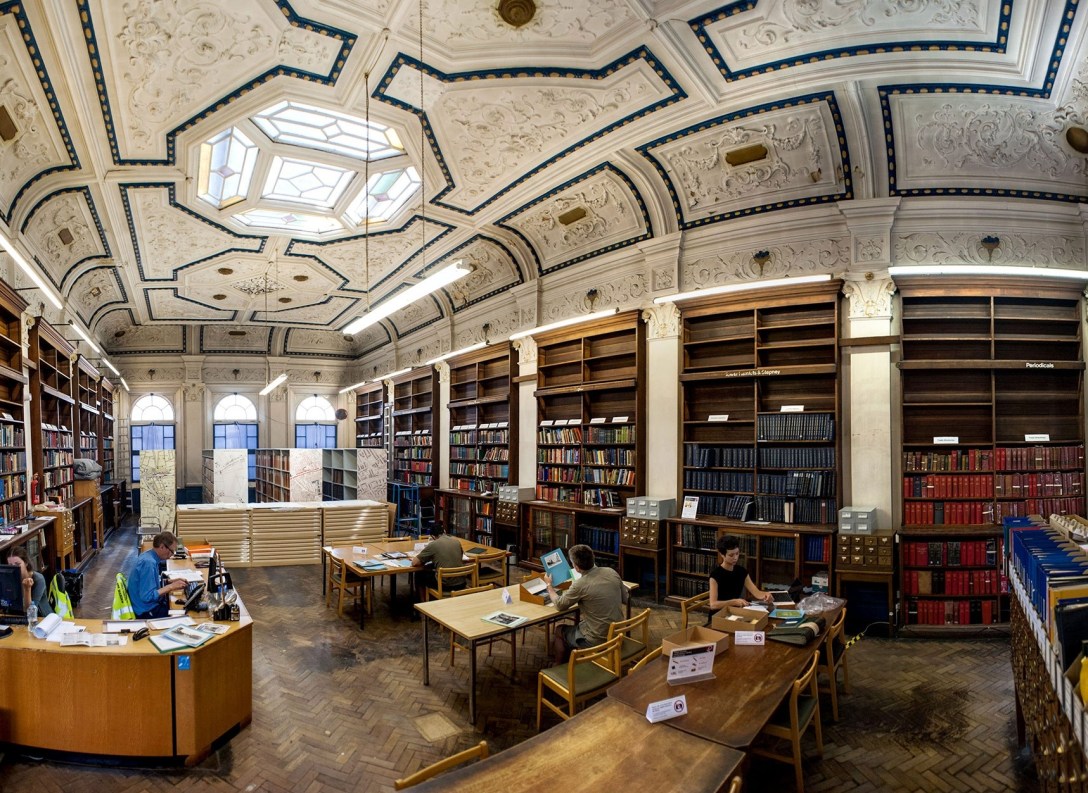
A local studies library should be a welcoming place for all members of society, ensure good working conditions for readers and staff, provide secure access to library materials, and be able to facilitate visits, events, meetings and group work.
The physical location of areas designed to house local studies collections should always be carefully planned. When library buildings are constructed or adapted the opportunity should be taken to provide accommodation of the highest standard, professionally space planned, in consultation with local studies staff.
Public areas
Areas designated for use by members of the public should be planned with both security and user convenience in mind. Considerations include:
Adequate seating complete with a power supply to enable readers to plug in laptops and other devices.
Access to wi-fi.
Generous provision of large tables for consultation of maps, plans, broadsheet newspapers, newspaper volumes, and other large items.
Design that allows for careful supervision of readers consulting irreplaceable materials.
Space for specialist equipment such as computers, microform readers/scanners and printers.
Lighting levels that are bright enough to enable readers to take digital photographs of material whilst protecting documents from over-intense exposure, and that permit the use of microforms without eye strain.
A display area to promote the range of material in the collection.
Adequate access and user facilities for disabled people.
Flexible enough to allow group visits and, ideally, to enable events to be held when the library is closed.
Open access materials
If possible, a collection of local studies books and other materials should be provided on open access. This will be much appreciated by researchers, and indeed some users come into the local studies library simply for the pleasure of browsing among the materials. Unique items should never be put at risk, but duplicate copies can be purchased as funds allow. Sometimes even out-of-print items can be obtained from specialist sources, and bound photocopies of rarer material can be prepared to enable the development of an open access section. If an open-access collection is provided, appropriate shelving and storage furniture will need to be provided in the public study area, and space made available to accommodate these.
Public-access computers should also be accessible in the local studies area. Ideally, these should be used to signpost users to online local and national resources of interest to local history researchers, for example photographic collections, maps, directories, digitised newspapers and family history resources, and online indexes.
Storage areas
Secure storage must be provided and should be located close to the public study areas, but with adequate controls to prevent entry by members of the public.
Provision within the stores should include specialist shelving and furniture, such as non-standard sizes of shelving including closely-mounted shelving of appropriate length for horizontal storage of single newspaper volumes, “jumbo folio” volumes or large illustrations. A separate filing area for unbound copies of local newspapers and periodicals is desirable.
Care should be taken to acquire appropriate storage equipment for special materials such as maps, microforms, photographs, negatives, 35mm transparencies, cuttings and ephemera.
Storage should ideally conform to standards outlined in BS 4971:2017 Conservation and care of archive and library collections. Smoke detectors should be installed, and fire escape routes be planned to avoid public egress through the stores. Ideally service pipes should not be routed through the stores, and neither should inappropriate electrical or heating appliances be located here.
Monitoring storage conditions
Equipment should be installed to monitor the correct environmental conditions, for example, Tinytag data loggers can be used to monitor the temperature and relative humidity of different areas of the space, including inside boxes. Insect traps should also be used to monitor pests.
Office accommodation
There should be adequate office accommodation for local studies staff, plus tabletop space for processing newly-received local studies materials and storage for archival and other specialist stationery. There should also be room to enable the scanning of photographs and other material, and to accommodate any volunteers.
Got something to add?
Do you have any comments, suggestions or updates for this page? Add a comment below or contact us. This toolkit is only as good as you make it.

 CILIP Local Studies Group