Alan Ball Awards 2017
Winner Hardcopy:
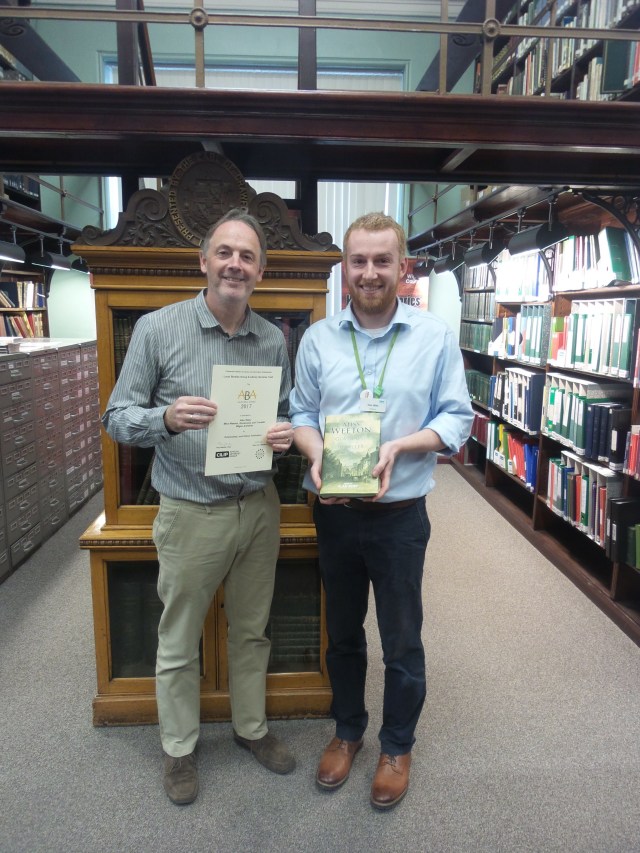
Alan Roby ed.; Miss Weeton, Governess and Traveller; Wigan Archives, 2016.
(Hardback, ISBN 978-1-5262-0553-7)
A skilfully edited, beautifully produced and illustrated volume containing the letters, journal entries and other autobiographical writings of Miss Nelly Weeton (1776-1849) providing a vivid insight into Georgian England. Born in Lancaster, the daughter of a sea captain who was mortally wounded in the American War of Independence, Nelly grew up in the village of Up Holland, near Wigan. At the age of 31 she left her family home to take up employment in the houses of the gentry. She became a governess and a traveller, moving to Liverpool and the Lake District; while her writings include accounts of a journey to London, excursions to the Isle of Man and North Wales, including lone ascents of Snaefell and Snowdon.
Winner E-publication:
Spratton Local History Society website http://www.sprattonhistory.org/
The society’s new website was launched in November 2016 with the aim to make 17 years of research by its members available to local people and the wider public. It is part of a much larger First World War projected aided by an award from the Heritage Lottery Fund. Members researched all the men of the village who served during the war. It included the first airman to be awarded the Victoria Cross, Lt William Rhodes-Moorehouse VC RFC.
Basing research on the 1911 census, local researchers identified where each person who served lived in the village, supported by an interactive map. This research was also inked to a searchable genealogical database (6,000 names) of 2,000 families living in Spratton in the nineteenth century. The society continues to add to the website, which includes villagers who were at the Battle of Waterloo, 2000 photographs including some previously unpublished images, and a Spratton Heritage Trail.
The project enabled volunteers to develop new skills and engage with the history of their local community; while it has also connected the community to descendants of those who served and their families, who live elsewhere in the UK and around the world. It is a fantastic example of an accessible, engaging and informative online community history archive, and of the wider impact such projects can achieve.
Other Hardcopy nominations
Emma Worrall, Amy Perry and Martin Hayes ed.; Military Voices Pat and Present: West Sussex Veterans in the 20th Century; West sussex County Council Library Service; 2017.
(Hardback, ISBN 978-0-86260-593-3)
The idea for this publication came out of a previous project on the Great War when Worthing History Teacher Peter Baker offered his collection to the library service for research. It contianed 32 interviews with 1914-18 veterans. The collection is now preserved at the West sussex Record Offcice. In addiotn, project staff and 45 volunteers conducted 63 interviews with 29 Second World War and 33 post war veterans. All the interviews are available indigital form at the West Sussex Record Office. Extracts from the interviews and biographical research have been combined skillfuly into this wonderful volume of military voices recording the contribution of some of the men and women from West sussex who served thier country.
Edmund Bird and Fiona Price; Lambeth’s Victorian Architecture; London Borough of Lambeth and the Lambeth Local History Forum; 2017. With photographs by Harry Orseni.(Paperback, ISBN 978-0-9926695-4-6)
This is the firth volume in the excellent series on the architectural history of Lambeth. It provides a fascinating pictorial and written record of Victorian buildings in Lambeth. These include public buildings and those relating to health, education, parks, shops, banks, transport, industry, pubs, housing and churches; with colour images and architectural summaries of hundreds of properties, sculptures and structures. There is also an introduction to Victorian Lambeth and a section on Lambeth’s lost Victorian buildings.
Doncaster Times, At Home At War. Issue 2: November 2016; Doncaster Library Service (Paperback)
Under the editorship of Helen Wallder, Local Studies Officer, Doncaster Local Studies Library, this local history journal was established via a HLF funded project, Doncaster 1914-18: At Home At War, supplementing a website and aimed at audiences who engage less with digital outputs. The journal is produced twice a year and this edition was submitted for the Alan Ball Award. THe journal is a great concept, containing article reserached and written by member sof the public, volunteers, local historians and staff at Doncaster Library. It covers all aspects of Doncaster’s history during the First World War. With a wide range of topics and illustrations, it helps to highlight items in the Doncaster Local Studies Collection. It has engaged a wide range of communities and individuals, and not just in Doncaster, but as far away as Europe and New Zealand.
Ellesmere Port Local and Family History Society, Ellesemere Port Town Centre Memories; 2016 (Paperback)
With the support of Cheshire West and Chester Libraries, the Ellesmere Port Local and Family History Society compiled this fourth booklet in the ‘Memories’ series, charting the history of the development of Ellesemere Port Town Centre, from its origins as a single farm known as Stud Farm to the present day. The memories include the local school, football ground, shops, arcades and the market; together with other developments in the civic and commercial areas of the town. It is a 104 page limited edition publication, which includes 250 photographs, maps and diagrams. It is an excellent example of community history being made accessible by dedicated group of volunteers.
Other E-nominations
Know Your Place South West http://www.kypwest.org.uk/
Know Your Place is a digital heritage mapping project designed to help you explore your neighbourhood online through historic maps, collections and linked information. It was initially developed by Bristol City Council in 2011, primarily as a planning tool. In 2015, funding was granted from the Heritage Lottery Fund to extend the map across six further counties in the West of England: Gloucestershire, Somerset, Wiltshire and the former Avon area (the unitary authorities of South Gloucestershire, Bath & North East Somerset and North Somerset). It received Heritage Lottery funding to run an extension project from June 2015 to the end of July 2017. This was added to by match-funding and in-kind support from local authorities and heritage groups in the region.
The project has been delivered through a complex partnership involving Museums, Bristol’s Know Your Place team, Archives and HER Officers in the six counties, and national partners including the British Library, who have supported the project by making available and digitising some of the maps. Other partners have included exhibition hosts, and smaller organisations which have provided match funding.
This funding and support has enabled the project to build a mapping resource that covers 4689 square miles (12,149 km), using maps from nine separate national, regional and local map collections and archives, and now makes the archaeological records, listed buildings and monuments data for those areas more publicly available. A notable feature of Know Your Place is its presentation of comparative historical maps for each area, making it possible for the site user to “whizz through history” looking at maps from different periods on the same screen.
The Know Your Place team also carried out an outreach programme to extend awareness of the site, that was made up of exhibitions, events and workshops. An online and touring exhibition was developed with content from 22 collections, while a range of outreach events attracted over 2,000 people. These were a combination of drop-in events and more structured workshops. 107 people were trained in using Know Your Place to map their organisation’s heritage information. The tangible outcome from these workshops is becoming apparent, as more information from the workshop locations appears online. 100 volunteers supported the project, including 70 people who helped crop or geo-reference maps. By the end of the project, 35 people were continuing to work regularly to ensure that new maps continued to appear on the website.
Flintshire War Memorials http://www.flintshirewarmemorials.com/
This is a community website on which the stories behind the names on Flintshire’s WW1 memorials are told. The project is ‘staffed’ by volunteer researchers – all amateur historians – who take on responsibility for a particular memorial and research the stories of those named on that memorial. (There are currently 24 researchers). Each researcher has a password and user name and has received training in how to add their research to the website. Once a story is posted on the website, members of the public can contact the website via the contact page and send in additional details and scanned images of documents, photographs personal memorabilia. These are added to the relevant pages and so the stories grow almost organically.
The project is managed by the two founders of the website who began by researching their own local memorial (Eifion and Viv Williams). It was financially supported in its early days by Flintshire Local Voluntary Council and by Heritage Lottery Wales. It has also been financed through a programme of talks to various community groups where a fee is charged. Some volunteer researchers have raised funds in other ways. Throughout the centenary period there has been an annual study visit to France/Flanders for researchers and other interested Flintshire residents.
Why not enter for the 2018 award … see details posted on this site




 CILIP Local Studies Group