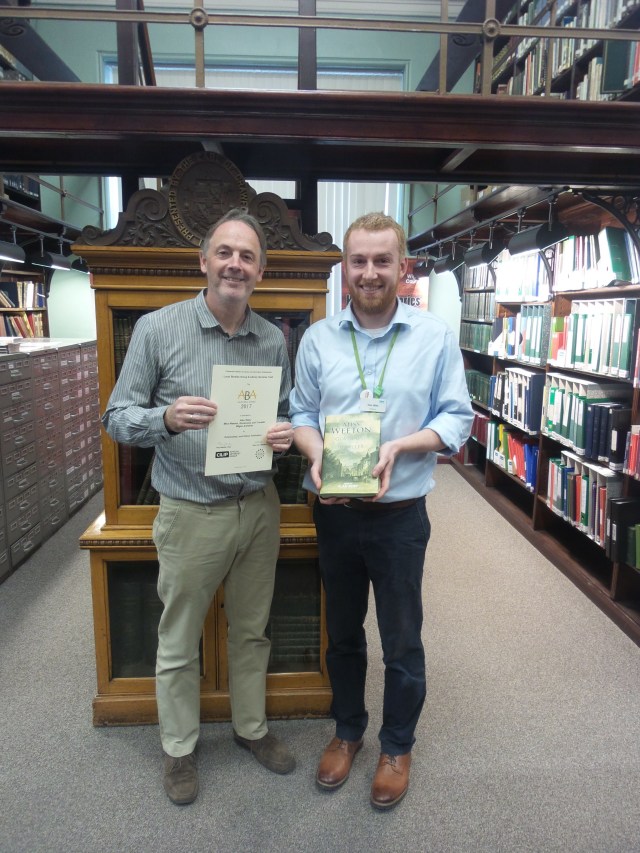
Alex Miller (r) receives the certificate from Andrew Walmsley (LSG NW)
Recently, we were pleased to present Wigan Archives and Local Studies with their Alan Ball Award for local history publication of the Year. Wigan won in the print category for their new edition of the Diary of Miss Weeton, edited by Alan Roby (ISBN 978-1-5262-0553-7). Alex Miller, archivist at Wigan, received the certificate from Andrew Walmsley, chair of LSG North-West.
The book is based on personal writings by Nelly Weeton (1776–1849), the Lancashire governess and diarist. Nelly Weeton’s diary is an important source for women’s history in the early 19th century. Terry Bracher, convener of the judging panel, said: “Miss Weeton, Governess and Traveller is an outstanding publication in every sense, with engaging content that is accessible to a wide range of audiences. Alan’s skilful editing and research for this new edition has enhanced the reader’s enjoyment and is a story that can be appreciated by audiences across the country and beyond. Wigan Archives and Local Studies have been very active in local history publishing, so we are especially pleased that this book has been recognised.”
Stella Wentworth reports back on History Day 2018 in London
After eight months of semi-retirement and occasional judicious use of off-peak rail transport, catching the 07:25 train on a foggy morning in late November came as a bit of a shock to the system. The friendly welcome from the reception team at Senate House when I arrived an hour and a half later with bicycle, heavy pannier bag and A3-sized portfolio case, followed shortly afterwards by a reviving tea and instant porridge from the Senate House cafe, were therefore very welcome.
CILIP LSG (and CILIP Library & Information History Group) were among the 66 organisations attending this year’s History Day at Senate House, a one-day event bringing researchers together with information professionals from libraries, archives and research organisations. In addition to the ‘history fair’, there is a series of drop-in talks throughout the day. To see this year’s talks programme and list of participants, go to https://historycollections.blogs.sas.ac.uk/history-day-archive/history-day-2018/ .
LSG’s representatives are, naturally, multi-talented. Will Farrell was also promoting the local history collections of the University of Leicester whose table we were sharing. I was quickly trained in the key message: their large specialist collection covers the historic counties of England, not just Leicestershire. If you are not already familiar with this collection, do have a look at https://le.ac.uk/english-local-history/about/collections and their various online collections https://elhleics.omeka.net/ and http://specialcollections.le.ac.uk to find out more.
Our other rep, Tony Pilmer, collected our new banner and some bookmarks from Ridgmount Street then spent the morning as an advocate for the Engineering Institutions’ Libraries before taking over on the LSG stand, allowing me to attend the series of talks on ‘Digital tools and methods’. I was interested to hear about the online, map-based history project Layers of London (www.layersoflondon.org ) and about “training” computers with Transkribus software to transcribe handwritten historical documents as part of the UCL’s Bentham project (www.ucl.ac.uk/bentham-project/ ).
Will Farrell from LSG/Leicester in action
We had fairly detailed conversations with around thirty enquirers – probably more. Recurring themes included the value of local newspapers as contemporary sources of social and historical information, and the advisability of contacting specialist local history collections in the local authorities adjacent to the area you are primarily researching as well, because of boundary changes and anomalies over the years.
To give some idea of the breadth of topics mentioned, they included:
the post-1964 diaspora from Tanzania
a “lost” Oxfordshire ancestor
women’s history and women pioneers with particular reference to Croydon
the Burma Campaign and its impact on Yorkshire
advice on routes to a career in archives management
population movement in WWII and its impact on Worcestershire
the suffragette movement in south-east London
statistics and pre-war experiences of BME communities
history of medicine
Occupations and industries: blacksmiths, knitting, the fur trade
trade union records for tin and aluminium foundry workers
navvies’ accommodation while building the Bridgewater Canal.
London-based research facilities, including the Guildhall Library and London Metropolitan Archives, were naturally well represented, but the day was a useful opportunity for LSG to promote local studies collections from further afield. We spoke to people with research interests relating to Croydon, Dorset, Ealing, Hounslow, Leicester, south east London, the Midlands, Worcestershire and Yorkshire over the course of the day.
It’s important to have a “hook” to encourage passers-by to come close enough to your stand to engage in conversation. Will had brought a range of postcards and some pencils which were invaluable in this respect, as had quite a few other stands (if the collection of postcards and bookmarks I came away with is any indication). A number of tables had tubs of sweets; one had a free quiz (to be done on the spot for a prize draw); another had a free raffle for a copy of one of their publications. The Geological Society’s Library had a “lucky dip” in a catalogue card drawer with beautifully-folded notes labelled “Discovery of Dinosaurs”, “Earth’s History” and so on, which unfolded to reveal several paragraphs of interesting facts about a scientist and their work in the appropriate geological sector. I was intrigued to learn that the most well-known historical example of an early dinosaur bone appeared in the 17th century antiquary Robert Plot’s book “The natural history of Oxfordshire”.
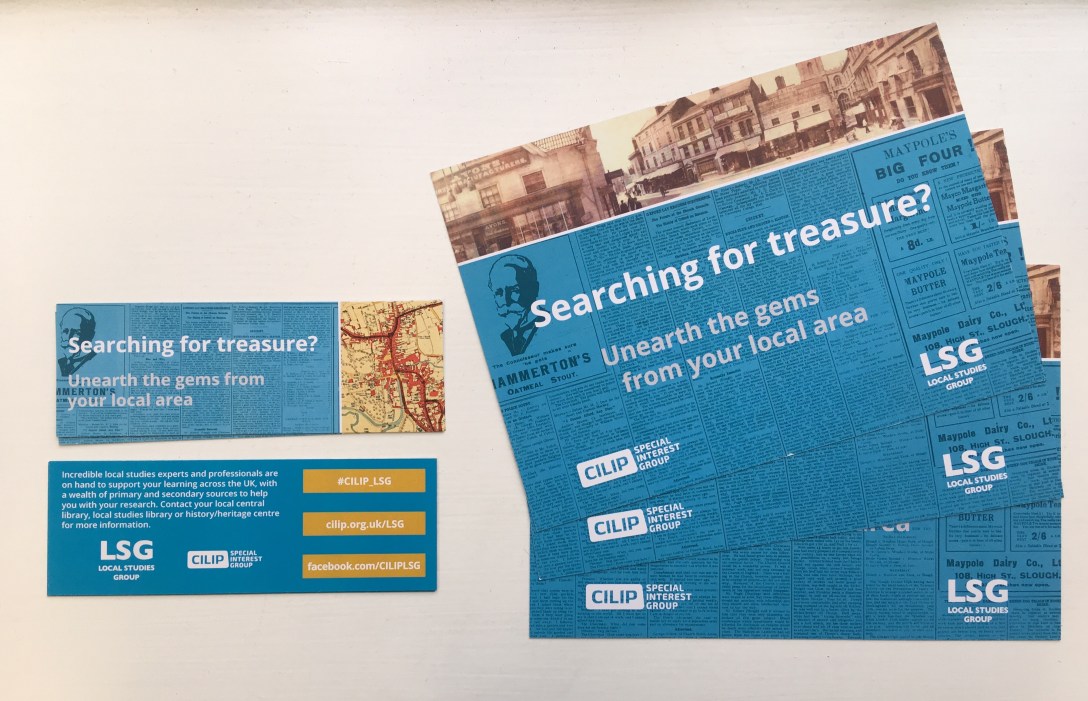
Our new bookmarks and postcards.
I had taken a selection of books and pamphlets, wondering whether they would justify the effort (weight?) of doing so, and was pleased to find that several did catch people’s eyes sufficiently for them to make a note of the titles. Most frequently commented on was Historical research using British newspapers by Denise Bates (Pen & Sword 2016, ISBN 9781473859005), but Catherine Exley’s diary: the life and times of an army wife in the Peninsular War edited by Rebecca Probert (Brandram 2014, ISBN 9780956384799) also attracted attention. Joan Grundy’s Dictionary of medical and related terms for family historians (Swansong 2006, ISBN 9780955345005) was spotted by someone who exclaimed “that’s just what I need!”.
I had also put together a portfolio of photocopies and leaflets to try to show the range of resources typically available in local studies collections. With hindsight this probably took up rather too large a share of the limited space available, and it was a serious embarrassment when the handle broke just as I was lifting it up to the luggage rack on the train home, but I did refer to items in it myself quite a few times as examples, and Tony said people were browsing through it in the afternoon.
We did not have access to electricity so my multi-way extension and numerous chargers were redundant, but I was pleased to find that my tablet connected to the wifi with no problem, the connection speed was good and the tablet’s battery held up well. I forgot to take a tablecloth (useful for concealing surplus baggage and boxes) but fortunately Will had brought one with him – an additional advantage of the table-sharing arrangement!
Hearty thanks are due to Tony for all his efforts beforehand in arranging for our new publicity material, and to the graphic design expert at CILIP who devised an attractive banner which won’t date too easily and which should help us to promote local studies libraries at this and similar events for several years to come. We also now have a supply of bookmarks and postcards with the slogan “Searching for treasure? Unearth the gems from your local area”.
They would be even more useful as outreach resources if they could cite a single gateway web address leading to a list of all the local studies collections / libraries / history centres in the country, or if there could be an obvious button on www.cilip.org.uk/LSG linking to a directory of local studies libraries etc., but that’s a whole new challenge – particularly in keeping such a list up-to-date! [Editor’s note: see a forthcoming blog post on this issue.]
I was let down by my usually-trusty bicycle which picked up a puncture on the way back to the station, but nevertheless I enjoyed the day. It was good to exchange ideas and enthusiasm both with researchers and fellow-practitioners from a wide range of institutions, and a useful opportunity to publicise local studies collections to researchers who might otherwise have overlooked their potential value.
Julie Davis reports back on Libraries Week in Wiltshire
I jumped at the fantastic opportunity to show case local history on a larger scale during Libraries Week at the beginning of October this year.
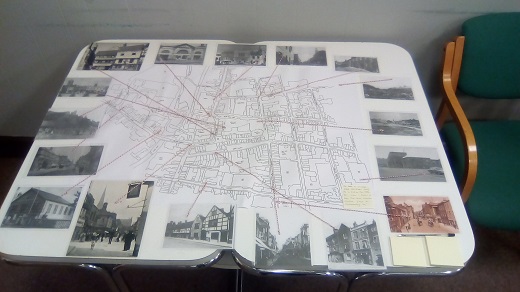
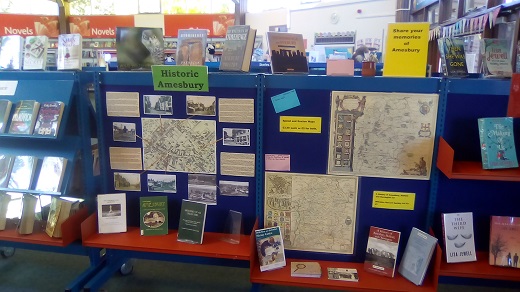
The week was centred around local history displays at many of Wiltshire’s public libraries with larger libraries making the most of the reproduction Goad Town Plans provided by the History Centre along side copies of photographs from our Historic Photograph and Print Collection which really brought back memories and brought the maps to life.
Our display in Amesbury
A small selection of local history material was also made available to purchase at some libraries which drew interest and sales.
There was a positive response to our call for comments and memories from local people which proved popular in many libraries– some of which are still ongoing.
Map and photographs of Salisbury
The maps caused a lot of chatter amongst library customers, many enjoying recalling old shops and haunts. Caroline, Local Studies Champion for Westbury noted; “Many people have been fascinated to see old photos of the streets in which they live. The display is bringing back memories for our older customers.” I plan to create a permanent record of the comments by making memory books using quotes and images.
Local Studies has an amazing power to excite, energise and share; for individuals in communities to discover commonalities and make connections which enrich and aid their health and well being.
It’s been a pleasure to for me and my colleagues at the History Centre to work with Wiltshire Libraries staff as one team to deliver local history to the heart of communities – one of the many, many reasons why our libraries are so special.
We are pleased to publish a new case study by Katie Heaton, Local History Librarian at Poole Museum.
Introduction
I have been a Librarian for fourteen years and have spent the last ten as a Local History Librarian at Poole Museum. I work closely with the museum team researching for exhibitions, alongside helping the public with family and local history enquiries.
Poole Museum has been working on a Heritage Lottery Funded Project, ‘Poole, the First World War and its Legacy’ since 2016, and this has been a major aspect of my role.
Name of Service Poole Museum
Title of Project Poole, the First World War and its Legacy: informal learning event.
Give a brief description of the project
The Heritage Lottery Fund has granted £50,600 to enable us to launch our project on Poole, the First World War and its Legacy. With our team of volunteers, and our partners in the community, we are creating a brilliant new website: www.pooleww1.org.uk
We will then go on to chart the nature of post-war Poole: those who mourned the 700 Poole men who fell, the returning servicemen – many of whom were damaged by the war – and the women who had supported the war effort and were no longer needed. It was a time of great change that played a part in forming modern Poole.
Our mission is to provide resources on what the War meant to those who fought, to those who made munitions, nursed soldiers, manned fishing boats – all the Poole people who were involved.
What made you start?
An important outcome of the Heritage Lottery Fund Project is
more people and a wider range of people will have engaged with heritage. Therefore alongside building a website we
built a number of outreach activities into our project plan. One of these was to work with the Museum
Learning Team and make the First World War a time period in their popular ‘Turn
Back Time’ summer holiday event programme.
This would mean two days of learning activities all about
Poole and the First World War.
What resources did
you need?
Staff time – Poole History Centre research and Learning Activity Leaders planning and implementing time.
Ingredients for cooking.
Craft materials.
Costumes.
Project publicity materials.
What challenges did
you face?
The project team had to put a case to the Learning Team to
take on the theme of the First World War as part of the summer holiday
programme. This was important as
informal family learning workshops are an approved purpose of the Heritage
Lottery funding.
Once the Learning Team had agreed, we needed to find suitableactivities for informal learning that tied in with the home front theme andmade the public aware of this aspect of the First World War.
A challenge is always staff capacity and time. Another challenge was making visitors aware of the link between the activities and the Heritage Lottery Fund project. Probably the greatest challenge was how to evaluate the two days. How do we know that more people engaged with the heritage?
What results have you
had?
Part of our project research had uncovered a really
interesting story in the local newspaper.
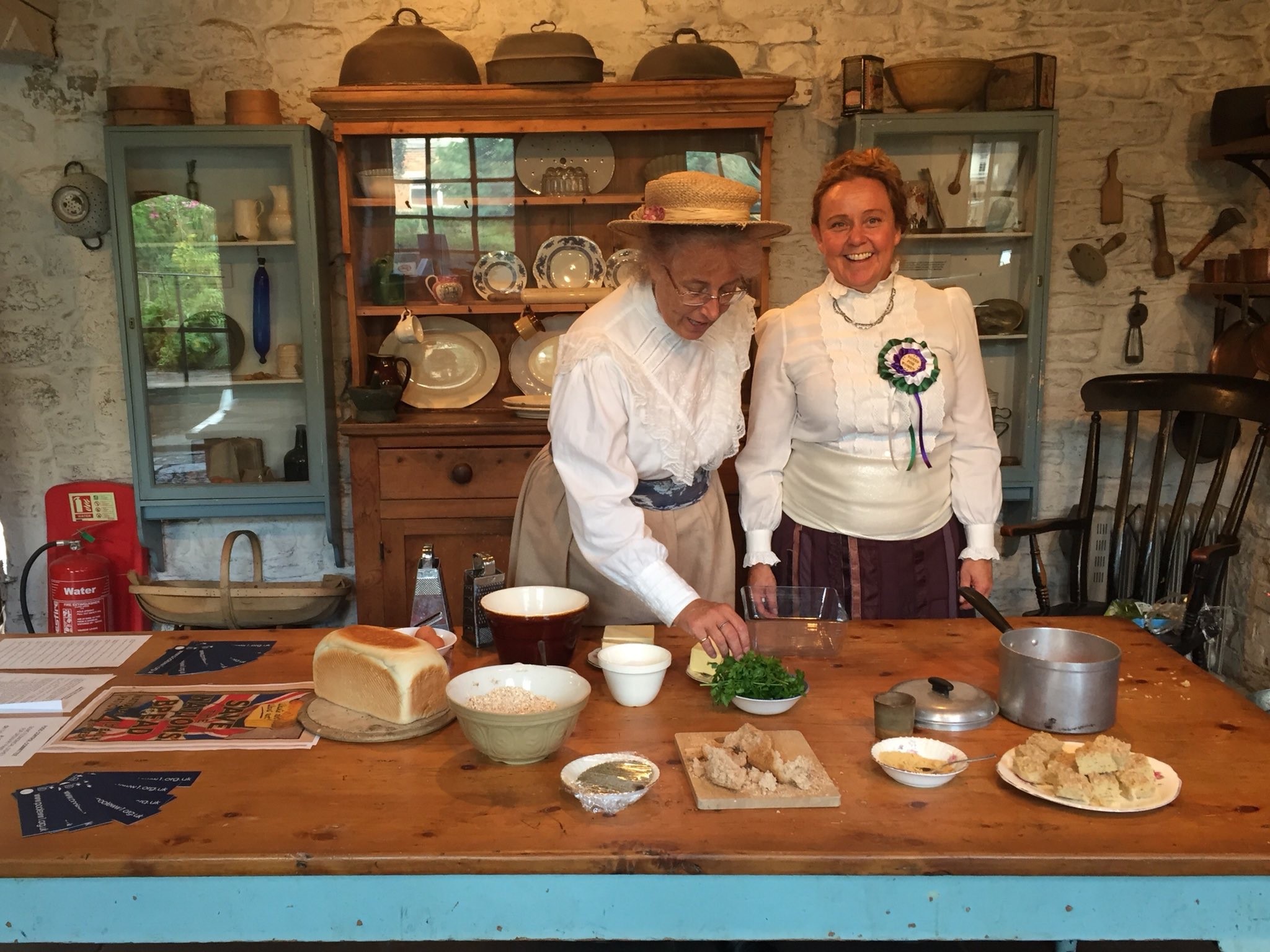
During the war a Poole Councillor, Evan Gambier, had run a series of
cooking demonstrations to teach ordinary people how to cook on a budget and
with rations. We decided that the main
part of the learning days would be a cookery demonstration with recipes from
the time.
People could watch the demonstration through the day, try
the food and engage with the activity leader about why cooking on a budget was
necessary. Posters, newspaper articles
and information was available to read.
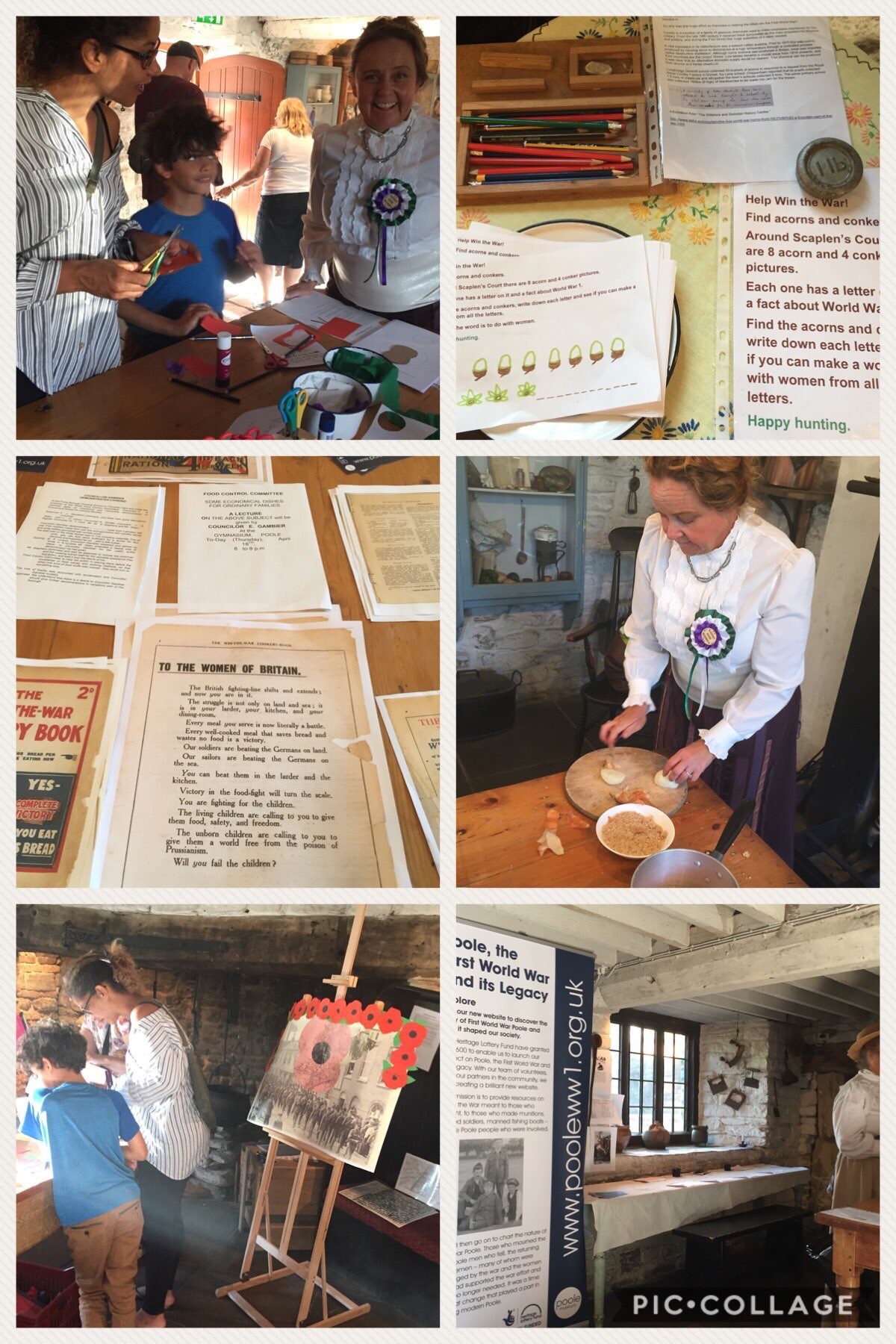
Alongside the cooking, visitors could make a poppy and dedicate it to one of Poole’s fallen; there was a print of the Roll of Honour. Visitors could also make a suffragette rosette.
A collection of First World War letters provided inspiration for people to have a go at writing their own in pen and ink. An acorn trail around the building helped people find out why acorns were collected in the war.
There were over 800 visitors over the two days and families were enjoying engaging with the activities. Project team members took part to chat about the Heritage Lottery Fund project.
The days were well attended, with 883 visitors over the two days, so more people definitely learnt about the heritage. We are hoping to repeat the days next summer and will spend more time planning evaluation. This needs to be much more robust for the Heritage Lottery Fund. Additionally we could work harder to link the activities to the project. We had good results over the two days, but also learnt that there is a lot more we could do. A challenge was staff time and capacity so next year I will start planning much earlier.
Pictures from the event.
How much time did it
take?
Two planning meetings, Learning Activity Leader planning
time and two full days of activities.
What advice would you
give to others?
If you’re planning an informal learning event or family
activities then this case study might inspire you!
As a Local History Librarian working as part of the Museum Team I have access to different skills and ideas. If your local Museum has a learning team make contact with them as they can help you bring history and projects to life. Collaboration was fundamental to the event.
The variety and number of activities helped to keep people
engaged and the mixture of guided and self guided activities was a good one and
worked really well for the two days.
If we do this again I will definitely strengthen the evaluation as no matter how good the event is evaluation is key – either for funding, a case to managers to continue activities or to simply see why the event worked or what aspects didn’t.
Nomination are still open for the Alan Ball Award for Local History publishing.
The award is open to all heritage and community organisations involved with some aspect of local history, and who have received public funding for the publication. Public funding includes lottery funding, e.g. Heritage Lottery Fund and Awards for All. In addition to local authority libraries, archives, museum and archaeology services, we welcome submissions from small local museums, heritage centres and community history projects. The publication needs to have appeared between July 2017 and June 2018.
We have two categories:
Book publication
E-publication.
One winner will be picked in each category.
Nominations close on the 30th November. To submit your nominations, please download and return the form


 CILIP Local Studies Group