This Saturday, as part of Bristol’s Radical History Festival, people will be able to view examples from the heyday of the radical press in Britain (c.1968-88) and explore an interactive map. The exhibition is part of the work of Recovering the Regional Radical Press in Britain 1968-88, a project based at the Regional History Centre, UWE Bristol.
The project is interested in hearing from anyone who can provide information on titles and their whereabouts. Come along to the exhibition, or contribute information via their website.
The next Oxfordshire Local History Association study day will be onusing manorial documents for local and family history. The day will include the launch of the Oxfordshire Manorial Documents Register. The National Archives and partners have been working on revising and computerising the Manorial Documents Register on a county by county basis. The Register provides listings and descriptions of manorial documents held publicly and privately. Manorial documents can be a rich source of information on places and often contain court rolls, surveys, maps and terriers.
Title: Using manorial documents for local and family history research
The University of Leicester Library holds one of the largest local history collections in the country. But what’s actually in the collections and how can you use them?
The first thing to emphasise is that we collect on all the historic counties of England (and London). We have more titles on Yorkshire, for example, than we do on Leicestershire. This follows the comparative approach of the Centre for English Local History. We also hold many works relating to landscape history and topography, another strength of the Leicester tradition.
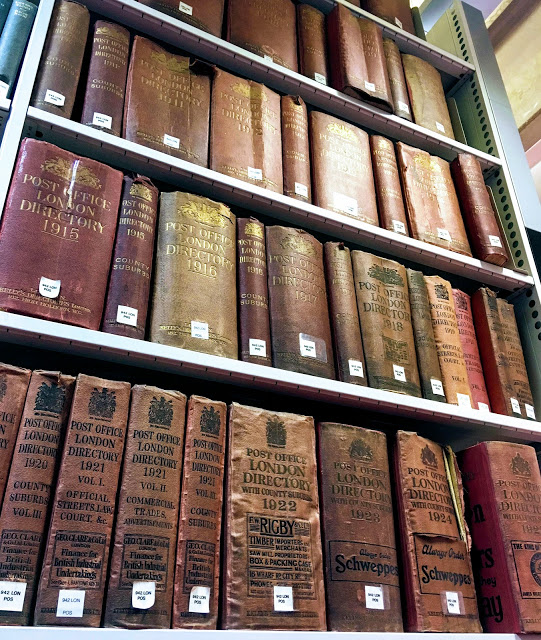
The main collection is on floor 3 of the David Wilson Library. It contains around 37, 000 titles. We hold major reference works, printed primary sources, monographs, finding aids and bibliographies, maps and ephemera. And a lot of directories…
London Post Office Directories towering over Library staff
The collection begins with general works (like the Victoria County History and the Buildings of England), dictionaries and guides to sources. You will also find books on methods here and major works of interpretation e.g. W.G. Hoskins, Making of the English Landscape.
The rest of the collection is organised by county, beginning with Bedfordshire and ending with Yorkshire. Within each county Record Society volumes come first, then items relating to the county as a whole, and then items relating to individual places within the county.
For researchers, the printed primary sources are very useful. Some are original items, but others have been edited and published by record societies, large and small. These sources can help you by: saving a trip to an archive; abstracting information to make it easier to find and re-use; providing historical context to aid interpretation. Having many similar sources in one collection is a great help to anyone working on a topic.
Example source: poll books We have over 100 poll books in our collections. Before the introduction of the secret ballot in 1872, English elections were run using open voting. The names of who voted in an election, and who they voted for, were recorded in either manuscript or printed form. These ‘poll books’ are of obvious interest to anyone studying political history. Indeed, they give historians information about voters that contemporary political analysts cannot access. They are also useful to someone researching local society, because of the class and status criteria that determined the franchise. Many poll books include further information such as where the voter lived and their occupation. Full names linked with a date and place are also useful for family historians and genealogists. Below are a few examples.
General election 1852: poll book of the North Lincolnshire election, taken in July, 1852, with a history of the election … (Boston: Morton, 1852). LOCAL HISTORY 942 LIN /LIN
This is a printed poll book from the 1852 General Election, recording the voters in the North Lincolnshire constituency. The title page and dedication (“Glorious Protection Triumph” & “To the tenant farmers and Yeomanry”) indicate it was printed by opponents of the repeal of the Corn Laws. This book is particularly detailed as it includes summary statistics of the voting, the candidates’ speeches and humour inspired by the campaign.
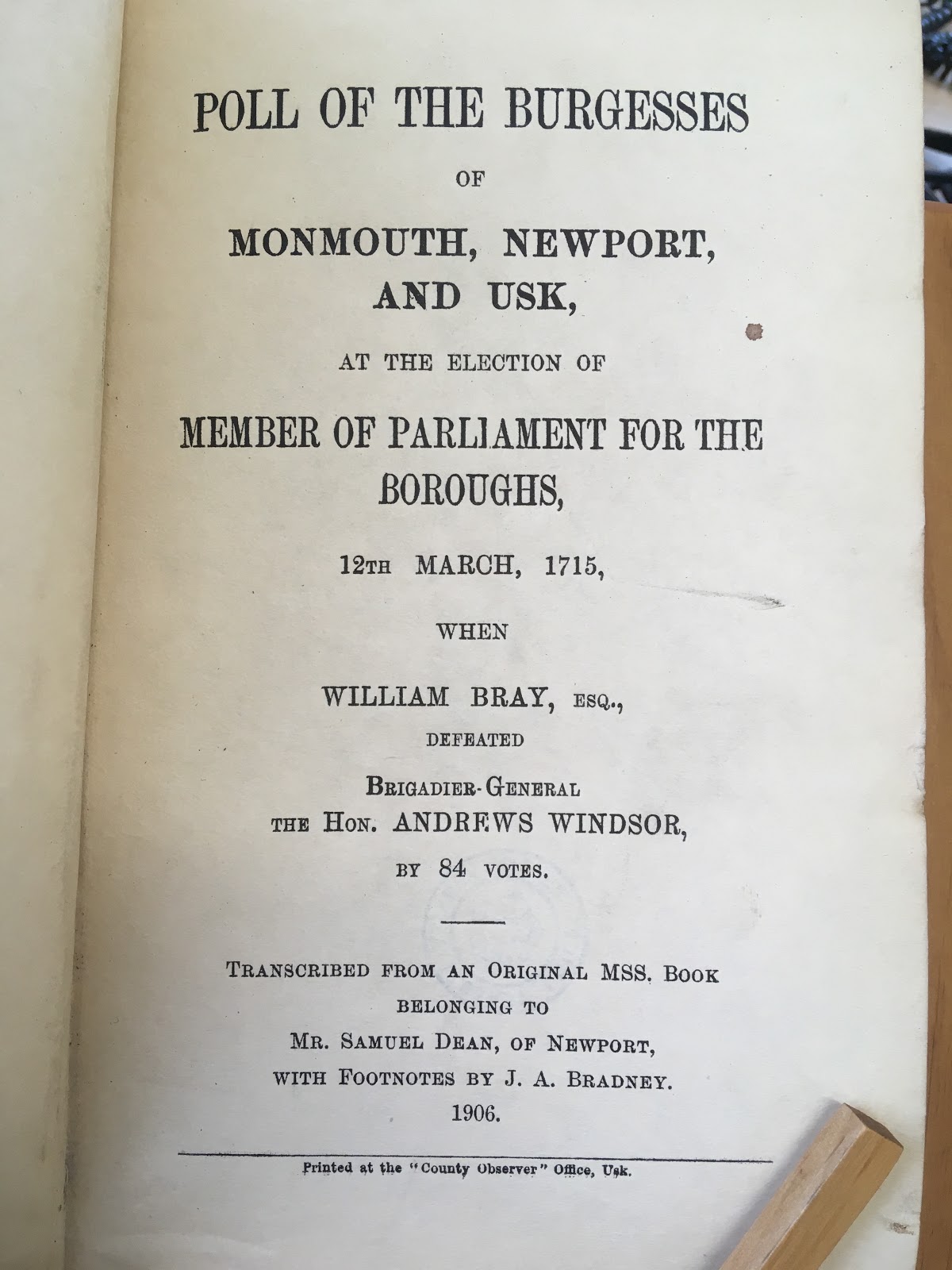
Poll of the burgesses of Monmouth, Newport, and Usk, at the election of Member of Parliament for the boroughs, 12th March, 1715 (Usk: 1906). H941.69 AAA /MON.
The title page tells us that it was transcribed from a manuscript in private hands.
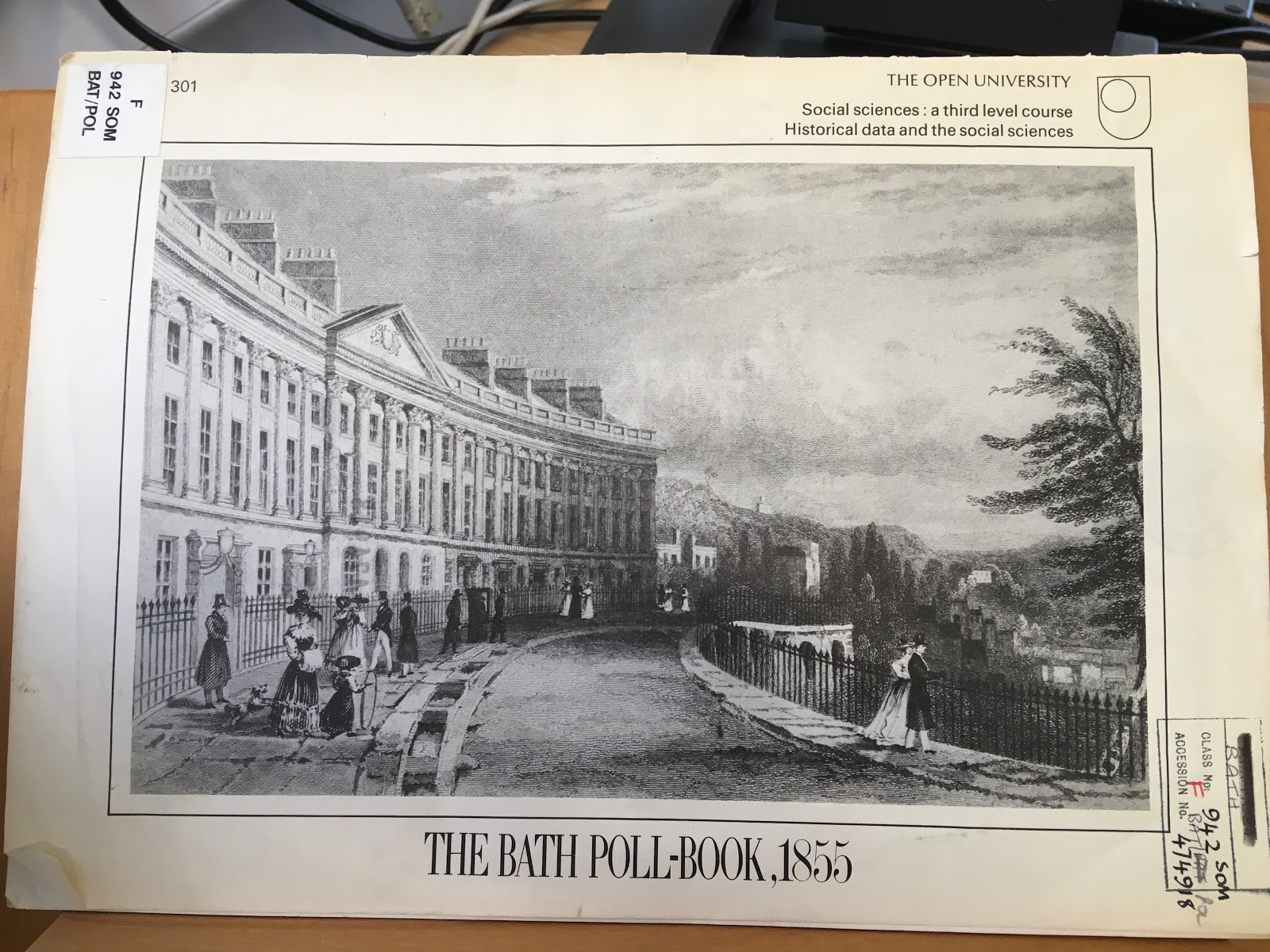
The Bath poll book, 1855: being a list of the names of persons with their residence and calling, who voted, or were entitled to vote, at the election of a member for the city and borough of Bath, June 4th, 1855 … (Milton Keynes: Open University Press, 1974) LOCAL HISTORY F 942 SOM/BAT /POL.
The uses of ephemera. This is a a facsimile of the Bath Poll-Book for 1855, printed for an Open University course in 1974.
Other topics you can find sources on include population, parishes, local government, religion, land, and the cooperative movement. We have even more in Special Collections and Archives who hold associated rare book and archive collections. Special Collections Online has several large digitised collections, including the Historical Directories of England and Wales and the East Midlands Oral History Archive. The PhD theses awarded to students of the Centre are freely available online. Soon we will add the occasional papers series originally published by Leicester University Press.
The Library welcomes visitors from outside the university: a reference card is available free of charge. Search our catalogue to see what we have: https://www2.le.ac.uk/library We are always interested to hear feedback from readers and ideas for collaboration. Email us: librarians@le.ac.uk
William Farrell Library Research Services, University of Leicester
Do you have a collection you would like to highlight to others? Then why not write about it on the LSG blog? We are here to help promote local studies libraries, large and small. Email ideas to William Farrell (LSG digital champion): wjbf1[at]le.ac.uk.
In celebration, the Historic Towns Trust (HTT) and the Oxford University Department for Continuing Education are holding a day-school in Oxford which will be of interest to many local studies librarians and archivists.
Title: Mapping the Town: 50 Years of the British Historic Towns Atlas
Date: Saturday October 12th
There will be talks on the town atlases of Oxford, York and Winchester, as well as the history of the project.
Do you know a Local Studies Librarian that has gone the extra mile? Have they pioneered an amazing project or given a career of excellent service to their community? If you do, nominate them for the McCulla Prize, the annual Local Studies Librarian of the Year Award.
We welcome nominations from colleagues, local historians, family historians and anyone who knows a local studies professional who has made a difference.
To nominate, please complete the form on this page.
This year nominations close on 30th November 2019. Nominations received after that would be considered for the next award.
The Network was established
earlier this year to support all black, Asian and minority ethnic (BAME)
library and information workers, regardless of whether they hold CILIP
membership or not.
The event is free to attend and will be a valuable opportunity for BAME workers to hear from inspiring speakers, connect with a support network and to feedback to the BAME Network on what they’d like from the Network.
We’d really appreciate allies promoting this event and to support and encourage BAME colleagues to attend this event. The Allies Forum will hold a separate launch event at a later date – please watch this space.
Nominations are now open for the Alan Ball Award 2019 aka Local History Publication of the Year.
The award is open to all heritage and community organisations involved with some aspect of local history, and who have received public funding for the publication. Public funding includes lottery funding, e.g. Heritage Lottery Fund and Awards for All. In addition to local authority libraries, archives, museum and archaeology services, we welcome submissions from small local museums, heritage centres and community history projects. The publication needs to have appeared between July 2018 and June 2019.
We have two categories:
Print publication
E-publication.
One winner will be picked in each category.
Nominations close on the 30th November. To submit your nominations, please use the forms at the bottom of this page.
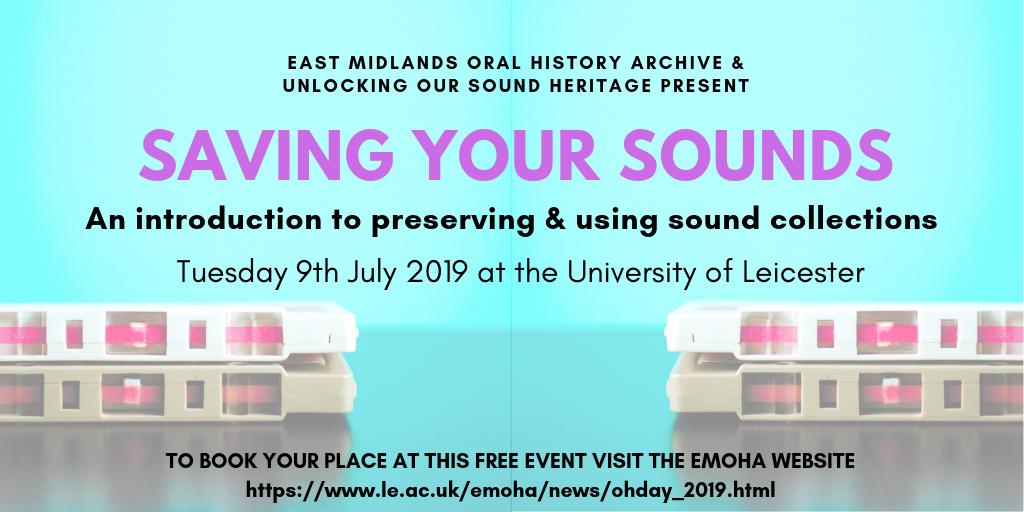
This free event will look at conserving and using sound recordings. This will interest any local history group or museum, library, archive or individual that holds sound recordings or is thinking of working with old sound recordings. It is organised by the Unlocking Our Sound Heritage Midlands Hub and the East Midlands Oral History Archive (EMOHA), with support from the Oral History Society.
Date and time: Tuesday 9th July from 10am–3.30pm.
To register contact Colin Hyde on ch38@le.ac.uk or tel: 0116 229 7358. If you want lunch please state if you have any particular dietary requirements.
Location: Ogden Lewis seminar rooms, David Wilson Library, University of Leicester, University Road, Leicester LE1 7RH
Maps and directions can be found here – http://www.le.ac.uk/maps/ . The nearest public car park is the Granville Rd/Victoria Park car park, while the campus is a 20 minute walk from the train station.
Provisional Timetable
09.30-10.00 Tea/coffee/registration.
10.00-10.20 Introductions from Colin Hyde of the UOSH project. Updates from Helen Foster of EMOHA and Cynthia Brown of the OHS.
10.20-11.00 Why the UOSH project has been set up. What sound recordings exist in the region and why they are ‘at risk’? What will we be doing?
11.00-11.45 The history and identification of recording formats with hands-on examples.
11.45-12.00 Tea/coffee break.
12.00-12.45 Preservation of formats. A guide to digitisation.
12.45-13.30 Lunch (provided).
13.30-14.15 Cataloguing your sound recordings. Hints and tips.
14.15-14.30 Tea/coffee break.
14.30-15.15 Using the archives – ideas for what to do with your sound recordings. Learning and engagement.
15.15-15.30 Summing up/close with option of a look at the digitisation studio.




 CILIP Local Studies Group
