Maps in Derby Local Studies Library featured recently on an episode of Free Thinking on Radio 3. Mark Young, Librarian at Derby Local Studies Library talks about a series of world maps by the 18th-century cartographer Hermann Moll held in the collections.
Delivering culture and heritage to audiences online has become increasingly important in 2020.
CILIP Cymru Wales (CCW), CILIP Metadata & Discovery Group (MDG), CILIP Local Studies Group and People’s Collection Wales (PCW) invite librarians across Wales to an online PCW session, which will show librarians how to share digital content, re-purpose it via the Hwb and Living memory initiatives, and measure its impact – all via the PCW site.
This webinar will be followed up with bespoke training to help libraries in Wales get their collections online.
Details
Join via Zoom on Friday 20 November, 12-1pm.
The session is free and open to all. Register via the event page.
Session outline
About us: People’s Collection Wales
An introduction to uploading digital content to PCW
An introduction to linking content from PCW to Hwb Learning and teaching for Wales
An introduction to linking content from PCW with the Living Memory initiative
An introduction to measuring digital impact
Discussion: what next?
At the end of this session participants will be able to:
Identify materials for uploading to PCW
Describe materials for upload to PCW
Identify opportunities to develop new resources for Hwb and Living Memory
Identify opportunities to promote and evaluate your users’ digital activities on PCW
Tailor subsequent training sessions around what you need to start sharing content via PCW.
The webinar will provide a useful oversight for all library and information professionals in Wales hoping to improve user engagement with digital collections. It will be particularly useful for public library and archives staff with local studies collections.
Presenters
People’s Collection Wales: Tom Pert, Gruffydd Jones, Rheinallt Ffoster-Jones Jessica Roberts
Facilitators: Amy Staniforth (CILIP Cymru Wales), Jane Daniels (CILIP Metadata & Discovery Group)
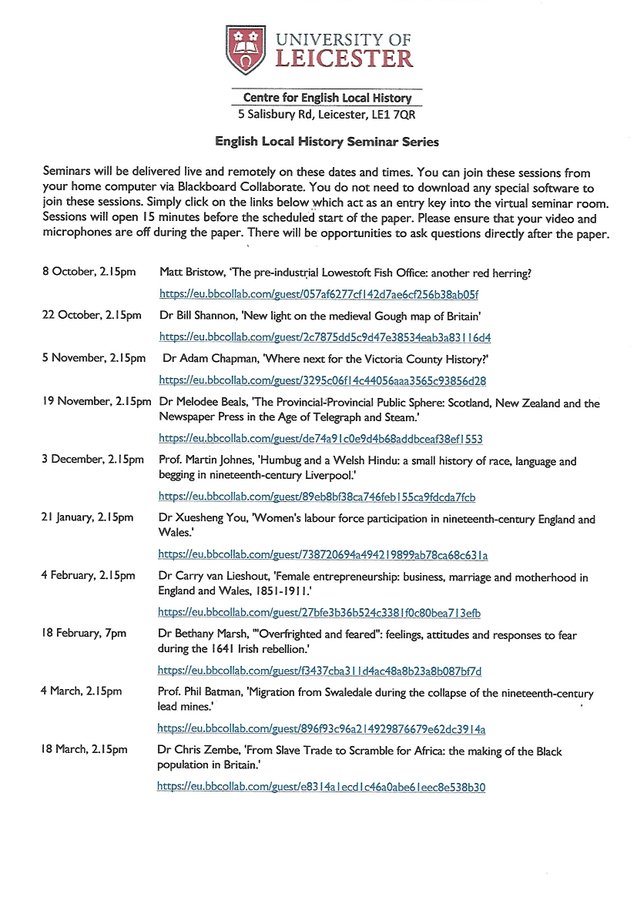
The Centre for English Local History at the University of Leicester are running their seminar series as an online event this year. So you can now join in from the comfort of your home or office. Full details below. It’s also worth following them on twitter @ELHLeicester for updates on the program.
We know the value and positive impact that local studies collections can have on people’s lives. Sharing and exploring together; understanding how the past has shaped a community, and the history of the places that matter to every one of us is proving, now more than ever, to be a comforting constant in an ever-changing world.
Tower Hamlets has been digitising film collections and sharing via social media channels such as You Tube.
Hosting online screenings of films from Local Studies collections: Tower Hamlets is doing this via Facebook Live.
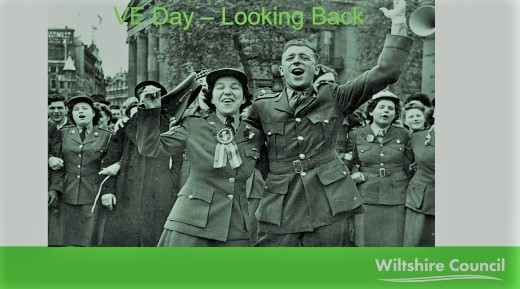
Creating film-shows using photographs from Local Studies collections alongside narration; such as the VE Day film show created by the Wiltshire & Swindon History Centre.
Local Studies for reminiscence: the Wiltshire & Swindon History Centre has been trialling the use of photographs from its collection to create film shows specifically to help those with memory loss.
Covid-19 specific projects
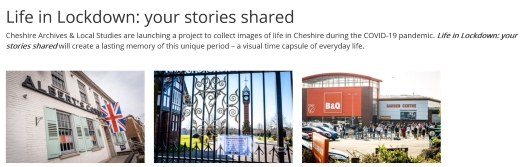
There are many libraries and archives garnering the support of their current volunteers, engaging with the public and growing their volunteer base to help document life under lockdown. Examples include Suffolk Archives, Hull History Centre and Cheshire Archives & Local Studies.
Online Outreach
Many are making recent exhibitions available online and offering fee virtual talks, plus the promotion of free online heritage resources. Examples include Poole History Centre and the Wiltshire & Swindon History Centre.
The Wiltshire & Swindon History Centre have produced an online version of their Memory Box Reading Group sessions which focus on Wiltshire’s local history.
Solihull Local Studies Library have created an e-book from people’s memories of wartime Solihull.
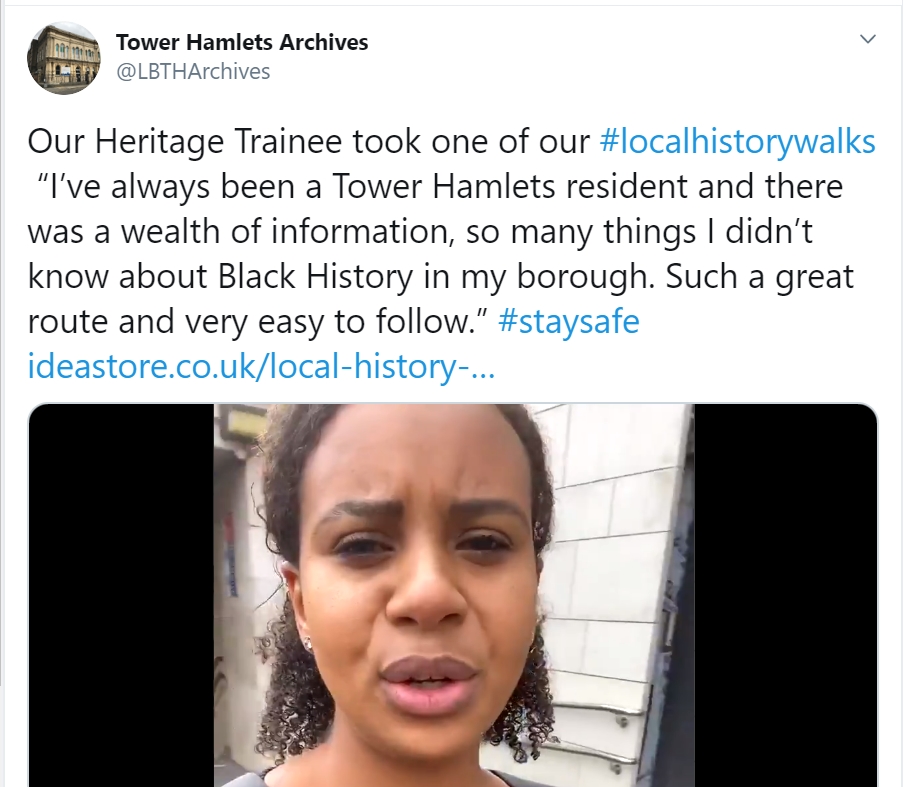
Tower Hamlets have established a number of socially-distanced local history walks, accessible via social media. They have also produced a set of online local history podcasts and continue to work on collections-led study material to support parents with the history curriculum.
West Sussex Local Studies have posted interviews from their WWI project online.
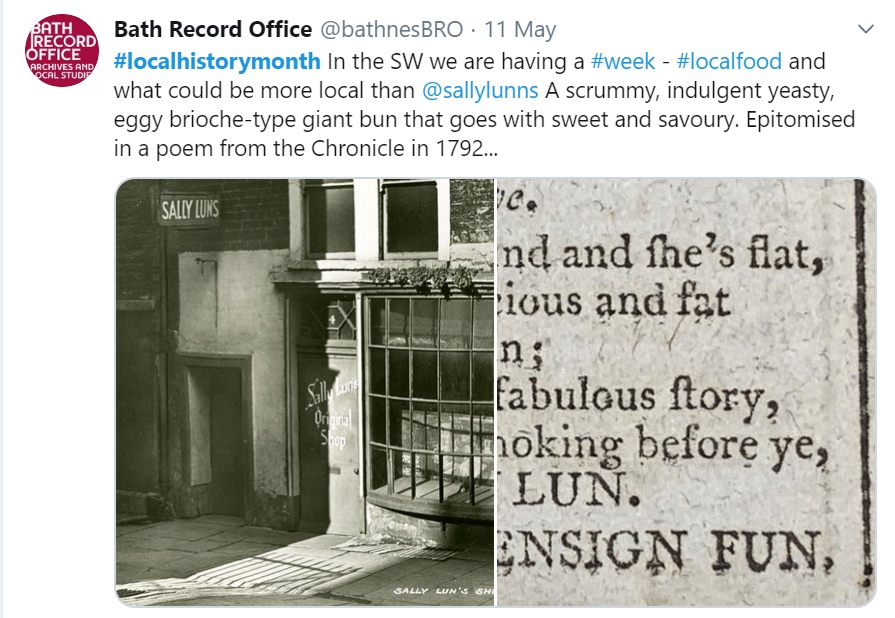
Members of the South West Local Studies Librarians Group took part in a joint social media outreach project for Local and Community History Month 2020 using an A to Z theme, plus hashtags such as #LocalFood, #LocalStories, #LocalBuildings, #LocalCelebrations. Somerset Archives, Poole History Centre, Wiltshire & Swindon History Centre, Devon Archives, Bristol Archives, Bath Record Office and Swindon Local Studies Library all took part.
There is a local history JISCmail list which is free to subscribe to at https://t.co/SxpP3By8u3 if you are interested in, or are working in the local history field, and would like to discuss and share information. The CILIP LSG blog is also a great platform to make the most of, and we would love to hear from anyone interested in Local Studies.
There is some amazing work happening all over the country, and certainly in my case it’s been a sharp learning curve, and a continued work in progress as my own skills improve…
We hope these examples help inspire everyone to discover more about the history of the places that matter to them in a greater variety of formats than ever before.
Julie Davis
County Local Studies Librarian, Wiltshire & Swindon History Centre & Member of CILIP LSG
Now that I’ve become a library user (viruses permitting), rather than a staff member, I can’t help noticing how many events and initiatives are arts based. I suppose that this is partly because the Arts Council has national responsibility for libraries and grants for activities come from them. This must bring in new audiences who can make use of local studies collections in different ways, but I worry that it an emphasis on arts rather than learning might have its drawbacks.
I’ve always believed that local history and family history are important because they are the most democratic form of education available to anyone. Anybody can walk through the door and decide for themselves what they want to study and how. They can interact with other people through chatting to others in the library or through societies – or they can work completely on their own if they wish. They don’t have to pay fees to an educational organisation, they can pick whatever aspect of history that interests them – and, if they adopt proper research techniques, their work has equal value to professionals in the field. Very few subjects allow complete amateurs opportunities like this. In my working life I came across many people who had not done well at school and had come to regret their perceived “lack of education” – local history gave them a second chance to learn, on their own terms. I can’t count the number of people who complained that the history of “kings and queens” which they encountered in their young days at school was of no interest to them. Local and family history is not only of interest because it concerns our immediate environment but it also focusses on the past lives of people like us.
Many years ago family history was regarded as a rather pointless exercise of collecting names and dates. Nowadays its value as a way of learning about our past and how society works is as evident as in the study of local history. But students learn so much more – research techniques (both online and with documents), how to evaluate evidence, how to analyse evidence, how to present findings etc etc.
To me this is what makes local studies collections important.
Do you work in the information, library or heritage sector? Do you work with local collections?
Then I want to hear from you!
I’m an MA student at University College London, and I’m researching how local collections are managed across different institutions and sectors for my dissertation. In addition, I hope I may be able to share some of my highlight findings either through an article or presentation.
There is little recent academic research in this area, so your responses to this survey will be especially valuable. I very much appreciate any time you can give. All of the questions are optional. You can complete the survey and remain anonymous.
Next Tuesday, University of Leicester Special Collections are running a free, public webinar looking at key ideas for interpreting and exhibiting archives.
Dr Peter Lester (School of Museum Studies) will lead a workshop looking at different types of exhibitions and a selection of interpretation techniques, as well as some thoughts around writing effective exhibition labels. The workshop will use examples of online exhibitions from archives and museums around the world, with the aim of inspiring you to start exploring these exciting resources. For participants planning and working on interpretation, the workshop will also help you to start thinking creatively about designing exhibitions. There will be opportunities to ask questions and to share your own examples of exhibitions you have visited.
On Thursday 30 July, the East Midlands Oral History Archive are organising an afternoon showcase of oral history work going on around the region.
Speakers
James McSharry from NHS@70, a UK-wide oral history project which kicked off last year to mark 70 years of the National Health Service.
Jan Reynolds from Adverse Camber Arts will be speaking about their Moon Stories project which celebrated 50 years of the moon landings through oral history and arts.
Tonya Outram from Nottingham Trent University guides us through Textile Tales, which collected stories about the decline of the East Midlands textile industries from 1980 to 2005.
Wajid Yaseen from Modus Arts introduces Tape Letters , a project which shines light on the practice of recording and sending messages on cassette tape as a mode of communication by Pakistanis who migrated and settled in the UK between 1960-1980.
Lesley Owen-Jones joins us from the National Lottery Heritage Fund to talk about oral history and funding in this time of pandemic.
The East Midlands Oral History Archive collects and looks after oral history collections from across the region. It also offers training and advice in oral history practice. It is part of the Centre for Urban History at the University of Leicester.
Creating Local Linkages is a free online course for library staff to develop skills in research and digital local history. It has been designed by the Institute of Museum and Library Services and the Roy Rosenzweig Center for History and New Media. Originally run as a credit-bearing course, it is now available for free, self-taught learning.
The five modules cover topics including:
developing research/public history projects
locating and understanding primary sources
using Omeka to publish digital collections
copyright, permissions and re-use
understanding the Dublin Core Metadata Schema
planning outreach activities.
Although it has an American focus, it would be suitable for library, archive and museum staff in Britain. It would particularly suit members of staff new to digital history or public history projects. Start here: https://locallinkages.org/course/ and work through at your own pace.
 CILIP Local Studies Group