McCulla Award Winners Announced

Librarian sitting on books painting a townscape. Large text below: Local Studies Group McCulla Award 2021

We are delighted to announce the winners of the McCulla Award. The McCulla Award recognises outstanding contributions to local studies librarianship. The winners for 2020 and 2021 are:

2020: Norma Crowe, Local Studies Librarian, Medway Archives Centre.

2021: Louise Birch, Senior Librarian Manager, Local Studies, Leeds Libraries

Many congratulations to Norma and Louise. We hope to organise a presentation in due course.

Alan Ball Award Winners Announced

We are very pleased to announced the winners of Alan Ball Awards for 2020 and 2021. The Awards recognise achievement in local history publication. This year there were three categories: best print publication, best e-publication and best community publication.  

It was very competitive field – we received around 38 nominations of the book award and 10 for the e-award – so many congratulations to all the winners and those highly commended. A thank you too to the judges and Solihull Library for hosting us.

2020

Hard-copy winner: John Simpson (ed),  Managing Poverty: Cheltenham Settlement Examinations and Removal Orders, 1831-52.  Published by the Bristol and Gloucestershire Archaeological Society.

Highly commended: Rowan Whimster, Ramsbury: A Place and its People. Published by the Friends of the Holy Cross Church, Ramsbury.

Community award: Louise Wong (ed.), Crossing the Borders [Stories of the S E Asian communities in Manchester]. An NLHF funded project by the Wai Yin Society / Manchester University / Ahmed Iqbal Ulah RACE centre –  Manchester Central Library / Manchester Art Gallery.

E publication award: Stroudwater History website – www.stroudwaterhistory.org.uk. Published by the Stroudwater Navigation Archive Charity.

2021

Hard-copy joint winner: The Picture of Yarmouth: 200 Years of Built Heritage. Published by the Great Yarmouth Local History & Archaeological Society.

Hard-copy joint winner: Louise Ryland-Epton (ed), Bremhill Parish Through the Ages: The Heritage of a Wiltshire Community. Published by the Bremhill Parish History Group.

Hard-copy highly commended: Lewis N Wood, Banstead War Memorial 100 Years: An Illustrated history. Published by the Banstead History Research Group.

Hard-copy highly commended: Clare Wichbold – Hard Work – But Glorious: Stories from the Herefordshire Suffrage Campaign (self-published).

Community award joint winner: Alison Wilson with Anna Crutchley and Lilian Rundblad, photography by Faruk Kara, A Community Remembers: Histon Road  (book with CD). Published by the Histon Road Area Residents Association.

Community award joint winner: Nunnery Lane and Clementhorpe: Exploring Old Shops and Pubs in York. Published by the Clements Hall Local History Group.

E-publication: South West Heritage Trails – Torbay Discovery Heritage Trail  www.southwestheritagetrails.org.uk. Published by South West Heritage Trust.

Sally Jenkinson – McCulla Award Speech

In the week we announce the latest winners of the McCulla Award, Sally Jenkinson of Surrey History Centre, reflects on the achievements that won her the Award in 2019/20.

Highlights of my projects 

When I first joined Surrey History Centre my main role was to help with a project to set up volunteer run Local History Centres in libraries around the county, mainly supporting the volunteers with training and resources.  Some of their excellent work can be seen online at Epsom & Ewell History Explorer and the RH7 History Group

I soon became involved in developing the Surrey History Centre website, and in due course in an interesting new project to make it possible for customers to pay for events and buy books online.  This has now been superseded by Surrey Heritage’s combined online catalogue and shop

The Quarter Sessions project was rather special as it was undertaken by the Surrey History Trust.  The project was led by volunteer John Holland who sadly passed away before completion.  I was pleased to be able to help finish producing the CD, and a few years later to arrange to put the same data on Findmypast where it continues to produce income for Surrey Heritage. 

Probably the most important work I have done has been arranging to put records online on Ancestry, Findmypast, Forces War Records and The Genealogist.  To be able to make so many records available all over the world so easily is something we would never have thought possible when I started work in Surrey Local Studies Library in Guildford.  That was in 1989, when enquiries arrived on paper in the post. 

The database I most enjoyed making is the Loseley Letters database.  I created this for colleagues so that they could enable researchers to reconstruct sequences of correspondence as well as searching for a person, place, subject or keyword.  

My favourite volunteers project was the Surrey tithe records project because tithe records are so useful for local history research.  We made transcripts and copies of the maps available to purchase, and we were all very pleased that the project also helped the Surrey Wildlife Trust protect some ancient woodlands.  In the second phase of the project volunteer David Young produced GIS-enabled tithe maps and first edition 25 inch OS maps for the county which researchers could purchase, and we were able to provide courses to show them how to use them.   

Local Studies Librarian of the Year 2020 and 2021 

We are pleased to announce the winners of the McCulla Award aka Local Studies Librarian of the Year. Two McCulla Awards for Local Studies Librarian of the year have been made this year, as the pandemic interrupted the usual arrangements. The Award is in memory of Dorothy McCulla, who was Head of the Local Studies Department at Birmingham Central Library from 1969 until her untimely death in 1981. The judges, from CILIP Local Studies Group, had a difficult job choosing winners from a strong field, which reflects the excellent work being done under difficult circumstances in the past few years. 

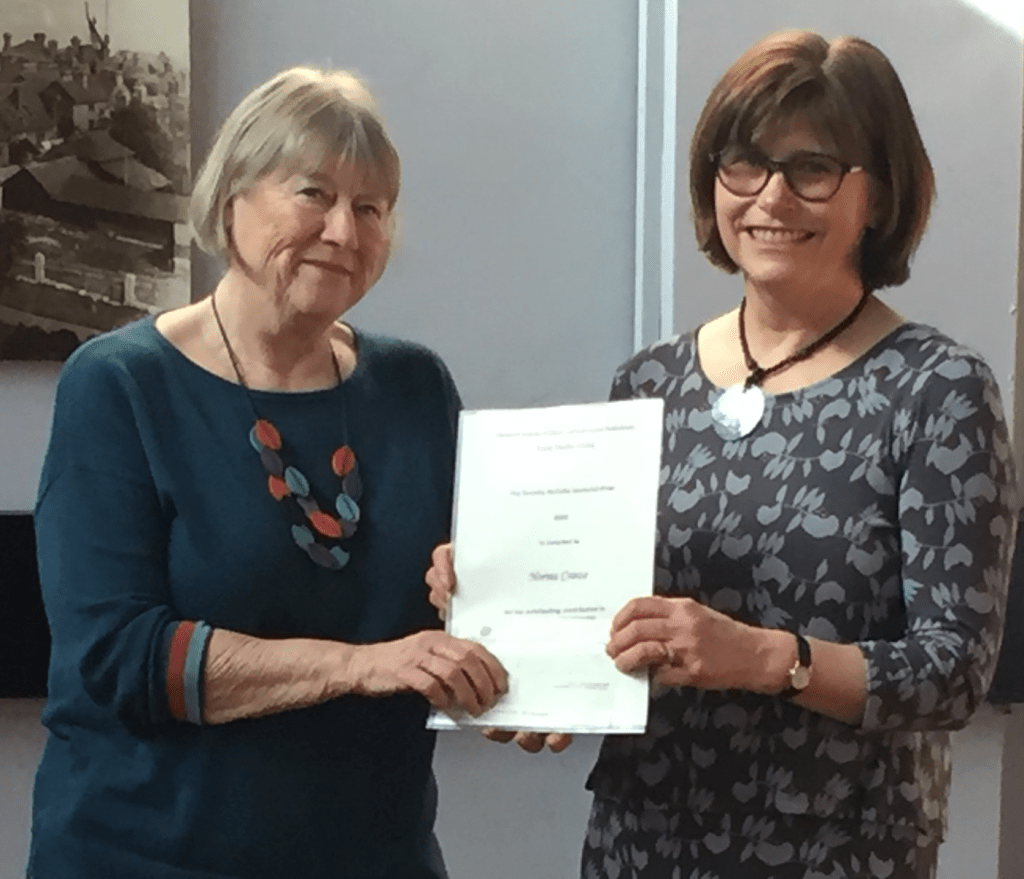
Norma Crowe receiving her certificate for the McCulla Award.
Norma Crowe receiving her certificate

Norma Crowe, Local Studies Librarian at Medway Archives Centre, won the Award for 2020. She has worked in local studies in Medway since 1995 and has a fine record of community engagement. Her work on the history of Short Brothers of Rochester led to the founding of the Short Brothers Commemoration Society (which she chaired) and the erection of a memorial in the town. A similar project led to the setting up of Strood Heritage Society. Her outreach work often uses exhibitions to involve local volunteers and encourage visitors to the Archives Centre, in recent years she has featured women’s history and World War I. New audiences have also been attracted by her wide range of publications and web pages.

The 2021 winner is Louise Birch who has been Senior Librarian Manager, Local Studies, in Leeds since 2015. She has strategic responsibility for the department and is particularly concerned with building digital platforms and leading an externally funded oral history project in partnership with other library authorities.  During the pandemic, she was able to oversee the development of a new website for the Leeds online photograph archive of over 66,000 images, which has massively increased public engagement with the collection. She also runs a regular programme of events for Heritage Open Days, is developing the local studies offer to schools and has created heritage tours of the Central Library building. 

Alice Lock, Secretary of CILIP Local Studies Group

New Grants for Working Class Heritage

Historic England has recently announced a major new initiative Everyday Heritage Grants: Celebrating Working Class Histories. These grants will fund community-led projects that focus on “heritage that links people to overlooked historic places, with a particular interest in recognising and celebrating working class histories”.

Community and heritage organisations can apply for grants up to £25,000. There is a focus on sharing untold stories and encouraging volunteering.

Applications open: Wednesday 23 February

Closing date:  Monday 23 May

For more information visit the grants page  or email EverydayHeritage@HistoricEngland.org.uk

A whisky for Dracula: Digitising Nottingham’s oral history

Bela Lugosi in the trailer for Dracula (1931). Source: WikiMedia Commons. Url: https://commons.wikimedia.org/wiki/File:Bela_lugosi_dracula.jpg.

Count Dracula walks into a bar and orders a whisky … It sounds like the start of bad joke, but in 1951, if you were drinking in a certain bar in the East Midlands, you would have got the fright of your life. That year, Bela Lugosi was reprising his most famous film role in a performance of Dracula at the Theatre Royal Nottingham. After the Monday night performance, he walked straight out of the stage door and, in full costume, headed for the Flying Horse Hotel in need of refreshment. Mr. Stokes, the Night Porter, remembered the shock of the regulars for many years afterwards. (You can see a copy of the original program on the Theatre Royal online archive.)

This anecdote is one of the highlights of Nottingham’s oral history collections. The Unlocking Our Sound Heritage (UOSH) project has been spent the last four years digitising oral history and sound collections from around the Midlands. This is part of a national project run by the British Library to preserve at-risk collections and improve public access, where possible.

Over on their blog, UOSH give overviews of the work they have been doing with Nottingham Local Studies and Nottingham University Special Collections. The former post includes a clip of the Bela Lugosi anecdote. Major collections that have been digitised by the project include:

  • Making Ends Meet: Earning a Living in Nottinghamshire 1900-1950
  • The History of the University of Nottingham
  • Nottingham General Hospital Oral History Project
  • The D.H. Lawrence Collection.

Historic Libraries Forum 2021 Annual Meeting and AGM

Join the Historic Libraries Forum on Wednesday 1 December for a fascinating trio of case studies exploring the various ways historic libraries have sought to engage their users and stakeholders online. The event will start with a short AGM and finish with a round table featuring librarians from a variety of historic/special libraries discussing their experiences under Covid-19. Register here

Schedule

14.00 Welcome, introductions and housekeeping

14.05 Historic Libraries Forum AGM

14.20 Session One

Enhancing collection access, online and off – Mari James (Library Development Officer, St David’s Cathedral)

Engaging digital volunteers – Tom Bilson (Head of Digital Media, The Courtauld)

15.15 Break

15.30 Session Two

Delivering a successful online event – Dr Jamie Cumby (Assistant Curator of Rare Books & Manuscripts, Linda Hall Library)

Has Covid-19 exacerbated a digital divide in our sector? Round table discussion

Steven Archer (Sub-Librarian, Trinity College, Cambridge), Julie Davis (County Local Studies Librarian, Wiltshire & Swindon History Centre), Dr Helen Kemp (Plume Librarian, Thomas Plume’s Library) and Emma Laws (Devon and Exeter Institution)

16.30 Close

Of Summer Wine, Comic Postcards and Silent Film

In this guest post, Roger Penny looks back at his work in The Postcard Museum, Holmfirth, West Yorkshire.

After seven years as a Librarian with the County of Avon, I joined Kirklees Cultural Services in November 1988 in the new post of Community Officer. This post had   responsibility for managing the Library, Postcard Museum and Civic Hall in the Pennine town of Holmfirth, home of the popular TV Series Last of the Summer Wine and of Bamforth & Co. Founded in 1870, Bamforth & Co became best known for their ‘saucy’ seaside postcards through to the 1980s. They were also one of the first companies to make silent films as well as magic lantern slides and sentimental postcards. The Postcard Museum had opened several years earlier after being planned and displayed by the Museum Service working closely with Jane Helliwell, Kirklees Local Studies Librarian. With a museum shop on the ground floor, the first floor gallery featured displays of magic lantern slides and a selection of sentimental and comic postcards by Bamforth & Co. On the second floor there was a seated area where visitors could watch early silent films by Bamforth & Co.

Visitors to The Postcard Museum came mainly by coach on Summer Wine pilgrimages from across the Pennines. People living in Holmfirth seemed to have lost interest in the Postcard Museum. After one visit there was little reason to come for a second look unless you were a Bamforth & Co enthusiast. One of my agreed goals was to encourage people to come again through putting together a series of temporary exhibitions of postcards, enhancing their experience when watching the silent films, and organising events. Over the next three years, we put on a series of temporary exhibitions of postcards in display cases on the landings before you entered the first and second floor galleries. Keep Smiling: Picture Postcards of World War 11 was the first temporary exhibition, followed by Fancy Ladies: Picture Postcards of Society Women on the Edwardian Stage by Bamforth & Co. I was fortunate to receive the continuing support of Jane Helliwell, who looked after and maintained the collection of Bamforth & Co postcards.

For Keep Smiling I wrote an exhibition brief that identified my target audience and marketing strategy, the steps in sourcing and displaying the objects to be included in the exhibition, and the budget. The postcards seemed to fall into three categories: The Home Front, Patriotism and Propaganda, and Humour. There were also photographs of the artists Douglas Tempest and Arnold Taylor. I had already been given leave to write my own press releases and was very encouraged by the level of interest shown by the Huddersfield Examiner and Radio Leeds. I was blown away when I was invited by BBC Look North to do a television interview in the museum about the Fancy Ladies exhibition, which was broadcast after the early evening news. To launch Keep Smiling, we held a 1940s evening with the staff serving a homemade supper to everyone who came, using authentic wartime recipes. A local community theatre company set the scene and led a sing-along.

After having gained some prior experience of working with video, my interest was aroused when I heard tell of a pianist accompanying the showing of silent films at a film festival in Leeds. He readily agreed to be recorded playing along to the Bamforth & Co silent films in the museum. I was fortunate to secure additional funding to pay the Production House in York to produce a new series of videos with dubbed piano soundtrack, which encouraged visitors to the Postcard Museum to extend their visits and watch the films. I undertook a second silent film project after the retired company secretary at Bamforth & Co handed me several reels of nitrate film that he’d been keeping in an old tool box in his garage. After having them collected by the National Film Archive, I eventually received back videos of lost Bamforth & Co films, including a procession by trades unions and churches through the streets of Holmfirth around the end of the Great War. A silent film evening was held to show the new films to local people and invite their comments as to the significance of the procession, which had culminated in a gathering in the local park.

One last area in which I made a particular contribution to the Postcard Museum was in respect of the museum shop. This had tended to sell confectionary and some Bamforth & Co postcards still in print to generate income and help balance the budget. After approaching the Managing Director of Dennis’s of Scarborough (the company that had bought Bamforth & Co in the 1980s), he agreed to reprint two sets of historic comic cards from Kirklees collection so they could be sold through the museum shop. I had the fun task of choosing the twelve cards, which became best sellers in the shop. Another commercial project was undertaken with the help of the Holmfirth Choral Society which recorded a music cassette for sale in the museum shop, featuring some of the songs featured on Bamforth & Co’s sentimental postcards.

Roger Penny was Community Officer for Holmfirth, and subsequently Marsden as well, from 1988 until 1993. He was Hon Publications Officer of the Association of Assistant Librarians and President of the AAL in 1990.

The Library: A Fragile History

Readers may be interested in the following event in Manchester.

Celebrate the launch of Arthur der Weduwen and Andrew Pettegree’s new book The Library: A Fragile History, under The Portico Library’s famous dome.

“Featuring the Portico Library, The Library: A Fragile History is the first major history of its kind, exploring the contested and dramatic history of the library, from the famous collections to the embattled public resources we cherish today.”

Event Details

Day: Wednesday, 10 November, 2021

Time: 6:30 PM – 8:00 PM

Venue: The Portico Library, 57 Mosley Street, Manchester, M2 3HY

Book tickets here.