Knowing and Growing Your Audiences to Achieve HLF Funding Course: 10th August 2017

Those excellent people at APML have another interesting course up their sleeves…

Knowing and Growing Your Audiences to Achieve HLF Funding

Trainer: Claire Adler

Thursday 10th August 2017, 10.30am – 4.30pm.

at the Royal Astronomical Society, Burlington House, Piccadilly.

The course will cover the following areas, and will consist largely of workshop activities.

  • Knowing your current audience – techniques for finding out more about your current audiences.
  • Finding out who your potential audiences are – interest groups and local communities etc.
  • Developing projects to target these new audiences.
  • An outline of the different HLF grant programmes
  • How to apply to HLF for funding – what HLF are looking for in a successful application

About the trainer: Claire Adler is a Museum and Heritage Consultant who specialises in researching, writing and delivering HLF applications and projects; and mentoring and monitoring projects as an HLF-appointed Expert Advisor on Learning and Community.

The fee for the course will be between £65 and £80 per person, depending on numbers. Lunch is not included.

Please contact Kay Walters to book a place via kayw@hellenist.org.uk

Should we microfilm local newspapers? The survey results are in.

A couple of months ago I asked local studies guys whether we they do and whether we should continue to microfilm local newspapers. I kicked off discussion with a blog post. Well the results are in! Thank you to the Eight Scottish and Eight English library authorities answered my call and the results are…
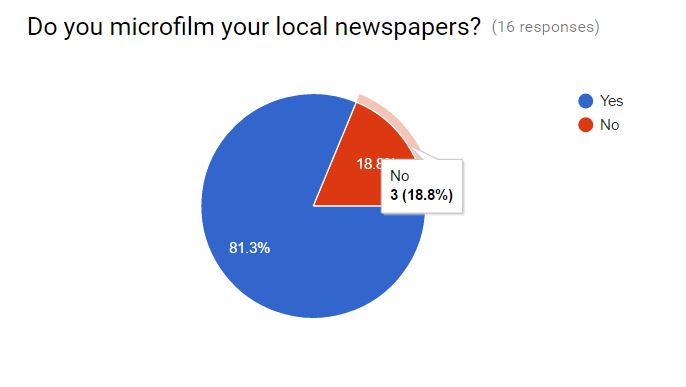
Capture

I hear what you cry…. well that it not a very good sample. I agree. Plus it is going to be rather skewed towards those authorities that still have enthusiastic local studies librarians who read blogs like this or subscribe to the right twitter accounts.

What was much more interesting was the opinions of those guys who left comments. They group into themes:

  1. Still relevant to the twenty-first century local studies library…

We absolutely want to continue providing our customers with microfilm archives of the local newspapers. They are an essential local and family history resource which we want to continue to update as one of our remits is to “preserve for the future”. Many of our customers just want to browse through the old newspapers as opposed to looking for individual items, and they are an essential tool for our social historians, students, etc.

We are aware that more and more newspapers are becoming available online, usually with a cost involved to the customer (i.e., via ancestry and find my past), but microfiche newspapers are also an invaluable tool for our own staff members to be able to carry out research quickly and efficiently within our own premises.

Our microfilm newspapers are the most popular resource besides Family History indexes – without microfilming we would not have a service.

We have a straight run of [out local newspapers]…. This means we have ownership, and unlimited pubic access. These are heavily used.

2. But there are technical considerations…..

My concern is how much longer we can afford to service the microform machines (and how much longer replacement parts will be available) and how access to them will be limited when we are open to the public but unstaffed. Regular users know how to use the machines but first time users are often very rough with the machines causing damage to them and the microfilm/fiche.

     3. Though on the other side……

Since we still had other material on microfilm and fiche, including parish registers, census information etc we also needed to ensure that we still had equipment which enabled this to be available for our customers. We have not regretted this decision as the added benefit has been that customers and staff remain confident using the equipment and only new staff require training.

4. But it is rather expensive in a time of financial constraint….

I will try and keep the filming continuing for as long as possible, although the recent announcement of still further cuts to our budget may make that more difficult

     5. It is still the trusted long-term answer

We also film our principal local paper for the paper itself. I do believe that filming still has a place even with the move towards digitisation; it’s a proven, stable format that also has the benefit of simplicity.

I know the British Library does provide the security of someone else making copies of our papers, but there’s no guarantee that we would have money available to access their resources (we only subscribe to the Gale C19 newspapers at present, and cannot afford to extend this to the newer and wider coverage British Library Newspapers) in the future.

  6. Alternatives are not necessarily the prefect answer….

Whilst the growth in online access is on the whole good, especially if searches are available, there is still a problem of the quality of what is on offer. One of our local titles recently made available by the British Library is so poorly executed that searching frequently results in a list of gobbledygook. With the added cost which adds insult to injury. Known items not being found at all. So yes microfilming still has its place.

There is now free access online to our local newspapers going back to 2007 but searching can only be carried out on each individual issue.

7. You can try and fudge the answer……

Only microfilming negatives so public don’t get access, and get annoyed they can’t see them

     8. Top tip…..

UK Archiving provides the service – so we don’t have to send them hard copy of current newspapers – they have their own mysterious ways of getting the copy.

9. There is still work to be done by the professional bodies……

I think it would be better to have pdfs of the more recent copies although I would want there to be support from the ARA or CILIP for standardised rights agreements with local newspapers, and guidance on how to manage digital copies.

     10. But on the other hand…..

We never used to microfilm anyway – local paper used to do it. We still keep hard copy of everything, plus cuttings files though.

The one big conclusion is that it a fascinating subject which would make an excellent topic for a MA dissertation…….. LSG might even be able to help with publicity and some expenses.

Did you miss adding your views to the debate? If you did, leave a comment below.

 

Fancy a free ticket for the 2017 CILIP Conference & 1 night’s accommodation thrown in?

CILIP ConfLocal Studies Group is very pleased to announce that we can offer a free place to attend the CILIP conference in Manchester to one of our members. The bursary includes access to both days of the conference, lunch, refreshments and all sessions, the evening reception at MOSI and one night’s accommodation at Motel One (on Wednesday 5 July). It does not include travel expenses. Information about the programme can be found at www.cilipconference.org.uk

We would ask the bursary holder to write a report on the conference for our journal or newsletter and CILIP are keen that anyone attending the conference is active on Twitter and through blogging to help people who cannot attend follow the event.

To apply please complete the following form by 7 April 2017:

Go back

Your message has been sent

Warning
Warning
Warning
Warning

Warning.

My all expenses paid trip to….Stoke-on-Trent!

Gosh, I hear you cry, why did you get an all expenses paid trip to the Potteries? Was it to judge the Staffs Oatcakes served at the museum? Was it to enjoy Virgin Train’s hope that you would not wash your “goldfish, hopes and dreams” down the toilet? Or was it the challenge to eating you pork pied lunch behind you laptop screen without the devout Muslims opposite seeing? No, none of that, it was to attend the last LSG Committee Meeting.

Hoping that you might be interested in hearing what I thought of the famous oatcakes at the end of this post, I thought I would fill in a bit of time by saying how interesting the session was. Top news includes the next copy of Local Studies Librarian will be landing on your door mat any time soon and will be followed after Easter with a version of the e-newsletter, Local Studies Librarian+.

The next conference is being planned for late 2017/early 2018, with LSG South’s Study day taking shape for the other spot, while as always, LSG NW is planning an amazing set of events, this time keep you diaries free for 14th June…..not to mention the amazing work being done by LOCSCOT. Work is also under way to review the old Local Studies Guidelines – lots more info to follow.

Of course, none of this amazing work could be done without those volunteers who do the work and, for the lucky ones, those whose employers allow them to attend the meetings in work time.

Does this sound just a little bit fun….. because it is! Do you want to give back to the profession? Play your part in helping to spread great ideas/best practice across the world of local studies ? Plus, you can always influence those doing most of the work at conferences to include speakers and projects that interest you. In part of the profession when you are often the sole local studies professional in your unit or even organisation, it is sometimes a life saver to have chance for a good gossip with great groups of heritage professionals from across the UK. As well as giving your view at a meeting or two, you’d be welcome to do a little more, such as writing blog posts, a bit of tweeting, helping to arrange speakers for conferences of venues for visits, or, if you like adding up a few rows of figures, help with the accounts. Plus, this type of work is excellent material for job interviews and chartership applications! You don’t even have to be a member of CILIP.

So have a tempted you a little? Can you tempt your employer to give you a couple of afternoons to go to meetings each year? Why not find out a little more, or even coming to a meeting to see what it is like? After all, your travel costs are reimbursed. If so, you have a number of options. LSG South helps with things in London, the South East and a little further afield and they generally meet in Woking – email Norma Crowe.  If you are north of the boarder you contact Nicola via nmcowmeadow@pkc.gov.uk, if you are west of the Pennines contact Alice Lock or if you fancy helping the national group, who normally meet in the Midlands, contact Alice Lock.

Ah, nearly forgot, the Oat Cakes….. sorry, I decided to take an earlier train home, but the other  Committee members thought they were excellent!

To microfilm, or not microfilm, that is the question

When the British Library closed its newspaper microfilming unit I huffed and I puffed whilst collecting together copies of all of our local newspapers. The puffing continued until I had sent them off to be microfilmed. I must admit that I was a bit happier when I discovered how much money we were saving!

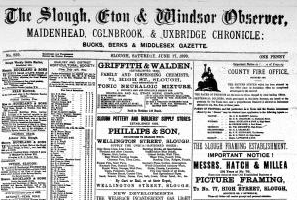
sl-ol-slough_observer17061899083901-e-00-000
Image courtesy of http://www.SloughHistoryOnline.org.uk


5 or so year later things have moved on……

Access to old newspapers has got much easier as there is more and more material on some newspaper websites, including an ability to buy old photos from newspapers (including an embarrassing supply of photos of local studies librarians carrying our events in years gone by!) Our local newspaper sells its content to Newsbank so my local library gives access to post-2007 local newspaper via that platform.

The problem is that local studies guys should also ensure that these newspapers are available for researchers in hundreds of years, so microfilming still provides both access and preservation. However……

Costs of microfilming have gone up and library budgets have gone down…. plus the number of local studies guys to organise it has also gone down too.

Local newspapers have been hit by cuts as much as libraries. Newsrooms have shrunk, titles have dwindled and my local 50p per week newspaper is now delivered free and looks very similar to our old free newspapers. Though, I must say, that is not universally so.

It is still a right faff to ensure that every year you collect a complete set of newspapers with all the appropriate alternative editions, though, if you can persuade your local newspaper to give you pdfs of their old newspapers it should be, in theory, relatively easy to get microfilmed.

The new generation of microfilm readers/scanners which link into computers are really good and the quality of microfilming has come on leaps and bounds.

After all, do we need to worry about conservation and access? Are we in a position to rely on the BL to permanently conserve all of the key papers in our collection area and then make them available via one of their strategic partnerships?

So what are you doing and what do you think? I’m sure that local studies collections across the country would love to know the “right answer”. Please share your thoughts by putting a comment below and please help us to find out what is happening on the ground by filling in this three question survey. All contributions will be treated anonymously.

Fancy a #uklibchat about Local and Family History?

Gaby Koenig talks to the LSG Blog as UK Libchat turns it’s mind to local studies………

For those of you not familiar with #uklibchat it’s a monthly live chat held on twitter talking about library and information topics. People taking part will follow the hashtag #uklibchat at the set time (6.30pm UK time, mostly the first Tuesday of the month) and will be guided through questions they have helped set on a shared agenda published in advance. The chat leader is one of a small group of volunteers who facilitates questions and keeps things moving. This month is my turn!

libchat

We’ve covered a wide range of topics across all library sectors and this month we are turning to a topic requested by one of our participants – Penny Allen – Family History and we’ve also added in Local History to the discussion. We would like people who work in libraries, archives and other sources of family and local history to come and join and talk about the challenges and solutions of answering enquiries from people in this field.

If you would like to add questions to be discussed please do on our googledoc – anyone can add questions even without a google account Supporting Local and Family History Enquiries #uklibchat Agenda 6th December 2016

And if you can come and join in and discuss the topic, please do! The chat will be on Tuesday 6 December at 6.30pm.

E-Local History Publication of the Year Award – nominations close on Monday 31st October

Have you been part of a group that has produced an electronic local studies project? Was it funded by local government or the national lottery? Was is launched between January 2015 & June 2016.

If the answer is yes, nominate your project for the electronic category of the Alan Ball Awards.

Projects could include websites, apps, video, animation and some aspects of social media, such as blogs. We are interested in both the quality and usefulness of the content, and also how it engages the reader or user, especially new users.

Winners will be given a certificate and accorded the title of Alan Ball Award winner, which can be used on promotional material. Sadly, there is no trophy or cash prize, but as previous award winners will confirm, it is a prestigious award that is very meaningful within Local History community.

To nominate your web-based project, please complete the form below, but be quick, nominations close on Monday 31st October 2016:

Go back

Your message has been sent

Warning
Warning
Warning
Warning
Warning
Warning

Warning.

Any questions? Please contact Terry Bracher via terry.bracher@wiltshire.gov.uk.

Nomination for the hard print prize also close on Monday 31st October. As with the e-prize, the project needs to have been funded by local government or the national lottery and had to be launched between January 2015 & June 2016.  To entre the hard print category, send a hard copy of your publication together with a paper entry form to: Terry Bracher (Chairman of CILIP LSG) c/o Wiltshire and Swindon History Centre, Cocklebury Road, Chippenham. SN15 3QN.

A look into Lancaster Libraries, 16/11/16

Join CILIP Local Studies Group NW to peer into three library collections at the University of Lancaster.

The Ruskin Library is the home of the Whitehouse Collection of Ruskin materials. The award-winning building was designed to house the collection and was opened in 1998.The collection is a fascinating mixture of pictures, books, manuscripts and photographs relating to the great Victorian writer and artist John Ruskin (1819-1900) who spent his later life at Brantwood, near Coniston.

Lancaster University Library is a stunning newly refurbished space designed with input from staff and students. Special collections range from the Jack Hylton collection through 1930s Cinema and Culture to the 2001 Foot and Mouth Archive.

11.00 A tour of the Ruskin Library with Diane Tyler and Rebecca Patterson

There will be a chance to look at the current exhibition which will be Gilded shadows: The stones of Ruskin’s Venice,  an exhibition of Ruskin’s drawings of Venice, with recent photographs by Sarah Quill

Lunch – there are numerous cafes on the Lancaster University campus

1.30 Special collections at Lancaster University Library

2.00 Tour of Lancaster University Library with Lynne Pickles

There is a regular bus service to the University from the train station. Detailed advice on travelling to the university can be found here –  –http://www.lancaster.ac.uk/contact-and-getting-here/maps-and-travel/

Map of campus at http://www.lancaster.ac.uk/media/lancaster-university/content-assets/documents/maps/campus-map.pdf which includes Ruskin Library and University Library

Please email Linda Clarke to book a place linda.clarke@cheshiresharedservices.gov.uk

Come and find out more about Local Studies Group

Do you fancy finding out more about what Local Studies Group is doing for you? Then come an join LSG for its annual meeting at Nottingham Central Library  on Thursday 20th October at 1pm. If you want to find out more but cannot make the meeting, contact our Chair, Terry Bracher, at terrybracher@wiltshire.gov.uk.

You can also join LSG South for its annual meeting at the Surrey History Centre on Wednesday 2nd November at 2pm. If you want to find out more but cannot make the meeting, contact our Vice Chair, Norma Crowe, at norma.crowe@medway.gov.uk.

Nominate your Local Studies Librarian of the Year – entries close this Friday

Do you know a Local Studies Librarian that has gone the extra mile? Have they pioneered an amazing project or given a career of excellent service to their community?

If you do, nominate them for the 2016 McCulla Prize, the annual Local Studies Librarian of the Year Award.

We welcome nominations from colleagues, local historians, family historians and anyone who knows a local studies professional who has made a difference.

To nominate, please complete form below.

Any questions? Please contact Alice Lock via alicelocalstudies@outlook.com

Nominations close on 30th September 2016 and nominations received after this date will be considered for the 2017 award.

Go back

Your message has been sent

Warning
Warning
Warning
Warning
Warning
Warning
Warning
Warning

Warning.