LSG Volunteer of the Year Award Winners Announced

The 2024 Alice Lock Memorial Volunteer Award (Under 25 Category) 

Winner: Jegan Jatta, Nottinghamshire Archives 

Jegan volunteered whilst studying at university in a project aiming to create activities for 18-25 year olds in the form of escape room activities using historical documents, followed by murder mystery events which he took part in delivering. Staff acknowledged his dedication to participate whilst balancing work and study commitments.

General information about Nottinghamshire Libraries and Archives can be found at:

www.inspireculture.org.uk/heritage

The 2024 Alice Lock Memorial Volunteer Award (Over 25 Category) 

Winner: Peter Slater, Leeds Libraries

Peter volunteered to assist in research on a British Library/ Leeds Libraries project to record local football fanzines. However, his enthusiasm didn’t stop there and he has now completed a survey of national significance, covering all UK fanzines which has already been useful to researchers. 

To find out more about the project please visit: 

An award ceremony for the winners will take place on-line in October. Thank you to all those who nominated volunteers. 

The deadline for the 2025 award is the end of January 2026 for those actively volunteering during 2025.

visit our nominations page: Local Studies Volunteer Award – CILIP Local Studies Group

If you wish us to consider previous nominees please contact us.

Not ticking the box – Local Studies and meaningful impact. An online presentation by Tracey Williams

Local Studies Group are proud to publish this talk based on Tracey’s section on Linking with local authority priorities in Local Studies Toolkit. A must watch for all librarians, archivists and other heritage professionals.

What did you think? Let us know by leaving a comment.

Still time to book: Heritage & the community – top tips from the CILIP Local Studies Toolkit – Free online session, 20 November, 2pm

Heritage resources can make a difference to individuals: the young couple in their first house who visited because they had chopped down some trees which were inside their fence only to find that their neighbour claimed the land and the trees; the schoolteacher who said that her students’ A level results had improved as a result of class visits to the local studies library; the family who were helped to find essential evidence about a local company and were able to obtain compensation for the loss of a loved one.

Heritage projects have the power to engage people from widely different backgrounds and generations. Interesting and creative projects have the power to motivate individuals to overcome barriers to learning, to experience digital technologies, to build new social networks (combatting isolation, depression and related health issues) and to rekindle an in interest in life through informal learning opportunities.

Heritage people working creatively, and in partnership with a wide range of educational providers, facilitators and artists, and others, can ensure that opportunities exist to engage different levels of ability and ranges of interest.

But how do you do this? Some of the finest and most experienced local studies librarians have come together to form a free online resource, The Local Studies Toolkit, that can help guide heritage people to the right answer for them.

In this session, we will explore the toolkit and hear some top tips from those who wrote some of its sections.

Speakers include:

  • Terry Bracher, Heritage Services Manager, Wiltshire & Swindon History Centre
  • Tracey Williams, Heritage & Local Studies Librarian, Solihull (Recorded)
  • Tony Pilmer, Librarian & Archivist, Royal Aeronautical Society & formerly Local Studies Librarian, Slough (Chair)
  • José Luiz Pederzoli Jr., Unit Manager – Strategic Planning, ICCROM (Recorded)

This event is organised by the CILIP Local Studies Group & The Historic Society of Lancashire & Cheshire

Heritage & the community – top tips from the CILIP Local Studies Toolkit – Free online session, 20 November, 2pm

Heritage resources can make a difference to individuals: the young couple in their first house who visited because they had chopped down some trees which were inside their fence only to find that their neighbour claimed the land and the trees; the schoolteacher who said that her students’ A level results had improved as a result of class visits to the local studies library; the family who were helped to find essential evidence about a local company and were able to obtain compensation for the loss of a loved one.

Heritage projects have the power to engage people from widely different backgrounds and generations. Interesting and creative projects have the power to motivate individuals to overcome barriers to learning, to experience digital technologies, to build new social networks (combatting isolation, depression and related health issues) and to rekindle an in interest in life through informal learning opportunities.

Heritage people working creatively, and in partnership with a wide range of educational providers, facilitators and artists, and others, can ensure that opportunities exist to engage different levels of ability and ranges of interest.

But how do you do this? Some of the finest and most experienced local studies librarians have come together to form a free online resource, The Local Studies Toolkit, that can help guide heritage people to the right answer for them.

In this session, we will explore the toolkit and hear some top tips from those who wrote some of its sections.

Speakers include:

  • Terry Bracher, Heritage Services Manager, Wiltshire & Swindon History Centre
  • Tracey Williams, Heritage & Local Studies Librarian, Solihull (Recorded)
  • Tony Pilmer, Librarian & Archivist, Royal Aeronautical Society & formerly Local Studies Librarian, Slough (Chair)
  • José Luiz Pederzoli Jr., Unit Manager – Strategic Planning, ICCROM (Recorded)

This event is organised by the CILIP Local Studies Group & The Historic Society of Lancashire & Cheshire

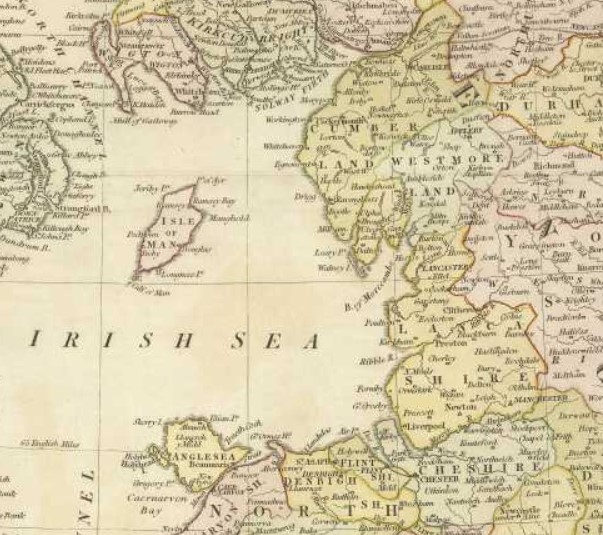
New archives group for the North West

Several colleagues in the North West of England have recently started discussing networking opportunities in the region. We are aware of some brilliant partnerships and networks operating in parts of the north west, with a range of different models, but want to take a sounding on whether we need to do more.

We would like to invite anyone working with archives to join an initial informal online discussion to simply ask the question, ‘what would you like to see?’ – to be held on Wednesday 29th June, 2.00-3.00.

We are interested in creating a regular informal space for people working with archives to meet, discuss issues, concerns or opportunities, and have a chance to find out from colleagues about activity and good practice taking place within the region. This could be through in person events, online chats or a mixture – and we want to follow up the online meeting with an event at Lancashire Archives towards the end of July.

If you are interested in joining the conversation, please get in touch with me at alexander.miller@lancashire.gov.uk and we will send on the invite. If you can’t make the date, but would be interested in keeping in touch with developments, please drop me a line as well so we can keep you informed.

Alex Miller

Lancashire Archives

Toolkit: Relationships with fellow heritage, library and local government professionals

Return to Toolkit homepage

It is important to build relationships with a wide circle of fellow professionals, so you can identify potential areas of joint working and refer enquiries to useful services. Local Studies staff also need an understanding and awareness of other heritage professionals’ practices, especially as the divisions between fellow heritage professionals are narrowing and users will not be aware that priorities, attitudes and training in these professions are quite different.

These can include visits, meetings and temporary exchanges in staff. Key groups include:

  • Neighbouring collections, especially those with overlapping collections. These include collections both inside and outside your authority. Local networks of local studies librarians include:
  • County Record Offices.
  • Local Museums
  • Family history societies
  • Local history societies
  • Archaeological services, especially the Site and Monuments Officers.

Other important relationships within your local authority network includes:

  • Planning offices (Especially the Buildings Conservation Officer and the guys who produce all of the maps for the Council)
  • Parks departments.
  • IT
  • Arts Development
  • Conservators
  • Communications & Social Media Officers.
  • Tourist information officers
  • Registrars and cemetery staff

You also need an understanding of roles of those organisations on the national stage. In England, Local Studies sits uneasily between the remits of the Arts Council and the National Archives, so an awareness of their priorities is important. The British Library also plays a key role and the Society of Antiquaries of London, the learned society for our area, also has some interesting resources.

There are a number of national heritage organisations you need to know about. These include:

Your local area history and traditions will also dictate which specialist regional and national heritage organisations you need to know about.

The Broader picture:

You also need a wider view of the library world, which is where CILIP Update and old friends from library school can help.

Further Reading

Martin Hayes, Sleeping wuth the enemy : co-operation between archivists and librarians in West Sussed, Local Studies Librarian, v.16(1) 1997, p.2-5

Local Studies Toolkit: Who uses a local studies collection

Got something to add?

Do you have any comments, suggestions or updates for this page? Add a comment below or contact us. This toolkit is only as good as you make it.

Return to Toolkit homepage
Toolkit: Conservation

Return to Toolkit homepage

Local Studies is a blend of special collections and lending library work. As such you have to treat lending and branch stock completely differently to material found in a local studies hub.

There is always a tension between access and preservation. With use local studies materials will deteriorate, however there is no point keeping most material if it is not used. After all, a large amount of local studies material is not unique. Pragmatically, judgements will be made on an item by-item basis, however there is a lot we can do to extend the life of our collections.

Lending & branch stock

As with all other lending stock in public libraries, local studies lending material needs to be attractive and kept in good condition, but unlike the majority of lending books, it should be durable as the contents of the book are unlikely to be replaced by a newer version. You can extend life of a title by:

  • Bind likely to be well-used paperbacks. Get your binders to use the original covers as part of the new boards.
  • Ensuring that hard-back cover protectors are cleaned and, when necessary, replaced.
  • Ensuring that you buy a good quantity of new publications. If a title is going to have a short print run and will be a valuable resource, you should factor in that some copies will be damaged and lost in the years ahead.

Storage

Storing materials in appropriate conditions is the best way to ensure long-term survival of materials. Each format has its appropriate packaging and storage conditions and those are described in the appropriate parts of the toolkit.

High replacement cost or low availability of a replacement may suggest that access should be restricted, however if an item cannot be browsed easily, or if it is stored away from the main book stock, it will be used less often.

Format specific guidance

Advice on storing different types of library stock can be found in the appropriate parts of this toolkit, however the National Archives and the old British Library website has some useful general advice on storing delicate materials:

https://www.nationalarchives.gov.uk/information-management/browse-guidance-standards/?letter=c&keyword=conservationhttps://web.archive.org/web/20220306212848/https://www.bl.uk/conservation/guides

Repackaging

Repackaging collections is a very valuable activity, but can also be extremely time-consuming, however there are some other ways you can do it:

  • Get staff reassigned during computer outages.
  • Hold an annual local studies help day. Staff are asked to drop in for an hour during a day and give you a hand. This is a good marketing tool and good for staff bonding.
  • Many companies lend groups of staff to organisations for community days.

Storage conditions

The British Standard for archival and library storage is set out in BS 4971:2017. This standard is used by Special Collections and archives and gives guidance on ideal conditions for storing important parts of collections.

Material should be protected from direct sunlight, dust, pests and atmospheric conditions. If material has to be stored in direct sunlight, film can be placed on windows to filter-out harmful rays. Dust damage can be limited by using boxes and regular cleaning. Insects and atmospheric should be monitored using pest traps and the temperature and relative humidity should be tracked.

It is unlikely that local studies collection will be in ideal storage conditions, but a quick regular check of conditions can pay dividends. A lot of damage to collections can be avoided by moving material away from areas where roofs are known to leak, spotting when widows become damaged and spotting fire risks.

Handling:

To help reduce the amount of damage caused by readers and staff using delicate material, make sure that:

  • book pillows are available for readers using delicate books
  • weights are available for those using rolled maps
  • cotton gloves are available for those handling photographic material

More information on handling rare materials can be found here in the old British Library guide, courtesy of the Wayback Machine

National Archives also provides some interesting information on handling rare items in differing formats:

https://www.nationalarchives.gov.uk/about/visit-us/researching-here/handling-documents/rules-and-handling-aids/

Surrogates

If certain materials are delicate but of wide interest, can a surrogate be made? If it is that popular, should it be digitised and/or microfilmed and placed online? Has it already been digitised by someone else, such as Archive.org, Google Books or the Hathi Trust? Under copyright law, publications can be photocopied for preservation purposes if the copy is kept for reference only.

Conservation

Delicate materials can be stabilised. Local Studies materials should be conserved and not restored – you are not returning the item back to its former glory but stabilising the object and making it less likely that further damage will be made through handling. As such, any work undertaken on an object should not be hidden.

Using professional conservators

Local studies collections should enjoy some support from the conservation unit in their county record office. However, if extra support is required, you can find contact details of conservators via the Institute of Conservation’s register: https://www.conservationregister.com/

In-house conservation projects

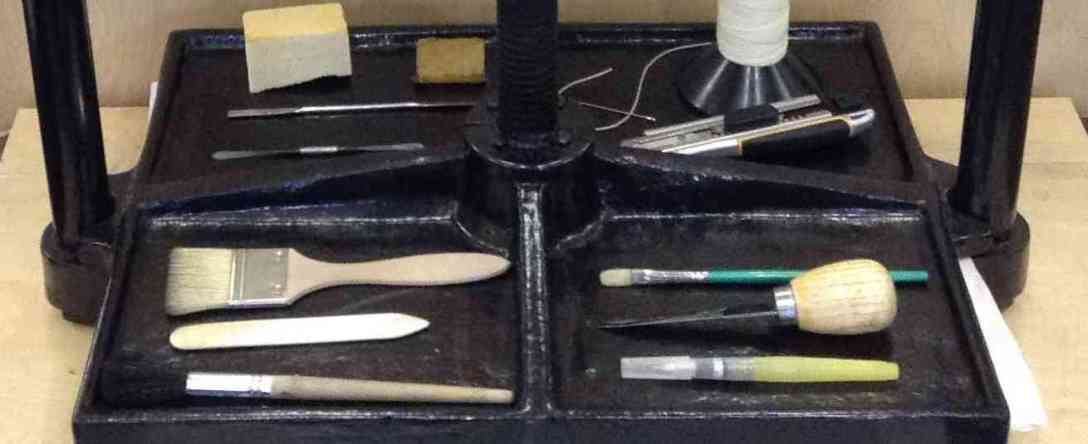
Repackaging should be the first conservation priority for a local studies collection. However, after receiving training from a conservator, members of staff and volunteers can undertake a range of basic conservation tasks. These can include:

  • Cleaning material using brushes and smoke sponges
  • Basic paper conservation, including using water pens to remove folds and using starch glue and Japanese paper to repair tears.
  • Re-sew pamphlets with rusting staples
  • Make phase boxes to protect delicate books

As with all projects, work has to be closely monitored. Conservation works should also be recorded, ideally on the item’s catalogue record.

Initial training for such projects may be available from your county record office, from free-lance conservators such as Caroline Bendix or through organisations such as the Historic Libraries Forum: https://historiclibrariesforum.com/events.

Rather than create an in-house volunteer project, you should consider approaching your local branch of The Art Society. Members of the Art Society can be trained to undertake paper conservation by in-house tutors. The upshot for collections is that, for the cost of travel plus tea and coffee, they can undertake conservation tasks for you. They also do a large amount of the volunteer management role too – the librarian’s job is to liaise with the volunteer leader.

For more information on the Arts Society, then known as NADFAS, read the second post on this page: https://www.webarchive.org.uk/wayback/archive/20130626183045/http://communities.cilip.org.uk/blogs/lsgblog/default.aspx

Conservation suppliers:

Got something to add?

Do you have any comments, suggestions or updates for this page? Add a comment below or contact us. This toolkit is only as good as you make it.

Return to Toolkit homepage
Local Studies Toolkit…. watch this space

Need some advice or top tips on all things local studies? Over the last two years a band of local studies librarians and associated hangers-on have been working away to produce the Local Studies Toolkit.

The aim of these pages is to produce a freely accessible online guide that will help and inspire local studies professionals and para-professionals to provide an excellent local studies service within their authority. 

Over the next week or two we will releasing the first versions of different sections of the guidance as blog posts. More will then follow in the coming months.

As of this moment, the only page published is a very boring introduction, but you can see the project unfold by following us on Twitter and Facebook, or just keeping an eye on our Toolkit homepage.

The toolkit will be a collection working documents for the entire community, so we need your help. If you have any questions, comments, suggestions, examples of best practice that you wish to share or, even better, completely disagree with points in this guide, please let us know. Put a comment at the foot of the appropriate page or send us a comment. This guide will only be as good as the contributions you make.

That gem of local studies just starting to be found by Google: local history society journal backruns

You know when somebody comes up with a statement and, later on you think of the perfect answer but, by then, it is far too late….. this is the one I was given together with what I should have said

You know, when I started working at the history centre, I thought I would much prefer working in the library, but I’ve really like working with the archives.

Yes, who can resist historic old documents, plus the very old books in the bookstore. But it is very hard work. Somebody might have done all of the hard graft already and, if they have, the answer would be in local studies.

Of course, the bibles of local history are the ones that you always refer too, such as The History of Slough by Maxwell Fraser. Though the real gems to less common answers, I often found, were in the journals written by enthusiastic historians – some of which go back to the nineteenth century. In those days, unless catalogued, indexed separately or browsed through by curious library staff, they just sat there gathering dust.

Imagine my delight when, being lazy, I did a google search for a 1930s map I once saw, and up came this…..

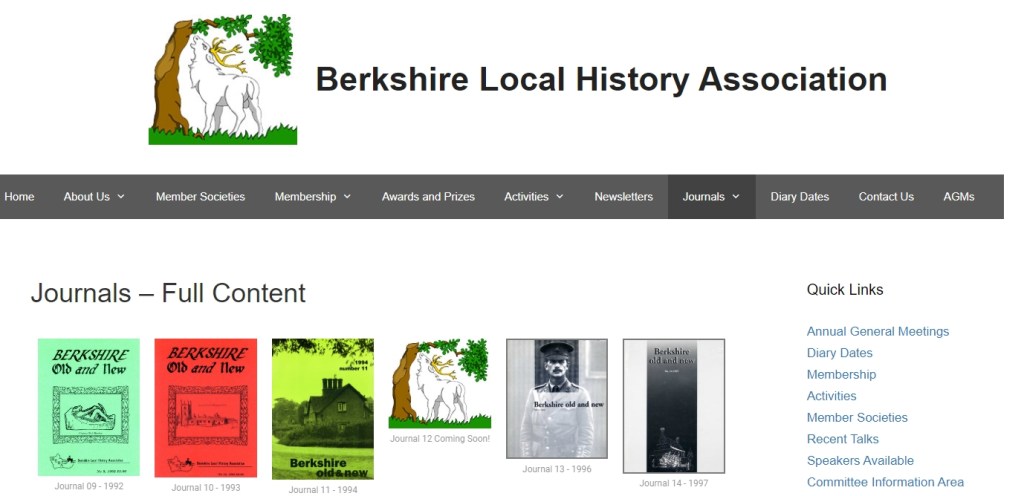
http://www.blha.org.uk/journals-full-content/

BLHA had digitised the vast majority of their journals, the articles are all searchable and can all be found by Google (or your own Google custom search engine or a site search e.g. by putting slough site:blha.org.uk into your google search box).

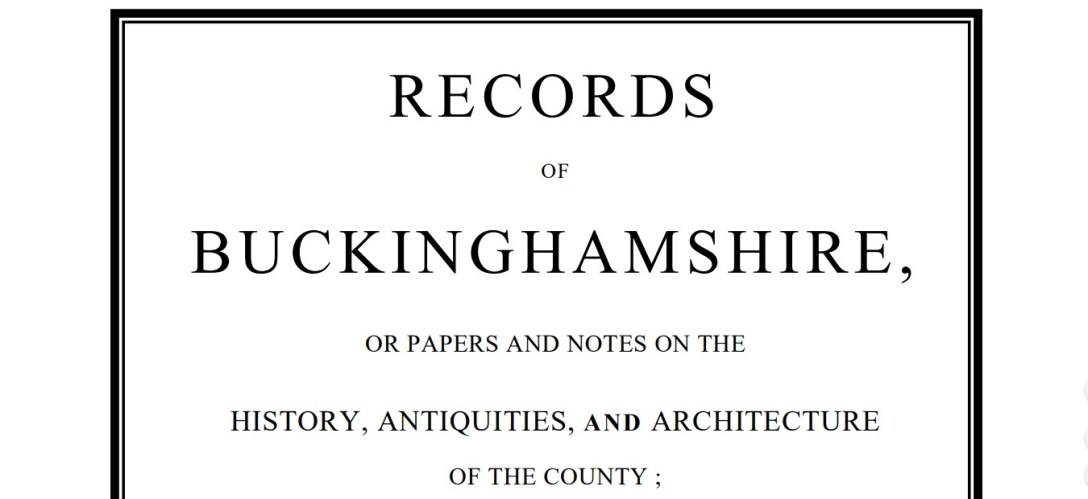
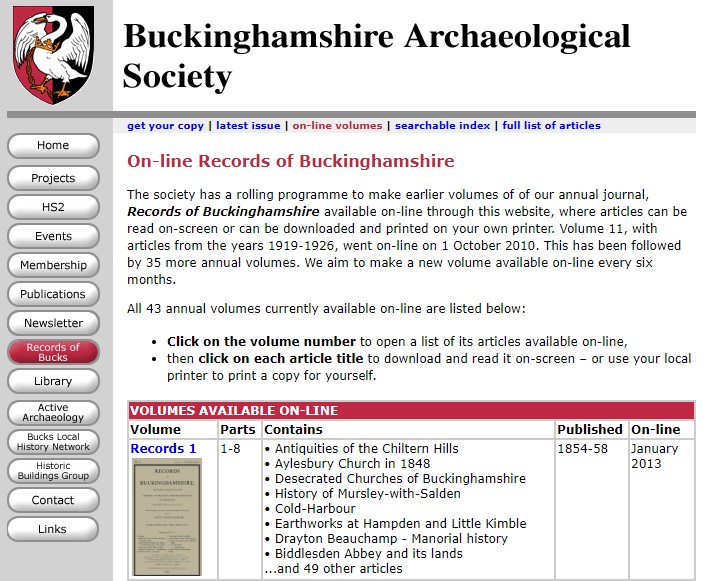
I won’t tell you how happy I was to see that Buckinghamshire Archaeological Society have gone back to 1854……..

http://www.bucksas.org.uk/onlinerecords.html

[Thanks to their volunteers, John Dodd, Peter Marsden, Jeff Pepper, Ken Wallis and Marion Wells, who have heroically digitised 35 of the 43 volumes so far!]

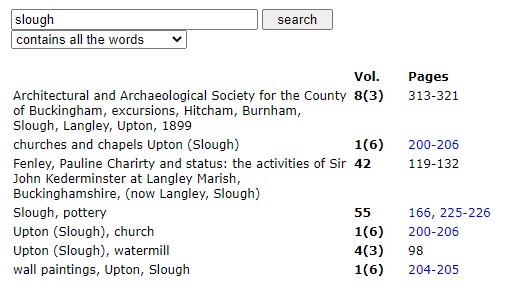
But Records of Bucks hasn’t stopped there – they have an index with hot links to the digitised articles!

http://www.bucksas.org.uk/list.php

Of course, it has only taken eight years to come up with this very long riposte to that pro-archives comment. But, if the person who said that statement ever stumbles over these words, I hope I have gone a little way to change their mind.

‘To Infinity and Beyond!’ Preserving and promoting the records of Britain’s aviation and aerospace heritage conference, 12 February 2020, Aerospace Bristol

The archives of Britain’s aerospace and aviation industries chronicles stories of design, advances in science and technology, and the business of international and space travel, all with the aim of perfecting man’s dream to master powered flight.

This one-day conference is for everyone who cares for the industry’s paper-based and electronic collections, both large and small. It aims to highlight these records’ importance and inspire ways forward in preserving and promoting them to a wide variety of new and established audiences.

Speakers include:

§  Keynote Speaker: Prof. David Edgerton, Kings College London and author of “England and the Aeroplane”,

§  Michael Lombardi, Boeing archivist and historian,

§  Graham Rood on Farnborough Air Sciences Trust’s work to rescue and promote the Royal Aircraft Establishment collections,

§  Amy Seadon on Aerospace Bristol’s projects to engage children with STEM,

§  Ally McConnell on how Gloucester Archives won a large grant to make Dowty’s archives more accessible,

§  Andrew Lewis on working with Brooklands Museum’s volunteers &

§  Howard Mason on the business drivers for maintaining and exploiting the BAE Systems network of archives.

Plus there will be an opportunity to visit the new Aerospace Bristol galleries and archive, and see the National Aerospace Library’s conservation volunteers in action.

The conference will also introduce the Aerospace and Aviation Archives Initiative (AAAI) and its work. The AAAI comprises representatives from organisations, museums and corporate collections and aims to promote the preservation of, and access to, Britain’s records relating to aerospace and aviation. To find out more about AAAI, visit https://www.aviationarchives.uk/

Discussion on the day will encourage delegates to help shape the future work of the AAAI.

The conference has been generously supported by The Royal Aeronautical Society Foundation.

To book, visit: https://www.aerosociety.com/events-calendar/to-infinity-and-beyond-preserving-and-promoting-the-records-of-britain-s-aerospace-and-aviation-industries/.