Want to know more about the CILIP Local Studies Toolkit? Last year Terry Bracher & Tony Pilmer gave a presentation to the The Historic Society of Lancashire & Cheshire. It included excellent presentations from Tracey Williams on not just ticking to box & Local Studies in an international context by José Luiz Pederzoli and a Q&A that also included Lancashire’s Louise Turner. Watch the record here:
I am Darren Edwards, an MA Library and Information Services Management student at the University of Sheffield.
For my dissertation research I am studying the representation of diverse communities in local studies collections, focused on the representation of LGBTQ+ and ethnic minority communities. I am looking to recruit participants who work in English local studies libraries to complete an online questionnaire. The questionnaire asks you to reflect upon your local studies collection and the representation of diverse communities within it. The questionnaire is anonymous and asks for no personal data.
This study will help to improve understanding of how well diverse communities are represented in local studies collections and by encouraging reflection on collections will lead to an improvement in this representation. Your participation will benefit my dissertation research and the completion of my degree.
For further information or questions, please contact me on dledwards1@sheffield.ac.uk. The project has received ethical approval from the Information School at the University of Sheffield and is being supervised by Dr. Sara Vannini.
Local Studies projects, collections and staff have the power to engage people from widely different backgrounds and across the generation. They can also meet the priorities of library, archive and heritage services in innovative ways.
To help guide and inspire those who work in our field, CILIP Local Studies Group are launching the Local Studies Toolkit, a free online guide containing nearly fifty sections written and peer reviewed by some of the best local studies professionals in the country. View it now at https://lslibrarians.wordpress.com/toolkit/.
The programme for the day is:
10am Reception open & tea and coffee available
10.25am Welcome, Terry Bracher, Chair LSG & Tina Morton, Head of Archives Sector Development, The National Archives.
10.30am Why local studies matters, Norma Crowe, formerly Local Studies Librarian, Medway
10.50am Launch of the Local Studies Toolkit, Tony Pilmer, Librarian & Archivist, Royal Aeronautical Society & formerly Local Studies Librarian, Slough (Editor-in-Chief of the toolkit)
11am Community Archives, Terry Bracher, Heritage Services Manager, Wiltshire
11.20am Oral history projects, Martin Hayes, County Local Studies Librarian, West Sussex
11.40am Delegates can choose from three of the following options:
1921 Census
Maps & plans
Directories
Ephemera
Discussion on doing Local Studies after COVID
Who uses a local studies library?
Copyright Discussion
Collection Development
12.50pm LSG AGM
1.00pm Lunch
2pm Not ticking the box: local studies and meaningful impact, Tracey Williams, Library Specialist: Heritage & Local Studies, Solihull
2.20pm Creating Online Events and Website Resources, Tudor Allen, Senior Archivist, Camden Local Studies and Archives Centre
2.40pm Opportunities for funding, Eloise Kane, Engagement Manager, London and South, National Lottery Heritage Fund
Local Studies projects, collections and staff have the power to engage people from widely different backgrounds and across the generation. They can also meet the priorities of library, archive and heritage services in innovative ways.
To help guide and inspire those who work in our field, CILIP Local Studies Group are launching the Local Studies Toolkit, a free online guide containing nearly fifty sections written and peer reviewed by some of the best local studies professionals in the country. View it now at https://lslibrarians.wordpress.com/toolkit/.
Join us at the National Archives to formally launch the CILIP LSG Local Studies Toolkit, explore inspirational projects and find out more about the nuts and bolts of local studies and heritage work in the post-COVID world including:
Oral history
Virtual events
Making a meaningful impact
Community archives
Attracting funding.
Speakers include former CILIP Local Studies Librarians of the Year, Martin Hayes, Tracey Williams & Norma Crowe, speakers from the National Lottery Heritage Fund together with staff from two of the UK’s most innovative collections: Wiltshire and Swindon History Centre & Camden Local Studies and Archives Centre.
There will also be an opportunity for you to choose from a number of workshops that will enable you to explore and discuss areas of heritage work that interest you, including:
1922 Census
Copyright
Collection development
Local Studies after COVID
Heritage users and their needs
Ephemera
Maps
Directories
You can also finish the day with a Tour of the National Archives and take part in the 2022 CILIP Local Studies AGM.
Cost: £25 plus VAT (£30 inc VAT) including lunch & drinks
Local Studies projects, collections and staff have the power to engage people from widely different backgrounds and across the generation. They can also meet the priorities of library, archive and heritage services in innovative ways.
To help guide and inspire those who work in our field, CILIP Local Studies Group are launching the Local Studies Toolkit, a free online guide containing nearly fifty sections written and peer reviewed by some of the best local studies professionals in the country. View it now at https://lslibrarians.wordpress.com/toolkit/.
Join us at the National Archives to formally launch the CILIP LSG Local Studies Toolkit, explore inspirational projects and find out more about the nuts and bolts of local studies and heritage work in the post-COVID world including:
Oral history
Virtual events
Making a meaningful impact
Community archives
Attracting funding.
Speakers include former CILIP Local Studies Librarians of the Year, Martin Hayes, Tracey Williams & Norma Crowe, speakers from the National Lottery Heritage Fund together with staff from two of the UK’s most innovative collections: Wiltshire and Swindon History Centre & Camden Local Studies and Archives Centre.
There will also be an opportunity for you to choose from a number of workshops that will enable you to explore and discuss areas of heritage work that interest you, including:
1922 Census
Copyright
Collection development
Local Studies after COVID
Heritage users and their needs
Ephemera
Maps
Directories
You can also finish the day with a Tour of the National Archives and take part in the 2022 CILIP Local Studies AGM.
A Service Business Continuity plan (BCP) provides a standardised business disruption plan for all services. The plan provides key service information to support the Head of Service (or nominated deputy) in returning the service to business as usual following a disruption. Larger collections may have a stand-alone policy, while smaller collections may find their plan is part of a service-wide policy. This can sometimes be deployed together with your emergency plan and there will be some overlap. But whereas the business continuity plan enables you to maintain your service during a period of disruption; an emergency is defined as any incident which cannot be contained, or which threatens any part of the Local Studies building / space or its holdings and therefore should be kept as a separate document (see Toolkit chapter on Emergency Planning).
The need for BCP has never been more apparent than during the Covid-19 pandemic, where Local Studies Libraries found themselves unable to provide direct access to their unique resources, but still managed to employ creative ways to continue engaging audiences and providing essential information. Other likely scenarios include loss of power supply, loss of IT and telephony networks, and adverse weather conditions.
Definition of Business Continuity
The definition of Business Continuity is the capability of the organisation to continue the delivery of products and services at acceptable predefined levels following a disruptive incident. It is a set of documented procedures that guide services to respond, recover, resume and restore to a predefined level of operation following a disruption.
Objectives of a BCP
A plan should:
Establish key service information
Detail the activation process for the plan
Identify priority functions undertaken by the service and the resources and timescales associated with their recovery
Outline the incident management procedures and key staff
Show how a local studies service should coordinate its response with other library and organisational services to reduce business disruption.
Quick steps to create a BCP:
A basic BCP should contain the following elements:
Create a contents sheet for quick reference
Establish within your organisation what is the priority level of your service, this will determine how many days you can be without essential operations such as ICT, desk space etc.
Who is the owner/s of the plan
Create a distribution list to relevant staff
List key contacts for your service – include both internal and external suppliers, with the most important during an emergency at the top.
Activation – what are the steps in your organisation to activate your plan e.g. who do you need to inform, what is the escalation process. It is also worth keeping this as a separate quick reference document or card
Communications – what are the key ways of communicating to your customers?
Key functions – List the key functions of your service, prioritise them and then decide how long you can be without them
Staff – list the points of risk if you lose staff and what is the contingency for this
ICT – what are your key ICT requirements / software, e.g. library catalogue, payment devices; decide how long you can be without each piece. What are the short-term and long-term workarounds? e.g., if part or the whole of telecommunications are disrupted can you use emergency mobile phones / mobile hotspots etc; are there alternative hardcopy catalogues?
Facilities – what are your workplace requirements? Can your team work elsewhere? If so what office requirements do you need – list the number of computers, desks, chairs etc.; what about specialist equipment – printers, scanners, card payment machines etc.
Work from home – work out how many staff could work from home if needed or if this is feasible. Do they have access to all the equipment they require?
Transport – list any specific transport requirements.
Fuel – are there any staff who require priority access to fuel if there are shortages to enable them to carry out essential roles e.g. do you have a duty manager who needs to access your site on a daily or weekly basis to check buildings and ensure they are maintained?
Scenario planning – list different scenarios and consider creating a flow chart of what might be affected, how you will respond e.g. to extreme weather event, pandemic; loss of: ICT, energy supply, essential supplier or partner, key staff, workspace, fuel.
What is your worst case scenario?
Reputation – Consider the effect on your organisation’s service loss – this will help you prioritise services
Flow charts and diagrams – where possible think about creating charts and diagrams for responses and communications
Templates – create standard templates / forms for providing situation reports and incident logs so they are ready to use
What should a BCP contain?
Below is a more detailed checklist of some of the things you may wish to consider and include in your plan:
Scope: The plan should enable your Local Studies service to continue to deliver priority functions, at a minimum acceptable level of service, throughout a business disruption, as far as is reasonably practicable.
Links: Your BCP should link to your Corporate BCP, your service Emergency Plan, local and corporate communications plans.
Activation: Who activates your BCP? The Head of Service or nominated deputy is usually tasked with this.
Where is advice available? For example, this might include departments within your own organisation such as an emergency planning team or incident room; external support such as software providers, suppliers, other libraries; CILIP and other professional networks.
What is the impact of an interruption to your service? It is useful to quickly supply information to stakeholders on the likely impact on your service and how the reduced services might impact on others that might rely on you, such as planning officers, rights of way teams and schools.
Details of key activities, withminimum number of staff needed for each function and timescale of when services should be re-started:This would include:
Access to Local Studies collections
Place for study & tutoring
Meetings – formal & informal
Room hire
Volunteer projects
Activities & events for all ages
Access to computers:
Public access to the Internet via PCs and Wi-Fi
Support to get online, access digital services
Respond to requests for information
Printing & photocopying
Details of key social outcomes, withminimum number of staff needed for each function: These may include
Local Studies as a trusted source of information
Informal reassurance – place of safety
Community space
Overcoming social isolation
Delivering other LA and service priorities – e.g. for delivering core organisational goals such as well-being, essential information for daily lives, education
Essential information: Details of key information and how it can be accessed, including
What documents will you need to access e.g. Policy documents, Service/ Team plans, Emergency Plan, Risk register
Which partners do you rely on? Which partners rely on you? What is the regularity of contact – e.g. daily / weekly / monthly?
Who are your Key contacts? Within the organisation this might include key staff, ICT, HR, Facilities Management; external contacts might include suppliers, contractors and partners.
Communications: How will you notify service users of a disruption to the service?
Help on activating and using the BCP: Think about creating an activation card or flow chart.
Model procedures to respond to likely scenarios:
Loss of workspace
Do you need to provide a public service – how will you do this from alternative spaces?
Are there alternative locations where your service can be delivered? If so, what additional resources do you need to use this space, for example, do you need desks and chairs, computers, photocopiers, key resources?
Can some staff work from home?
What constraints are there preventing staff from working at a different location?
Loss of public access
Are there alternative collections, such as in other libraries or the county archive, that customers could use if your main collection is unavailable?
Can staff access collections and provide a remote enquiry service?
Are there any online resources e.g. photo collections, family history collections, that can be highlighted and accessed at home? If there is a pay wall are there mechanisms to provide any free access?
What are the alternative ways to continue to engage with local communities, e.g. social media, podcasts and videos, blogs etc.
Do you have volunteers, if so, can they undertake work from home or alternative venues? How will you communicate with them?
Loss of ICT – computer technology and telephony.
What impact would a lack of access to the phone network have on your service?
Do you have phone lines that are essential in an emergency such as from strong rooms?
Do you have systems in place to maintain business without access to phones?
What alternative methods of communication, do you have access to, mobile phones etc
What systems are there in place to update messages to your website, can this be done remotely using a different network?
What services can you operate without access to the computer network?
Do you have systems in place to maintain business without access to the network?
What duties can staff and volunteers undertake without access to the network? If they are undertaking computerised tasks, how will you ensure that material is added to the normal systems once you regain access to them?
Staff shortage / skills:
How many / which staff are needed to complete essential functions?
Are you dependent on staff with specialist knowledge? Can these skills be shared / what contingency / training is in place?
Do you have duty managers or staff with specific skills that can enable BCP to come into force?
What needs to happen when you activate your business continuity plan?
Start a log of the incident and record the information on the options available, decisions on actions to take and justification of those decisions.
Report details of activation, additional staff and resources to your organisational leads in emergency planning etc.
Determine services to be provided / recovered in priority order e.g. do you need to prioritise access to physical collections, is browsing essential or can you create other ways to access material? Are online resources and access to digital a greater priority than physical access?
Allocate staff to priority roles and notify all service staff of the disruption, identify additional staff e.g. can staff provide Local Studies service from other libraries, answer enquiries from home or via other mechanisms? What access do they need to Local Studies material?
Consider whether the disruption will lead to local, regional or national media interest.
Contact contractors / partner organisations / your own organisation’s services and inform them that you are activating your business continuity procedures.
Identify gaps in critical service provision by checking with other Council services including other libraries, archives, museums etc., and partner organisations to ensure they are still able to deliver services.
Provide mutual aid to other service areas, as required/requested.
Consider messages that are required for the public e.g. opening times (if relevant) and where to send their enquiries.
Got something to add?
Do you have any comments, suggestions or updates for this page? Add a comment below or contact us. This toolkit is only as good as you make it.
Providing easy and effective access to collections is an essential part of any librarian’s role. The creation of coherent and consistent catalogue entries sited on web-based platforms will provide staff and users with a reliable point of entry to collections, plus enable a quicker response time to enquiries. Catalogued entries can also be used to highlight interesting features of content that may be of particular interest to local studies users.
When creating any catalogue entry, it is important to ensure that it meets international standards. In this way, the data can be updated, transferred, and migrated to other systems more easily.
The Cataloguer
Historically, large organisations employed professional cataloguers to create and amend records to ensure that all catalogue entries were fully compliant to industry standards. Developments in library stock management and Library Management Systems have led to greater automation and the creation of catalogue entries sent direct from suppliers to library stock controllers, dramatically reducing the amount of original cataloguing required.
Unfortunately, the professional cataloguer is often no longer employed, leaving library staff to undertake cataloguing work with minimal training. As has been shown in the book stock section of this toolkit, many local studies publications cannot be purchased from library suppliers and records for these entries will normally need to be created from scratch. As well as cataloguing books, local studies units will need to record details of non-book materials, such as photographs, maps and digital files.
Before you start cataloguing
Before they start cataloguing, a local studies librarian should be confident that they:
Have a good grasp of relevant standards. A professional librarian should have received training on cataloguing as part of their CILIP accredited course, however the amount of training is different depending which library school they attended, skills may be rusty and international standards may have evolved. A brief description of how the relevant standards affect local studies can be found below, but staff fresh to local studies may benefit from refresher training.
Have a good grasp of the authority’s cataloguing standards and procedures. Book material should be entered into the main library catalogue, so needs to meet the authority’s standards. This is especially important if the library authority is part of, or joins, a library consortium which shares a catalogue. Your authority should provide you with training before allowing you to make changes to the catalogue.
Have policies and procedures on how local studies materials should be catalogued. As will be shown below, local studies catalogue records should be more detailed than standard library books. Some non-book cataloguing can be undertaken by volunteers and, as it is essential that cataloguing is consistent, written procedures should be in place which maintains high standards and control.
A local studies librarian will not be alone when they tackle these duties; there will be people in the authority who can provide help and support. Though your authority may not employ a professional cataloguer, they will employ staff within a stock unit whose main duties involve getting material onto library shelves and onto the catalogue. There will also be staff charged with selecting material, whether inside or outside of the stock unit, and these may include other non-standard materials, such as music scores.
Cataloguing standards
Cataloguing should adhere to standards developed to suit the need of their material and users. For heritage professionals, the main standards are ISAD(G) for archives, Spectrum for museums and RDA (Resource Description and Access) for libraries.
RDA
RDA was created to replace the second edition of the Anglo-American Cataloguing Rules (AACR2). Whilst AACR2 was designed for the paper age, RDA was designed to tackle the challenges of the digital age.
CILIP, the American Library Association and the Canadian Federation of Library Associations have published an RDA toolkit which includes the British Library’s RDA workflows and a guide to RDA name authority records. The toolkit www.rdatoolkit.org/ is subscription based but the Library of Congress’s Training modules are available here: https://www.loc.gov/catworkshop/rda/index.html.
There are also specialist standards for particular content types developed by specialists in their field. Depending on the strengths and collection areas of a Local Studies Collections, some of these may be relevant. For example, rare books librarians use DCRB (Descriptive Cataloging of Rare Books): Descriptive Cataloging of Rare Materials | RBMS – Rare Books & Manuscripts Section. If you are creating a digital archive, you should ensure that your fields follow the Dublin Core principles: DCMI: Creating Metadata (dublincore.org).
See the following sections of the toolkit for advice on cataloguing and arranging specific media:
A local studies collection’s main book stock should be recorded in a local studies subset of the main public library catalogue. Examples of Library Management Software are Civica’s Sydus, products produced by SirsiDynix and Axiell’s SPARK software for archives and libraries. Some library systems can provide a search screen where only local studies material can be searched, for example: https://buckinghamshire.spydus.co.uk/cgi-bin/spydus.exe/MSGTRN/LOCAL/BSEARCH.
Local studies collections that are part of archives and/or museum services may have material catalogued in the CALM archive systems or MODES. In smaller organisations it is often not possible to afford specialist cataloguing systems and other types of databases are used to catalogue collections, such as Access and Excel. Digitised collections may also be catalogued in online archives.
Book Cataloguing onto Library Management Systems.
RDA standards need to be translated into machine readable formats. The Library of Congress’ MARC 21 is the current standard used by public libraries for bibliographic data. MARC 21 is a communications and exchange format which provides the structure for encoding the content of bibliographic and authority data. The British Library leads and sets the standards for UK participation in MARC 21.
Local studies publications often come with a catalogue record that has been purchased with the book, but it is necessary to enhance records created by stock suppliers if there is one. In many cases local studies materials can be locally published or not formally published at all, so are not available via large stock suppliers such as Askews and Holts. Therefore, catalogue entries must be created locally.
The easiest way is to copy records from a reliable source, however older books are likely to have records that were produced using earlier standards so entries will have to be carefully reviewed, whilst others may not have been catalogued before. Some library management systems allow you to search and import records directly, while others may require you to import them manually or copy and paste them line-by-line.
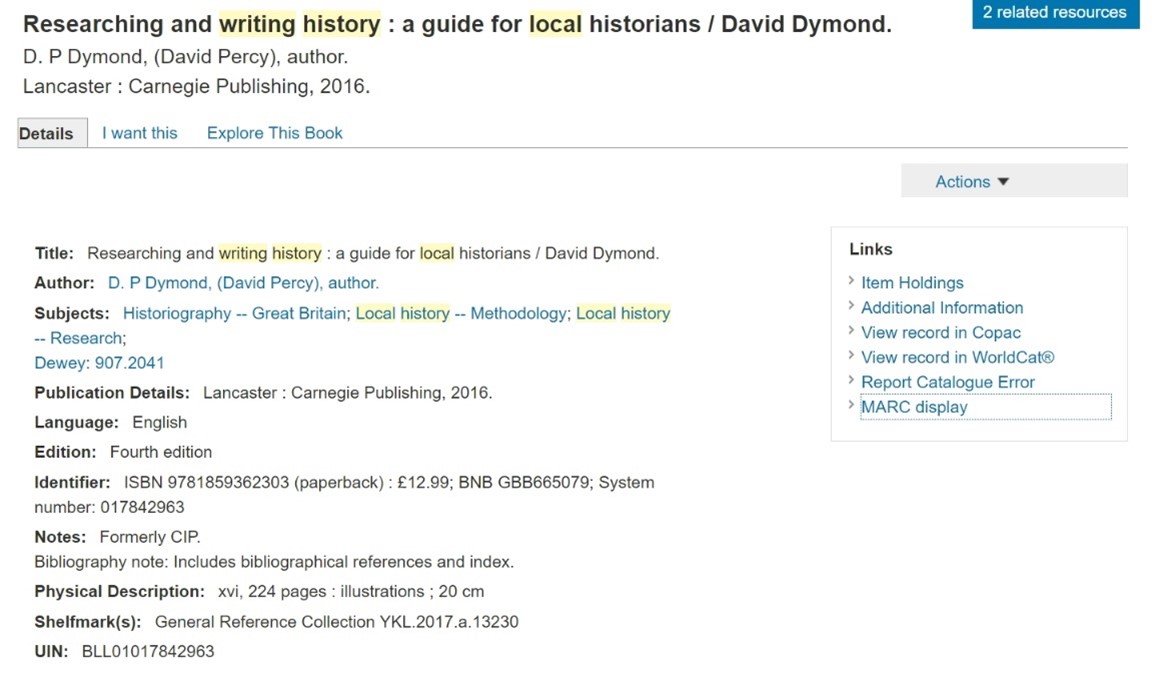
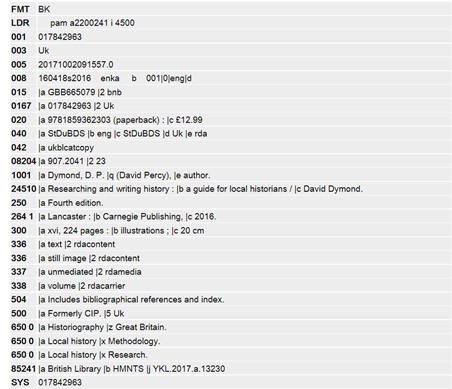
The BNB enables you to freely download MARC 21 records.
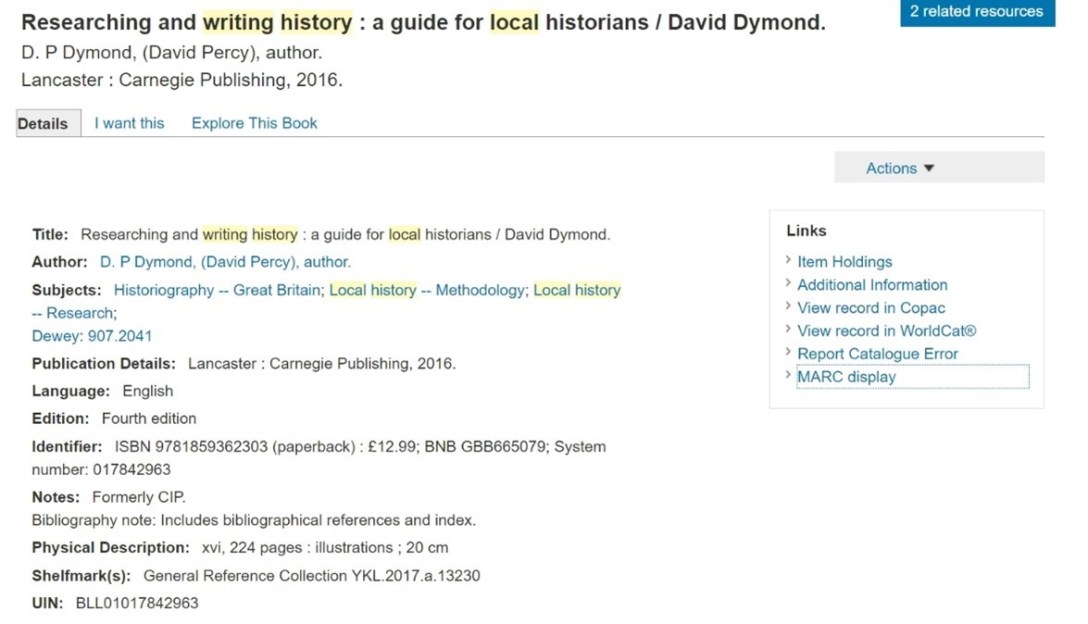
Entry on the British Library catalogue. You can see the option for MARC display for this item on the right.
MARC display for the same item on the BNB
Library Hub, https://discover.libraryhub.jisc.ac.uk/, is also an excellent source of cataloguing information, but that site does not display records in MARC 21 format.
Key differences between a Local Studies and standard public library catalogue entry
The unique nature of local studies material requires a more thorough catalogue entry than, for example, a work of fiction on a general library shelf. The importance of person, place and community to local studies collections means that the item has been acquired for a specific reason; for the knowledge contained within it or for its association to the community the collection serves, and this must be reflected in the catalogue entry.
A suggestion for comprehensive catalogue entries for local studies items can be found on the table below and should be used in conjunction with the Library of Congress MARC standards available online:
Description
MARC 21 identifier
See section below
ISBN plus type eg. hardback or paperback
020
Dewey number
082
A
Local call/classification number (if applicable)
090-099
A
Author
100/110
B
Title
245
Edition
250
Publisher details (including publication date)
264
Physical Description (number of pages, inclusion of illustrations, format and media type eg. map, CD, dimensions in cm)
300
Sequential journal dates
362
Series statement
490
Note field
500
C
Bibliography/index (if present)
504
Summary
520
D
Surname of Person/family
600
Topic heading
650
Local subject use eg. local place name and subject heading
690-699
E
Added name (for additional authors/editors)
700
A: Dewey and Local call/classification number
Here you should detail how you arrange your books on the shelves. Your branch stock will very likely be catalogued in Dewey, which is a good method for a small number of books, but has challenges for specialist collections. For local studies the key problem is that Dewey does not allow a collection to combine subject and location into one short number, nor is if very good at dividing your collection area into the geographical areas. As a consequence, a large number of local collections have created their own classification schemes tailor-made for their area. For example:
The days of a library dedicating a member of staff to reclassify each book in a local studies collection are over, however small additions to numbering systems should be included as material using new areas are acquired. A scheme typically designed in the 1970s is likely to be strong in archaeology but not in social issues, let alone include new towns.
B: Personal, corporate and series names
An interesting recent development has been the spread of NACO (Name Authorities Co-operative). Members across the world have created an international standard that aims to create a unique entry for each name. Details of approved headings are available through the RDA toolkit and https://authorities.loc.gov/. However, local studies collections will be the first to catalogue many locally produced publications, so it is likely that many of the authors will yet to have reached NACO.
C: General notes
You can add miscellaneous information about the item in this field, such as whether your copy is part of a donation, part of a collection, information about previous owners or whether it contains any manuscript comments or annotations of note.
D: Summary
It is important to give potential local studies readers a flavour of the book and its strengths. It is also important to be aware that the library catalogue will interrogate this field when users search the catalogue, so make sure that you include keywords that will not be included in the title or subject fields.
E: Local subject use
Whilst field 082 (Dewey and Local call/classification number) forces you to pick one subject term, this field enables you to add multiple terms. Your authority is likely to use Library of Congress Subject Headings as its standard subject terms, but this is not detailed enough for British local studies, so you should use a specialist scheme.
Your authority may have its own local studies thesaurus, such as that produced by Berkshire.
Some local numbering schemes, such as that provided by Wiltshire above, will be thorough enough for use in this field.
Whichever classification scheme is used for this field, it is important that it captures both the subject and the geographical element. For example:
SMOKING PIPES – Slough – Cippenham
Though the subject can be taken from a generic list of local studies terms, the geographical element should be carefully considered at a local level.
Item record
A catalogue entry describes a certain publication, whilst the item record contains information relating to individual copies. Each copy must have its own item record describing the physical location of the item and its classification number. Information about the conservation work undertaken on the item can also be added onto the item record.
Contributing material to a county bibliography
Some counties have local history bibliographies, often compiled by county local history associations. Where possible, new additions to library stock should be added to these listings.
Contributing material to union catalogues
You can reach a bigger audience by contributing information about your holdings to collections of library catalogues: Your library authority may be part of a consortium so, for example, if a SELMS library user cannot find a book in their local library website, they can find holdings in other partner libraries by selecting a ‘Try this search in the SELMS Catalogue’ link. They may also contribute to WorldCat.
You can also contribute information about your pre-1800 holdings to the English Short Title Catalogue which, however you will need some understanding of DCRM to do this properly.
Got something to add?
Do you have any comments, suggestions or updates for this page? Add a comment below or contact us. This toolkit is only as good as you make it.
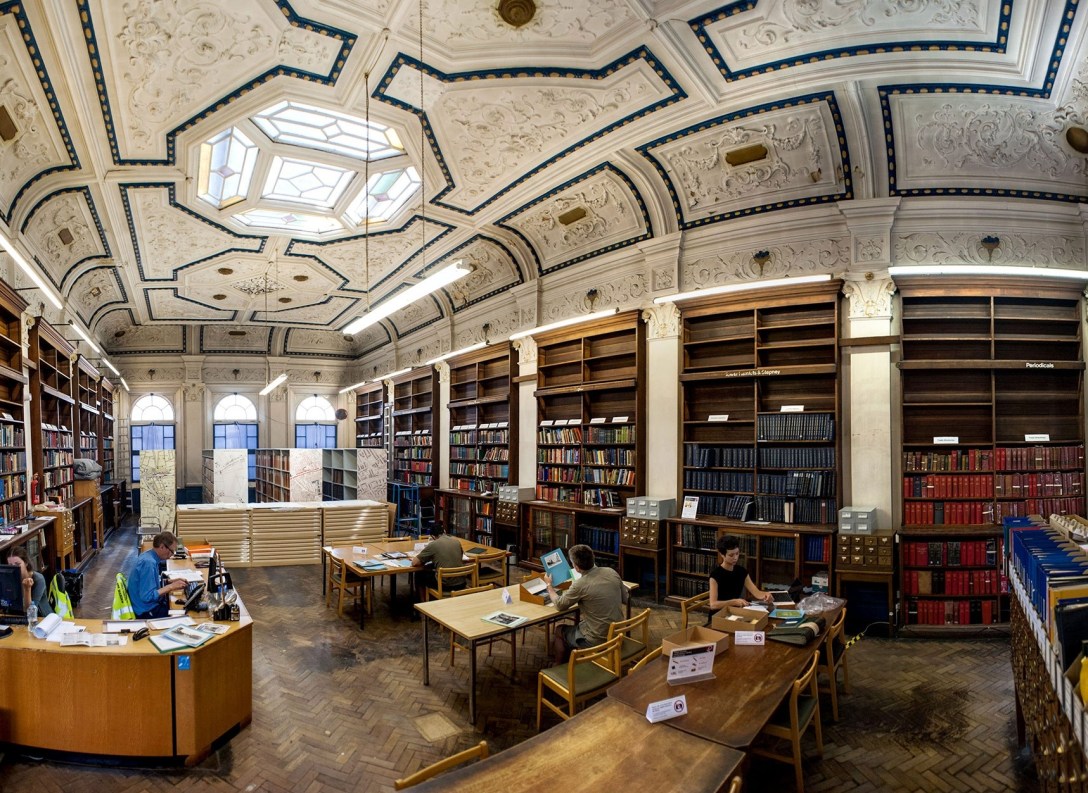
A local studies library should be a welcoming place for all members of society, ensure good working conditions for readers and staff, provide secure access to library materials, and be able to facilitate visits, events, meetings and group work.
The physical location of areas designed to house local studies collections should always be carefully planned. When library buildings are constructed or adapted the opportunity should be taken to provide accommodation of the highest standard, professionally space planned, in consultation with local studies staff.
Public areas
Areas designated for use by members of the public should be planned with both security and user convenience in mind. Considerations include:
Adequate seating complete with a power supply to enable readers to plug in laptops and other devices.
Access to wi-fi.
Generous provision of large tables for consultation of maps, plans, broadsheet newspapers, newspaper volumes, and other large items.
Design that allows for careful supervision of readers consulting irreplaceable materials.
Space for specialist equipment such as computers, microform readers/scanners and printers.
Lighting levels that are bright enough to enable readers to take digital photographs of material whilst protecting documents from over-intense exposure, and that permit the use of microforms without eye strain.
A display area to promote the range of material in the collection.
Adequate access and user facilities for disabled people.
Flexible enough to allow group visits and, ideally, to enable events to be held when the library is closed.
Open access materials
If possible, a collection of local studies books and other materials should be provided on open access. This will be much appreciated by researchers, and indeed some users come into the local studies library simply for the pleasure of browsing among the materials. Unique items should never be put at risk, but duplicate copies can be purchased as funds allow. Sometimes even out-of-print items can be obtained from specialist sources, and bound photocopies of rarer material can be prepared to enable the development of an open access section. If an open-access collection is provided, appropriate shelving and storage furniture will need to be provided in the public study area, and space made available to accommodate these.
Public-access computers should also be accessible in the local studies area. Ideally, these should be used to signpost users to online local and national resources of interest to local history researchers, for example photographic collections, maps, directories, digitised newspapers and family history resources, and online indexes.
Storage areas
Secure storage must be provided and should be located close to the public study areas, but with adequate controls to prevent entry by members of the public.
Provision within the stores should include specialist shelving and furniture, such as non-standard sizes of shelving including closely-mounted shelving of appropriate length for horizontal storage of single newspaper volumes, “jumbo folio” volumes or large illustrations. A separate filing area for unbound copies of local newspapers and periodicals is desirable.
Care should be taken to acquire appropriate storage equipment for special materials such as maps, microforms, photographs, negatives, 35mm transparencies, cuttings and ephemera.
Storage should ideally conform to standards outlined in BS 4971:2017 Conservation and care of archive and library collections. Smoke detectors should be installed, and fire escape routes be planned to avoid public egress through the stores. Ideally service pipes should not be routed through the stores, and neither should inappropriate electrical or heating appliances be located here.
Monitoring storage conditions
Equipment should be installed to monitor the correct environmental conditions, for example, Tinytag data loggers can be used to monitor the temperature and relative humidity of different areas of the space, including inside boxes. Insect traps should also be used to monitor pests.
Office accommodation
There should be adequate office accommodation for local studies staff, plus tabletop space for processing newly-received local studies materials and storage for archival and other specialist stationery. There should also be room to enable the scanning of photographs and other material, and to accommodate any volunteers.
Got something to add?
Do you have any comments, suggestions or updates for this page? Add a comment below or contact us. This toolkit is only as good as you make it.
An emergency plan can be deployed alongside a business continuity plan and in some areas they will overlap. But whereas the business continuity plan should enable you to maintain your service during a period of disruption in a range of situations; an emergency is defined as any incident which cannot be contained, or which threatens any part of the Local Studies building / space or its holdings. Your emergency plan will most likely relate specifically to your collections and building, but it could be part of a wider organisational response, especially if the Local Studies library is housed within a building that delivers other services e.g. a central library or local government offices. But is essential that Local Studies collections and archives are recognised as requiring specific responses during an emergency.
The Emergency Plan should have the following objectives.
Increase staff awareness of potential hazards and the circumstances in which an emergency arising from them might occur.
Procedures set out in the Plan are intended to minimise the damage to the collections, should an emergency arise.
The Plan should be based on the essential aspects of emergency control: response, management and recovery. The two major emergencies are fire and flood. Security implications must also be taken into consideration.
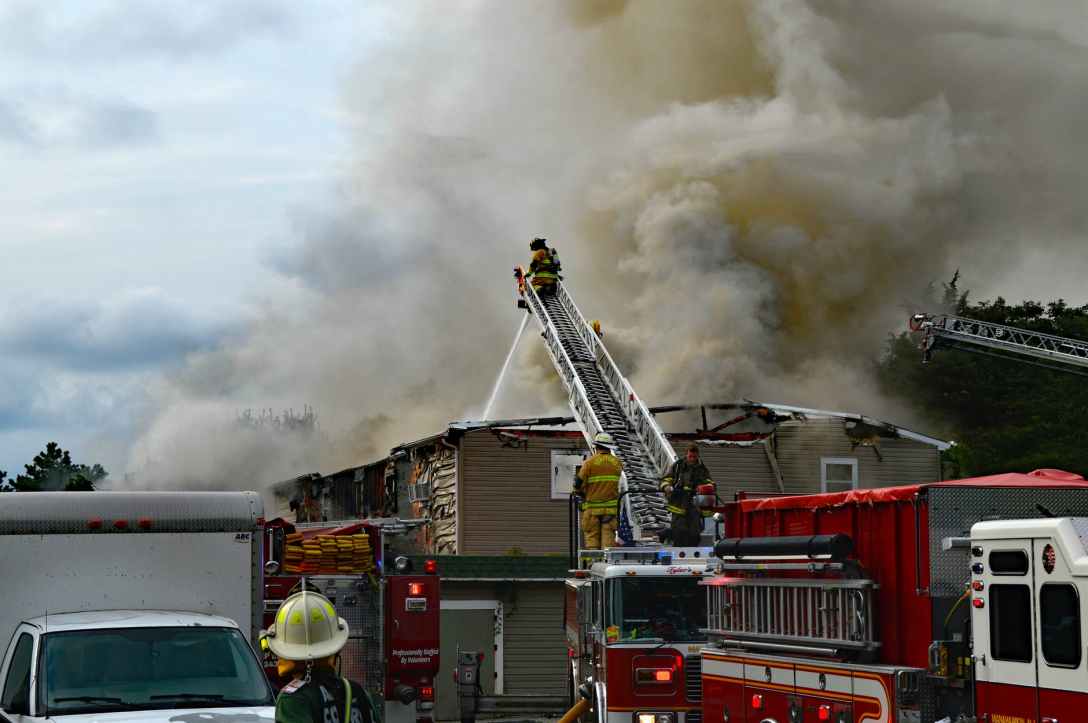
The Plan should consider the firefighting equipment and emergency exits of your building. Is your building is fitted with automatic fire detection and intruder alarm equipment? How is the fire brigade contacted? Note that some fire brigade services no longer respond to automated calls during office hours. Do you have fire extinguishers – to suit a variety of different types of fires available in every room or area? The safety of the staff and public is a paramount consideration. Staff should be instructed to only fight a fire when they are certain that it can be put out straight away. (NB you should incorporate your own organisation’s guidelines within this)
Flood prevention is of equally vital importance to fire prevention. Water is the most common source of damage to the holdings of libraries, archives and museums. Most water damage occurs from burst pipes or the aftermath of a fire. Unless your building is fitted with a flood alarm, flooding is much more difficult to detect than fire, and could wreak havoc for hours or even days without detection.
Priority Recovery Plans for Local Studies Services and collections should be drawn up that prioritise material for recovery. Ideally copies should be supplied to the fire brigade, any conservation services you may use, senior managers and duty managers.
Consider subscriptions to specialist salvage and conservation companies, including out of hours emergency cover and bulk freeze drying.
Quick steps for creating an emergency plan
Divide your plan into two parts: 1) Immediate Action and 2) Prevention
Immediate Action:
Emergency facilities – note the locations of emergency systems – main utility controls (e.g. water mains stop tap, electricity and gas shut off), fire suppression systems (extinguishers, blankets, hoses etc.), keys, first aid kits.
Emergency contacts – do you subscribe to a recovery service for damaged collections? Add other important contacts such as alarm companies, cleaners, your organisation’s emergency planning and facilities teams etc.
Salvage priorities – establish which parts of your collection / building are most important to salvage if everything cannot be saved.
Immediate action procedures – create flow charts or action plans for specific threats: Fire and flood; theft; loss of power, ICT or water supply.
Major incidents – what is the worst-case scenario, how would you need to deal with this?
Create a salvage plan – management and procedures, contacts / subscriptions for salvage specialist organisations.
Create templates for incident logs and situation reports – this will save time when you are dealing with a live situation.
Where is your emergency plan kept? Is it accessible if you cannot get into your building or log in to your computer?
Prevention:
Security – what systems do you have in place and are they adequate?
Flood – are any water pipes and radiators close to your collections, do you know how to turn off the water supply; do you have mops, towels, buckets, and plastic covering readily available?
Fire – are smoke detectors and fire alarms tested regularly, do you have suppression systems, know the location of extinguishers and which ones to deploy? Avoid the accumulation of rubbish, cardboard, dust etc.
Storage – consider how material is kept e.g. sufficiently above floor surface to avoid flood damage, in archive boxes and cabinets that can act as barriers to water and fire damage; is the room / building environment (temperatures / humidity) sufficient to avoid gradual damage to material?
Salvage – do you subscribe to a salvage service? If not, what plans to salvage material damaged by fire and flood do you have?
Staff training should be considered for an awareness of the emergency plan such as utility supply points, fire evacuation procedures and extinguisher points, flood and water damage, basic salvage techniques, security, and vigilance.
Below are more details on how to create an emergency plan:
Scales of Emergency
It is useful to consider different scales of incidents that will help you decide what the appropriate action is. For example, the Wiltshire and Swindon History Centre uses the following grades:
Grade 1 An incident that can be dealt with from the service’s resources. Amount of damaged material: Archives: 1 – 20 boxes or Library Service: One bay of books, one drawer of photographs and one microform cabinet.
Grade 2 An incident that can be dealt with from each service’s resources, with assistance from wider organisation. Amount of damaged material: Archives: 20 – 100 boxes or Library Service: Two bays of books, two to four drawers of photographs and two microform cabinets.
Grade 3 An incident that cannot be handled by your organisation and outside assistance from external conservators and agencies is required. Amount of damaged material: Archives: 100 + boxes or Library Service: Three bays of books, two photograph cabinets and three microform cabinets.
What to include in your emergency plan:
Emergency telephone numbers –
Emergency services – Police, Fire Brigade, Ambulance
Fire and intruder alarm contacts
Facilities Management Team for your organisation
Out of hours security / emergency contacts
Utility companies – water, gas and electricity
Emergency conservation recovery contracts – e.g. bulk freezing, specialist book, archive and museum conservators
Location of Emergency Plan copies – who has copies of your plan and where are they held. NB some copies should be held outside of your building. Managers should have easy access.
Emergency Procedures: what are your procedures if an incident occurs? Do you have flow charts or easy to follow steps? The following might be included:
Action in the event of theft or vandalism
Contact police / crime number
Collect witness statements / CCTV footage
Appoint a recovery coordinator
Contact organisation’s insurance team
Action in the event of a fire
Appoint a fire marshal(s) and staff responsible for evacuating Local Studies area and create an evacuation plan. These should be your normal fire procedures.
Do you have a priority recovery plan?
Have fire grab-packs near fire exits that include your emergency and business continuity plans, building plans – including fire refuges and identifying higher risk collections / priority recovery plan.
See salvage below for water or fire damaged items
Action in the event of a major flood.
Do you have access to equipment to alleviate flooding e.g. mops, buckets, sandbags etc.
Do you know where to hire water pumps?
Hold a store of polythene sheeting for carrying or covering potentially vulnerable items
A plan to remove vulnerable items (see also salvage)
What alternative storage can you access?
Action in the event of loss of power, ICT or water supply
Refer to Business Continuity Plan
Do you have torches / mobile phones etc. and where are they located?
Have an evacuation plan for staff and customers from dark areas such as repositories, lifts etc.
Can a member of staff access the website remotely to update customer information?
Power failure – it is a good idea for staff to turn off all electrical equipment at sockets.
Water supply – it is a good idea for staff to turn off all taps and stop cocks and be prepared to enact flooding emergency plan when water supply returns.
Major incidents: It is worth including in a flow chart actions you would undertake for major incidents, this might include:
The primary duty of the Directing Officer in this phase is to make the premises secure
Have a priority recovery plan
Can the building / Local Studies collection be secured – how will you do this?
Key contacts such as your organisation’s emergency planning, health & safety team and insurance teams; services for salvage and securing the building.
Reference your business continuity plan – especially regarding alternative accommodation.
Media protocols
Salvage management
One the disaster is over, the process of limiting the damage from the incident begins. There are a number of things to consider when drafting the salvage section of your emergency plan:
Salvage generally cannot begin until loss adjusters have assessed the site/damage.
The Directing Officer must acquire secure premises in which damaged material can be sorted for transfer to the appropriate specialists for treatment.
If the scale of the incident is very large rotas for salvage teams will need to be drawn up.
Great care must be taken when lifting wet materials and manual handling training should be provided. All staff involved with salvage must wear appropriate Personal Protective Equipment. Mould can grow very quickly in high humidity and respirators (face masks) should be worn.
Recovery Co-ordinator and will direct the personnel available to undertake the primary task of recovering damaged material and objects. They should check the list of priority salvage items and will undertake these first if possible.
Your insurance team need to have a list of library material damaged or destroyed at the earliest opportunity.
Are contracts in place for the use of a Drying Restoration Service?
An early call to such a service should be made to enable their staff to co-ordinate the recovery of damaged material. These services will usually supply transport with crates within 2- 4 hours of calling and arrange for blast freezing. 24-hour emergency access is often available. They can provide the following:
Expert advice from a drying specialist
On-site assessment of water-damaged materials
Packaging and freezing water-damaged materials
Arrangements for refrigerated transport.
Use of purpose-designed refrigerated storage facilities.
Use of specialised techniques for drying water-damaged materials.
Staff should familiarise themselves with the layout of the building so that they can point out potential hazards, as well as the locations of fire and intruder alarm installations, fire extinguishers, water isolation valves, electricity and gas isolation switches and external doors.
Salvage procedures
Always photograph the item in situ of the incident, when recovered and during work on it. Disposable/one use cameras will be kept in the Emergency Store. The item should also be photographed after treatment as a record. Ensure there is a good supply of emergency treatment forms.
Always ensure that any labels or markings are kept with the item for identification.
Crates must be colour coded to denote type of damaged material they contain. Trolleys are required to transport crates.
Where masses of material are found stuck together, there should be no attempt to separate them.
If material is stuck hard, it is better frozen and then freeze-dried when it will separate more easily.
Do not turn archive boxes upside down to empty them. This will result in damage to contents.
Any washing off of mud etc. This must only be done on the instruction of a conservator.
Some single leaf material may be suitable for air-drying. It should be taken to a drying area, in crates if necessary, after being recorded.
Material to be frozen should be packed in plastic crates, separated by polythene bags or sheets.
Maps etc. too large for the crates should, where possible, be packed in layers of blotting paper and polythene between boards to be sent for freezing.
Material with inks and pigment affected by damp should not be covered but kept flat and taken to a conservator for advice.
Air-drying of material should only be carried out under the supervision of archive conservators.
When investigating for wet damage, keep the wet material in the box, support the base of the box when moving to a crate, and despatch for freezing. If the box is wet but the contents are not, then re-box.
Drying different materials:
Parchment and Vellum
Flat sheets. To air dry – place between sheets of release paper and blotters and dry under light pressure or lay out on release paper with a weight at each corner (with release material between weights and document). To freeze – interleave with polythene and support between stiff card taped together.
Rolled material. To air dry – unroll and treat as flat material. To freeze – roll around tube if possible, interleaved with polythene so that the skin cannot stick to itself or the tube.
Skin covered books. To air dry – close book. Dry flat under light pressure. To freeze – treat as other books.
Books with parchment pages. If pages are wet and stuck together prepare for freeze-drying. If slightly damp and easily separated interleave and dry flat under light pressure.
Bound Books
Remove carefully from shelves, taking the wettest books first, but try to remove them in order.
Do not open any books unnecessarily.
Wash off any mud or solids on the outside of the binding with handheld sprays.
Water damaged books printed on coated paper must be interleaved at every page.
The conservator should decide if the book is to be frozen or air dried and, after the details have been entered on the Emergency Treatment Form, it will be placed in the appropriate plastic crate which should carry a number.
Pack wet books in the crates upright. They may either be individually packed or separated from each other and the crate by polythene sheets or bags. Put as many books as possible in each crate so that they support one another and thereby minimize distortion.
When full, the crates should be removed for transport to the freezer.
Folio volumes etc. should be individually packed and labelled and carefully stacked flat for transport to the freezer.
Photographic Material
Immerse all water-damaged microforms in buckets of cold water for transport to the processing laboratory.
Immerse water-damaged photographs (including glass-plate negatives) in their wrappings in cold water. Then when drying space is available, remove wrappings and wash prints or plates in cold water again. Layout on absorbent paper, emulsion side up, for air. Note that collodion wet plates, ambrotypes and tinotypes should never be frozen.
Prevention measures
It is always better to stop an incident from occurring in the first place, so consider:
Security – minimise the possibilities of theft when the Local Studies building is open and reduce the opportunities for unauthorised entry when closed. Do you have an intruder alarm system and high visibility CCTV? Do you record access to non-public areas and sign keys in and out? Can volunteers, contractors be easily identified for non-authorised access? Are public space invigilated?
Fire – Has your building / service been appraised by fire safety inspectors and your internal health and safety teams? Ensure actions resulting from inspections are recorded. Are fire alarm tests on a regular basis? Are fire extinguishers tested/ serviced regularly? Are electrical circuits tested? Is rubbish removed regularly and are fire exits kept clear? Do you liaise with your local fire service and are they familiar with the building? Identify and clearly label priority areas for saving if all the fire cannot be extinguished.
Flood – ensure the regular clearing of roof drains. Any leaks that are observed should be reported. Any roof leaks observed above books, archives etc should lead to objects under threat being removed. Where bookshelves and large objects cannot be moved then they must be covered by plastic sheeting. Staff should be encouraged to be vigilant in looking out for evidence of water or damp in unusual places. Stopcocks should be checked once a year to make sure they are working.
Storage – If you have strong rooms or secure storage, environmental conditions should meet those recommended in BS 4971:2017 Conservation and care of archive and library collections. Regular checks of temperature and humidity must be made and deviations investigated. Microforms, maps, photographs and ephemera should be stored in steel cabinets. Photographs and older ephemera (pre-1960) should be in acid-free polyester sleeves. Volumes/books, pamphlet boxes and journal boxes should be shelved tidily and set back slightly in the shelves. This will hamper the spread of fire vertically from shelf to shelf. In a flood, water will cause tightly packed books to swell to a point where they burst from the shelves. More information on storage can be found in the conservation part of the Local Studies Toolkit.
Much of the guidance found throughout this toolkit is relevant to delivering a successful local studies service in Scotland. The aim of this section is to provide additional information relating specifically to the Scottish context. This section does not aim to be exhaustive, but to provide a concise account of the key information relevant to local studies throughout Scotland. It focuses on organisations and resources that are relevant to all or most of Scotland. This does not include those with a narrower regional scope, excellent though they may be.
The Scottish professional organisation for librarians, information specialists and knowledge managers. CILIPS is affiliated and works in partnership with CILIP, the UK-wide organisation.
CILIPS delivers a diverse programme of development activities every year, which includes an annual conference, Autumn Gathering and a range of online learning sessions. Different areas of Scotland are covered by a network of regional branches and different aspects of the profession are represented by a range of Special Interest Groups, including one on local studies.
CILIPS is additionally a key force at a national level in advocacy for the value and potential of libraries and information professionals and runs a host of associated campaigns. The objectives of the organisation are set by its Trustee Board and shaped by the advice of the CILIPS Council, formed by representatives from the above branches and groups.
The CILIPS Special Interest Group focused on local studies.
LocScot is devoted to the care and dissemination of local and family history material in Scotland and to encouraging its use for the public good. The group aims to support individuals working in this specialism, run events throughout the year and represents local and family history interests in a wide variety of Scottish cultural and historical forums.
The group’s committee consists of librarians from around Scotland and involvement from new voices and new areas is welcome and desired. Membership of and involvement in the group is open to all CILIPS members.
The independent advisory body to the Scottish Government on library and information related matters. SLIC was formed in 1991 and provides a leadership focus for Scottish library and information services. The organisation seeks to lead and promote development in the library sector and monitor standards of provision. It also undertakes research promoting innovation and a greater understanding of the library and information sector in Scotland.
SLIC’s aim is to support Scottish library and information services through service innovation, funding provision and informative research.
It is a vital source of funding for Scottish library projects, runs its own high profile projects and develops national strategies and evaluative frameworks that relate to local studies provision and the wider library and information sector.
A national charity that believes books, reading and writing have the power to change lives. This organisation states that a love of reading inspires creativity, improves employment opportunities, mental health and wellbeing and is one of the most effective ways to help break the poverty cycle. Their Live Literature programme is a significant part-funder for author events for organisations across Scotland, including for events with a local studies focus.
The Scottish Government has a huge influence on the planning, delivery, and evaluation of public services in the country. The overall goals of the Scottish Government are outlined in their National Performance Framework. There is strong potential for local studies to contribute to the national outcomes of this framework. The national outcomes can serve as top-level rationale for local studies work. Additionally, local Community Planning Partnerships, important organisations for local studies services across Scotland, take their lead from this national framework.
The country’s national library and the only legal deposit library. The NLS’s collections range from rare historical documents to online journals and covers every subject. It specialises in Scotland’s knowledge, history and culture.
Beyond their vast reference collection, including much material concerning local areas, there is a wide range of eResources available to all Scottish residents, important in-house digital provision such as their Map Images website, and an interest in collaborating with local public libraries on innovative projects.
The latter includes the NLS’s involvement in the British Library created Living Knowledge Network. This network represents one way public libraries can collaborate with the NLS and other UK national libraries.
Scotland’s national collection of the moving image. The collection, formerly known as the Scottish Screen Archive, is part of the National Library of Scotland.
The Moving Image Archive collects, preserves and promotes access to films capturing Scotland and its people, from the early days of filmmaking to the present day. Their collection numbers over 46,000 items including film cans, videotapes, and digital files.
They are the foremost collection of this specialist type of material in Scotland. Their expert knowledge in this area, and exceptional collection, make them a vital organisation for Scottish local studies.
The lead public body set up to investigate, care for and promote Scotland’s historic environment. Local studies librarians should be aware of their significant collections, their range of useful online resources relating to the country’s historic environment (detailed below), and the organisation’s ongoing role in managing Scotland’s historic environment.
The national archive for Scotland. The NRS is a Non-Ministerial Department of the Scottish Government and their purpose is to collect, preserve and produce information about Scotland’s people and history, making it available to inform current and future generations.
Their collections and digital provision make them a key organisation for local studies librarians. The NRS hold the most significant Scottish family history records, alongside a range of other important historical records. Their family history website, ScotlandsPeople (detailed below), is one of the key digital resources for Scottish family and local history.
Additionally, the NRS provide authoritative guidance on a variety of Scottish historical records – Research Guides A-Z. These are of great help for local studies librarians, for understanding the wider Scottish context, and for providing guidance to members of the public requiring help.
It should be noted that records relating to Scotland are also held by the UK National Archives. It is important to be aware that relevant information may be held at Kew rather than Edinburgh or Glasgow. The excellent research guides from both organisations provide information on this.
A membership organisation which aims to stimulate and encourage interest in local history and heritage in Scotland and to advance education and research in Scottish local history. The Forum can be joined by individuals or organisations such as libraries, museums and archives.
The Forum is a useful network allowing librarians to connect with people and groups interested in the subject area beyond public libraries. Additionally, it can be used to promote events, projects and collaborative opportunities and to learn what is going on in Scottish local history, including about new publications.
The chair of LocScot sits on the Forum’s Advisory Committee.
Regional groups which are run independently though they receive support from MGS representatives. Their focus is on museums of any size, but the membership is open to any organisation with a heritage interest, including public libraries. These forums cover most of Scotland and can be good networks for peer-support, training, opportunities for collaboration, the sharing of news and to discuss matters of mutual interest.
Local heritage partners
This is not limited to Scotland, but it is vital to establish what other heritage organisations are active in one’s locality and how they relate to local studies provision. This potentially includes local authority colleagues in museums, archives, registrars, planning and archaeology. These services may have varied formal and informal links to the library service.
Additionally, it is vital to develop an understanding of the non-council heritage related groups, including those with tangential connections to heritage such as art, reminiscence, nature, community, and environmental groups amongst others, as well as family history societies and local heritage organisations. Groups such as the abovementioned Geographic Museums Forums from Museums Galleries Scotland can be useful for developing this understanding and building rewarding relationships with compatible organisations.
Got something to add?
Do you have any comments, suggestions or updates for this page? Add a comment below or contact us. This toolkit is only as good as you make it.

 CILIP Local Studies Group