
Heritage resources can make a difference to individuals: the young couple in their first house who visited because they had chopped down some trees which were inside their fence only to find that their neighbour claimed the land and the trees; the schoolteacher who said that her students’ A level results had improved as a result of class visits to the local studies library; the family who were helped to find essential evidence about a local company and were able to obtain compensation for the loss of a loved one.
Heritage projects have the power to engage people from widely different backgrounds and generations. Interesting and creative projects have the power to motivate individuals to overcome barriers to learning, to experience digital technologies, to build new social networks (combatting isolation, depression and related health issues) and to rekindle an in interest in life through informal learning opportunities.
Heritage people working creatively, and in partnership with a wide range of educational providers, facilitators and artists, and others, can ensure that opportunities exist to engage different levels of ability and ranges of interest.
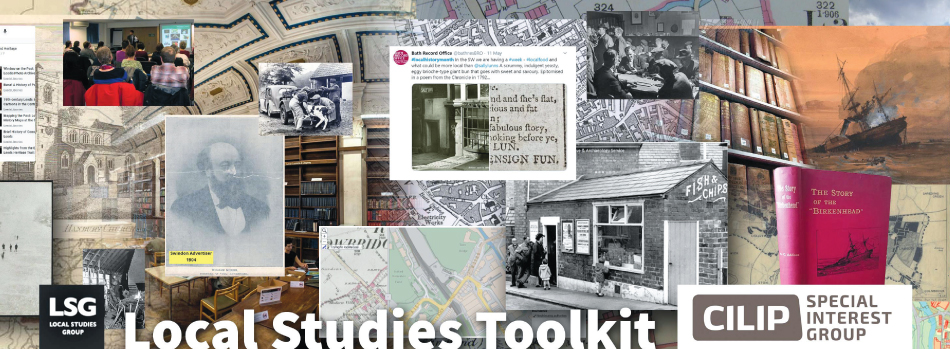
But how do you do this? Some of the finest and most experienced local studies librarians have come together to form a free online resource, The Local Studies Toolkit, that can help guide heritage people to the right answer for them.
In this session, we will explore the toolkit and hear some top tips from those who wrote some of its sections.
Speakers include:
- Terry Bracher, Heritage Services Manager, Wiltshire & Swindon History Centre
- Tracey Williams, Heritage & Local Studies Librarian, Solihull (Recorded)
- Tony Pilmer, Librarian & Archivist, Royal Aeronautical Society & formerly Local Studies Librarian, Slough (Chair)
- José Luiz Pederzoli Jr., Unit Manager – Strategic Planning, ICCROM (Recorded)
This event is organised by the CILIP Local Studies Group & The Historic Society of Lancashire & Cheshire

 CILIP Local Studies Group