
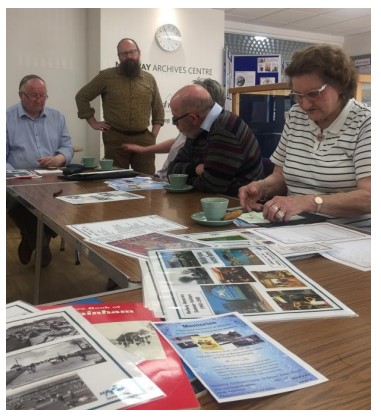
Volunteering in public libraries has become mainstream in recent years with many libraries around the country now offering general volunteering opportunities for specific events or projects, for example assisting with the children’s Summer Reading Challenge. The biggest exception to this rule has been local studies collections, which have harnessed the power of volunteers for decades. Classically helping with indexing newspapers and census records, the variety of opportunities have mushroomed in recent years.
See the following sections of the toolkit for examples of how volunteers can play a role in local studies projects:
- Oral history
- Photographs & other visual material
- Newspapers
- Indexes & transcriptions
- Conservation
- Community archives
- Friends groups
Though running projects with volunteers can unlock material within collections, aid collecting and help you to find new audiences, whilst making a real difference to those who give their time, it is also a big commitment to any organization, as recruiting, managing and celebrating volunteers is very time consuming.
When to use volunteers and not to use volunteers:
In 2012 CILIP released the following policy statement:
CILIP believes that society benefits from the contribution that trained and skilled library, information and knowledge workers make to developing and delivering services. We do not believe that volunteers should undertake core service delivery or be asked to replace the specialised roles of staff who work in libraries.
Volunteers have long supported and provided highly valuable additional support, working alongside qualified and paid staff, and they should be acknowledged and valued for this role. They should also be given appropriate role descriptions, training and management.
CILIP is opposed to job substitution where paid professional and support roles are directly replaced with either volunteers or untrained administrative posts to save money. This applies to all library and information services in every sector.
If this happens services will suffer and will be unsustainable. What remains would be a library service unable to serve the community comprehensively, support people’s information needs or provide everyone with the opportunity for learning and development.
CILIP will not assist in recruiting or training volunteers who will be used to substitute the role of qualified, trained and paid library and information workers.
We acknowledge the difficult times that we live in, but now more than ever, high quality information services are vital to people’s lives, and local communities, learners, workers and businesses need the support of a trained and skilled workforce to thrive.
A local studies unit should clearly define what is their core local studies service and, by extension, which activities should be undertaken purely by professionals and what activities are open to volunteers. For example, stock selection and cataloguing books are core roles for a local studies professional, however the extent of photographic collections means that volunteers are often asked to help catalogue and digitize photographs.
Volunteers as a resource for meeting your objectives
Using volunteers is not an end in itself, but a very powerful tool in helping you meet your objectives. Unsurprisingly, once a local studies unit has decided its priorities and examined the projects open to them, many activities will involve volunteers. For more information on deciding your objectives, please see section 6 of this toolkit.
Running a project which involves volunteers:
As volunteering has become more central to the work of public libraries and local authorities in general, you are likely to have to ensure that your procedures are in line with the wider organisation’s volunteer processes and policies. However, there are still key stages that should be followed whether it is part of your wider volunteer process or not:
- Defining a project: The running a large project and evaluation sections of this toolkit highlights the importance of a having a clear plan.
- Defining a volunteer role: A project requires tasks which need to be performed, whether by paid project workers or unpaid volunteers. Roles will be of different durations, with some requiring a few hours or days of help whilst others will be decades long. A volunteer should be appointed to a project and, when that project comes to an end, they should be considered for another project and only appointed if they are right for the role. Consider putting together a short description of a volunteer role, which can then be used for advertising. For example: Volunteer at your library or archives | Hertfordshire County Council
- Appoint a named contact: Volunteers should have a named person to whom they can raise problems, concerns and questions. In some organizations with a larger number of volunteers, there will be a specific member of staff dedicated to coordinate volunteer work.
- What skills, knowledge and abilities do you need for your project?
- Consider working with people from the community who wouldn’t naturally see libraries as a place for them.
- Work experience students looking for a career in heritage. This group of people should be given experience in some areas normally reserved for professional staff.
- Many younger people who volunteer do so as part of the Duke of Edinburgh Award scheme. They may be required to undertake a particular number of hours and so a formal method of recording hours maybe relevant.
- Those seeking work, whether they are short-term or long-term unemployed. As staff may be asked to act as a referee, making a note of punctuality and absence should also be considered.
- Those with specialist knowledge and skills, such as those from the local family history society who could help with family history IT support and members of the Art Society with conservation skills. See section on working with partners.
- Approach a local company which releases groups of their employees to volunteers for local good causes – especially good for short sharp projects such as re-boxing material into conservation grade materials.
- Remote volunteering is becoming increasingly popular, for example indexing projects, with material being emailed out to volunteers. This extends the scope of the project to reach volunteers unable to leave home, or those with an interest in the subject from around the world, in addition to those living locally. See the Crowdsourcing part of the indexes and transcriptions section of the toolkit.
- Mix the groups, perhaps look towards an intergenerational project linking younger and older people.
- The recently retired looking for a new challenge – including those who have recently retired from your own library – some of the finest volunteers are retired librarians!
- Recruitment: As with recruiting for a paid position, you are looking for the right person to fill the right role, so do not feel that you have to accept everyone who asks to become a volunteer. The potential volunteer may also feel that the opportunity is not right for them. It is useful for a potential volunteer to come in for a tour, an explanation of the volunteer roles available and an informal chat. Most authorities are likely to have their own application forms and volunteering agreements, though a checklist is also useful to have.
- Induction: It is important that new volunteers receive a good induction, covering
- Bread and butter issues, such as a health and safety briefing, location of the toilets and tearoom.
- Introducing them to staff and other volunteers.
- It is also important to point out that volunteering is not a permanent position and that it is fine if volunteers change their minds and decide that the position is not for them.
- You should also point out that volunteering is a two-way process and that, if problems occur, you can work together to try and resolve them and, in the worst case scenario, end the relationship, subject to the procedure laid down in your volunteer policy.
- A check-list can be useful to ensure that all items are covered.
- Training and Supervision: Support given to volunteers by library staff may involve specialist staff in training and explaining the role and in giving ongoing support.
- Written guidance is often useful for more detailed roles, such as photograph scanning and cataloguing.
- Many roles may not require any close supervision, however an element of checking work should be built into the process, some of which can be done by fellow volunteers. Some volunteers enjoy this additional responsibility and are invaluable for managing large projects. For projects that produce large amounts of data, such as indexing projects, staff can sample data and use searches and filters on spreadsheets or queries on databases to identify and remove common problems and, if significant problems are identified, another volunteer could be asked to review the work line by line.
- It is very easy for volunteers to deviate from the way they were taught to undertake their project, especially as they quickly become the expert in their section of the collection. You should keep an open mind about whether you should take on board their changes or not but remember that results need to be consistent.
- Some authorities will require volunteer coordinators to hold appraisals, but even if they do not, it is worth taking opportunities to discuss how things are going on a one-to-one basis with individual volunteers and take on board positive suggestions on how things could be improved.
- Recognise why a volunteer gives their time to you:
- As with everyone working with your organization, you need to ensure their contribution is valued and you need to demonstrate that they are making a positive contribution.
- Ensuring that you are offering well thought-out projects that the chosen volunteer can do well. Though the importance of choosing volunteers to meet the requirements of projects are listed above, you should build on the strengths of potential volunteers. After all, if you have a volunteer with a passion for images and has already scanned and catalogued their own photos at home and you have boxes of fascinating unsorted photos, it would be tempting to start an image project or if you have a volunteer who just likes inputting data, them creating a digital version of a card index could be invaluable.
- Volunteers often enjoy the social side and make new friends. Working on computers or other jobs around the same table can provide this opportunity, as does working together on group projects. The importance of tea breaks and an occasional slice of cake can never be overestimated.
- Celebration: Thanking your volunteers is the most important thing anyone running a volunteer project needs to do. Social activities maybe popular including trips out to different locations, summer garden parties and talks on relevant subjects.
- Measuring impact: As with any other project, those involving volunteers should be reviewed, and impacts measured. See measuring impact section of the toolkit for more information. As well as helping to develop your collections and your audiences, volunteering does have a positive impact on the volunteers themselves. Volunteering can tackle loneliness, raise community cohesion and pride, give people additional skills that they can use in the workplace and more. Local authorities will ask you to collect statistics on the number of hours that volunteers help you, but also supply those above with stories about how volunteers and volunteering has made a difference.
Further reading:
- Local Studies Toolkit – Friends Groups
Got something to add?
Do you have any comments, suggestions or updates for this page? Add a comment below or contact us. This toolkit is only as good as you make it.

 CILIP Local Studies Group