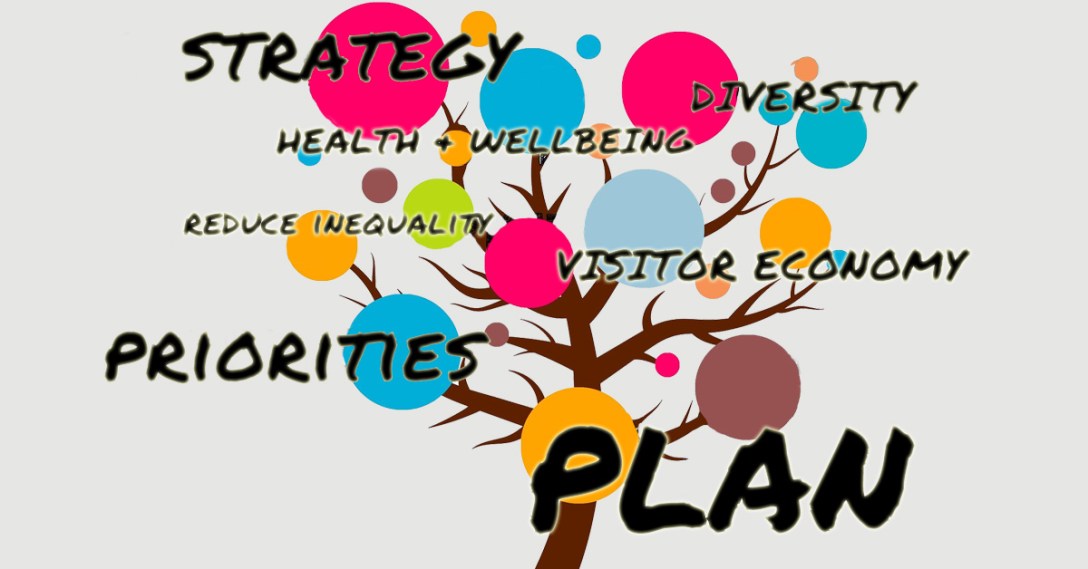
It’s easy to claim that local studies libraries are contributing to broad service priorities, such as increasing the visitor economy. However, making a claim that can’t be backed up by strong evidence runs the risk of undermining the credibility of the service with decision-makers within the authority.
Although activities often have some sort of evaluation or feedback, this may not always be designed in such a way as to collect evidence that can be used to demonstrate how this has helped the local studies service to contribute to strategic priorities.
It is often easier to measure outputs rather than outcomes, which is why outputs are often used as evidence. The drawback with this approach is that outputs don’t demonstrate impact and don’t necessarily resonate with stakeholders.
Outputs are defined as what was produced or delivered (e.g. the number of family history courses run) whilst outcomes are the differences made and the benefits that customers receive as a result of the outputs (e.g. a person using the knowledge they gained on the course to find lost family and feel a sense of identity that they hadn’t felt before). Whilst outputs are the “what”, outcomes are the “why.”
Outcomes may best be measured through stories rather than statistics, so it can be useful to try to capture stories from participants in any activity.
The Inspiring Learning for All (ILFA) framework was launched by the Museums, Libraries & Archives Council (MLA) in 2008 as a way for museums, libraries and archives to develop their learning offer.
The framework transferred with other MLA functions to the Arts Council in 2011 and was refreshed in 2014.
The ILFA framework includes the use of Generic Learning Outcomes (GLOs) and Generic Social Outcomes (GSOs) to provide evidence of the benefits people gain by interacting with arts and cultural organisations.
The Arts Council website give useful tips for capturing impact as well as other resources and templates relating to the GLOs and GSOs.
Got something to add?
Do you have any comments, suggestions or updates for this page? Add a comment below or contact us. This toolkit is only as good as you make it.

 CILIP Local Studies Group