Business or service plans
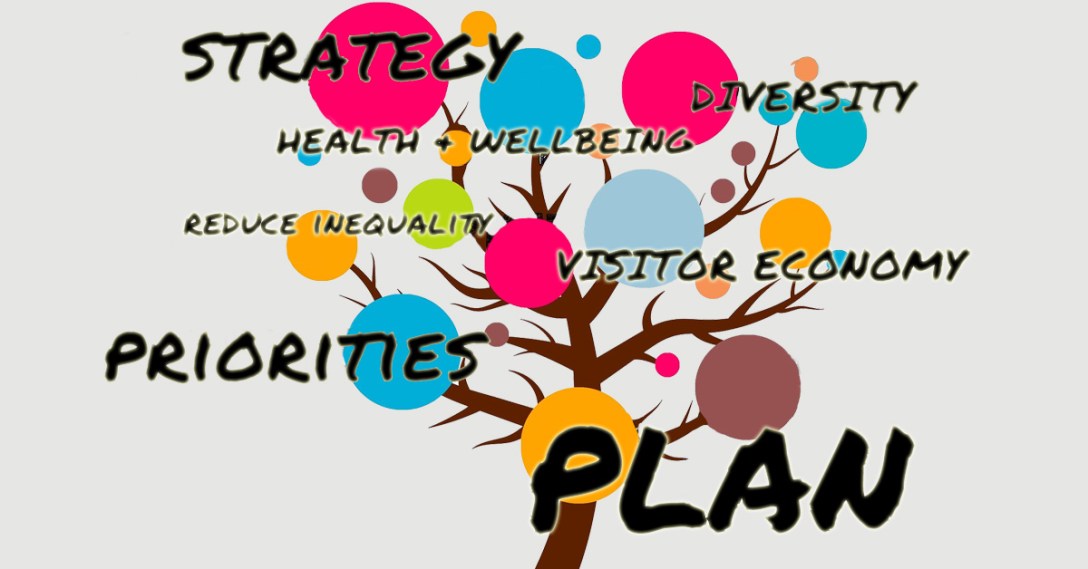
Every local authority is likely to produce a Council Plan that sets out its vision and strategy for the next two to ten years.
Common priorities, which local studies services may be able to link with, include:
- Promoting stronger, safer and healthier communities
- Increasing educational attainment and skills development
- Developing the visitor economy
- Celebrating diversity
- Encouraging sustainable economic growth and regeneration
- Protecting and enhancing the environment
- Reducing economic, educational and health inequality and improving the lives of the most vulnerable
- Increasing organisational efficiency
Increasingly, as financial pressures continue, there may be a focus on collaboration and partnerships as many councils aim to reduce direct delivery of services and, instead, to use their resources to enable, influence and facilitate delivery by others.
The Council Plan should form the basis of the library service’s strategic plan and trickle down to inform objectives for teams and individual staff. In this way, it shouldn’t be too difficult for local studies services to align their services with council aims.
However, this shouldn’t be a tick-box exercise but should involve real alignment and be backed up by evidence including measurable outputs and outcomes.
It may be advisable to concentrate on one or two target areas and demonstrate real impact, rather than making broad claims that are not backed up by robust and specific evidence.
Learning, wellbeing and community
Particular themes where local studies has the potential to make a real difference include learning (formal and informal, across all age groups), health and wellbeing, and supporting the development of stronger communities through helping to foster a sense of place and the strengthening of community networks.
Learning though using local studies resources isn’t only a matter of acquiring local or family history knowledge. It’s unlikely that anyone will be motivated to increase their IT skills in order to access official government information. However, learning how to research family history may motivate the digitally diffident to use a computer, thereby also enabling them to be more confident in using government services that are increasingly digital by design.
To have the most impact, a joined-up approach to activities and events is likely to be most effective. For example, a library service may run family history courses as a means of income generation. The income target could be met and the learners could all go their separate ways at the end of the course. The library service may achieve its income target and it could be considered that the activity was a success on this basis.
However, added value could be created by aligning the activity to priorities relating to wellbeing and stronger communities. For example, the family course participants could be encouraged to stay in touch with the library service and to join or form a self-organised family history group that continues to meet in the library once the course ends. This creates an ongoing relationship between the library and the learners, in a way that’s not likely to happen if the course were run in a more traditional education setting.
Over time, members of the group are likely to develop friendships and the group then becomes a source of emotional support for its members in addition to being a means of staying motivated to continue learning.
The group may also become a source of support and a resource for the library service – for example, members may be willing to assist with family history drop-in events or focus groups, encouraging more take-up of the family history courses and becoming advocates for the library service in general.
An activity that started out as a means of income generation can thus develop into a virtuous circle that may be life-changing for participants, by increasing IT skills, reducing isolation through developing community networks, and sharing their skills and knowledge to help others to learn.
Measuring impact
It’s easy to claim that local studies libraries are contributing to broad service priorities, such as increasing the visitor economy. However, making a claim that can’t be backed up by strong evidence runs the risk of undermining the credibility of the service with decision-makers within the authority.
More information on this topic can be found in the measuring your impact section of the toolkit.
Useful tips
- Keep a list of potential projects
Most local studies librarians have more ideas for projects and initiatives than they have capacity to implement them. It can be handy to have a note of these so that if the opportunity arises – e.g. for an external funding bid, or to meet a corporate requirement – they can be tweaked to fit the funding criteria or relevant requirement. - Be aware of forthcoming anniversaries or awareness days/months
Many local studies libraries keep lists of local anniversaries or significant dates which may be of use for community engagement activities. Awareness days/months – e.g. Black History Month – may be an opportunity for the library service to make an important contribution to council activities marking the event. - Case studies and inspiration
The CILIP Local Studies Group blog and Twitter feed aim to feature news and ideas that may provide inspiration for activities and events. The UK Web Archive also includes an archive of case studies from the old CILIP LSG website.
Further reading
Case study from the Greater Manchester Archives & Local Studies Partnership, 2015
Got something to add?
Do you have any comments, suggestions or updates for this page? Add a comment below or contact us. This toolkit is only as good as you make it.

 CILIP Local Studies Group